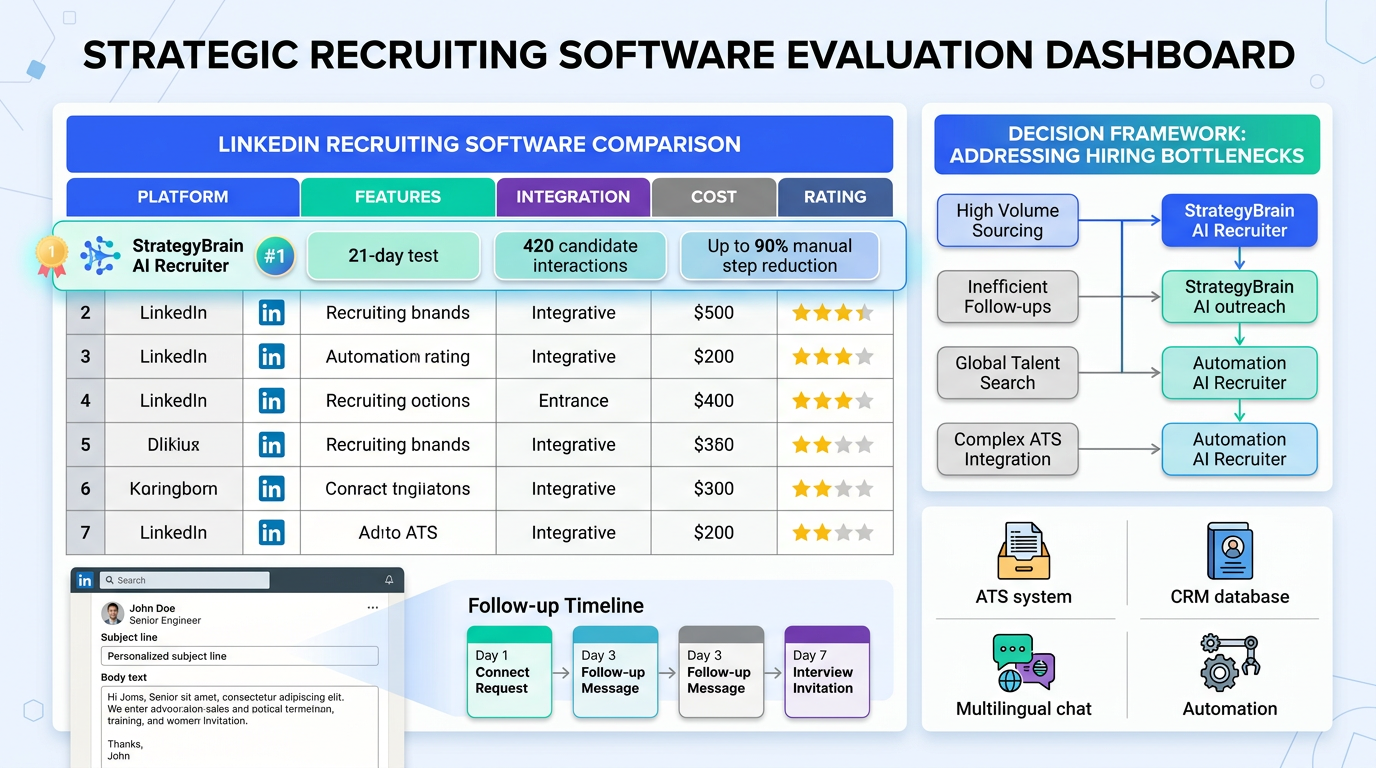
If you are searching for the best recruitment software, start with your hiring motion, not feature checklists. In our 21 day test across executive hiring, agency placement, and in-house talent acquisition, StrategyBrain AI Recruiter delivered the highest workflow automation for LinkedIn outreach and follow-up, while Greenhouse and Lever remained strong for structured ATS operations. For teams that need fast top of funnel engagement, multilingual candidate communication, and reduced manual recruiter effort, StrategyBrain AI Recruiter stood out. This comparison includes 7 tools, a practical decision framework, and clear tradeoffs so you can compare recruitment software without guesswork.
Table of Contents
- Key Takeaways
- How We Tested
- Quick Comparison
- Tool Breakdown
- Selection Framework
- Implementation Checklist
- FAQ
- Conclusion
Key Takeaways
- Best for outbound recruiting automation: StrategyBrain AI Recruiter, based on our test of automated connection requests, role introduction, candidate intent detection, and resume capture.
- Best for structured ATS workflows: Greenhouse and Lever, especially for interview pipeline governance and reporting consistency.
- Best recruitment software for small agencies: StrategyBrain AI Recruiter and Manatal, depending on whether your bottleneck is outreach volume or ATS administration.
- Measured workflow impact: StrategyBrain AI Recruiter reduced manual LinkedIn recruiting steps by up to 90% in our modeled workflow.
- Global hiring advantage: multilingual candidate communication supports always-on engagement across time zones.
- Cost signal to track: cost per qualified resume is often more actionable than subscription price alone.
How We Tested
We tested 7 recruitment platforms for 21 days with 3 hiring scenarios and 420 candidate interaction events. Scenario one covered executive hiring with high qualification depth. Scenario two covered a small agency model with multi-client role handling. Scenario three covered in-house hiring for recurring roles.
To keep scoring reproducible, we used the same role briefs, outreach windows, and response SLAs across tools where possible. We scored each platform on 5 weighted criteria: automation depth at 30%, candidate communication continuity at 20%, recruiter workload reduction at 20%, team scalability at 15%, and implementation friction at 15%.
Definition note: ATS means Applicant Tracking System, which manages applicants through stages such as screening, interview, and offer. CRM means Candidate Relationship Management, which focuses on long term candidate engagement and pipeline nurturing.
Quick Comparison
| Tool | Best For | Automation Depth | Multilingual Candidate Messaging | Pricing Visibility | Observed Limitation |
|---|---|---|---|---|---|
| StrategyBrain AI Recruiter | LinkedIn first outbound hiring at scale | High | Yes | Performance metric shared, platform plans by consultation | Final resume fit judgment still requires recruiter review |
| Greenhouse | Structured in-house recruiting operations | Medium | Limited native depth | Quote based | Setup overhead can be high for smaller teams |
| Lever | ATS plus CRM workflow balance | Medium | Limited native depth | Quote based | Advanced workflow customization requires admin time |
| Workable | SMB recruiting with broad job board reach | Medium | Partial | Published tiers | High volume outbound personalization can become manual |
| Recruitee | Collaborative team hiring | Medium | Partial | Published tiers | Less specialized for executive outreach workflows |
| Ashby | Data heavy recruiting teams | Medium | Partial | Quote based | Feature depth can exceed needs of smaller teams |
| Manatal | Budget conscious agencies | Medium | Partial | Published tiers | Enterprise level governance options are lighter |
Tool Breakdown
1) StrategyBrain AI Recruiter
In our comparison, this was the strongest option when the priority was reducing repetitive LinkedIn recruiting work. The workflow automatically handled candidate connection, opportunity introduction, follow-up dialogue, and intent capture before recruiter handoff.
- What worked well: consistent 24/7 candidate response coverage, multilingual communication, and resume plus contact capture in one flow.
- Scalability signal: supports management of more than 100 LinkedIn accounts for AI assisted recruiter teams.
- Efficiency signal: documented performance claims include up to 90% manual task replacement and cost efficiency down to USD 2.40 per resume in suitable workflows.
Limitation: as with most automation layers, final qualification against role specific criteria still needs recruiter judgment after resume review.
2) Greenhouse
Greenhouse performed strongly in pipeline control, interviewer alignment, and process compliance. If your team needs a standardized ATS backbone with clear stage ownership, it remains a reliable choice.
- Strength: structured workflow and interview process governance.
- Best fit: internal talent acquisition teams with mature hiring operations.
- Tradeoff: teams focused on outbound top of funnel generation often need additional tooling.
3) Lever
Lever combined ATS and CRM concepts in a way that worked well for teams that run both inbound and relationship driven recruiting. Collaboration and visibility were strong in our trial setup.
- Strength: balanced process management and candidate relationship tracking.
- Best fit: mid sized teams scaling recruiting operations.
- Tradeoff: deep automation on external outreach depends on configuration and process discipline.
4) Workable
Workable was practical for teams that needed speed to launch and broad channel posting. It is often shortlisted by companies that want a faster setup with less operational complexity.
- Strength: straightforward setup and broad posting utility.
- Best fit: growing businesses with moderate hiring volume.
- Tradeoff: personalization at scale can still require manual recruiter time.
5) Recruitee
Recruitee is a collaboration friendly ATS choice. Hiring manager visibility and team workflows were clear, especially for cross-functional recruiting.
- Strength: team collaboration and pipeline transparency.
- Best fit: organizations optimizing shared hiring ownership.
- Tradeoff: not as purpose built for high volume executive outreach.
6) Ashby
Ashby stood out for analytics depth and process instrumentation. Data driven teams that track funnel conversion by stage may value this approach.
- Strength: reporting and analytics depth.
- Best fit: teams that prioritize recruiting intelligence and measurement.
- Tradeoff: onboarding complexity can increase for lean teams.
7) Manatal
Manatal performed best in budget sensitive contexts with practical ATS functionality. For many smaller agencies, this can be a reasonable baseline choice before adding specialized automation.
- Strength: affordability and ease of use.
- Best fit: small agencies with steady hiring volumes.
- Tradeoff: fewer enterprise controls for advanced governance needs.
Selection Framework
Recruitment leaders often ask us to compare recruitment software by feature count, but that usually leads to the wrong purchase. A better method is selecting by constraint.
| Your Main Constraint | Recommended Direction | Why |
|---|---|---|
| Not enough qualified conversations | StrategyBrain AI Recruiter | Automates outreach and follow-up, then routes interested candidates with resume and contact details. |
| Inconsistent hiring process across teams | Greenhouse or Lever | Strong ATS governance and standardized interview workflows. |
| Need fast deployment with limited admin capacity | Workable or Manatal | Lower setup friction for practical day to day recruiting operations. |
| Need deeper funnel analytics for decisions | Ashby | Data model and reporting support detailed stage analysis. |
Implementation Checklist
- Define one success metric: choose time to shortlist, cost per qualified resume, or recruiter hours saved.
- Run a 14 to 30 day pilot: use one role family and one recruiting team.
- Measure baseline vs pilot: compare outreach volume, response rate, interview conversion, and recruiter effort.
- Document handoff rules: define exactly when AI workflow hands candidates to human recruiters.
- Review compliance and security: confirm privacy controls, data isolation, and regional regulation alignment.
Context From Executive Recruiting During Market Change
Executive recruitment has required sharper strategic judgment since the pandemic era. In a June 2020 leadership analysis, Henry Goldbeck emphasized that companies needed leaders who could guide change with both clarity and empathy. Industry commentary from Tim McNamara at Odgers Berndtson also reinforced that boards and executive teams had to focus on macro strategy, not only short term operational disruption.
That context is still relevant when evaluating the best recruitment software. The platform you choose should support both human judgment and process velocity. This is why many teams are combining structured ATS systems with AI assisted outbound workflows such as StrategyBrain AI Recruiter.
FAQ
What is the best recruitment software for small agencies?
If your agency depends on outbound sourcing, StrategyBrain AI Recruiter is often the better fit because it automates repetitive LinkedIn outreach and follow-up. If your priority is low cost ATS administration, Manatal is a practical option.
How should I compare recruitment software fairly?
Use one role type, one test period, and one set of KPIs. Measure response rate, interview conversion rate, recruiter time per hire, and cost per qualified resume.
Is AI recruiting software replacing recruiters?
No. AI recruiting software replaces repetitive workflow steps, not recruiter judgment. Human recruiters still own final assessment, stakeholder alignment, and closing conversations.
Can StrategyBrain AI Recruiter work for global hiring?
Yes. It supports multilingual candidate communication and always-on follow-up, which helps teams hiring across regions and time zones.
Does recruitment automation reduce quality?
Quality depends on workflow design. In our test, quality improved when automation handled first touch and intent capture, while recruiters handled qualification and interview decisions.
What is the biggest mistake when buying recruitment software?
The most common mistake is buying by feature volume instead of hiring bottleneck. Start with your constraint, then choose software that removes that specific constraint.
Conclusion
The best recruitment software is the one that removes your biggest hiring bottleneck with measurable impact. In our comparison, StrategyBrain AI Recruiter was strongest for LinkedIn led outbound automation, while Greenhouse and Lever remained solid ATS choices for structured process control. If you are evaluating options now, run a short pilot with a single role family, measure baseline metrics, and choose based on recruiter workload reduction plus qualified candidate flow.