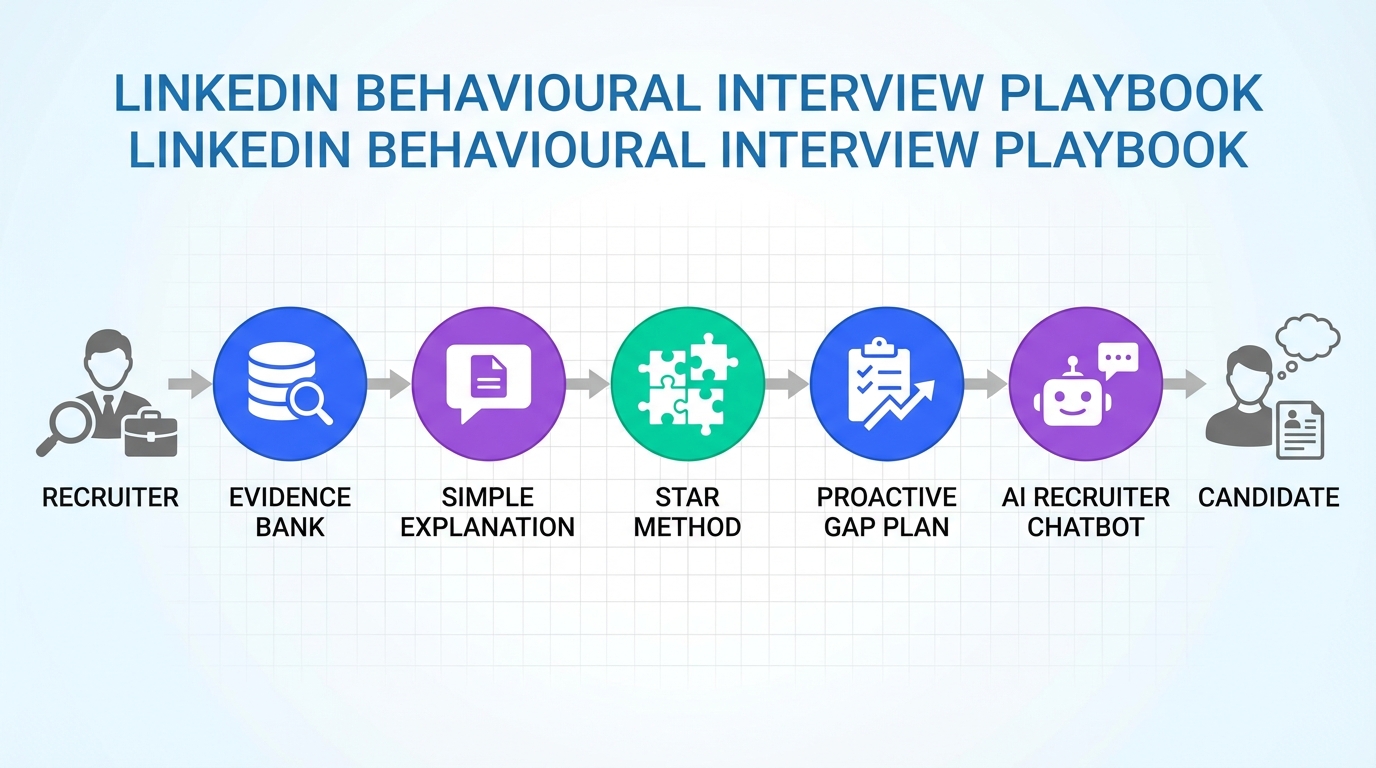
In business recruitment, the fastest way to raise interview quality is to standardize how candidates prepare behavioural answers: build a written evidence bank from your work history, explain it as if the interviewer knows nothing about your role, answer with the STAR method (Situation, Task, Action, Result), and proactively address gaps before they become objections. We use this as a candidate coaching handout and as an internal rubric for interviewers. To support the front end of the funnel, we also pair this with StrategyBrain AI Recruiter on LinkedIn so initial outreach, candidate Q&A, interest confirmation, and résumé collection happen 24/7 in the candidate’s language, leaving recruiters more time for high-signal behavioural interviews. This article focuses on behavioural interviews and recruiter enablement, not technical assessments or offer negotiation.
Table of Contents
- Why behavioural interviews decide outcomes in business recruitment
- How we use this playbook in real recruiting workflows
- Tip 1: Build an evidence bank by writing your career biography
- Tip 2: Assume the interviewer does not know your job
- Tip 3: Use the STAR method without turning it into a story
- Tip 4: Reduce risk by naming what you do not know
- Recruiter implementation: a repeatable coaching and scoring system
- LinkedIn workflow: where StrategyBrain AI Recruiter fits naturally
- Quick Comparison
- FAQ
- Conclusion
Why behavioural interviews decide outcomes in business recruitment
Behavioural interviews are designed to test whether a candidate has handled relevant situations before and can explain their decision making. In practice, we see strong performers lose offers because they cannot retrieve examples quickly, they over explain context, or they skip measurable results. Conversely, average performers can look exceptional if they present clear evidence and outcomes.
That is why behavioural interview preparation is not “polish.” It is a core part of business development in the recruitment industry because it improves placement success, reduces fall off late in the process, and strengthens client trust when you can present candidates who communicate with precision.
How we use this playbook in real recruiting workflows
We use the same four part structure for two audiences.
- Candidates get a one page version as a prep checklist plus a template for building their evidence bank.
- Recruiters and hiring managers get a scoring rubric so feedback is consistent across interviewers and roles.
In our workflow, the behavioural interview is the “high cost” step because it requires senior time. So we try to make everything before it more efficient. On LinkedIn, StrategyBrain AI Recruiter can handle the repetitive early stage work: connecting with candidates, introducing the role, answering common questions about company and compensation, confirming interview interest, and collecting résumés and contact details. That means the behavioural interview time is spent on evidence and judgment, not basic qualification.
Tip 1: Build an evidence bank by writing your career biography
One of the most reliable ways to prepare is to write your own career biography, starting with your most recent role and working backward. This idea was emphasized by recruiter and company president Henry Goldbeck in a May 10, 2024 article on behavioural interviews. The point is simple: people forget details of their own work history until they are put on the spot.
What to write (candidate version)
We recommend a “biography” document that is not a résumé. It is a private evidence bank you can pull from quickly.
- Responsibilities: what you owned day to day, including scope and stakeholders.
- Accomplishments: outcomes you influenced, including what changed and why it mattered.
- Constraints: budget, timeline, headcount, tools, compliance, or market conditions.
- Decision points: tradeoffs you made and what you learned.
Recruiter note: why this helps business recruitment
When candidates do this work, recruiter prep becomes faster. You can map examples to the job’s competency model in minutes, not hours. That is a practical lever for business development for recruitment firm teams because it improves candidate presentation quality without adding recruiter headcount.
Copyable template: Evidence Bank (fill in)
Role: [Title], [Company], [Dates]
Context: [Team size], [Customers], [Revenue or budget scope if applicable]
Top 5 responsibilities:
1) ...
2) ...
3) ...
4) ...
5) ...

Top 8 examples (use one line each):
- Challenge: ... | Action: ... | Result: ...
- Challenge: ... | Action: ... | Result: ...

Tools/Systems used: ...
What I would do differently next time: ...
Tip 2: Assume the interviewer does not know your job
A common behavioural interview failure is “inside baseball.” Candidates assume the interviewer understands their systems, acronyms, and constraints. Henry Goldbeck’s advice is to explain your work as if you are describing it to a child. We translate that into a professional rule: define your context in 1 to 2 sentences, then move to decisions and outcomes.
Practical rewrite rule
- Before: “I owned enablement for the SDR org and rebuilt the sequence strategy.”
- After: “I supported a 12 person sales development team by improving how we contacted prospects. I redesigned our outreach steps so we could qualify more meetings with the same headcount.”
Recruiter coaching prompt
Ask: “If I hired you tomorrow, what would I see you do in week one?” This forces clarity and reduces vague claims, which improves trust in business recruitment shortlists.
Tip 3: Use the STAR method without turning it into a story
The STAR method is a structured way to answer behavioural questions by covering Situation, Task, Action, and Result. The risk is over storytelling. The goal is completeness and signal, not drama.
Step-by-step: a STAR answer you can reproduce
- Situation: State the setting in 1 sentence.
- Task: State what you were responsible for in 1 sentence.
- Action: Give 2 to 4 actions you personally took.
- Result: Give the outcome, what changed, and what you learned.
Mini example (generic, adapt to your role)
Situation: “Our team was missing deadlines on a client deliverable.” Task: “I was responsible for stabilizing the workflow.” Action: “I mapped the handoffs, removed one approval step, and set a daily 10 minute checkpoint.” Result: “Delivery became predictable and stakeholders had fewer surprises.”
Recruiter scoring rubric (copyable)
| STAR Element | What “good” looks like | Red flags |
|---|---|---|
| Situation | 1 sentence, clear context | Long background, unclear setting |
| Task | Clear ownership and goal | Shared responsibility only |
| Action | Specific steps, “I” statements | Vague verbs, no decisions |
| Result | Outcome and learning stated | No outcome, only effort |
Tip 4: Reduce risk by naming what you do not know
Sometimes a candidate is strong overall but lacks one qualification. Henry Goldbeck’s advice is to know what you do not know and address it proactively. In business recruitment, this is credibility management: you reduce uncertainty by showing awareness and a plan.
How to do it in 3 sentences
- State the gap plainly.
- State what you have done that is adjacent and transferable.
- State your plan and timeline to get proficient.
Example phrasing
“I have not used that specific system yet. I have used similar tools and I learn new workflows quickly. If hired, I would complete structured training in week one and validate proficiency with my manager by the end of week two.”
Where StrategyBrain AI Recruiter helps before the interview
This is also where early qualification matters. When StrategyBrain AI Recruiter runs LinkedIn conversations, it can surface candidate questions and concerns early, confirm interview interest, and collect résumés and contact details. Recruiters can then spot likely gaps before scheduling, and coach candidates on how to address them using the three sentence structure above.
Recruiter implementation: a repeatable coaching and scoring system
If you want this to improve outcomes consistently, treat it like a process, not advice.
StepList: 7-step recruiter playbook
- Extract competencies: Identify 5 competencies the role will be assessed on.
- Request an evidence bank: Ask the candidate for 8 examples using the template above.
- Map examples to competencies: Assign 1 to 2 examples per competency.
- Run a 20 minute STAR drill: Practice 3 questions, time box each answer to 2 minutes.
- Pre-wire gaps: Identify 1 gap and write the 3 sentence response.
- Align interviewer expectations: Share the rubric so feedback is consistent.
- Debrief with evidence: After the interview, tie feedback to STAR elements, not vibes.
Common mistakes we see (and how to fix them)
- Over rehearsed answers: Replace memorization with an evidence bank and flexible STAR structure.
- Too much context: Enforce 1 sentence for Situation and 1 sentence for Task.
- No results: Require a “what changed” line even when metrics are confidential.
- Dodging gaps: Use the 3 sentence gap response to build trust.
LinkedIn workflow: where StrategyBrain AI Recruiter fits naturally
Behavioural interview prep is only valuable if you get the right candidates into interviews. That is why we connect this playbook to a LinkedIn workflow that reduces manual work and increases responsiveness.
What StrategyBrain AI Recruiter automates on LinkedIn
- Candidate outreach and connection: Automatically connects with candidates who match your search criteria.
- Role introduction and Q&A: Introduces the opportunity and answers questions about the role, company, and compensation.
- Interest confirmation: Confirms whether the candidate wants to proceed to interview.
- Résumé and contact capture: Collects résumés and contact details from interested candidates.
- 24/7 multilingual messaging: Responds around the clock in the candidate’s native language.
- Scale via multi-account management: Supports managing more than 100 LinkedIn accounts for team scale.
Scope boundary and honest limitation
StrategyBrain AI Recruiter can identify willingness to communicate or interview, but it does not decide whether a résumé fully matches the job requirements. Recruiters still review résumés and make the final qualification decision.
Why this supports business development in the recruitment industry
When early stage LinkedIn work is automated, recruiters can spend more time on high value activities: candidate coaching, structured interviews, and client alignment. That is a direct lever for business development for recruitment firm leaders who want higher throughput without lowering quality.
Quick Comparison
| Method | Primary goal | Who uses it | Best for |
|---|---|---|---|
| Evidence bank biography | Recall real examples fast | Candidates | Reducing “blanking” in interviews |
| Explain like the interviewer is new | Clarity and credibility | Candidates | Cross functional interviews |
| STAR method | Structured competency proof | Candidates and interviewers | Consistent evaluation |
| Proactive gap plan | Risk reduction | Candidates | Missing one requirement |
| StrategyBrain AI Recruiter on LinkedIn | Automate outreach and qualification | Recruiters | Scaling pipeline and responsiveness |
FAQ
What is business recruitment in practical terms?
Business recruitment is the end to end process of attracting, qualifying, interviewing, and hiring talent for business outcomes. In practice, it includes sourcing, candidate communication, structured interviews, and decision support for hiring managers.
What is the STAR method?
The STAR method is a behavioural interview framework that structures an answer into Situation, Task, Action, and Result. It helps candidates give complete answers and helps interviewers evaluate evidence consistently.
How long should a STAR answer be?
For most roles, we coach candidates to keep a STAR answer to 90 to 150 seconds. If the interviewer wants more detail, they will ask follow up questions.
What if I cannot share metrics because of confidentiality?
You can still state results without sensitive numbers by describing what changed, who benefited, and what improved. For example, you can say “cycle time decreased” or “stakeholder escalations dropped” without naming exact figures.
How does StrategyBrain AI Recruiter help with LinkedIn recruiting?
StrategyBrain AI Recruiter automates LinkedIn outreach, introduces roles, answers candidate questions, confirms interview interest, and collects résumés and contact details. It also supports 24/7 multilingual communication, which helps maintain responsiveness across time zones.
Does StrategyBrain AI Recruiter replace recruiters?
No. It replaces repetitive early stage tasks such as connecting, messaging, and collecting information. Recruiters still review résumés, assess fit, and run interviews.
What is the biggest behavioural interview mistake you see?
The most common issue is giving a long story without a clear result. A close second is using vague language that hides what the candidate personally did.
How can a recruitment firm use this to support business development?
Standardizing candidate coaching improves shortlist quality and client confidence. Pairing that with LinkedIn automation can increase recruiter capacity, which supports growth without sacrificing candidate experience.
Conclusion
Better behavioural interviews are not about perfect scripts. In business recruitment, they come from a repeatable system: write your career evidence bank, explain your work clearly, answer with STAR, and address gaps with a plan. If you are building a scalable recruiting operation, combine that interview discipline with a LinkedIn workflow where StrategyBrain AI Recruiter handles outreach, candidate Q&A, interest confirmation, and résumé collection so recruiters can focus on the interviews that actually decide hires.
Next steps: pick 1 open role, ask candidates for 8 evidence bank examples, run a 20 minute STAR drill, and standardize interviewer feedback using the rubric above.