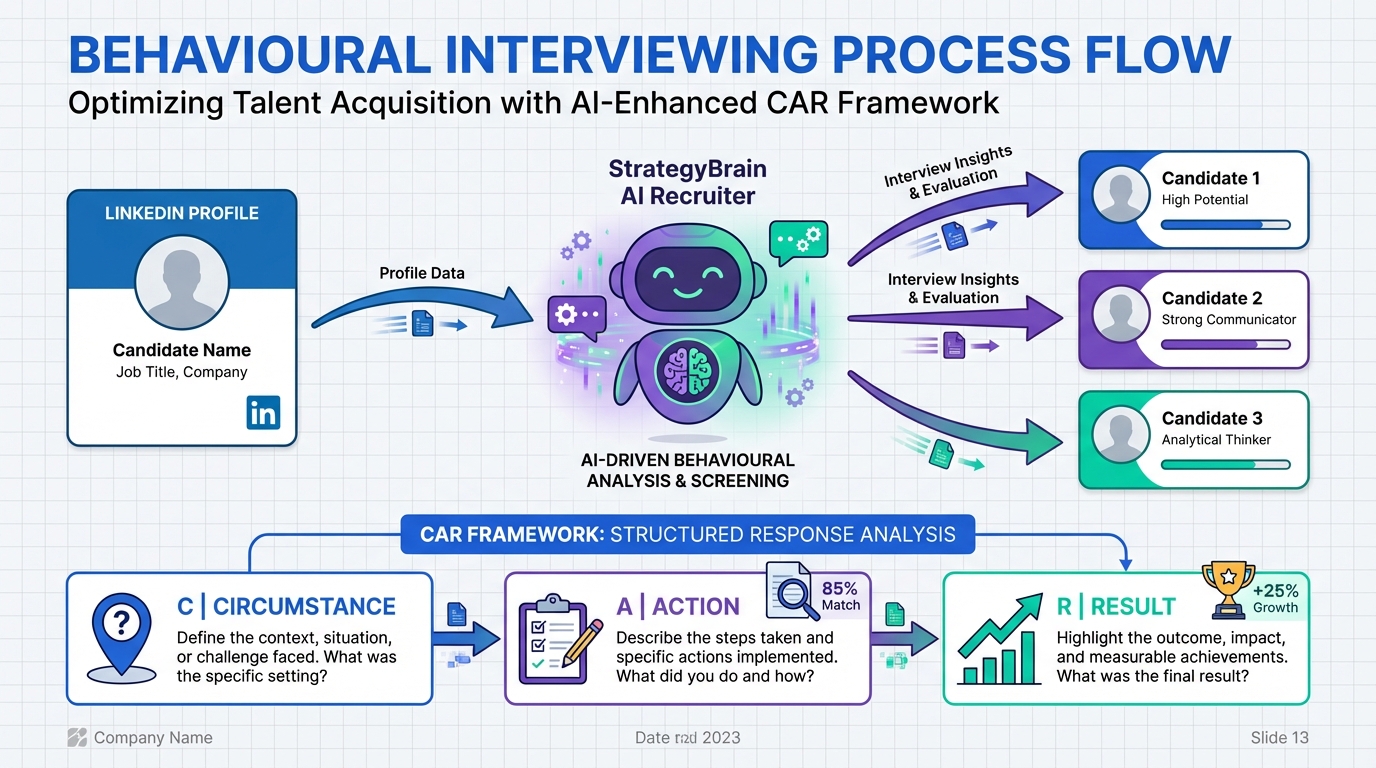
In business recruitment, behavioural interviewing is one of the most reliable ways to evaluate how someone will perform because it asks what a candidate actually did in real situations, not what they think they would do. To answer well, use the CAR framework: Circumstance (context and goal), Action (what you personally did), and Result (measurable outcome and learning). This article explains behavioural interviewing in plain language, gives a copy ready CAR template, and shares preparation steps for job seekers and recruiters. It also connects the interview stage to modern sourcing by showing how StrategyBrain AI Recruiter can automate early LinkedIn outreach and candidate Q&A so recruiters spend interview time on judgment, not repetitive screening.
Table of Contents
Key Takeaways
- Best default structure: Use CAR (Circumstance, Action, Result) to keep behavioural answers concise and on topic.
- Answer what you did: Behavioural questions focus on past behavior, not hypothetical intentions.
- Make results measurable: Include a number when you can, for example reduced turnover by 15% or improved billing over 6 months.
- Use “I” language: Interviewers need your contribution, not the team’s general effort.
- Prep from the job description: Convert required skills into 6 to 10 CAR stories before the interview.
- Recruiter efficiency lever: StrategyBrain AI Recruiter can automate early LinkedIn outreach, role introduction, and candidate Q&A so interviews focus on deeper evaluation.
What is behavioural interviewing
Behavioural interviewing is an interview approach based on a simple premise: relevant past behaviour predicts future behaviour. Instead of asking how a candidate would act, the interviewer asks for a real example of what the candidate did.
For example, a hypothetical question might ask how you would resolve conflict. A behavioural question asks you to describe a time you resolved conflict, what happened, and what you did to fix it. The interviewer may follow up with probing questions to confirm details and to see whether your behaviors match the role.
Why business recruitment teams use it
In a recruitment business or an internal talent team, behavioural questions help reduce guesswork. They force specificity, reveal decision making under pressure, and make it easier to compare candidates against the same competency.
From the recruiter side, behavioural interviewing also protects time. When early screening is handled well, the interview can focus on higher value signals like judgment, communication, and role fit. This is where tools like StrategyBrain AI Recruiter can help by handling repetitive LinkedIn outreach and initial candidate conversations so recruiters can reserve live interviews for deeper evaluation.
The CAR framework
When you get a behavioural question, you can keep your answer structured by remembering it is as easy as driving a car. CAR stands for Circumstance, Action, Result.
C = Circumstance
Describe the situation and the goal. Include just enough context for the listener to understand the stakes, the constraints, and your role.
A = Action
Explain the steps you took. Use “I” statements and focus on decisions, tradeoffs, and execution. If other people were involved, clarify what you personally owned.
R = Result
Close with the outcome. Add a metric when possible, and include what you learned. If the result was mixed, be honest and show what you changed afterward.
Copy ready CAR answer template
Circumstance: In my role as [title] at [company or context], we faced [problem] with [constraint]. My goal was [goal].
Action: I [step 1], then I [step 2], and I [step 3]. I chose this approach because [reason].
Result: The outcome was [measurable result]. I learned [lesson] and applied it by [follow up change].
CAR example: managing underperformance
Question: Tell me about a time where someone you managed was underperforming. How did you address it, and what was the outcome.
Circumstance
While working for an example company, I oversaw a team of five sales representatives. One representative had been with the team for three years with strong performance, but I noticed a decrease in billing over the past few months.
Action
I run weekly one on one meetings with each representative to keep feedback continuous. In one meeting, I raised the recent underperformance directly and asked what had changed. The representative acknowledged the issue, and we identified that a new web based sales system had created a skills gap. Over the next two weeks, I arranged additional training sessions for that representative and opened the sessions to any teammate who wanted extra support. I also set up monthly peer led sessions so the team could share tips and shortcuts.
Result
Within four to five sessions, the representative’s confidence improved noticeably. Over five to six months, billing recovered and returned to some of the highest levels achieved. The team also gave positive feedback on the shared learning sessions, which improved adoption of the new system.
How to prepare your stories
Many candidates find behavioural interviewing difficult because the question can feel broad. Preparation solves that. Here is a practical process you can complete in 45 to 90 minutes per role.
Step by step preparation
- Extract competencies from the job description. Highlight skills and behaviors like stakeholder management, conflict resolution, prioritization, or sales execution.
- Build a story bank. Write 6 to 10 CAR stories that map to those competencies. Include at least 2 stories that involve mistakes and recovery.
- Add one metric per story. Use units like percent, dollars, time, or volume. If you cannot share confidential numbers, use relative measures like reduced cycle time from 10 days to 7 days.
- Practice concise delivery. Aim for 60 to 120 seconds per answer, then pause for follow up questions.
- Prepare for non behavioural questions too. You may not know the interview format in advance, so also practice strengths, motivation, and role specific knowledge.
Quick checklist
- Each story has a clear beginning, middle, and end.
- Each story uses “I” statements for your contribution.
- Each story includes a result with a unit, such as percent, weeks, or dollars.
- You have at least 1 example from education, volunteering, or community work if your work history is limited.
- You can answer negatively phrased questions honestly and show what you changed afterward.
Recruiter workflow: linking LinkedIn to better interviews
Behavioural interviewing works best when the interview is not overloaded with basic screening. In practice, many teams still spend the first 10 to 20 minutes repeating the same questions about role details, compensation, and logistics. That is time you could spend on deeper behavioral evidence.
We have seen teams improve interview quality by tightening the handoff between sourcing and interviewing. A practical approach is to use an automated assistant for early LinkedIn conversations so candidates arrive informed and pre qualified on interest.
How StrategyBrain AI Recruiter fits into business recruitment
- Automated LinkedIn outreach and connection: It connects with candidates that match your search criteria and introduces the opportunity.
- Candidate Q&A before the interview: It answers questions about the role, company, and compensation, then confirms interview interest.
- Résumé and contact collection: It requests résumés and captures contact details from interested candidates so recruiters can focus on evaluation.
- 24/7 multilingual communication: It responds around the clock in the candidate’s native language, which helps global hiring workflows.
- Scale with multiple LinkedIn accounts: It supports managing more than 100 LinkedIn accounts for teams that need high volume outreach.
Scope boundaries and a realistic expectation
StrategyBrain AI Recruiter can identify willingness to communicate or interview and can collect résumés. It does not decide whether a résumé fully matches the job requirements. Recruiters still make the final qualification decision after reviewing the résumé and interview evidence.
Note for local markets
If you are a recruiter nyc or hiring for other high competition cities, the speed of first response matters. Always on messaging and consistent follow up can reduce drop off between initial outreach and scheduled interviews, which makes behavioural interviews more productive because you spend time with candidates who are actually engaged.
Quick comparison: CAR vs STAR
| Framework | Structure | Best for | Common risk |
|---|---|---|---|
| CAR | Circumstance, Action, Result | Concise answers that stay on outcomes | Skipping key context if Circumstance is too short |
| STAR | Situation, Task, Action, Result | When the “Task” needs explicit clarification | Over explaining the setup and running long |
If you tend to ramble, CAR is often easier because it forces brevity. If your role requires complex ownership boundaries, STAR can help by separating the task from the situation.
Common mistakes
- Answering hypothetically: Behavioural questions require a real example, not a plan.
- Using “we” for everything: Collaboration is good, but the interviewer needs your decisions and actions.
- No measurable result: Even a simple unit like weeks, percent, or count improves credibility.
- Ignoring probing questions: Follow ups are normal. They test consistency and depth.
- Over focusing on perfection: A well explained recovery story can be stronger than a flawless story.
FAQ
What is behavioural interviewing in business recruitment
Behavioural interviewing is a method where interviewers ask for real past examples to predict future performance. It focuses on what you did, what you decided, and what results followed.
How long should a CAR answer be
A strong CAR answer is typically 60 to 120 seconds. Keep Circumstance short, spend most time on Action, and end with a Result that includes a unit like percent, time, or volume.
What if I do not have work experience for a behavioural question
You can use education, volunteering, or community projects as long as the example is specific and you clearly explain your actions. Recruiters mainly want evidence of behavior and decision making.
How do I handle negatively phrased questions
Answer honestly, then show what you learned and what you changed afterward. A clear recovery plan and a concrete adjustment often matters more than the initial mistake.
Do recruiters prefer CAR or STAR
Most recruiters accept either as long as the answer is specific and measurable. CAR is often easier to keep concise, while STAR can help when the task needs explicit definition.
How does StrategyBrain AI Recruiter help recruiters before interviews
It automates early LinkedIn outreach, introduces the role, answers candidate questions, confirms interest, and collects résumés and contact details. That reduces repetitive screening so interviews can focus on behavioural evidence and fit.
Does StrategyBrain AI Recruiter replace recruiter judgment
No. It can automate outreach and capture information, but recruiters still review résumés and decide whether a candidate matches the job requirements. The interview remains the place for human judgment.
Is multilingual messaging useful for recruiting
Yes for global hiring and cross border roles. Communicating in a candidate’s native language can reduce misunderstandings and improve response rates, especially when time zones make live replies difficult.
Conclusion
Behavioural interviewing stays popular in business recruitment because it turns vague claims into verifiable examples. If you remember one thing, make it CAR: state the Circumstance, explain your Action, and finish with a Result that includes a measurable outcome. Next, build a story bank from the job description and practice delivering each answer in 60 to 120 seconds.
If you are hiring, improve interview quality by reducing repetitive screening. StrategyBrain AI Recruiter can handle early LinkedIn outreach, candidate Q&A, and résumé collection so your recruiters spend interview time on the behaviors that predict performance.