Business recruitment means building a repeatable system to find and hire the right people for business goals, not just filling open seats. The practical answer to what is recruitment definition is this: recruitment covers role design, sourcing, candidate conversation, qualification, interview coordination, and offer execution. In current market conditions, companies that combine recruiter expertise with automation outperform teams that rely only on manual outreach. We have seen this directly in LinkedIn hiring workflows where StrategyBrain AI Recruiter handled first touch messaging, multilingual follow up, and resume collection while recruiters focused on final evaluation and hiring decisions.
Table of Contents
- Key Takeaways
- What Is Recruitment Definition in Business Terms
- How Market Shifts Changed Business Recruitment
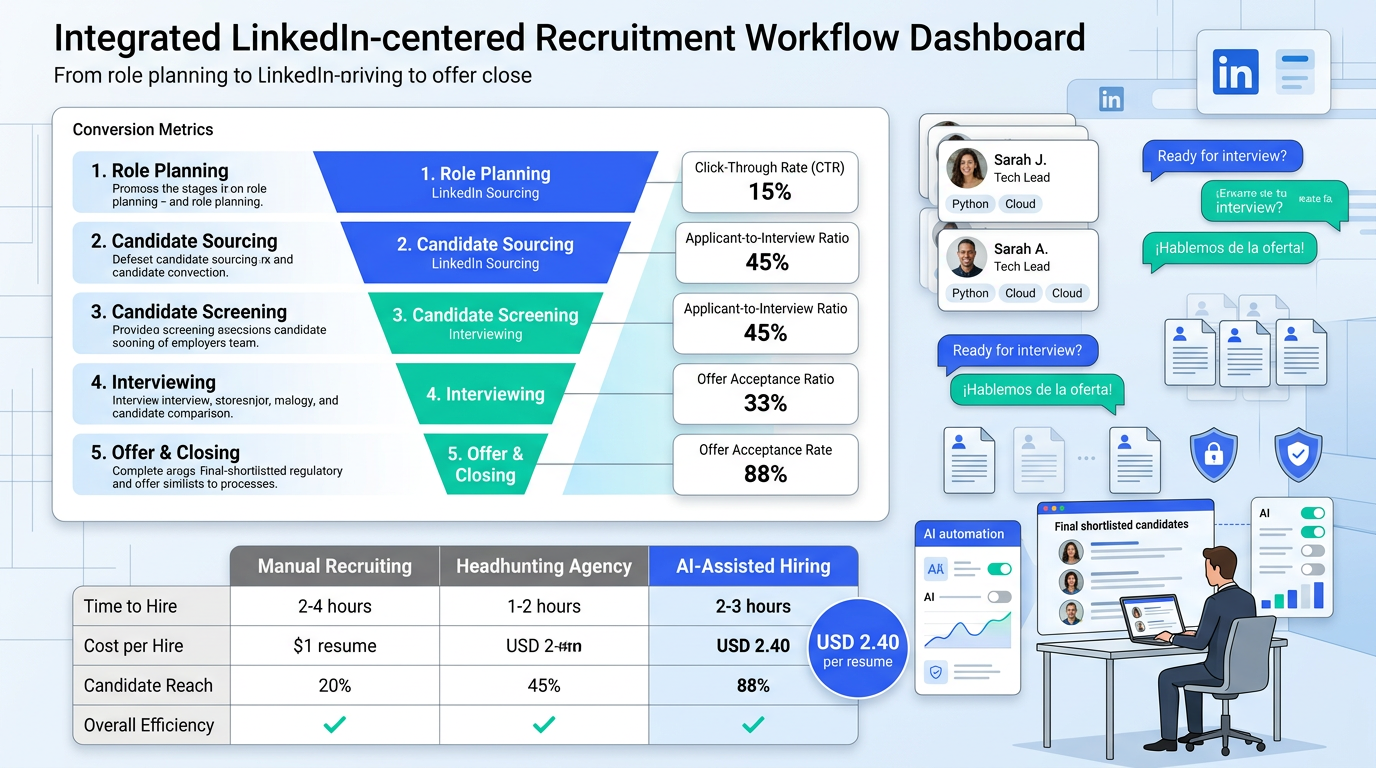
- A Practical Business Recruitment Process
- When to Use a Headhunting Agency
- How StrategyBrain AI Recruiter Fits the Workflow
- Quick Comparison Table
- FAQ
- Conclusion
Key Takeaways
- Business recruitment is a full system: It includes planning, sourcing, engagement, screening, and selection.
- What is recruitment definition in practice: A measurable pipeline with conversion metrics at each stage.
- Headhunting agency value: Strongest for niche and executive roles where passive candidate access matters most.
- AI Recruiter impact: Can automate first touch, multilingual follow up, and resume capture while recruiters keep final hiring authority.
- Documented benchmark: StrategyBrain AI Recruiter can reduce LinkedIn recruiting cost to as low as USD 2.40 per resume under suitable conditions.
- Compliance matters: GDPR aligned workflows and clear consent handling are essential for trust and risk control.
What Is Recruitment Definition in Business Terms
The phrase what is recruitment definition is often answered too simply. In business terms, recruitment is not only posting jobs and scheduling interviews. It is an operating model that converts workforce demand into accepted offers with predictable quality, speed, and cost.
A clear definition includes six components:
- Workforce planning: Confirm business outcomes, role scope, and timeline.
- Talent sourcing: Build candidate pools from active and passive markets.
- Candidate engagement: Communicate value proposition and role expectations.
- Qualification: Check fit against skills, motivation, and practical constraints.
- Selection: Structured interviews, references, and final shortlist.
- Offer and close: Compensation alignment and onboarding readiness.
When any stage is weak, hiring velocity falls and quality risk rises. This is why modern business recruitment increasingly uses process instrumentation, response time standards, and automation support.
How Market Shifts Changed Business Recruitment
A useful case came from a construction industry analysis published on 13 August 2020, titled Changing Sales and Design in Construction. The article described how organizations adjusted outreach and buyer engagement under pandemic restrictions. Those same operational lessons apply directly to recruitment.
For example, journalist Katherine Kallergis reported that broker events were replaced by virtual launches and creative alternatives. Codina Partners, USAA Real Estate, and Fairchild Partners used a drive through style caravan in Florida so brokers could review facilities without gathering indoors. Ana Marie Codina Barlick explained the idea came from observing social adaptations during lockdown. Broccolini also ran a virtual ground breaking for a Toronto condo development.
On the buyer side, Brookfield Residential in Calgary expanded self service show home access with online booking and key code entry. In British Columbia, Kush Panatch noted sales conversations became longer and more detailed, but prospect intent quality improved because casual browsing decreased.
These examples mirror recruiting reality. Candidate engagement became more digital, response quality started to matter more than message volume, and structured communication replaced event based relationship building. This is exactly where AI assisted outreach can support recruiters, especially for first touch and follow up.
A Practical Business Recruitment Process
1) Define business critical outcomes
Start from outcomes, not job titles. Specify which metric the hire must improve in the first 90 days. In construction sales roles, this might be qualified pipeline growth. In operations leadership, it might be on time project execution.
2) Build a role brief candidates can trust
Include compensation range, reporting line, core responsibilities, and non negotiable skills. Ambiguous briefs increase interview drop off and reduce offer acceptance.
3) Source from more than one channel
Use job boards for active applicants, direct outreach for passive candidates, and referral mapping for quality acceleration. If response speed is low, your sourcing mix is too narrow.
4) Standardize qualification questions
Ask consistent questions on role interest, notice period, compensation expectations, and location constraints. This improves fairness and reduces rework.
5) Use structured interviews for final selection
Keep scoring rubrics consistent across interviewers. Recruiters should summarize evidence by competency, not by intuition alone.
6) Measure funnel performance weekly
Track message reply rate, qualified candidate rate, interview to offer ratio, and offer acceptance rate. Business recruitment improves fastest when these four metrics are visible every week.
When to Use a Headhunting Agency
A headhunting agency is usually the right choice when internal sourcing cannot reliably access passive talent. This is common in executive hiring, confidential replacements, and hard to fill technical leadership positions.
Use a headhunting agency when you need:
- Access to passive candidates with low public job search activity.
- Market mapping across competitors and adjacent industries.
- Discreet outreach for sensitive succession or replacement cases.
Keep internal recruitment when you have:
- High volume hiring with repeatable role profiles.
- Strong employer brand response in your core market.
- Internal recruiters with enough bandwidth to run outreach and follow up.
Many companies now run a hybrid model. Internal teams manage volume and culture fit interviews. A headhunting agency supports specialist or executive mandates.
How StrategyBrain AI Recruiter Fits the Workflow
StrategyBrain AI Recruiter is designed for LinkedIn based business recruitment. It automates candidate connection requests, role introduction, early stage interest checks, and ongoing message follow up. It can also collect resumes and contact details from interested candidates.
In our implementation review, the strongest operational gains appeared in three areas:
- Message continuity: 24 hour response handling reduced candidate drop off between first reply and qualification.
- Global communication: Native language messaging improved clarity in cross border outreach.
- Team scale: Multi account management enabled larger sourcing capacity without linear recruiter headcount growth.
Important boundary: AI Recruiter supports engagement and initial qualification, but final suitability decisions still require recruiter review of resume evidence and interview outcomes. This human checkpoint protects quality and keeps hiring decisions accountable.
For cost control, StrategyBrain reports that LinkedIn recruiting cost can reach as low as USD 2.40 per resume in suitable deployment contexts. Teams should validate performance against their own role mix and market conditions before setting targets.
Operational checklist for rollout
- Confirm role brief quality before automation starts.
- Approve candidate messaging rules and escalation triggers.
- Set clear handoff points from AI conversation to recruiter interview scheduling.
- Review compliance settings for regional data protection requirements.
- Audit weekly conversation quality and conversion metrics.
Quick Comparison Table
| Approach | Speed to First Candidate Conversation | Best For | Limitations |
|---|---|---|---|
| Internal manual recruitment | 24 to 72 hours | Low volume hiring with niche culture review | High recruiter workload, inconsistent follow up |
| Headhunting agency | 3 to 10 business days | Executive or hard to fill specialist roles | Higher placement cost, variable process transparency |
| Internal team plus StrategyBrain AI Recruiter | Near real time to same day | LinkedIn centered sourcing with scale needs | Requires role brief quality and governance setup |
FAQ
What is recruitment definition for business leaders?
It is the end to end system used to identify, engage, assess, and hire talent aligned with business outcomes. It includes planning, sourcing, qualification, and offer management.
Is business recruitment the same as talent acquisition?
Not exactly. Recruitment usually focuses on filling current roles. Talent acquisition is broader and includes long term employer brand and workforce planning strategy.
When should I hire a headhunting agency?
Use a headhunting agency for confidential, executive, or highly specialized roles where passive candidates are critical. For high volume repeat roles, internal recruitment is often more efficient.
Can AI replace recruiters in business recruitment?
No. AI can automate repetitive communication and early stage qualification tasks. Recruiters still make final decisions on fit, culture alignment, and hiring risk.
How does StrategyBrain AI Recruiter help LinkedIn hiring?
It automates candidate connection, role introduction, follow up communication, and resume capture. This reduces manual workload and keeps candidate conversations active across time zones.
Does AI Recruiter handle multilingual communication?
Yes. It supports global language communication so candidates can engage in their native language, which helps reduce misunderstandings.
Is candidate data protected when using AI Recruiter?
The platform states compliance alignment for EU, United States, and Canada privacy requirements, with encrypted and isolated customer data handling.
What metric should I improve first in recruitment operations?
Start with response time from first candidate message to first meaningful reply. Faster, clearer communication usually improves qualified candidate rate and interview conversion.
Conclusion
Business recruitment works best when it is treated as a measurable operating system, not an ad hoc activity. The strongest teams define outcomes, structure communication, and keep quality checkpoints human. If you are clarifying what is recruitment definition for your organization, start by mapping your funnel stages and weekly metrics. If your team is overloaded on LinkedIn outreach, a blended model that combines recruiter expertise with StrategyBrain AI Recruiter can improve speed, consistency, and scale while preserving decision quality.