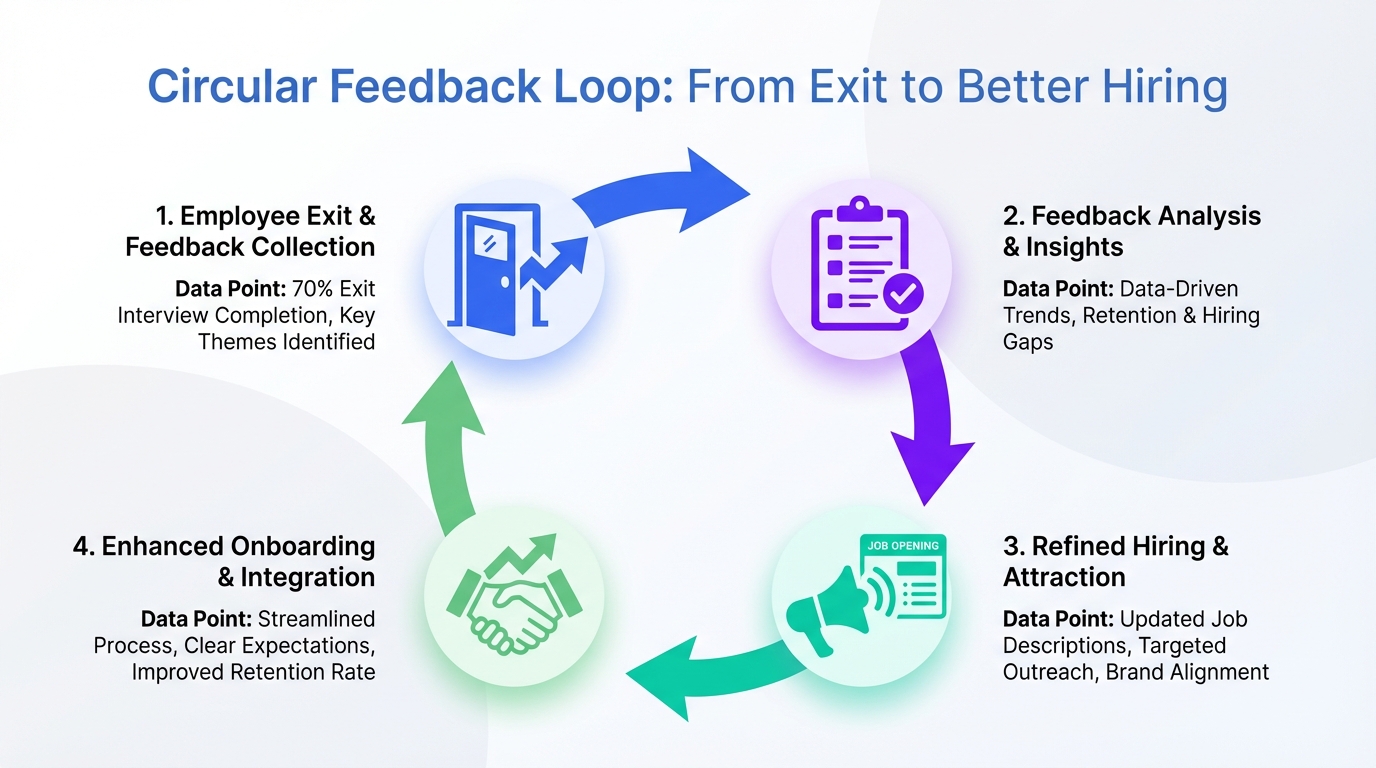
Business recruitment gets measurably better when you systematically gather feedback from exiting employees and feed it back into your hiring process. In practice, that means choosing a feedback format that fits your resources, asking consistent questions about the recruitment experience and the job reality, and then reviewing patterns over time so you can change job ads, screening, onboarding, and manager training. This article covers two proven formats, a structured question bank, and a lightweight way to apply the insights to how to recruit employees for small business teams. It does not cover legal advice, severance, or jurisdiction specific employment law.
Key Takeaways
- Fastest improvement lever: Track exit feedback themes monthly and convert them into 1 to 3 hiring process changes per cycle.
- Best format for depth: An in person conversation enables follow up questions but can reduce candor if the interviewer is not neutral.
- Best format for honesty: A written survey often increases openness and is easier to compile, but preset questions can limit nuance.
- Recruitment specific questions matter: Always ask how the initial recruitment process felt and whether the job matched expectations.
- Small business advantage: You can trial both formats quickly and standardize the one that yields clearer signals.
- Where AI helps: StrategyBrain AI Recruiter can reduce manual LinkedIn outreach and follow up so recruiters have time to act on feedback insights.
What does recruitment mean in a business context
Recruitment means the end to end process of attracting, engaging, assessing, and hiring people for a role. In a business recruitment workflow, that includes how you describe the job, where you source candidates, how you communicate, how you screen, and how you set expectations before day one.
Exit feedback is relevant because it reveals whether your recruitment messaging matched reality. When the job description, interview promises, compensation discussion, or onboarding story does not align with the actual role, you often see early turnover and lower retention.
Why exit feedback improves business recruitment
When we audit hiring funnels, the most expensive problems are usually not sourcing volume. They are expectation gaps. Exiting employees can tell you exactly where the gap started, often during the recruitment process or onboarding.
The practical value is compounding. If you track the same questions over time, you can spot recurring themes and measure whether changes worked. For example, if multiple exits mention unclear supervision, you can adjust manager onboarding and interview evaluation criteria, not just rewrite the job ad.
Choose the right feedback format
Traditionally, companies used an exit interview. Today, many teams also use written surveys and less structured conversations. Each option has strengths and limitations.
Option 1: In person conversation
- Strength: You can ask follow up questions and clarify details in real time.
- Limitation: Some employees moderate their feedback, especially if the interviewer is their manager.
- Risk control: Use a neutral interviewer such as an HR representative or someone from an unrelated department.
Option 2: Written survey
- Strength: Employees often share more candid feedback when writing privately.
- Strength: It is efficient to collect and compile responses across multiple exits.
- Limitation: Preset questions can restrict depth if you do not include open text fields.
If you are unsure which is best for your business, trial both formats for 30 days, then choose the one that produces clearer, more actionable signals for how to recruit employees for small business teams.
What to ask and why it maps to hiring fixes
There is a growing preference for conversational exits rather than rigid scripts. The tradeoff is consistency. If you want trend data, you need a stable core question set even if the conversation is open.
Below is a structured question bank you can reuse. It is designed to connect directly to business recruitment decisions such as job ad accuracy, screening criteria, compensation alignment, and onboarding quality.
Core questions to ask an exiting employee
- Reason for leaving: What prompted you to start looking for a new job?
- Recruitment experience: How did you find the initial recruitment process and did the job match your expectations?
- Onboarding: Do you feel the onboarding process was well executed?
- Compensation: Were you satisfied with your pay and benefits?
- Management: Do you feel you received the appropriate amount of supervision and direction from management?
- Work environment: Was your physical working environment comfortable?
- Growth: Did you receive opportunities for skill development and career advancement?
- Recognition: Do you feel you were appropriately rewarded and recognized for your contribution?
- Sensitive issues: Do you have any comments regarding bias, harassment, or discrimination?
- Open improvement: Any other suggestions to improve the employee experience?
How to translate answers into recruitment changes
- If “job did not match expectations” repeats: Rewrite the role summary, add a realistic day in the life section, and adjust interview questions to test for the real work.
- If “pay and benefits” repeats: Standardize compensation ranges in the hiring workflow and train interviewers to set expectations early.
- If “supervision and direction” repeats: Add manager readiness checks before hiring and strengthen onboarding plans.
How to run the process step by step
- Pick a format: Choose in person, survey, or both for a 30 day trial.
- Assign a neutral owner: Select HR or a cross functional leader who is not the direct manager.
- Use a consistent core script: Keep the same 10 core questions so you can compare results over time.
- Capture data in a simple log: Record date, department, role, tenure in months, and top 3 themes.
- Review monthly: Identify the top 3 recurring themes and decide 1 to 3 changes to your recruitment process.
- Close the loop: Communicate internally what changed and why, then check if the theme frequency drops over the next quarter.
How StrategyBrain AI Recruiter fits into the loop
Exit feedback only helps if you have time to act on it. In many small teams, recruiters spend most of their week on repetitive outreach and follow up, which leaves little capacity for process improvement work.
StrategyBrain AI Recruiter is designed to automate the initial LinkedIn recruiting workflow. It can automatically connect with candidates that match your search criteria, introduce the opportunity, answer common questions about the role, company, and compensation, confirm interview interest, and collect resumes and contact details from interested candidates. It also supports 24/7 multilingual communication, which helps reduce delays in candidate conversations across time zones.
In our experience implementing recruiting operations, this division of labor is practical. The AI handles consistent first touch messaging and follow up, while the recruiter focuses on reviewing resumes, interviewing, and improving the business recruitment system using the exit feedback themes you collected.
Where it directly supports small business recruiting
- Consistency: Candidate messaging stays aligned with your updated job expectations, which reduces mismatch risk.
- Speed: Faster responses and follow ups reduce candidate drop off during early stages.
- Scale: If you manage multiple LinkedIn accounts, AI Recruiter supports building an AI powered recruitment team across more than 100 accounts.
Limitations to plan for
- Final qualification still needs a human: AI Recruiter can identify willingness to proceed, but it does not decide whether a resume fully matches job requirements.
- Process quality still matters: If your job expectations are unclear, automation can scale the confusion. Use exit feedback to fix the message first.
Quick comparison
| Method | Speed to run | Best for | Main limitation |
|---|---|---|---|
| In person exit conversation | 30 to 60 minutes per exit | Deep context and follow up | Lower candor if interviewer is not neutral |
| Written exit survey | 10 to 15 minutes for employee, 10 minutes to review | Higher honesty and easier trend tracking | Preset questions can limit nuance |
| Hybrid: survey plus short call | 15 minutes survey plus 20 minutes call | Trend data plus targeted clarification | Requires scheduling and discipline |
| AI assisted recruiting execution with StrategyBrain AI Recruiter | Always on candidate messaging | Reducing manual LinkedIn outreach so you can improve the process | Does not replace human resume qualification |
FAQ
What does recruitment mean for a small business owner?
Recruitment means attracting candidates, communicating the role clearly, screening, and hiring. For small teams, the highest impact is usually clarity and speed, because unclear expectations and slow follow up increase early turnover and lost candidates.
How to recruit employees for small business roles without a full HR team?
Start with a simple, repeatable process: a clear job description, a consistent screening checklist, and a standard interview scorecard. Then use exit feedback to refine what you advertise and what you assess, because that is where mismatch often begins.
Is an exit interview better than an exit survey?
An exit interview is better for depth because you can ask follow up questions. An exit survey is better for candor and trend tracking because it is easier to compile and employees may feel safer writing privately.
Who should conduct the exit conversation?
A neutral interviewer is usually best, such as HR or a leader from an unrelated department. This reduces the chance that the employee filters feedback due to relationship dynamics with their manager.
What questions most directly improve business recruitment?
Ask how the recruitment process felt and whether the job matched expectations. Those answers point to fixes in job ads, interview messaging, compensation discussions, and onboarding plans.
How often should we review exit feedback data?
Review it monthly for operational changes and quarterly for trend validation. Monthly reviews keep improvements moving, while quarterly reviews help confirm whether changes reduced recurring themes.
How does StrategyBrain AI Recruiter help with LinkedIn recruiting?
It automates early stage LinkedIn recruiting tasks such as connecting with candidates, introducing the role, answering common questions, confirming interest, and collecting resumes and contact details. It also supports 24/7 multilingual communication, which helps maintain momentum with candidates across time zones.
Does AI Recruiter replace recruiters?
No. It replaces repetitive outreach and follow up work, but recruiters still review resumes, run interviews, and make hiring decisions. It is most effective when paired with a clear recruitment process and a feedback loop from exits.
Conclusion
If you want business recruitment to improve in a way you can actually observe, treat exit feedback as a recurring input to your hiring system. Choose a format you can run consistently, ask the same core questions, and track themes over time so you can make targeted changes to job expectations, onboarding, compensation communication, and management practices.
Next step: implement the 10 question set above for your next exit, then schedule a monthly 30 minute review to decide 1 to 3 recruitment changes. If your team is stretched thin on sourcing and follow up, consider using StrategyBrain AI Recruiter to automate early LinkedIn outreach so you can spend more time improving the process that drives retention.