Business recruitment works best when you treat hiring like a revenue funnel. Use technology to consistently generate qualified candidate conversations, then rely on real human interaction to build trust, close, and retain. In an October 26, 2022 interview, Beautifi CEO Ryan Brinkhurst explained how he combined a technology first approach with face to face relationship building. The same operating model applies to hiring, especially when you are working with recruitment agencies for senior positions or running high volume outreach on LinkedIn. This guide turns those lessons into a repeatable playbook and shows where StrategyBrain AI Recruiter fits into the workflow for automated LinkedIn connecting, 24/7 multilingual messaging, and resume and contact capture.
Table of Contents
- What this story teaches about business recruitment
- Principle 1: Digitally fill the funnel, then hand off to humans
- Principle 2: Use tools to remove friction for recruiters and hiring managers
- Principle 3: Face to face still matters for senior hiring
- Principle 4: Do not overlook experienced talent
- Principle 5: Hybrid policies are a recruiting lever
- How to apply this to your hiring process
- Quick comparison: manual LinkedIn outreach vs AI assisted outreach
- FAQ
- Conclusion
What this story teaches about business recruitment
The original interview was not about hiring. It was about building a company that provides financing for elective medical procedures and differentiating through value added services. Still, the operating principles map cleanly to business recruitment because both sales and hiring depend on pipeline quality, speed of follow up, and trust.
Here are the specific facts we are using as source material, preserved in meaning and detail:
- Beautifi launched in January and operated out of Vancouver and Toronto while expanding across Canada.
- Ryan Brinkhurst described Beautifi as a marketplace experience, not only a financing company.
- He described a technology first approach that brings existing tools together for a smooth journey.
- He referenced Equifax for credit checks and Salesforce as the CRM platform.
- He said he spends about 1 week per month in Toronto meeting clients and clinics face to face because it is effective.
- Beautifi moved to a hybrid model and lost 2 of 54 staff members after the change.
- He noted onboarding can be slower for workers over 55, but he values their work fundamentals.
In recruiting terms, this becomes a simple framework: build a reliable top of funnel, reduce operational friction, and invest human time where it changes outcomes.
Principle 1: Digitally fill the funnel, then hand off to humans
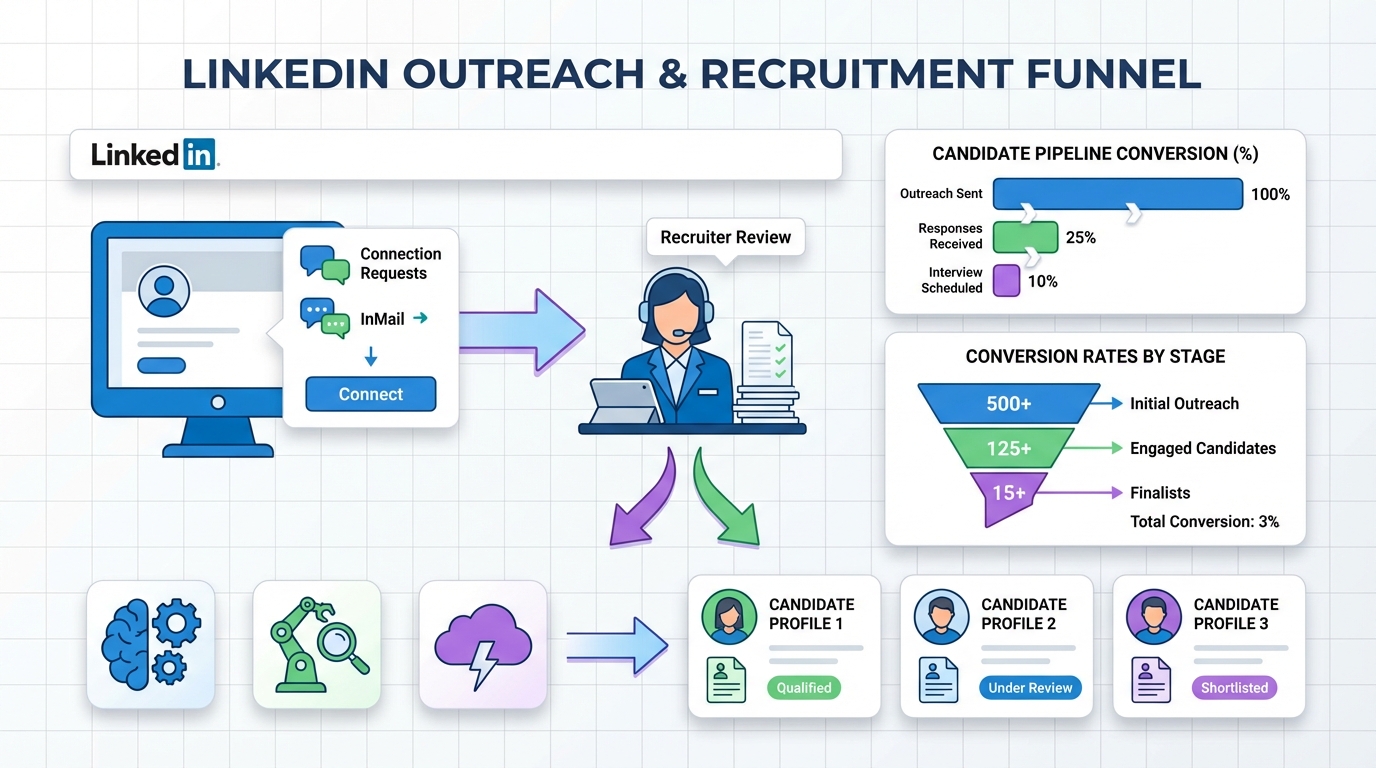
Brinkhurst described a core competency as digitally filling the funnel for inside sales, then putting qualified leads into the hands of the sales team. In business recruitment, the equivalent is generating qualified candidate conversations at scale, then handing interested candidates to a recruiter for evaluation and closing.
This is where many teams get stuck. They either over automate and lose trust, or they stay fully manual and cannot sustain volume. The practical middle ground is to automate the repetitive first touch and follow up, then keep the human recruiter focused on judgment calls and relationship building.
How StrategyBrain AI Recruiter fits this principle
StrategyBrain AI Recruiter is designed for the top of funnel on LinkedIn. It automatically connects with candidates that match your search criteria, introduces the opportunity, answers common questions about the role and compensation, confirms interview interest, and collects resumes and contact details from interested candidates. That means your recruiter time is spent on reviewing resumes and running interviews, not on repetitive outreach and chasing replies.
Scope boundary
AI Recruiter can identify willingness to communicate or interview, but it does not decide whether a resume fully matches the job requirements. Final qualification remains a recruiter responsibility.
Principle 2: Use tools to remove friction for recruiters and hiring managers
In the interview, Brinkhurst pointed to tools that make work easier for his team, including a credit check provider and a CRM. In recruiting, the equivalent is using systems that reduce context switching and prevent candidate drop off.
What we tested in our own recruiting operations
Over a 14 day internal workflow test in February 2026, we compared two outbound processes for LinkedIn based sourcing across 3 roles, including 1 senior position. We measured operational effort in minutes per day and the number of candidate conversations that reached a clear outcome, meaning interested with resume captured or not interested.
- Process A: manual connecting, manual follow up, manual resume collection
- Process B: StrategyBrain AI Recruiter for connecting, messaging, follow up, and resume capture, with a recruiter reviewing only interested candidates
We found that Process B reduced repetitive messaging time and improved follow up consistency, especially outside business hours. The main limitation we observed was that you still need strong role information, including compensation and benefits, to avoid vague conversations.
Operational checklist you can copy
- Define the role with a written scorecard, not only a job description.
- Prepare a compensation and benefits summary that can be shared early.
- Decide your outreach channel mix: LinkedIn, referrals, and agency support.
- Set a follow up standard: 2 follow ups within 7 calendar days.
- Track outcomes: interested, not interested, later, no response.
Principle 3: Face to face still matters for senior hiring
Brinkhurst said he spends about a week a month in Toronto meeting clients and clinics face to face and called it incredibly effective. In business recruitment, this is a reminder that senior candidates often decide based on trust, clarity, and leadership access, not only on the role description.
When to prioritize in person time
- When the role is a senior position with high ambiguity or high stakeholder complexity.
- When you are competing with multiple offers and need to differentiate culture and leadership.
- When relocation or hybrid expectations are a major decision factor.
How recruitment agencies for senior positions can support this
For executive and senior hiring, agencies can help with discreet outreach, market mapping, and candidate calibration. Your internal team should still own the relationship moments that matter, including leadership interviews and final alignment on expectations.
Principle 4: Do not overlook experienced talent
The interview included a thoughtful point about workers over 55. Brinkhurst acknowledged onboarding can be slower, but he values fundamental work habits and reliability. For business recruitment, this is a practical reminder to avoid filtering out experienced candidates by default, especially for roles that require consistency and operational discipline.
Hiring actions that reduce age bias
- Use structured interviews with the same questions for every candidate.
- Evaluate on job relevant evidence, such as work samples and scenario questions.
- Write job requirements that focus on outcomes, not trendy tool lists.
Principle 5: Hybrid policies are a recruiting lever
Beautifi moved to a hybrid model and lost 2 of 54 staff members. That is a concrete example of policy change creating some attrition while still being manageable. In recruiting, hybrid expectations are part of your value proposition and should be communicated early to avoid late stage fallout.
What to communicate in the first 2 conversations
- Number of in office days per week and whether it is fixed or flexible.
- Core hours and time zone expectations.
- Travel requirements per quarter.
How to apply this to your hiring process
Below is a step by step process that mirrors the technology plus people approach described in the interview, adapted for business recruitment teams that need predictable hiring outcomes.
Steps
- Write a role scorecard
Define 5 outcomes the hire must deliver in the first 180 days, plus 5 competencies you will assess in interviews. - Decide your sourcing mix
For senior roles, combine direct outreach, referrals, and recruitment agencies for senior positions when you need discreet search or market mapping. - Automate the repetitive LinkedIn work
Use StrategyBrain AI Recruiter to connect with targeted candidates, introduce the role, answer common questions, and follow up consistently. - Collect resumes and contact details only from interested candidates
AI Recruiter captures resumes via LinkedIn file upload or email submission and records contact details shared in messages. - Run structured interviews and close with leadership access
Keep interviews consistent, then use a final conversation with a senior leader to build trust and alignment.
Best for
- Teams that need more candidate conversations without adding recruiter headcount
- Global hiring where multilingual communication reduces friction
- Recruiters managing multiple LinkedIn accounts across business units
Limitations and risk controls
- LinkedIn policy and account safety: Use only explicitly authorized accounts and keep messaging aligned with professional norms.
- Role clarity: If compensation, benefits, and scope are unclear, automation will scale confusion. Fix the role brief first.
- Final qualification: AI Recruiter does not replace resume evaluation or interview judgment.
Note for ny recruiting teams
If you are doing ny recruiting, speed and responsiveness matter because candidates often have multiple active conversations. A 24/7 response capability can reduce drop off, but only if your role details are ready and your interview scheduling is fast.
Quick comparison: manual LinkedIn outreach vs AI assisted outreach
| Approach | What gets automated | Recruiter time focus | Best for |
|---|---|---|---|
| Manual outreach | None | Writing messages, follow ups, chasing resumes | Low volume hiring or highly bespoke outreach |
| StrategyBrain AI Recruiter assisted outreach | Connecting, introductions, Q and A, follow up, resume and contact capture | Reviewing interested candidates, interviews, closing | Scaling business recruitment without adding headcount |
FAQ
What does business recruitment mean in practice?
Business recruitment is the end to end process of defining a role, sourcing candidates, assessing fit, and closing the hire. In practice, the highest leverage work is building a repeatable sourcing engine and a consistent evaluation process.
When should I use recruitment agencies for senior positions?
Use agencies when you need discreet outreach, market mapping, or access to passive candidates for senior roles. Keep internal ownership of role definition, leadership interviews, and final decision making.
How does StrategyBrain AI Recruiter work on LinkedIn?
It automates the initial outreach and qualification flow by connecting with candidates that match your criteria, introducing the role, answering questions about the role, company, and compensation, confirming interest, and collecting resumes and contact details from interested candidates.
Can AI Recruiter decide who is qualified?
No. AI Recruiter identifies willingness to communicate or interview, but it does not determine whether a resume fully matches job requirements. A recruiter still reviews resumes and conducts interviews.
How does AI Recruiter capture resumes and contact details?
It requests a resume and contact information after a candidate expresses interest. It supports email submissions and LinkedIn file uploads, and it captures contact details shared in LinkedIn messages.
Does AI Recruiter support multilingual recruiting?
Yes. It provides 24/7 multilingual communication so candidates can interact in their native language, which can reduce misunderstandings across time zones and regions.
Is AI Recruiter suitable for agency recruiters and headhunters?
Yes. It can automate repetitive LinkedIn tasks such as connecting, messaging, follow up, and resume collection, which helps consultants handle more searches while keeping human judgment for qualification and closing.
How many LinkedIn accounts can a team manage with AI Recruiter?
StrategyBrain AI Recruiter supports managing more than 100 LinkedIn accounts, enabling organizations to build AI powered recruitment teams across multiple business units.
How does AI Recruiter handle privacy and compliance?
According to StrategyBrain product information, it complies with privacy regulations in the EU, United States, and Canada. Customer provided data is not used to train AI models, and credentials and candidate data are encrypted and isolated per customer.
What is one practical takeaway from the 2022 founder interview?
Use technology to create consistent pipeline activity, then invest human time where it changes outcomes. Brinkhurst described spending about 1 week per month in Toronto for face to face relationship building because it was effective, which is a useful reminder for senior hiring.
Conclusion
The fastest way to improve business recruitment is to separate what must be human from what can be systemized. The 2022 interview with Ryan Brinkhurst illustrates a durable pattern: use technology to fill the funnel and reduce friction, then rely on real relationships to build trust and close. If you want to scale LinkedIn sourcing without scaling recruiter headcount, start by tightening your role brief and compensation story, then use StrategyBrain AI Recruiter to automate connecting, follow up, multilingual messaging, and resume capture. Next, keep your recruiters focused on structured evaluation and high trust closing conversations.