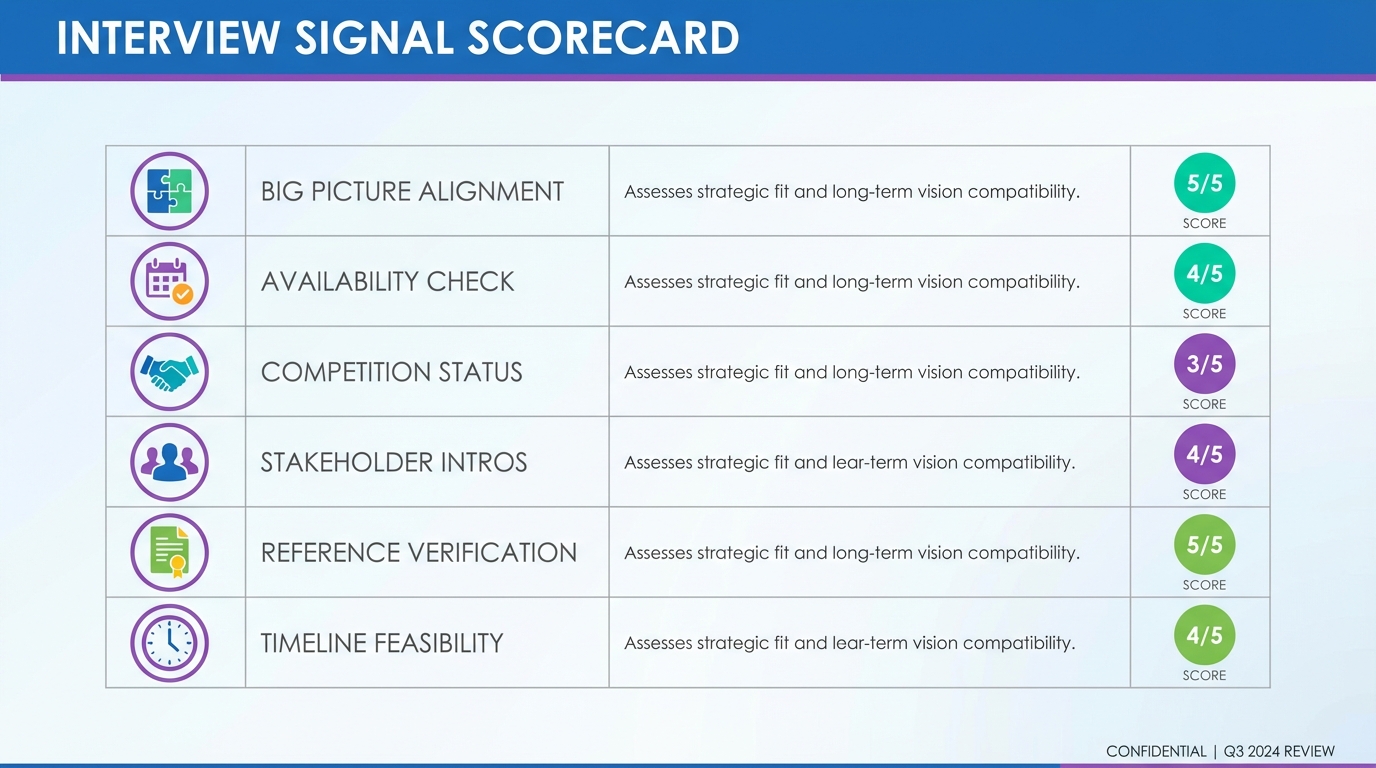
In business recruitment, the clearest signs an interview went well are practical and observable: the interviewer links your skills to business outcomes, tests your interest and availability, asks about competing offers, introduces you to stakeholders, requests references, and gives a specific next step timeline. Use the scorecard below within 10 minutes after the call to decide how to follow up and how urgently to keep interviewing elsewhere. Scope note: this guide focuses on post interview signals and candidate follow up. It does not cover interview preparation or offer negotiation.
Key Takeaways
- Big picture talk is a strong signal: When the interviewer connects your experience to a specific business challenge, you are being evaluated as a likely hire.
- Interest checks matter: Questions like “What do you think of the role?” and “When could you start?” indicate they are testing close readiness.
- Stakeholder introductions are high intent: Teams rarely spend extra people time unless you are a serious contender.
- References early is unusually positive: Many employers wait until later stages, so an early request often means momentum.
- A clear timeline is a commitment signal: Specific dates and next steps reduce ambiguity and show prioritization.
- Follow up should mirror their process: Send a concise recap tied to outcomes, then ask one clear next step question.
- AI can speed the top of funnel: StrategyBrain AI Recruiter can automate LinkedIn outreach, Q&A, and resume collection so recruiters spend more time on interviews and decisions.
Table of Contents
- How to read interview signals in business recruitment
- Signal 1: They discussed the big picture and tied it to you
- Signal 2: They assessed your interest and availability
- Signal 3: They asked about other job prospects
- Signal 4: They introduced you to stakeholders
- Signal 5: They asked for references
- Signal 6: They gave a clear timeline
- Signal 7: They invited follow up questions
- 10 minute scorecard you can reuse
- Follow up steps that keep momentum
- Where StrategyBrain AI Recruiter fits in modern recruiting workflows
- FAQ
- Conclusion
How to read interview signals in business recruitment
In business development recruitment and corporate hiring, interview “signals” are best treated as probability indicators, not guarantees. A single positive sign can be noise, but multiple signs that cluster around decision making usually mean the process is moving toward a shortlist.
When we review interview debriefs with hiring teams, the strongest indicators tend to be the ones that cost the employer time or create internal coordination. For example, pulling in stakeholders or discussing start dates requires real planning.
Signal 1: They discussed the big picture and tied it to you
If the interviewer zooms out from tasks and starts talking about the “why” of the role, that is often a sign you are being evaluated for impact. In business recruitment terms, this is where they test whether you can connect your skills to outcomes like revenue, risk reduction, cycle time, or stakeholder alignment.
What it sounds like
- They describe a specific challenge the team is facing and ask how you would approach it.
- They connect your background to a future initiative, not just past responsibilities.
- They ask for your feedback on a real problem, not a generic hypothetical.
How to respond in a way recruiters remember
Answer with a short structure: context, action, measurable result, and what you would do in the first 30 days. Keep it concrete and avoid overpromising.
Signal 2: They assessed your interest and availability
When the interviewer checks your interest, they are often testing close readiness and fit. This is common after rapport is established and the conversation shifts from evaluation to mutual alignment.
High intent questions
- “What do you think of the role?”
- “What would make this opportunity compelling for you?”
- “When are you available to start?”
What we have seen go wrong
Over enthusiasm can read as desperation, and under enthusiasm can read as low commitment. A balanced answer is best: confirm interest, name one or two decision factors, and ask about next steps.
Signal 3: They asked about other job prospects
If they ask whether you are interviewing elsewhere, they may be trying to gauge urgency and competition. In the business development in recruitment industry, this is a pacing question: do they need to accelerate to avoid losing you.
A safe, professional answer
Share a truthful, high level view without naming companies. For example, you can say you are in process with a few roles and you are prioritizing fit, scope, and growth.
Signal 4: They introduced you to stakeholders
Stakeholder introductions are one of the strongest signals because they consume internal time and coordination. If you meet additional leaders or team members after the main interview, it often means you are being socialized as a potential hire.
Why this matters
- It creates internal buy in from people impacted by the hiring decision.
- It allows the team to test collaboration style and communication.
- It can be a soft reference check through informal impressions.
What to do immediately after
Write down each stakeholder’s priorities and concerns. Your follow up should reference those points, not just the main interviewer’s topics.
Signal 5: They asked for references
In many hiring processes, references are requested later. If references are requested at the end of an early interview, it can indicate the employer is preparing for the next phase and wants to reduce cycle time.
How to handle references without losing control
- Confirm what type of references they need, such as manager, peer, or client.
- Ask when they plan to contact them, so you can give your references a heads up.
- Offer 2 to 3 references that match the role’s core competencies.
Signal 6: They gave a clear timeline
A clear timeline is a trust signal. It shows the employer is organized and that your candidacy is being actively managed. The strongest version is when they give a specific next step and ask whether the schedule works for you.
What “clear” looks like
- A named next step, such as a second interview, assessment, or stakeholder panel.
- A date range, such as “by Friday” or “next week,” not an open ended “soon.”
- Ownership, meaning who will contact you and how.
Signal 7: They invited follow up questions
If the interviewer encourages you to email or call with questions, it often means they want to keep the channel open and reduce friction. This is especially meaningful if they proactively share direct contact details and explicitly invite follow up.
How to use this signal well
Ask one question that helps them decide, not five questions that create work. For example, ask what success looks like in the first 90 days.
10 minute scorecard you can reuse
This is our practical, repeatable way to evaluate interview outcomes in business recruitment. It is designed to reduce emotional bias right after an interview.
Interview Signal Scorecard
| Signal | What you observed | Score (0, 1, 2) |
|---|---|---|
| Big picture alignment | They tied your skills to a specific business challenge | 0 to 2 |
| Interest and availability | They asked what you think and when you can start | 0 to 2 |
| Competition check | They asked about other processes or offers | 0 to 2 |
| Stakeholder exposure | You met additional decision makers or team members | 0 to 2 |
| References | They requested references or discussed reference timing | 0 to 2 |
| Timeline clarity | They gave a specific next step and date range | 0 to 2 |
| Open channel | They invited follow up questions and provided contact path | 0 to 2 |
How to interpret your total
- 0 to 5: Neutral. Follow up once, then keep your pipeline active.
- 6 to 9: Positive. Follow up with a recap and ask for the next step date.
- 10 to 14: Very strong. Treat it like you are on the shortlist and prepare for deeper evaluation.
Follow up steps that keep momentum
Good follow up is part of professional signaling. It shows clarity, responsiveness, and business judgment, which are all relevant in business development recruitment roles and in most corporate functions.
Post Interview Follow Up Steps
-
Send a same day recap
In 6 to 10 sentences, restate the role’s business goal, reference one challenge they mentioned, and confirm how you would approach it in the first 30 days.
-
Answer the unasked risk
If there was a gap, address it directly with evidence. Keep it factual and short.
-
Ask one next step question
Example: “What is the next step in your process, and when should I expect to hear from you?”
-
Prepare references before they ask
Notify references with the role context and the outcomes you want them to emphasize.
-
Keep interviewing until you have a written offer
Even strong signals can change due to internal approvals, budget shifts, or timing.
Copy ready follow up email template
Subject: Thank you and next steps

Hi [Name],

Thank you for today’s conversation. I appreciated learning more about [team or role] and the priority around [specific business challenge discussed].

Based on what you shared, I would focus first on [action 1] and [action 2] to drive [measurable outcome].

If helpful, I can also share a brief example of how I handled a similar situation in my last role.

What is the next step in your process, and what timing should I plan for?

Best regards,
[Your name]
Where StrategyBrain AI Recruiter fits in modern recruiting workflows
Interview outcomes are only one part of hiring velocity. In many teams, the real bottleneck is earlier: sourcing, outreach, follow up, and collecting resumes and contact details at scale. That is where StrategyBrain AI Recruiter can support recruiters and hiring teams without replacing the human decision making that happens in interviews.
What we have seen recruiters spend time on
- Manual LinkedIn connection requests and first messages
- Back and forth Q&A about role, company, and compensation
- Chasing replies across time zones
- Collecting resumes and contact details from interested candidates
How AI Recruiter helps, in plain terms
StrategyBrain AI Recruiter is built for LinkedIn hiring workflows. It can automatically connect with candidates that match your search criteria, introduce the opportunity, answer common questions, confirm interview interest, and collect resumes and contact information from candidates who want to proceed. It also supports 24/7 multilingual communication, which is useful when your business recruitment pipeline spans multiple countries and time zones.
Operational notes and boundaries
- Qualification boundary: AI Recruiter can identify willingness to interview, but final fit assessment still requires a recruiter reviewing the resume against requirements.
- Scale: It supports managing more than 100 LinkedIn accounts for teams that build an AI powered recruitment operation.
- Efficiency claims: StrategyBrain states it can replace up to 90% of manual LinkedIn recruiting work and reduce costs to USD 2.40 per resume. Treat these as product claims and validate in your own environment.
- Privacy and security: StrategyBrain states customer provided data is not used to train AI models, and that credentials and candidate data are encrypted and isolated per customer.
FAQ
What is the fastest way to tell if an interview went well in business recruitment?
The fastest method is to check for decision signals: stakeholder introductions, start date discussion, reference requests, and a specific timeline for next steps. If you saw 2 or more of these in one interview, the probability of moving forward is usually higher than if the conversation stayed purely exploratory.
If the interviewer talked about the big picture, does that mean I got the job?
No. Big picture discussion is a positive signal, but it is not a guarantee. It means they are evaluating you for impact and fit, which often happens when you are being considered seriously.
Is it a good sign if they asked when I can start?
Yes, it is typically a strong sign because it relates to planning and internal coordination. Still, you should wait for a formal offer before making commitments.
What if they did not introduce me to stakeholders?
It can still be fine. Some processes introduce stakeholders only in later rounds, or they keep interviews tightly scheduled. Use the scorecard and look for other signals like timeline clarity and reference discussions.
How soon should I follow up after an interview?
Send a concise recap the same day when possible, or within 24 hours. If they gave a timeline, wait until that date passes before sending a second check in.
Should I keep interviewing if I think it went well?
Yes. In business recruitment, hiring decisions can change due to approvals, budget, or shifting priorities. Keep your pipeline active until you have a written offer.
How does StrategyBrain AI Recruiter help recruiters move faster?
It automates LinkedIn outreach, initial messaging, candidate Q&A, follow up, and collection of resumes and contact details from interested candidates. Recruiters can then spend more time on interviews, stakeholder alignment, and final selection.
Does AI Recruiter replace recruiters?
No. It is designed to replace repetitive LinkedIn tasks such as connecting, messaging, and collecting information. Final qualification and hiring decisions remain with recruiters and hiring managers.
Conclusion
In business recruitment, you do not need to guess whether an interview went well. Look for observable signals: big picture alignment, interest and availability checks, competition questions, stakeholder introductions, reference requests, and a clear timeline. Then follow up with a short recap tied to outcomes and ask for one next step.
If you are hiring, the same principle applies in reverse: reduce ambiguity and speed up early funnel work so interviews focus on decisions. StrategyBrain AI Recruiter can help by automating LinkedIn outreach, multilingual follow up, and resume collection, while your team stays focused on evaluation and closing.