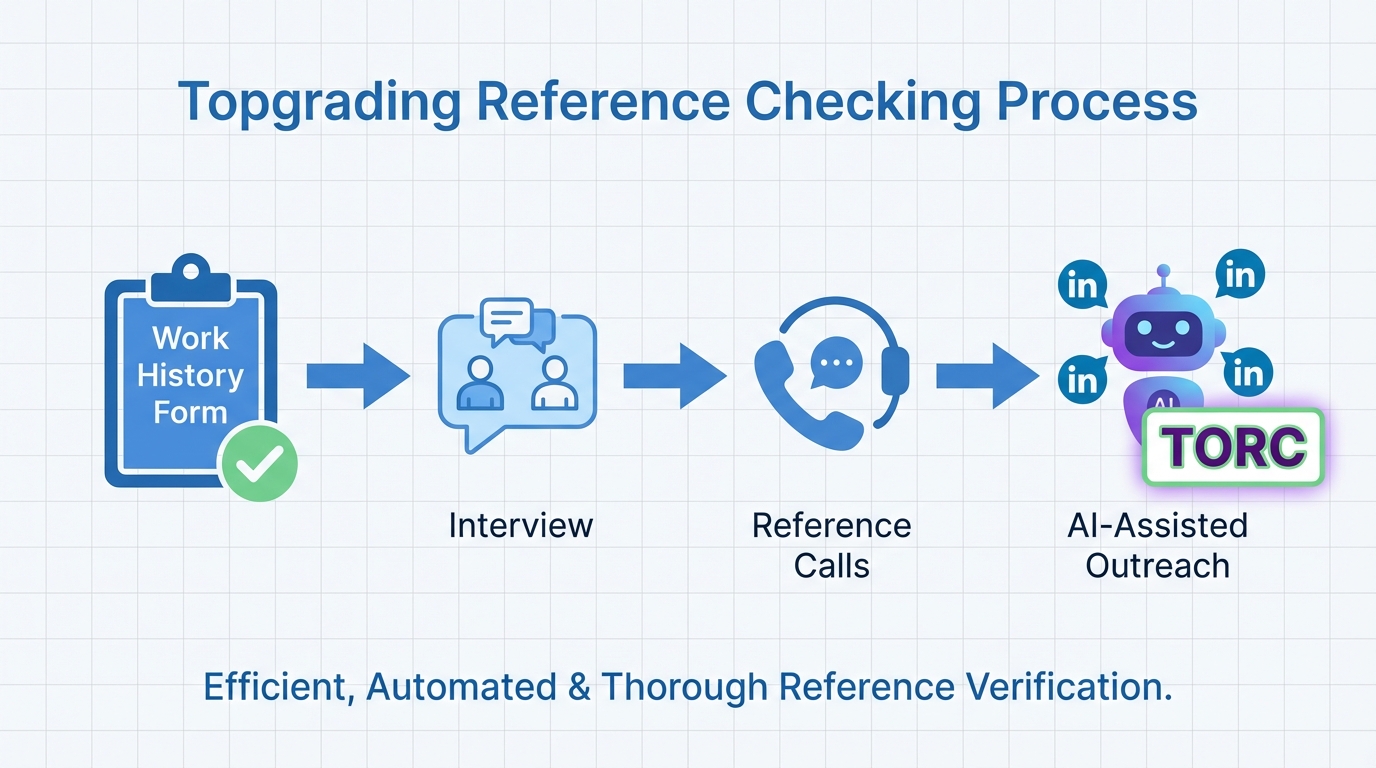
In business recruitment, Topgrading reference checking is a structured way to validate a candidate’s full work history with evidence by collecting the name and contact details of each past manager, then conducting targeted reference checks that the candidate expects will happen. The practical “secret sauce” is TORC, which stands for Threat of a Reference Check, meaning candidates are more likely to be accurate and complete when they know you will verify specifics. This guide explains what Topgrading reference checking is, when it is worth the extra time, and how to run it step by step. It also shows how teams can reduce the manual workload by using StrategyBrain AI Recruiter to handle high volume LinkedIn candidate communication, follow up, and résumé collection while recruiters focus on final evaluation.
Table of Contents
- What Topgrading reference checking is
- Why TORC changes candidate behavior
- When it is worth using in business recruitment
- Step by step process you can run
- How StrategyBrain AI Recruiter fits into the workflow
- Limitations and risk controls
- Quick comparison: Topgrading vs standard reference checks
- FAQ
- Conclusion and next steps
Key Takeaways
- Topgrading reference checking collects manager contacts for every prior role, then verifies claims with structured questions.
- TORC means candidates expect verification, which can reduce exaggeration and withdrawals late in the process.
- Best fit is management, leadership, and high impact technical roles where a bad hire cost is high.
- Core inputs are a comprehensive work history form plus an interview focused on past success and challenges.
- Scaling challenge is time, especially for candidates with 20+ years across multiple employers.
- StrategyBrain AI Recruiter can reduce manual LinkedIn outreach and follow up by automating initial conversations and collecting résumés and contact details.
What Topgrading reference checking is
Topgrading is an interview and verification approach designed to build a full picture of a candidate’s personality and work history, then require evidence to support it. The reference checking component is more intensive than a typical “two references at the end” process because it starts earlier and is tied to a detailed work history.
In the source material, the process begins by asking candidates to complete a comprehensive work history form that includes the name and contact information of the manager for each past role. That form is then paired with an interview that concentrates on past success and challenges, producing a more complete view of strengths and weaknesses than a behavioral interview alone.
Why TORC changes candidate behavior
TORC, or Threat of a Reference Check, is the idea that candidates are more likely to be accurate when they know you will verify specifics with the people who managed them. In practice, TORC is not about being adversarial. It is about setting a clear expectation that claims will be checked, which can reduce surprises after an offer and improve decision quality.
From a business development recruitment perspective, TORC also helps align stakeholders. Hiring managers get a repeatable, defensible process, and recruiters can explain why the extra steps exist, especially for roles where the cost of a wrong hire is high.
When it is worth using in business recruitment
Topgrading reference checking is not the right tool for every hire. It is most valuable when the role has high impact, high autonomy, or high risk if performance is poor.
Best for
- Management and leadership roles where decision making and people leadership are central.
- Technical and engineering roles where past execution quality matters and is hard to judge from interviews alone.
- Senior candidates where the résumé spans multiple employers and titles.
Not ideal for
- High volume entry level hiring where speed is the primary constraint.
- Roles with limited manager traceability such as frequent contracting without stable reporting lines.
- Situations where references are structurally unavailable due to policy or confidentiality constraints.
Step by step process you can run
Below is a reproducible workflow we use when we want Topgrading level verification without turning the process into a months long project. The steps are written so a recruiter, a hiring manager, and an operations coordinator can each own a piece.
Steps
- Collect a full work history form
Ask the candidate to list every relevant role and include the name, title, and contact details of the direct manager for each position. Make it clear that references will be contacted later in the process.
- Run an interview focused on past success and challenges
Use the work history form as the backbone. For each role, confirm scope, outcomes, and what “good” looked like. Capture specific claims you can verify later.
- Identify verification targets
Select the roles and managers that matter most for the current job. For a leadership hire, prioritize roles with similar team size, budget, and accountability.
- Prepare structured reference questions
Write questions that map to the job scorecard. Keep them consistent across references so answers are comparable.
- Conduct reference checks and document evidence
Record what was confirmed, what was contradicted, and what was unclear. Separate facts from opinions in your notes.
- Close the loop with the hiring team
Summarize findings in a short decision memo. Include what was verified, what remains a risk, and what follow up is recommended.
Practical checklist (copy and use)
- [ ] Work history form received with manager contacts for each prior role
- [ ] Interview notes include 5 to 10 verifiable claims tied to outcomes
- [ ] Reference questions mapped to the role scorecard
- [ ] At least 2 manager references completed for the most relevant roles
- [ ] Evidence summary shared with hiring manager before final decision
How StrategyBrain AI Recruiter fits into the workflow
Topgrading style verification is powerful, but it is time intensive. The bottleneck is often not the reference call itself. It is the coordination, follow up, and candidate communication that surrounds it. This is where StrategyBrain AI Recruiter can reduce manual work while keeping the verification standard high.
Where we have seen it help most
- Automated LinkedIn outreach and follow up so recruiters spend less time sending initial messages and reminders and more time evaluating evidence.
- Always on candidate communication with 24/7 responses, which is useful when candidates reply outside business hours or across time zones.
- Multilingual messaging so candidates can communicate in their native language, reducing misunderstandings during early qualification.
- Résumé and contact detail collection from interested candidates, which keeps the pipeline moving while reference checks are being scheduled.
- Scaling across many LinkedIn accounts when a team needs to expand outreach capacity without adding headcount.
Important boundary
StrategyBrain AI Recruiter can automate initial outreach, qualification, and information capture. It does not replace the recruiter’s final judgment on whether a résumé matches job requirements. In our experience, that division of labor is exactly what makes the workflow scalable.
Limitations and risk controls
Topgrading reference checking can feel long and arduous for candidates with 20+ years of experience across multiple jobs. That is a real tradeoff. The goal is not to create friction. The goal is to reduce the risk of a costly hiring mistake.
Common issues
- Time cost increases with each additional role and manager to verify.
- Reference availability varies by employer policy and manager responsiveness.
- Inconsistent reference quality can lead to vague feedback unless questions are structured.
Workarounds
- Prioritize roles that match the current job’s scope and accountability.
- Standardize questions so answers are comparable across references.
- Use automation for coordination such as AI assisted candidate follow up on LinkedIn, while keeping the reference conversation itself human led.
Quick comparison: Topgrading vs standard reference checks
| Approach | Inputs required | Speed | Best for |
|---|---|---|---|
| Standard reference checks | 2 to 3 references near the end | Fast | Lower risk roles and high volume hiring |
| Topgrading reference checking | Work history form plus manager contacts for each role | Slower | Management and high impact technical roles |
| Topgrading plus AI assisted coordination | Topgrading inputs plus automated LinkedIn communication | Medium | Teams scaling business recruitment without adding recruiters |
FAQ
What does TORC mean in Topgrading?
TORC means Threat of a Reference Check. It is the expectation that specific claims will be verified with past managers, which can encourage more accurate and complete candidate disclosure.
Is Topgrading only for executives?
No. The source material notes it can be useful for management roles and can also be applied to technical and engineering roles when quality of hire matters and verification is feasible.
Why is Topgrading reference checking more intensive than a behavioral interview?
Because it combines a comprehensive work history form with manager contact details and a verification step. A behavioral interview focuses on examples, while Topgrading adds evidence gathering and reference validation.
How many past managers should we contact?
There is no single number that fits every role. A practical approach is to prioritize the most relevant roles and contact at least 2 managers who can speak to performance in similar scope.
What if a candidate has 20+ years of experience and many jobs?
The process can become lengthy. Prioritize roles that match the current job’s responsibilities and use structured questions to keep calls efficient.
Can StrategyBrain AI Recruiter replace reference checks?
No. StrategyBrain AI Recruiter automates LinkedIn outreach, initial qualification, follow up, and résumé and contact detail collection. Reference checks remain a human led verification step.
How does StrategyBrain AI Recruiter help recruitment agencies with business development recruitment?
It can increase outreach capacity and responsiveness without adding headcount by automating repetitive LinkedIn tasks. That frees recruiters to spend more time on client management, evidence based screening, and closing roles.
Does StrategyBrain AI Recruiter support multilingual candidate communication?
Yes. It is designed for 24/7 multilingual communication so candidates can interact in their native language, which can reduce misunderstandings during early stage conversations.
How does AI Recruiter handle résumés and contact details?
When candidates express interest, it requests a résumé and contact information. It can capture details shared in messages and track whether a résumé was received, supporting both email submissions and LinkedIn file sharing.
Conclusion and next steps
Topgrading reference checking is a high rigor option for business recruitment when you need a defensible view of a candidate’s real work history, not just interview performance. The combination of a comprehensive work history form, an interview focused on past success and challenges, and TORC creates a verification driven process that can improve quality of hire.
Next steps are simple. Choose one high impact role, run the step by step workflow above, and standardize your reference questions. If coordination and follow up are slowing you down, consider using StrategyBrain AI Recruiter to automate LinkedIn outreach, candidate conversations, and résumé collection so your team can spend its time on evidence based decisions.