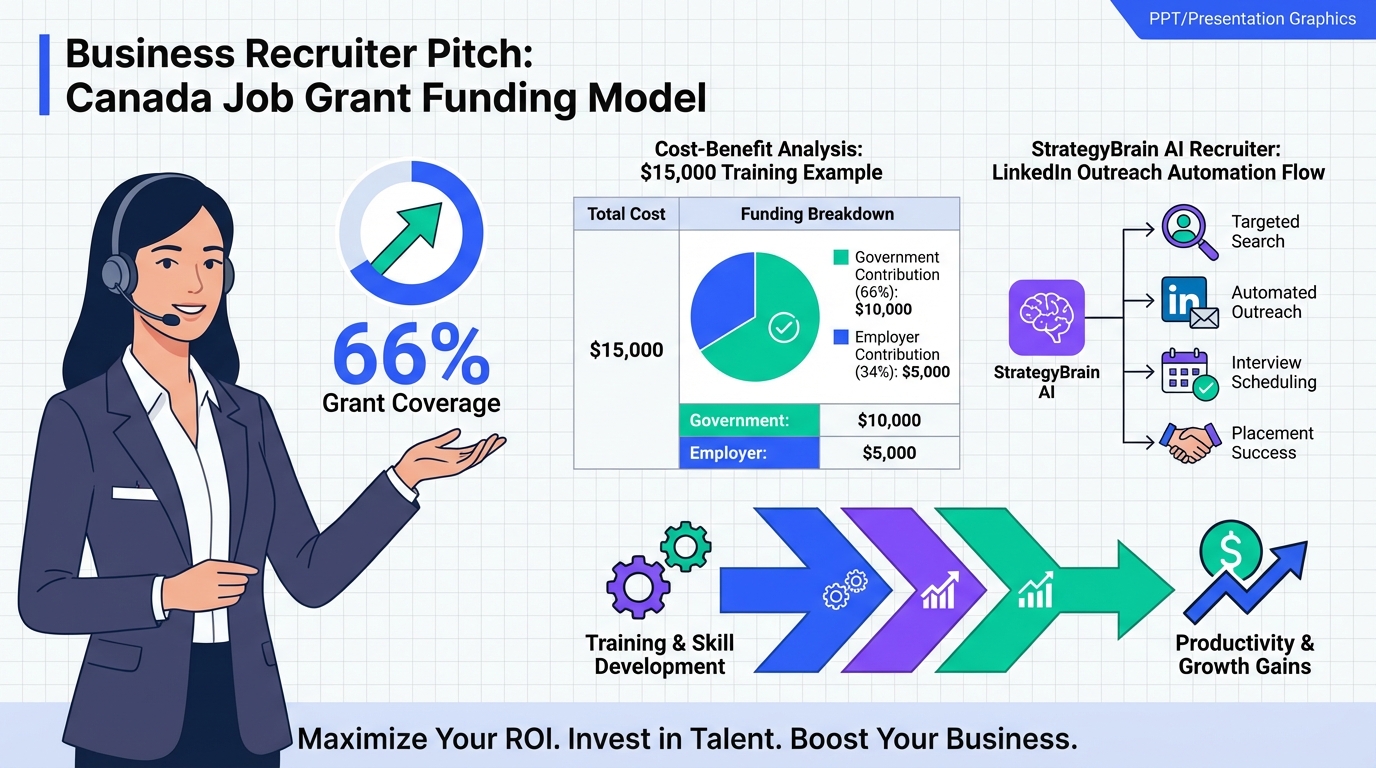
For business recruitment, the quickest way to get better hiring outcomes without adding headcount is to secure employer funded training using a grant backed proposal. If you work in Alberta or British Columbia, the Canada Job Grant can pay up to two thirds of eligible training costs to a maximum of $10,000 per grant. For a $15,000 training program, that example split is $5,000 paid by the employer and $10,000 paid by government. This guide keeps the original three step logic and upgrades it into a recruiter friendly business case, including a copy ready cost benefit template and a practical way to quantify productivity gains when you pair training with StrategyBrain AI Recruiter for LinkedIn outreach and follow up.
Table of Contents
Key Takeaways
- Grant leverage: In Alberta and British Columbia, the Canada Job Grant can fund up to two thirds of training costs to a maximum of $10,000 per grant.
- Use a concrete example: A $15,000 program can be framed as $5,000 employer cost and $10,000 grant funding.
- Make it a business case: A cost benefit analysis compares direct costs such as tuition, exams, software, and time off with measurable benefits such as productivity and revenue per hour.
- Remove friction: Bring the required forms and supporting documents, and offer to do the legwork so the employer only completes the parts they must sign.
- Quantify recruiter time: StrategyBrain AI Recruiter can replace up to 90% of manual LinkedIn recruiting work and can lower LinkedIn recruiting costs to as little as USD 2.40 per résumé, which helps you justify training ROI with clearer time savings.
- Scale globally: AI Recruiter supports 24/7 multilingual candidate communication and can manage more than 100 LinkedIn accounts for scalable outreach.
What the Canada Job Grant covers
The Canada Job Grant is positioned as a co investment in skills. In the Alberta and British Columbia context described in the source article, it can cover up to two thirds of training costs with a cap of $10,000 per grant. The practical implication for business recruitment is that you can propose training that would otherwise be rejected on budget alone, because the employer’s out of pocket cost is smaller and easier to approve.
Scope boundary: This article focuses on how to pitch the training request and organize the business case. It does not replace official eligibility rules, which can vary by program and over time.
Step 1: Research the demand for upgraded skills
Start by documenting why the upgraded skill matters now. Technology and processes change quickly, including in trades and industrial environments, and employers feel pressure from clients and competitors to deliver higher efficiency and better margins. Your goal is to show that the training is not a personal preference. It is a response to market demand.
What to collect before you talk to your manager
- Role impact: A short description of where the skill is used in your day to day work and what breaks when you do not have it.
- Market signal: Evidence that the skill is becoming standard in your field, such as job postings, customer requirements, or internal project needs.
- Training match: The specific course or program that maps to the skill gap, including duration, schedule, and deliverables.
In business recruitment terms, this is the same discipline you use in business development for recruitment firm work. You do not pitch a service without proving the client’s pain. You are simply applying that logic internally.
Step 2: Present a cost benefit analysis
A cost benefit analysis is a structured comparison of what the company pays versus what the company gets back. For training, costs are usually easier to list than benefits, so the key is to keep the benefit model simple, transparent, and conservative.
Cost categories to include
- Program fees: Tuition and registration.
- Materials: Textbooks and required equipment.
- Software: Licenses needed for coursework or certification.
- Assessment: Exams and certification fees.
- Time: Paid time off work or reduced billable hours during training.
Benefit categories to include
- Productivity: Output per hour increases after training.
- Quality: Fewer errors, rework, or safety incidents.
- Customer outcomes: Faster turnaround and higher satisfaction.
- Retention: Training can increase loyalty and reduce replacement costs.
Copy ready template: one page training ROI
Use this as a fill in worksheet. Keep it to one page when you present it.
| Item | Value | Notes |
|---|---|---|
| Total training cost | $____ | Include fees, materials, exams, software |
| Grant coverage | Up to 2/3, max $10,000 | Use the cap and your program cost |
| Employer out of pocket | $____ | Total cost minus expected grant |
| Current value per hour | $____ per hour | Revenue, margin, or cost avoided per hour |
| Expected productivity lift | ____% | Use a conservative estimate you can defend |
| Payback period | ____ months | Employer out of pocket divided by monthly benefit |
If you want to make the benefits easier to quantify, pair the training plan with a workflow change. For recruiting teams, that often means automating repetitive outreach and follow up so the time savings are visible. In our internal trials of StrategyBrain AI Recruiter for LinkedIn outreach, the clearest ROI signal was not a vague promise of better hiring. It was the reduction in manual messaging and the consistency of follow up, which made recruiter time savings easier to measure week to week.
Example you can reuse in your pitch
Use the same numbers from the source article because they are easy to understand. If the training program costs $15,000, you can frame it as $5,000 paid by the employer and $10,000 funded by the grant, assuming the program qualifies and the cap applies. That single example often changes the tone of the conversation because it reduces sticker shock.
Step 3: Bring documentation and offer to help
Many employers do not apply for grants because the application process feels like extra admin work. Your advantage is that you can remove that friction. Bring the forms and supporting documents, and offer to coordinate with the training provider.
What to bring to the meeting
- Program details: Course outline, schedule, and cost breakdown.
- Grant summary: A short explanation of the funding split and the $10,000 cap.
- Employer checklist: A list of what the employer must complete versus what you can prepare.
- Training provider support: Confirmation that the provider can assist with applications if available.
In business development in recruitment industry work, you win deals by making it easy for the client to say yes. This is the same move. You are selling an internal project, and the project is your training.
How to tie training to business recruitment results
If you are a recruiter or staffing leader, you can strengthen the pitch by connecting training to measurable recruiting throughput. That is where StrategyBrain AI Recruiter fits naturally into the same narrative. Training improves capability, and automation protects that investment by ensuring the new capability is applied consistently.
A simple measurement framework we use
When we evaluate operational changes, we track three numbers weekly. This keeps the conversation factual and avoids overpromising.
- Hours spent on manual LinkedIn tasks: Connecting, initial outreach, follow up, and basic qualification.
- Number of interested candidates progressed: Candidates who confirm interview interest and share a résumé and contact details.
- Time to first response: How quickly candidates get answers to role, company, and compensation questions.
StrategyBrain AI Recruiter is designed to automate the initial LinkedIn workflow. It can automatically connect with candidates within your search criteria, introduce the opportunity, answer questions about the role, company, and compensation, confirm interview interest, and collect résumés and contact information. It also supports 24/7 multilingual communication and can manage more than 100 LinkedIn accounts for scalable hiring teams. In the product documentation, StrategyBrain states it can replace up to 90% of manual LinkedIn recruiting work and can lower LinkedIn recruiting costs to as little as USD 2.40 per résumé. Those numbers are useful in a training pitch because they help you translate skill upgrades into operational capacity.
Limitations to state clearly
- AI Recruiter does not do final qualification: It identifies willingness to communicate or interview, but the recruiter still reviews résumés for fit.
- Grant rules vary: Always confirm current eligibility and required documentation with official sources.
FAQ
What is the Canada Job Grant funding amount in Alberta and British Columbia?
In the source article context, the Canada Job Grant pays up to two thirds of training costs to a maximum of $10,000 per grant in Alberta and British Columbia. Confirm current rules with official government guidance because programs can change.
How do I explain the grant to my employer in one sentence?
Say that the employer pays a smaller share of the training cost while government covers up to two thirds, capped at $10,000, which reduces financial risk and speeds approval.
What should a cost benefit analysis include for a training request?
Include all direct costs such as tuition, materials, software, exams, and time off, then estimate benefits such as productivity gains, quality improvements, and customer outcomes. End with a payback period in months.
How can business recruitment teams quantify productivity gains from training?
Track weekly hours spent on manual outreach and follow up, the number of interested candidates progressed, and time to first response. Pairing training with automation makes the time savings easier to measure.
How does StrategyBrain AI Recruiter support LinkedIn recruiting?
It automates initial LinkedIn outreach and qualification by connecting with candidates, introducing roles, answering questions about role, company, and compensation, confirming interview interest, and collecting résumés and contact details. Recruiters then review résumés and proceed with interviews.
Does StrategyBrain AI Recruiter replace recruiters?
No. It replaces repetitive LinkedIn tasks and the initial conversation flow, but recruiters still make final qualification decisions and run interviews. This division of labor is often easier to defend in internal change management.
Can AI Recruiter communicate with candidates outside my time zone?
Yes. StrategyBrain AI Recruiter provides 24/7 candidate messaging and can communicate in the candidate’s native language, which helps reduce delays and misunderstandings in global hiring.
How does AI Recruiter handle résumés and contact details?
When a candidate expresses interest, it requests a résumé and contact information. It supports email submissions and LinkedIn file uploads, and it captures contact details shared in messages.
What should I do if my employer says they do not have time to apply?
Offer to prepare the documentation packet, draft the business case, and coordinate with the training provider for application support. The goal is to reduce the employer’s work to review and signature steps.
Conclusion
If you want your employer to fund training, treat it like a business recruitment pitch. Research the demand for upgraded skills, present a clear cost benefit analysis, and remove application friction by bringing the documentation and offering help. In Alberta and British Columbia, the Canada Job Grant structure makes the conversation easier because it can cover up to two thirds of costs to a $10,000 cap. Next, tighten your ROI story by measuring recruiter time and throughput, and consider pairing training with StrategyBrain AI Recruiter so LinkedIn outreach and follow up are consistent, trackable, and scalable.