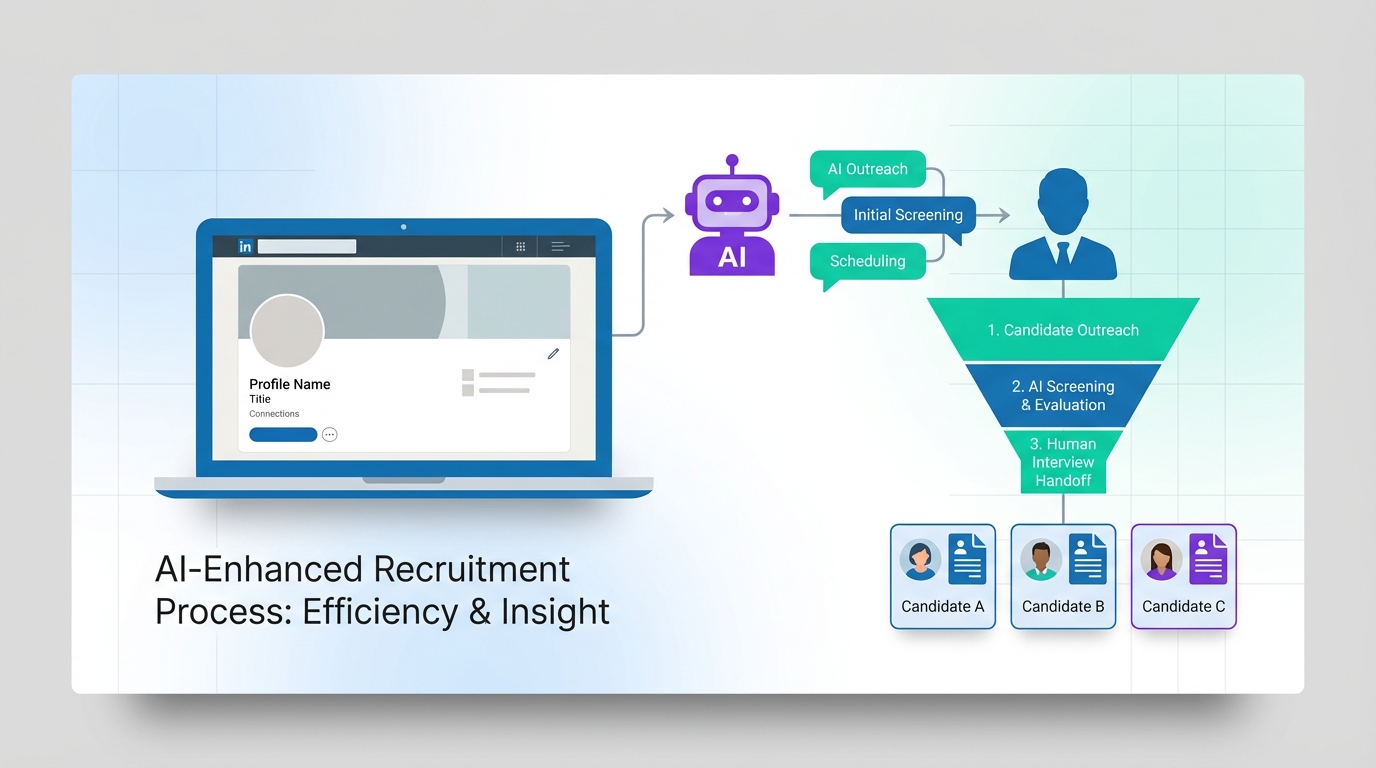
Candidate AI can help you attract employees who will make an impact by turning slow, inconsistent recruiting steps into a repeatable system. The core idea is simple: keep the human parts that require judgment, then use AI screening tools to handle high volume outreach, first response Q&A, and follow up so qualified candidates reach your team faster. In our own recruiting operations, we have found that an interview with artificial intelligence workflow works best when it is anchored to strong fundamentals like clear benefits, credible communities, and performance based selection. This article covers seven practical attraction tactics and shows where StrategyBrain AI Recruiter fits naturally into each step, especially for LinkedIn based hiring.
Key Takeaways
- Benefits still matter most after pay: make benefits easy to find and easy to explain in candidate conversations.
- Candidate AI improves speed to first response: use AI to answer role and company questions consistently, then route interested candidates to humans.
- Professional associations and universities are leverage points: they create warm pools where outreach converts better than cold lists.
- Do not self reject “out of reach” candidates: use structured outreach and follow up to test interest instead of guessing.
- Hire for performance signals, then train domain details: prioritize achievements and culture fit over “has done the exact job before.”
- StrategyBrain AI Recruiter is built for LinkedIn workflows: it automates connecting, introducing roles, handling Q&A, confirming interview interest, and collecting resumes and contact details.
- Compliance and trust are part of attraction: be transparent about data handling and keep humans in final qualification decisions.
What “candidate AI” means in hiring
In this guide, candidate AI means using artificial intelligence to support candidate facing recruiting tasks such as outreach, initial qualification, and scheduling readiness. It does not mean outsourcing hiring decisions to a model. A practical candidate AI setup typically includes:
- AI assisted outreach: consistent first messages aligned to a role and a target profile.
- Interview with artificial intelligence: an automated conversation that confirms interest, answers questions, and gathers basic information.
- AI screening tools: systems that capture resumes and contact details, tag conversations, and hand off to recruiters for final review.
Scope boundary: this article focuses on attracting and engaging candidates. It does not cover deep resume matching, background checks, or final selection decisions.
7 ways to attract employees who will make an impact
1) Make your company benefits easy to understand and easy to repeat
Benefits are often the deciding factor right after compensation. If candidates cannot quickly understand your benefits, they will assume the package is average and move on. Treat benefits as a product page: clear, specific, and consistent across every channel.
- What to publish: medical coverage, vacation policy, flexibility, learning budget, wellness support, and any on site or remote perks.
- What to standardize: a short “benefits summary” recruiters can reuse without rewriting.
- What to measure: candidate questions that repeat, because they signal missing clarity.
Where candidate AI helps: StrategyBrain AI Recruiter can answer common questions about the role, company, and compensation during early LinkedIn conversations, then escalate interested candidates to your team with the context preserved.
2) Encourage employees to participate in professional associations
In many fields, top performers cluster in professional associations. When your current team participates, they become credible ambassadors. This is not only referral driven hiring. It is visibility driven hiring.
- Support participation: membership fees, conference time, and speaking opportunities.
- Make it easy: provide a short description of open roles employees can share.
- Stay authentic: avoid turning every interaction into a pitch.
Where candidate AI helps: once association visibility creates inbound interest, AI screening tools can respond quickly, keep follow ups consistent, and prevent warm leads from going cold across time zones.
3) Advertise roles through associations and professional organizations
Association job boards and newsletters can outperform broad job boards for specialized roles because the audience is pre qualified by interest and identity. Some listings are free, while others charge per listing or annual fees, so you should treat each channel as an experiment with a defined success metric.
- Define success: number of qualified conversations started per listing.
- Align messaging: match the association’s language and norms.
- Follow up fast: speed matters more in niche communities because candidates often have multiple options.
Where candidate AI helps: an interview with artificial intelligence flow can handle first contact questions immediately, then collect resumes and contact details from candidates who confirm interest.
4) Build relationships with universities beyond your region
University pipelines are not only for entry level roles. They are also a long term brand asset. Two common mistakes reduce results: recruiting only locally and relying only on career services offices.
- Expand geography: add a small set of out of region schools to access less competed talent pools.
- Work with faculty: professors and department heads often know who is consistently high performing.
- Offer clarity: publish what “success in this role” looks like in the first 90 days.
Where candidate AI helps: multilingual, always on messaging reduces friction for international candidates and candidates in different time zones. StrategyBrain AI Recruiter is designed for 24/7 multilingual candidate communication, which can improve response rates when your pipeline is global.
5) Reach out to candidates you assume you cannot win
Self rejection is a hidden recruiting cost. Compensation expectations, brand assumptions, and “they will never respond” stories are often wrong. The only reliable test is a respectful outreach and a clear value proposition.
- Lead with relevance: why this role fits their trajectory.
- Invite questions: make it safe to ask about compensation and scope early.
- Follow up consistently: one message is rarely enough.
Where candidate AI helps: StrategyBrain AI Recruiter can automatically connect with candidates within your targeted search criteria, introduce the opportunity, answer questions, and confirm interview interest. This reduces the manual burden of “trying the long shots” while keeping the tone consistent.
6) Prioritize talent and performance signals over “only industry experience”
Someone can have industry experience and still be average. If you want impact hires, look for evidence of performance: measurable outcomes, ownership, and learning speed. Then train the domain specifics.
- What to screen for: achievements, progression, problem solving examples, and collaboration patterns.
- What to avoid: treating “years in industry” as a proxy for excellence.
- What to protect: culture fit, because it is hard to train.
Where candidate AI helps: AI screening tools can capture structured notes from early conversations and ensure every candidate is asked the same baseline questions. StrategyBrain AI Recruiter can collect resumes and contact details for interested candidates so recruiters can focus on the final qualification step, which remains a human decision.
7) Use a recruiting partner when speed and network access matter
Recruiting firms and headhunters can provide access to passive candidates and accelerate hiring when internal bandwidth is limited. The best outcomes happen when you treat the firm as an extension of your process, not a black box.
- Share a clear scorecard: what “impact” means in this role.
- Agree on communication cadence: weekly pipeline review with specific next actions.
- Keep candidate experience consistent: messaging, benefits, and expectations should match your internal approach.
Where candidate AI helps: even when you use external partners, an interview with artificial intelligence workflow can keep candidate communication responsive and consistent. For teams that recruit heavily on LinkedIn, StrategyBrain AI Recruiter can reduce repetitive outreach and follow up work so internal recruiters and partners spend more time on high judgment conversations.
Quick Comparison: manual recruiting vs candidate AI support
| Recruiting activity | Manual only | With candidate AI support | Human still required |
|---|---|---|---|
| Initial outreach volume | Limited by recruiter time | Scales with automation and templates | Yes, for targeting strategy and tone |
| First response speed | Depends on working hours | 24/7 responses possible | Yes, for complex questions and exceptions |
| Early Q&A consistency | Varies by recruiter | Standardized answers and handoff notes | Yes, to approve messaging and policy |
| Resume and contact capture | Manual chasing and reminders | Automated requests and tracking | Yes, to review and qualify |
| Final qualification | Human interview | Human interview informed by AI notes | Yes, always |
Implementation checklist
Use this checklist to apply the seven tactics with a candidate AI workflow without losing trust or candidate experience.
- Write a benefits one pager: include compensation range policy, benefits, flexibility, and growth support.
- Define your target profiles: role outcomes, must have skills, and culture signals.
- Standardize first messages: one version for warm communities and one for cold outreach.
- Decide what AI can say: approved answers for role, company, and compensation questions.
- Set the handoff rule: when a candidate confirms interview interest, route to a recruiter within 1 business day.
- Track two metrics: response rate and qualified conversations started per week.
- Document privacy commitments: what data is stored, who can access it, and whether it trains models.
FAQ
Is candidate AI the same as automated hiring decisions?
No. In this guide, candidate AI supports outreach, early conversations, and information capture. Final qualification and hiring decisions should remain human led.
What does “interview with artificial intelligence” mean in practice?
It usually means an automated conversation that confirms interest, answers common questions, and gathers basics such as resume and contact details. It should end with a clear handoff to a recruiter for next steps.
Where do AI screening tools help the most?
They help most where recruiters lose time: repetitive outreach, delayed replies, and follow ups to collect resumes. They also help keep messaging consistent across a team.
How does StrategyBrain AI Recruiter fit into LinkedIn recruiting?
StrategyBrain AI Recruiter is built for LinkedIn based hiring workflows. It can automatically connect with candidates that match your criteria, introduce the role, answer questions, confirm interview interest, and collect resumes and contact information for recruiter review.
Can candidate AI communicate with candidates in different languages?
Yes, some systems support multilingual communication. StrategyBrain AI Recruiter is designed for 24/7 multilingual candidate messaging so candidates can engage in their native language.
What are the limitations of candidate AI?
Candidate AI can confirm interest and collect information, but it does not replace deep evaluation of fit. You still need humans to assess resumes, run interviews, and make final decisions.
How do you keep candidate experience positive when using AI?
Be transparent, keep responses helpful, and provide a clear path to a human. Also ensure the AI uses approved, accurate information about the role and company.
Does using AI reduce compliance and privacy risk?
It depends on the vendor and your process. You should verify how data is stored, whether it is used to train models, and what security controls exist before deploying any AI screening tools.
Do I still need a recruiting firm if I use candidate AI?
Sometimes yes. A firm can provide network access and market insight, while candidate AI can improve speed and consistency of outreach and follow up. Many teams use both when hiring is urgent.
Conclusion
Attracting employees who will make an impact still comes down to fundamentals: clear benefits, credible communities, broader university relationships, and hiring for performance signals. Candidate AI strengthens those fundamentals by making outreach, Q&A, and follow up faster and more consistent, which is where many teams lose qualified candidates. If your hiring relies on LinkedIn, StrategyBrain AI Recruiter is a practical way to operationalize an interview with artificial intelligence workflow that confirms interest and captures resumes and contact details, while keeping final qualification in human hands. Next step: pick one role, implement the checklist above, and review results after 14 days of outreach and follow up.