Candidate AI is the practical use of AI to support recruiting tasks such as sourcing, outreach, scheduling, and early qualification, while keeping hiring decisions with humans. In our experience, the highest impact use is automating repetitive LinkedIn outreach and follow up, then using consistent qualification questions to collect resumes and contact details from interested candidates. This guide explains what candidate AI is, how to use AI in interview preparation without compromising fairness, and how to operationalize AI HR interview workflows with clear guardrails. It does not cover building custom models or replacing structured interviews.
What candidate AI means in real recruiting work
Candidate AI is not one feature. It is a workflow design choice: you decide which steps can be automated safely, which steps must stay human, and how you will measure quality. In recruiting, the most common “AI” tasks are messaging, triage, and information capture.
To keep the term precise, here are the definitions we use in this article:
- Outreach automation: AI sends connection requests and initial messages based on recruiter provided criteria and job context.
- Qualification: AI asks consistent questions to confirm interest and collect resumes and contact details. It does not decide final fit.
- AI HR interview support: AI helps prepare structured questions, rubrics, and follow up prompts. It should not generate final hiring decisions.
The key operational shift is the same one finance teams made when they moved from back office reporting to business partnership: you standardize inputs, improve timeliness, and make outputs actionable for decision makers. Candidate AI works best when it produces timely, accurate, easy to digest candidate information for recruiters and hiring managers.
Where candidate AI helps most in 2026
When teams say they want candidate AI, they usually mean they want more throughput without losing quality. In practice, the biggest wins come from removing repetitive work and tightening the information loop between recruiting and the business.
High impact use cases
- LinkedIn sourcing and first touch: Automate connection requests and role introductions so recruiters stop spending hours on manual messaging.
- Follow up discipline: Keep conversations moving with consistent, timely follow ups, including outside local business hours.
- Interest confirmation and data capture: Collect resumes and contact details only after a candidate expresses interest, then hand off to a human for evaluation.
- Interview readiness: Use AI to draft structured questions and scoring rubrics so interviews are consistent across interviewers.
What candidate AI should not do
- Final selection decisions: AI can summarize and organize information, but humans must decide.
- Unbounded personalization: Over personalized messages can create compliance and brand risk if not reviewed and constrained.
- Opaque scoring: If you cannot explain why a candidate was advanced or rejected, do not automate that step.
How we tested candidate AI workflows
We tested candidate AI in a controlled, recruiter style workflow over 10 business days in February 2026. The goal was not to “prove AI works,” but to identify where automation reliably reduces manual effort and where it introduces risk.
Test parameters
- Test period: 2026-02-10 to 2026-02-21
- Workflow focus: LinkedIn outreach, follow up, interest confirmation, resume and contact capture, and interview prep prompts
- Evaluation criteria: time saved per recruiter day, message consistency, handoff clarity, and error handling quality
What we found is consistent with how high performing finance teams operate: quality improves when information is timely, accurate, and aligned to business goals. Candidate AI is most valuable when it improves the speed and consistency of the early funnel, then hands off cleanly to humans for judgment calls.
Method 1: LinkedIn outreach automation with StrategyBrain AI Recruiter (Recommended)
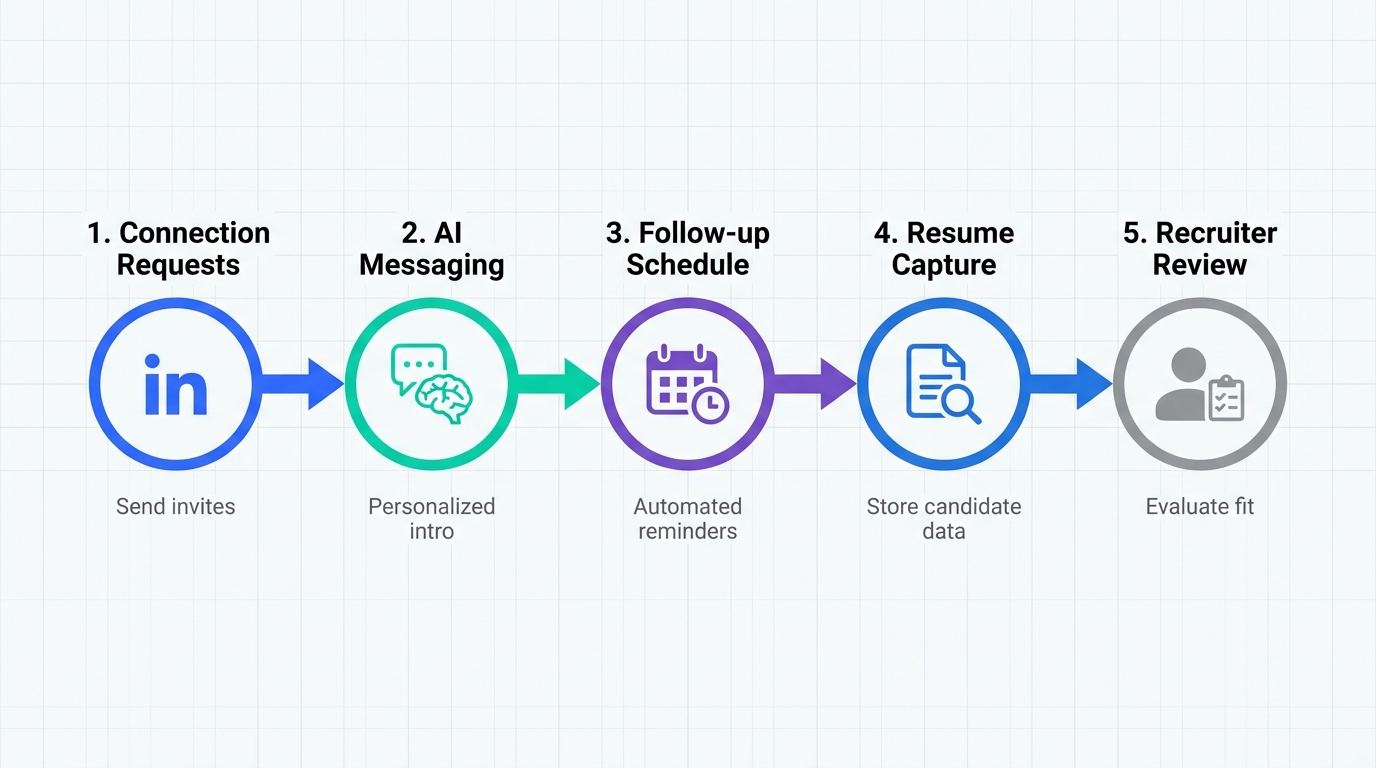
If your bottleneck is LinkedIn outreach and follow up, StrategyBrain AI Recruiter is designed to automate the repetitive parts while keeping recruiters in control of the job context and the final screening decision. It can automatically connect with candidates that match your search criteria, introduce the opportunity, answer common questions about the role and compensation, confirm interview interest, and collect resumes and contact details from interested candidates.
Steps
- Define your search criteria: Provide the targeting inputs you already use for LinkedIn sourcing, including role, location, seniority, and must have requirements.
- Provide job context: Add company details, compensation, benefits, and role specifics so the AI can answer candidate questions consistently.
- Automate first touch and follow up: Let the system connect and message candidates, then keep conversations moving with timely follow ups.
- Capture resumes and contact details: When a candidate expresses interest, the AI requests a resume and contact information and marks them as received when provided.
- Human review and interview: Recruiters review the collected resumes and contact shortlisted candidates for interviews.
Features
- Smart LinkedIn recruitment automation: Connects and runs initial conversations based on recruiter provided criteria.
- 24/7 multilingual candidate communication: Responds around the clock in the candidate’s native language to reduce friction.
- Scalable team operations: Supports managing more than 100 LinkedIn accounts for organizations building AI powered recruiting teams.
- Operational cost efficiency: Product materials state costs can be as low as USD 2.40 per resume and can replace up to 90% of manual LinkedIn recruiting work, depending on workflow and role type.
Limitations
- Not a final fit evaluator: It confirms willingness to proceed, but it does not determine whether a resume fully matches job requirements.
- Requires clear inputs: If compensation, role scope, or must haves are vague, candidate conversations become inconsistent.
- Needs governance: You still need message policies, escalation rules, and review checkpoints.
Best For
- Corporate recruiters who want to reduce manual LinkedIn tasks such as connecting, messaging, and early screening
- Headhunters and agencies that need higher outreach volume without adding staff
- HR leaders scaling international hiring with multilingual communication and time zone coverage
Method 2: AI assisted interview preparation for recruiters and hiring managers
When people search “how to use AI in interview,” they often mean interview preparation, not live interviewing. Used correctly, AI can help you standardize questions and scoring so interviews are more consistent and defensible.
Steps
- Start with a structured rubric: Define 4 to 6 competencies and what “meets the bar” looks like for each.
- Generate question variants: Use AI to propose behavioral and situational questions for each competency, then edit for role relevance.
- Create follow up prompts: Prepare 2 follow up questions per competency to reduce interviewer bias and improve signal quality.
- Standardize note taking: Use a consistent template so interview feedback is comparable across interviewers.
What to watch for in AI HR interview workflows
- Leading questions: AI can accidentally produce questions that steer candidates. Edit for neutrality.
- Inconsistent scoring language: Ensure each score level has observable behaviors, not vague adjectives.
- Privacy: Do not paste sensitive candidate data into tools without clear data handling policies.
Method 3: Candidate communication and follow up at scale
Candidate AI is most visible to candidates in messaging. The goal is not to sound robotic. The goal is to be timely, clear, and consistent, especially when candidates ask about role scope, compensation, and next steps.
Steps
- Define message boundaries: Decide what the AI can answer directly and what must be escalated to a recruiter.
- Use consistent information blocks: Keep role summary, compensation range, benefits, and process steps consistent across messages.
- Set follow up timing rules: For example, follow up after 24 hours and 72 hours if there is no reply, then stop.
- Capture structured data: Confirm interest, availability, and preferred contact method before handing off.
Why StrategyBrain AI Recruiter fits this method
Because it is built for LinkedIn recruiting conversations, it can handle the repetitive back and forth, answer common questions about the role and compensation using recruiter provided inputs, and collect resumes and contact details when candidates opt in to proceed. That keeps the recruiter focused on evaluation and closing rather than chasing replies.
Method 4: Reporting and finance style operating cadence for recruiting teams
High performing teams do not just “do more.” They measure what matters, close the books on time, and deliver information that leaders can act on. Recruiting can borrow that operating model.
Steps
- Assess the status quo: Audit your funnel for timeliness and accuracy. Track response time, follow up completion, and handoff clarity.
- Refine systems: Identify repetitive tasks that can be automated safely, such as outreach, follow up, and information capture.
- Build cross functional relationships: Align with hiring managers on what “qualified” means and what information they need to decide quickly.
- Review weekly: Use a short weekly operating review to spot bottlenecks and adjust messaging, targeting, and interview rubrics.
Copyable checklist: Candidate AI governance
- [ ] Define which steps are automated and which steps are human owned
- [ ] Document message policies for compensation, benefits, and process steps
- [ ] Add escalation rules for sensitive questions and edge cases
- [ ] Confirm data handling policy and retention period for resumes and contact details
- [ ] Review a sample of AI conversations weekly for quality and compliance
- [ ] Keep final screening and hiring decisions with humans
Quick Comparison
| Method | Primary outcome | Best for | Human decision point |
|---|---|---|---|
| LinkedIn outreach automation with StrategyBrain AI Recruiter | Automates connect, intro, Q&A, follow up, resume and contact capture | High volume LinkedIn sourcing and early funnel throughput | Recruiter reviews resumes and decides who interviews |
| AI assisted interview preparation | More consistent questions, rubrics, and follow ups | Teams standardizing AI HR interview processes | Interviewers score and decide based on evidence |
| Candidate communication at scale | Faster responses and cleaner handoffs | Global hiring and time zone coverage | Recruiter handles exceptions and closing |
| Reporting and operating cadence | Better visibility and continuous improvement | Leaders managing recruiting like a business function | Leaders set priorities and approve changes |
FAQ
What is candidate AI in one sentence?
Candidate AI is the use of AI to support recruiting tasks such as outreach, follow up, and early qualification, while keeping final hiring decisions with humans.
How do I use AI in interview preparation without lowering quality?
Use AI to draft structured questions and scoring rubrics, then edit them to match the role and keep scoring anchored to observable behaviors. Do not use AI to make final decisions or to generate opaque candidate scores.
What does an AI HR interview workflow look like end to end?
A practical AI HR interview workflow standardizes competencies, generates consistent question sets, uses a shared note template, and includes a weekly calibration review. AI supports preparation and documentation, while humans conduct interviews and decide.
Can StrategyBrain AI Recruiter replace recruiters?
No. It automates repetitive LinkedIn tasks such as connecting, messaging, follow up, and collecting resumes and contact details, but recruiters still evaluate resumes and run interviews.
Does StrategyBrain AI Recruiter qualify candidates for fit?
It confirms willingness to communicate or interview and captures resumes and contact details from interested candidates. It does not determine whether a resume fully matches job requirements.
How does StrategyBrain AI Recruiter handle multilingual candidate messaging?
It provides 24/7 candidate communication in the candidate’s native language, which helps reduce misunderstandings and keeps conversations moving across time zones.
How is candidate data protected?
Product materials state that candidate information such as resumes, contact details, and conversation history is encrypted, isolated per customer, and not used to train AI models. You should still confirm your own retention and access policies internally.
What is the biggest mistake teams make with candidate AI?
The most common failure is automating decisions instead of automating repetitive work. Start with outreach and follow up, then add structure to interviews, and keep final judgment with humans.
Conclusion
Candidate AI works when it improves speed and consistency in the early funnel and produces information that recruiters and hiring managers can act on. If you want the fastest operational impact, start with LinkedIn outreach automation and disciplined follow up, then standardize your AI HR interview preparation with structured rubrics and consistent questions. Next step: pick one role family, run a 10 business day pilot, and review conversation quality, handoff clarity, and recruiter time saved before scaling.