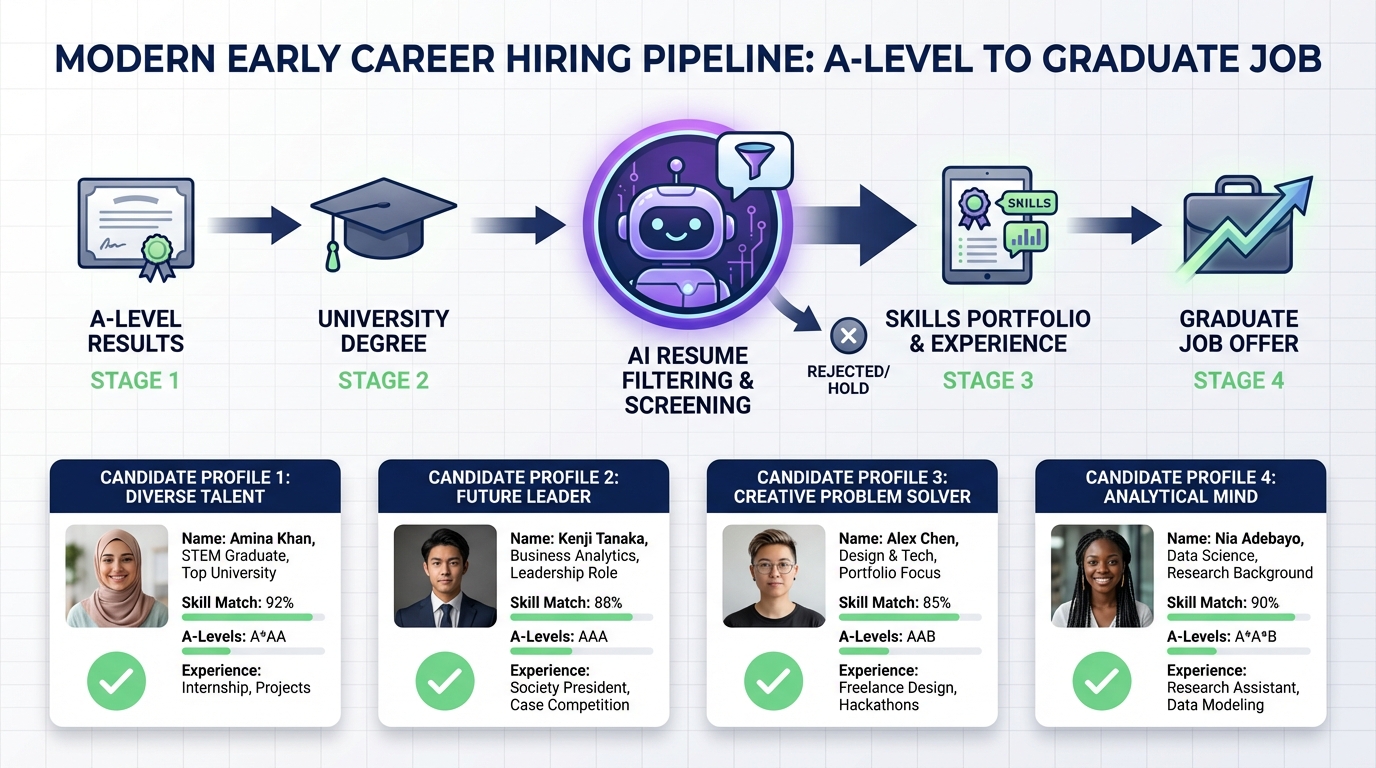
First of all, massive congratulations to everyone who received A level results yesterday. I remember that day vividly myself, mainly the relief of knowing what I would be doing for the next 3 to 4 years. But a couple of decades on, I find myself asking a harder question: does the old pipeline of A level to university to graduate job to comfortable middle class still feel realistic in 2026? And if it does not, what should we tell young people who are making decisions right now, especially as candidate AI and automated candidate screening reshape how early career hiring works?
The pipeline question: what changed and what did not
When I look at early career hiring now, two things can be true at the same time. First, education still matters in many fields. Second, the route is less linear, and the competition is more global and more filtered by software than it used to be.
What has changed most is not ambition or talent. It is the hiring system around you. Many employers use automated candidate screening, which means your CV, application answers, and even your online footprint can be triaged before a human ever speaks to you. That is where candidate AI becomes relevant, because it is not only used by candidates. It is also used by recruiters and hiring teams to manage volume.
What has not changed is that people still hire people. The final decision is still made by humans who want evidence you can do the work, learn quickly, and communicate clearly.
Recruiter advice for results day decisions
If you are deciding between university, an apprenticeship, a gap year, or going straight into work, I would frame it like this: choose the option that gives you the fastest path to credible proof of skills, plus a network that can vouch for you.
Three questions I would ask before choosing a path
- What will I be able to show in 12 months? A portfolio, a project, a certification, a placement, or measurable outcomes.
- Who will know my name? Tutors, managers, mentors, clients, or community leaders who can provide references.
- What doors does this keep open? The best early decisions are reversible, or at least adaptable.
This is also where I would encourage you to learn how modern hiring works. Not to game it, but to understand it. Candidate AI is part of that reality now.
What candidate AI means for graduates and school leavers
Candidate AI, in plain terms, is the use of artificial intelligence to support candidate side tasks such as CV drafting, interview practice, and job search organization. On the employer side, AI is often used for high volume workflows such as outreach, scheduling, and early stage conversations.
In practice, this creates a new baseline. More candidates can apply to more roles faster, which increases competition. At the same time, recruiters can contact more people and manage more conversations, which changes how quickly you might hear back.
What I have seen work well for early career candidates
- Clarity beats cleverness: simple CV structure, specific achievements, and consistent dates reduce screening friction.
- Proof of work beats potential: a small project you can explain is often more persuasive than a generic statement of interest.
- Communication beats perfection: timely replies and thoughtful questions stand out in AI assisted pipelines.
Scope boundary: what this article covers and what it does not
- Covered: practical advice for A level students, how AI shows up in hiring, and how to use AI in interview prep responsibly.
- Not covered: legal advice, country specific employment law, or a guarantee of outcomes for any individual candidate.
How to use AI in interview prep without sounding robotic
If you are asking “how to use AI in interview” prep, the best approach is to use AI as a coach, not as a scriptwriter. Interviewers can usually tell when an answer is memorized or generic. The goal is to become clearer, not more artificial.
A practical 5 step interview prep workflow
- Write your raw story first: in your own words, describe a time you solved a problem, helped a team, or learned something difficult.
- Ask AI to turn it into a structure: for example STAR, which stands for Situation, Task, Action, Result.
- Stress test with follow ups: ask for 10 follow up questions a recruiter might ask, then answer them out loud.
- Make it specific: add numbers with units where you can, such as hours saved per week, number of customers helped, or exam improvement points.
- Rehearse for clarity: record yourself once, then remove filler words and tighten the story to 60 to 90 seconds.
What to avoid
- Do not paste AI generated answers verbatim: it often sounds polished but empty.
- Do not invent achievements: automated candidate screening and reference checks can surface inconsistencies.
- Do not over optimize keywords: humans still read the final shortlist, and authenticity matters.
Where StrategyBrain AI Recruiter fits in the real workflow
To make this concrete, here is what I see on the recruiter side. A lot of time is spent on repetitive LinkedIn tasks: connecting, introducing a role, answering basic questions, confirming interest, and collecting a CV and contact details. This is exactly the kind of work that AI can handle consistently.
StrategyBrain AI Recruiter is designed for that early stage workflow on LinkedIn. It automatically connects with candidates that match a recruiter’s search criteria, introduces the opportunity, answers questions about the role, company, and compensation, and confirms interview interest. When a candidate wants to proceed, it collects résumés and contact information so the recruiter can focus on actual evaluation rather than chasing replies.
Two details matter for trust. First, StrategyBrain AI Recruiter does not claim to decide whether a résumé fully matches job requirements. It identifies willingness to communicate or interview, then hands off to the recruiter for final qualification. Second, the product documentation states that customer provided data is not used to train AI models, and that credentials and candidate data are encrypted and isolated per customer.
From a candidate perspective, this means you may increasingly have your first “conversation” with an AI assisted recruiter workflow. The winning move is not to fear it. It is to respond clearly, ask sensible questions, and provide the requested information promptly when you are genuinely interested.
A simple 12 month plan you can copy
If you are unsure what to do next, I would rather you follow a simple plan than freeze. Here is a 12 month structure that works whether you choose university, an apprenticeship, or work.
Months 1 to 3: build a base
- Pick one skill track: for example sales, software, design, data, operations, or healthcare support.
- Create one proof asset: a portfolio page, a GitHub project, a case study, or a documented volunteering outcome.
- Set up your LinkedIn profile: clear headline, clear interests, and a short summary of what you are learning.
Months 4 to 8: get real experience
- Apply to 2 roles per week: internships, part time roles, or entry level positions that match your track.
- Do one project per month: small and finished beats big and abandoned.
- Practice interviews weekly: use candidate AI tools to generate questions, then answer in your own voice.
Months 9 to 12: turn experience into offers
- Refine your CV for screening: consistent formatting, measurable outcomes, and role relevant keywords used naturally.
- Ask for references: do it while your work is fresh in someone’s mind.
- Follow up professionally: if you are in an AI assisted outreach flow, timely replies can be the difference.
Common mistakes I see early career candidates make
- Assuming one decision defines your whole life: most careers are built through iteration, not one perfect choice.
- Sending generic applications at scale: automated candidate screening rewards clarity and relevance, not volume alone.
- Ignoring communication speed: in fast moving pipelines, a 72 hour delay can mean the shortlist is already full.
- Over relying on AI text: candidate AI should sharpen your thinking, not replace it.
FAQ
Is candidate AI only for writing CVs?
No. Candidate AI can help with interview practice, job search organization, and turning your real experiences into clearer examples. The best use is coaching and structure, not copying text.
What is automated candidate screening?
Automated candidate screening is when software helps recruiters triage applications or conversations at scale. It can include parsing CVs, checking required criteria, and prioritizing candidates for human review.
How do I use AI in interview prep without sounding fake?
Start with your own story, then use AI to structure it and generate follow up questions. Rehearse out loud and keep details specific to your real experience.
Will recruiters reject me if they think I used AI?
Most recruiters care more about honesty and clarity than the tool you used. Problems usually arise when candidates submit generic answers or exaggerate achievements.
Why does LinkedIn outreach feel more automated now?
Recruiters often manage high volumes of outreach and messages. Tools such as StrategyBrain AI Recruiter automate early conversations like introductions, Q and A, and collecting résumés so recruiters can focus on evaluation.
Does StrategyBrain AI Recruiter decide if I am qualified?
Based on the product documentation, it identifies willingness to communicate or interview and collects information such as résumés and contact details. Final qualification against job requirements is completed by the recruiter.
What should I do if an AI assisted recruiter asks for my CV and contact details?
If you are interested in the role, respond clearly and provide the requested information through the channel they specify. If you are not interested, decline politely so you do not waste your time or theirs.
Is my data safe in AI recruiting tools?
It depends on the vendor. StrategyBrain AI Recruiter states that candidate data is encrypted, isolated per customer, and not used to train AI models. You should still ask employers how your data is stored and processed.
Conclusion
Results day can feel like a finish line, but it is really a starting point. My advice is to choose the next step that helps you build proof of skills and a network in the next 12 months, then learn how modern hiring works so you can navigate it confidently. Candidate AI and automated candidate screening are now part of the system, and the best candidates use AI to become clearer, not to become someone else.
If you are a recruiter reading this, the same principle applies on your side. Automate the repetitive work so you can spend more time on real assessment. StrategyBrain AI Recruiter is built for that early LinkedIn workflow: connecting, introducing roles, answering questions, confirming interest, and collecting résumés and contact details so humans can do the hiring decisions.