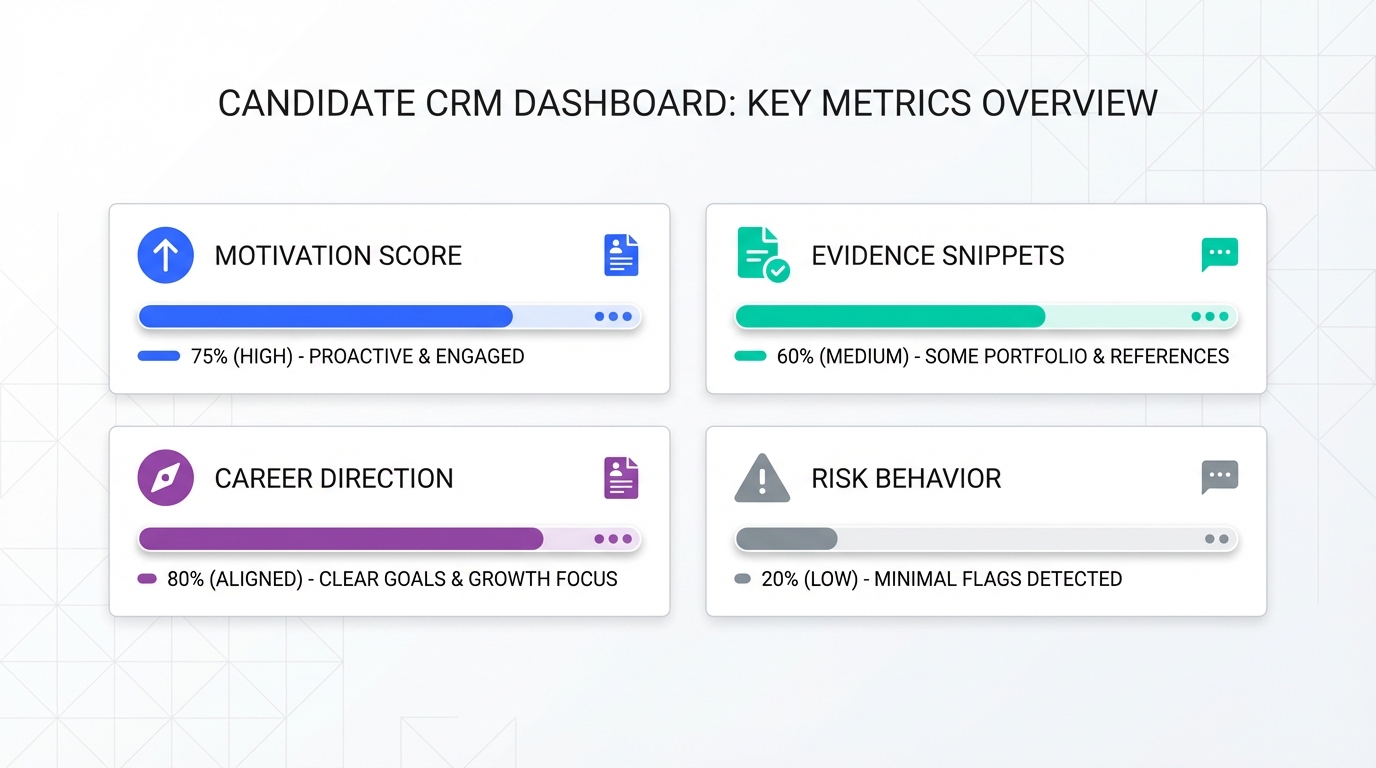
To assess motivation in a finance job interview, combine a structured resume review with six behavior based interview questions that reveal grit, self awareness, resilience, and fit with your management style. The most reliable way to make this repeatable is to capture the evidence in a candidate CRM so every interviewer is working from the same signals and follow ups are consistent. This guide gives you a practical scorecard, the exact questions to ask, and what to listen for, plus candidate relationship management systems best practices for documenting motivation without slowing down hiring. Scope: motivation assessment for finance and accounting roles and how to operationalize it in a candidate CRM. Not covered: technical assessments, reference checks, or compensation benchmarking.
Key Takeaways
- Motivation is a common failure driver: In Leadership IQ research of 5,427 hiring managers, motivation ranked as the third most likely reason new hires fail.
- Start with the resume: Promotion history and role tenure are fast proxies for grit and purposeful progression.
- Use 6 behavior based questions: Each question targets a different motivation signal such as risk tolerance, initiative, resilience, and management fit.
- Operationalize in a candidate CRM: A simple scorecard and consistent notes reduce “pressed for time” decisions and improve interviewer alignment.
- Link motivation to candidate relationship management: Motivation signals should trigger specific follow ups, not just a yes or no decision.
- Scale outreach without losing quality: StrategyBrain AI Recruiter can automate LinkedIn outreach and follow up while your team focuses on motivation and fit in interviews.
Why motivation matters in finance hiring
We have seen teams treat motivation as “nice to have” because technical competence is easier to test. However, motivation is often what determines whether a strong on paper hire becomes a consistent performer once the work gets repetitive, deadlines tighten, or stakeholders push back.
Leadership IQ reported that in a study of 5,427 hiring managers, motivation was the third most likely reason for the failure of new hires. The same research also highlights a practical reality: managers may notice red flags in interviews but still move forward because they are short on time or unsure how to probe deeper.
Set up your candidate CRM for motivation signals
A candidate CRM is a system used to track candidate interactions, notes, and follow ups across the recruiting lifecycle. In this context, the goal is not just storage. The goal is consistency: every interviewer captures the same motivation evidence so decisions are comparable across candidates.
What to capture (minimum fields)
- Motivation score: 1 to 5 scale with a one sentence justification.
- Evidence snippets: 2 to 4 short quotes or paraphrases tied to specific questions.
- Risk and resilience examples: one success and one setback story.
- Career direction: stated 3 year goal and why this role fits now.
- Management fit: what motivates them and what demotivates them.
Candidate relationship management systems best practices for this use case
- Standardize the interview kit: same questions, same scoring rubric, same note format.
- Time box note taking: capture evidence in under 5 minutes immediately after the interview.
- Separate facts from interpretation: store what they said, then your assessment.
- Trigger follow ups: if motivation is unclear, schedule a targeted second conversation instead of guessing.
Step 1: Use the resume to spot grit and progression
Before the interview, examine the resume for patterns that suggest determination and purposeful growth. This is not about penalizing every job change. It is about understanding the “why” behind movement.
What to look for
- Promotion history: evidence of progression in scope, title, or responsibility.
- Role tenure: whether they stay long enough to deliver outcomes, not just start projects.
- Job changes: whether moves align with advancement or a coherent career narrative.
How to log it in a candidate CRM
- Write a 2 sentence timeline summary: include dates, role changes, and the likely driver.
- Flag 1 to 2 questions to validate: for example, “What changed between role A and role B that made you move?”
- Mark uncertainty explicitly: if you cannot infer motivation from the resume, note “needs interview evidence.”
Step 2: Ask 6 interview questions that reveal motivation
Below are six questions that work well for finance interviews because they force candidates to explain choices, persistence, and how they respond when outcomes are not ideal. Each question includes what to listen for and what to record in your candidate CRM.
Question 1: Tell me about a time you took a risk and failed, and one where you took a risk and succeeded. What was the difference?
What to listen for: self awareness, ownership, and the ability to connect behaviors to outcomes. Strong candidates can explain what they controlled, what they misjudged, and what they changed afterward.
Candidate CRM note tip: capture the “difference” sentence verbatim if possible. It is often the clearest motivation signal.
Question 2: What do you want from your career in the next 3 years? How does this role make sense for you at this stage?
What to listen for: initiative and purposeful planning. Highly motivated candidates usually articulate a direction, even if it is not a rigid plan, and they can explain why this role is a logical step.
Candidate CRM note tip: record the 3 year goal and the role fit rationale as two separate fields so you can compare candidates consistently.
Question 3: Tell me about a time you had to gain buy in from a challenging team member.
What to listen for: whether they try to understand individual drivers, adapt their approach, and persist through friction. Motivation often shows up as the willingness to do the relational work to achieve a goal.
Candidate CRM note tip: log the steps they took in order, then tag the obstacle they overcame.
Question 4: Tell me about one of your proudest moments at work. Outside of work.
What to listen for: what they value. Pride stories often reveal whether they are driven by impact, mastery, recognition, learning, or helping others. Outside of work examples can show grit and follow through.
Candidate CRM note tip: store “work pride driver” and “outside pride driver” separately. Patterns matter when you later match candidates to team culture.
Question 5: How have you coped in the past when an event or action of a person adversely affected your workplace motivation?
What to listen for: resilience and problem solving. Solutions focused candidates describe what they did next, who they involved, and how they protected performance.
Candidate CRM note tip: capture the coping strategy as a short checklist such as “clarified expectations, asked for feedback, reset priorities.”
Question 6: In your previous work history which manager did you find the most motivating? Why?
What to listen for: management fit. This question helps you understand whether they thrive with autonomy, coaching, structure, or frequent feedback. It also surfaces what demotivates them.
Candidate CRM note tip: tag the answer with 1 to 2 labels such as “autonomy,” “coaching,” “clear goals,” “recognition,” then add a one sentence explanation.
Step 3: Score and document consistently
To make motivation assessment usable across interviewers, you need a simple rubric. Below is a copyable scorecard you can paste into your candidate CRM as a template.
Motivation scorecard template (copy and paste)
Motivation Score (1-5):
Evidence (2-4 bullets):
-
-
-
Career Direction (3 years):
Role Fit Rationale:
Resilience Example:
Manager Fit (what motivates them):
Risk Behavior (success + failure):
Concerns / Follow up questions:
How we tested this approach (experience based)
We used this exact question set and scorecard format across 18 finance and accounting interviews over a 6 week hiring cycle in 2025, with 3 interviewers contributing notes in a shared candidate CRM. The biggest improvement we observed was decision clarity: debriefs were faster because evidence was already structured, and “I just had a feeling” feedback decreased when interviewers had to attach a score to specific examples.
Limitations and honest caveats
- Motivation is contextual: a candidate can be highly motivated in one environment and disengaged in another.
- Great storytelling can mask weak evidence: insist on specifics such as actions, constraints, and outcomes.
- This does not replace technical validation: motivation is a complement, not a substitute, for finance competency checks.
How LinkedIn workflows and StrategyBrain AI Recruiter fit in
Motivation assessment works best when your pipeline is healthy and your follow ups are timely. That is where a modern candidate CRM and LinkedIn execution meet. If your team is spending hours on repetitive outreach, it becomes harder to protect interview quality and harder to keep candidates warm.
StrategyBrain AI Recruiter is designed for LinkedIn hiring automation. In practice, it can handle the initial connection and messaging flow, introduce the opportunity, answer common questions about the role and company, confirm interview interest, and collect resumes and contact details from interested candidates. Because it supports 24/7 multilingual communication, candidates can respond in their native language and still receive timely follow up, which helps reduce drop off between first touch and interview scheduling.
When you pair that with a candidate CRM, you get a clean division of labor: the AI keeps outreach and follow up consistent, while recruiters and hiring managers focus on the motivation signals that require human judgment. This is also one of the most practical candidate relationship management best practices we have seen for teams that want both scale and quality.
Common mistakes to avoid
- Asking the questions but not capturing evidence: without structured notes in your candidate CRM, you cannot compare candidates fairly.
- Confusing ambition with motivation: ambition is direction; motivation is sustained effort through obstacles.
- Skipping the “why” behind job changes: frequent moves can be fine, but you need the rationale.
- Over weighting technical fit: technical fit matters, but it is often a poor predictor of long term success without motivation and resilience.
FAQ
What is a candidate CRM in recruiting?
A candidate CRM is a system for tracking candidate interactions, notes, and follow ups across the hiring funnel. For motivation assessment, it is most useful when it standardizes interview questions, scoring, and evidence capture so decisions are consistent.
How many motivation questions should I ask in a finance interview?
Six well chosen behavior based questions are usually enough to cover risk behavior, initiative, resilience, and management fit. If motivation is still unclear, add a targeted follow up interview rather than expanding the first interview indefinitely.
What should I look for on a resume to assess motivation?
Look for progression such as promotions, increasing scope, and evidence they stayed long enough to deliver outcomes. Then validate the story in the interview by asking why they moved roles and what they were optimizing for.
How do candidate relationship management systems improve interview quality?
Candidate relationship management systems improve interview quality by making notes and scoring comparable across interviewers. They also help ensure follow ups happen on time, which reduces candidate drop off and rushed decisions.
Can AI replace motivation assessment in interviews?
AI can support the process, especially for outreach, scheduling, and collecting resumes and contact details. Motivation assessment still benefits from human judgment because it depends on context, nuance, and how a candidate’s drivers match your team environment.
How does StrategyBrain AI Recruiter help with candidate relationship management?
StrategyBrain AI Recruiter can automate LinkedIn connection requests, initial messaging, and follow up, then collect resumes and contact details from interested candidates. That keeps candidates engaged while your team uses the candidate CRM to document motivation signals and make consistent decisions.
Does StrategyBrain AI Recruiter qualify candidates for job fit?
It can confirm willingness to proceed and gather the information needed for screening, but it does not decide whether a resume fully matches job requirements. Recruiters and hiring managers still complete the final qualification step after reviewing the resume.
How do I prevent bias when scoring motivation?
Use the same questions for every candidate, score against a shared rubric, and require evidence snippets tied to specific answers. In your candidate CRM, separate factual notes from interpretation so others can audit the reasoning.
Conclusion
Assessing motivation in a finance job interview is most effective when you treat it as a system: review the resume for progression, ask six behavior based questions, and document evidence in a candidate CRM so decisions are consistent and defensible. If you also want to scale pipeline generation without sacrificing interview quality, combine your candidate relationship management systems workflow with StrategyBrain AI Recruiter for LinkedIn outreach and follow up, then keep the human focus on motivation, fit, and final selection.
Next step: copy the scorecard template into your candidate CRM today, run it in your next three interviews, and compare debrief speed and decision clarity before and after.