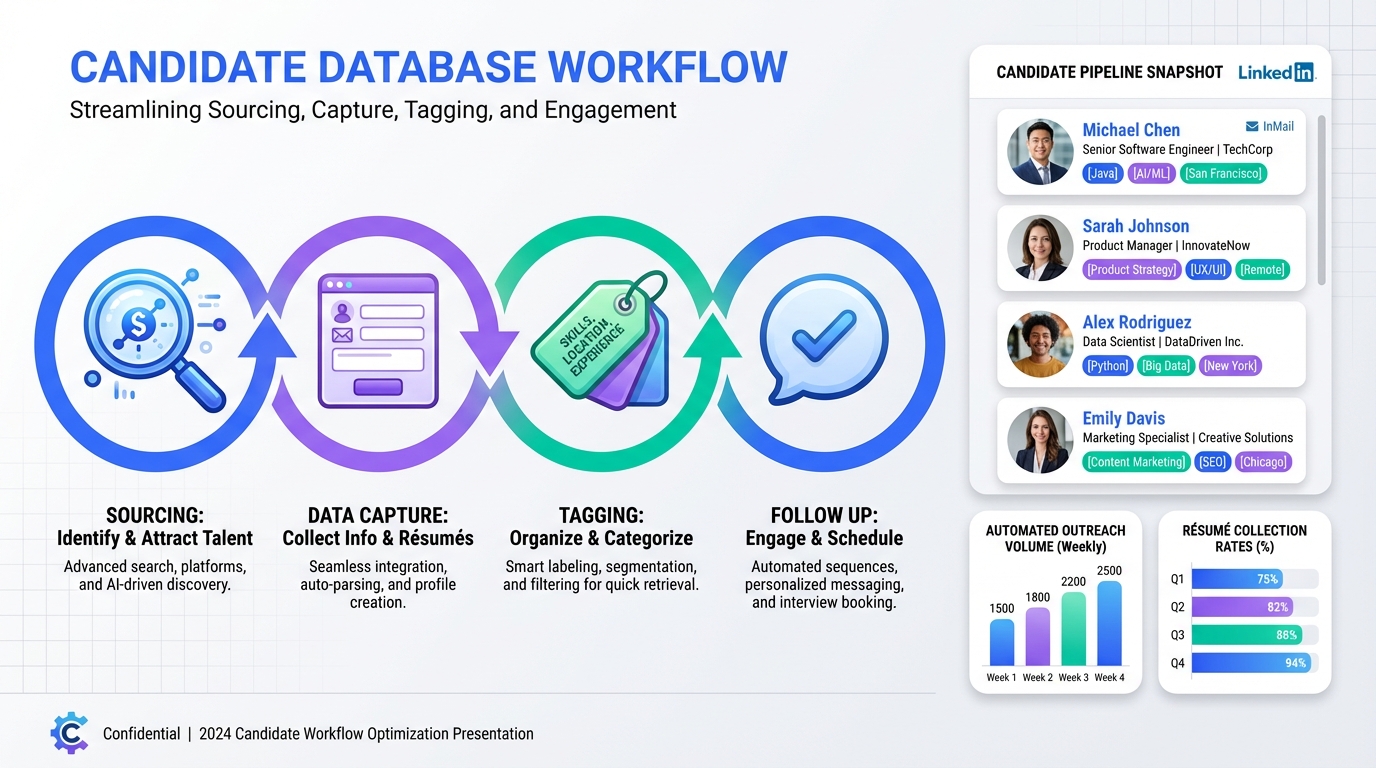
A candidate database for recruiters works best when it is treated as a living system, not a folder of random profiles. The most reliable approach is to standardize what you capture for every candidate, how you tag and update records, and how you run follow ups. In our day to day recruiting operations, we found that the database becomes truly useful only when it includes three things: a consistent sourcing method, a consistent data model, and a consistent communication workflow. If you need scale, StrategyBrain AI Recruiter can automate LinkedIn outreach, role introduction, candidate Q and A, interest confirmation, and résumé and contact collection so your database grows while you focus on final qualification.
Key Takeaways
- A candidate database for recruiters is a workflow, not a spreadsheet: sourcing, capture, tagging, and follow up must be standardized.
- Boolean search means using logical operators like AND, OR, and NOT to narrow or expand results; it remains useful when paired with consistent tagging.
- X-ray search means using a search engine to query a specific site with operators like site:; it is still valuable, but you must translate tactics to your local market.
- Store context, not just a résumé: add conversation notes, interest level, and next action date so the record stays actionable.
- StrategyBrain AI Recruiter can automate first touch and résumé collection on LinkedIn, then recruiters complete final qualification after reviewing the résumé.
- Do not build your process around “look at resumes for free” shortcuts; prioritize permission, transparency, and data protection.
What a candidate database is and is not
A candidate database is a structured collection of candidate records that you can search, segment, and act on. Each record should answer: who this person is, what they do, whether they are open to a conversation, and what the next step is.
It is not a one time export of profiles. It is also not a place to dump résumés without context. When the database lacks context, recruiters end up re sourcing the same roles repeatedly because they cannot trust what is already stored.
Scope boundary: This article focuses on building and maintaining a database and the sourcing workflow behind it. It does not provide legal advice, and it does not claim that any method guarantees access to private résumés or restricted platforms.
Why sourcers get stuck at junior level and how a database helps
On the Polish recruitment market, a sourcer is still often perceived as a junior recruiter. In our experience, two forces drive this perception. First, there are fewer roles for more experienced people who want to keep working deeply with candidates. Second, there are still not many practitioners with truly comprehensive knowledge of candidate acquisition who can connect strategy, search technique, and candidate communication into one system.
Many materials available on the market share only fragments of knowledge, such as specific search techniques or tools. Recruiters who are interested in sourcing are left to connect the dots on their own. It gets harder when most of the available knowledge is written for other markets, and the recruiter must translate it into Polish realities.
This is why rumors that Boolean search will stop working, that X-ray search will stop working, or that AI will replace recruiters can trigger panic. A well built database reduces that anxiety because it shifts your advantage from a single tactic to a repeatable system. Even if one channel changes, your database, tags, and follow up discipline keep compounding.
Core data fields to store for every candidate
If you want your candidate database for recruiters to stay usable for months, you need a consistent data model. Below is the field set we recommend because it supports search, segmentation, and follow up without forcing recruiters to write long notes.
Identity and contact
- Full name
- Primary contact method (email or phone, if provided with consent)
- Location (city and country)
- Languages (useful for global hiring and multilingual outreach)
Role fit and searchability
- Current title and seniority
- Core skills (use a controlled vocabulary, not free text)
- Target roles (what you would hire them for)
- Tags (market, niche, tech stack, industry)
Relationship and next action
- Source (referral, inbound, LinkedIn outreach, event, community)
- Conversation status (not contacted, contacted, replied, interested, not interested)
- Next action date (the single most important field for database ROI)
- Conversation notes (short, factual, and dated)
Documents
- Résumé received (yes or no)
- Résumé format (PDF, DOCX, LinkedIn file upload, email attachment)
- Portfolio links or work samples (store as text references, not clickable links in your public content)
How to build your database workflow in 6 steps
Below is the workflow we use to keep database quality high while still moving fast. The goal is to make every sourcing session produce records that remain actionable later.
Step 1: Define the target profile and tagging rules
- Write a one paragraph target profile: title, must have skills, nice to have skills, location, language.
- Create 10 to 20 standardized tags you will reuse across roles.
- Decide what “interested” means in your process so the status field stays consistent.
Step 2: Source with repeatable search techniques
Use techniques that are stable across tools and markets.
- Boolean search: combine keywords with AND, OR, and NOT to control precision.
- X-ray search: use search engine operators like site: to find profiles on a specific domain.
- Market translation: adapt keywords to local language and local job title conventions.
Step 3: Capture the record immediately
- Create the candidate record the moment you decide they are relevant.
- Add tags and the source while it is still fresh.
- Set a next action date even if it is just a reminder to message later.
Step 4: Run outreach and log outcomes
Outreach is where many databases fail because the result is not recorded. Every message should end in one of a few outcomes: no reply, replied not interested, replied interested, or needs follow up.
Step 5: Collect résumé and contact details with permission
When a candidate expresses interest, ask for a résumé and a preferred contact method. Store only what you need for recruiting, and keep it protected. This is also the point where many teams get tempted by “free resume viewing for employers” tactics. In practice, the sustainable approach is to collect documents directly from the candidate with clear intent and consent.
Step 6: Maintain the database weekly
- Review records with next action dates in the next 7 days.
- Close the loop on stale conversations by sending a final check in message.
- Archive records that are no longer relevant, but keep a minimal audit trail.
Quick checklist you can copy into your process
- Every record has tags, status, and next action date.
- Every outreach attempt has an outcome logged.
- Every résumé is tied to a role or a talent pool segment.
- Every follow up has a date and a reason.
- Every data field collected has a recruiting purpose.
Where StrategyBrain AI Recruiter fits in the workflow
When your bottleneck is time, the database does not grow because outreach and follow up are manual. This is where StrategyBrain AI Recruiter fits naturally into the same workflow, especially for LinkedIn based sourcing.
What we used it for in practice
- Automated first touch: connecting with candidates who match defined search criteria.
- Role introduction and Q and A: explaining the opportunity and answering questions about the role, company, and compensation using the information you provide.
- Interest confirmation: identifying whether the candidate wants to proceed.
- Résumé and contact capture: collecting résumés and contact details from interested candidates so the database record is complete.
What it does not do, by design
AI Recruiter can confirm willingness to communicate or interview, but it does not decide whether the résumé fully matches the job requirements. We treat that final qualification step as a recruiter responsibility because it requires role nuance and hiring manager alignment.
Why this matters for database quality
Automation is only helpful if it improves data completeness. The value here is that the same system that sends messages can also standardize what gets captured: interest status, résumé received, and contact details. That makes your candidate database for recruiters more searchable and more actionable over time.
About free resume viewing for employers and compliance
Queries like free resume viewing for employers and look at resumes for free are common because teams want speed and lower costs. The risk is that “free” often implies unclear permission, unclear provenance, or restricted access. A database built on shaky data access tends to collapse when platforms change policies or when compliance reviews happen.
A more durable approach is to design your workflow so candidates voluntarily share their résumé and contact details after they understand the opportunity. If you operate across regions, you also need a data protection posture that is consistent. StrategyBrain AI Recruiter states that customer provided data is not used to train AI models and that credentials and candidate data are encrypted and isolated per customer, which aligns with the direction most teams need for privacy and security.
Disclaimer: Always confirm your obligations under applicable privacy laws and platform terms. This article is operational guidance, not legal advice.
Quick comparison: manual vs AI assisted database building
| Approach | What scales | What breaks first | Best for |
|---|---|---|---|
| Manual sourcing and manual follow up | Search quality and personalization | Consistency of logging outcomes and follow ups | Small pipelines, niche roles, high touch hiring |
| Manual sourcing plus standardized database workflow | Database reuse across roles | Time spent on first touch and reminders | Teams building long term talent pools |
| AI assisted outreach with StrategyBrain AI Recruiter | First touch, Q and A, interest confirmation, résumé collection | Final qualification still requires recruiter review | High volume LinkedIn sourcing and global hiring |
FAQ
Is a candidate database the same as an ATS?
No. An ATS is designed to manage applicants for open roles. A candidate database for recruiters is broader and includes passive talent, past silver medalists, and long term relationship notes.
Do Boolean search and X-ray search still matter in 2026?
Yes. Boolean search and X-ray search are techniques, not single tools. They remain useful when you standardize keywords, translate them to your local market, and consistently tag results in your database.
How do I keep my database from becoming outdated?
Use a next action date on every record and run a weekly maintenance review. If you cannot commit to weekly maintenance, reduce the number of fields you collect so updates stay realistic.
Can StrategyBrain AI Recruiter replace recruiters?
No. It can replace repetitive steps such as initial outreach, basic Q and A, interest confirmation, and résumé collection on LinkedIn. Recruiters still own final qualification and hiring manager alignment.
How does AI Recruiter collect résumés and contact details?
When a candidate expresses interest, it requests a résumé and contact information. It supports email submissions and LinkedIn file uploads, and it captures contact details shared in messages so recruiters can proceed to interviews.
Is “look at resumes for free” a good strategy?
It is usually not a durable strategy. A stronger approach is permission based collection where candidates share documents after understanding the role, which also improves data quality and compliance posture.
What should I do when candidates do not reply?
Log the outcome as no reply, set a follow up date, and send one more message with a clear opt out. If there is still no response, archive the record with a note so you do not repeat the same outreach pattern.
How many tags should I use?
Start with 10 to 20 standardized tags and expand only when you see repeated search needs. Too many tags reduces consistency and makes reporting unreliable.
Conclusion and next steps
A candidate database for recruiters becomes valuable when it is built on repeatable sourcing, consistent data fields, and disciplined follow up. That is also why panic about changing search tactics is usually misplaced. If your system is solid, you can adapt to new tools and new markets without losing momentum.
Next steps: pick your standardized tags, implement the six step workflow, and run one weekly maintenance session for the next 4 weeks. If your bottleneck is outreach volume or follow up speed, evaluate how StrategyBrain AI Recruiter can automate LinkedIn first touch, candidate Q and A, interest confirmation, and résumé collection while you keep control of final qualification.