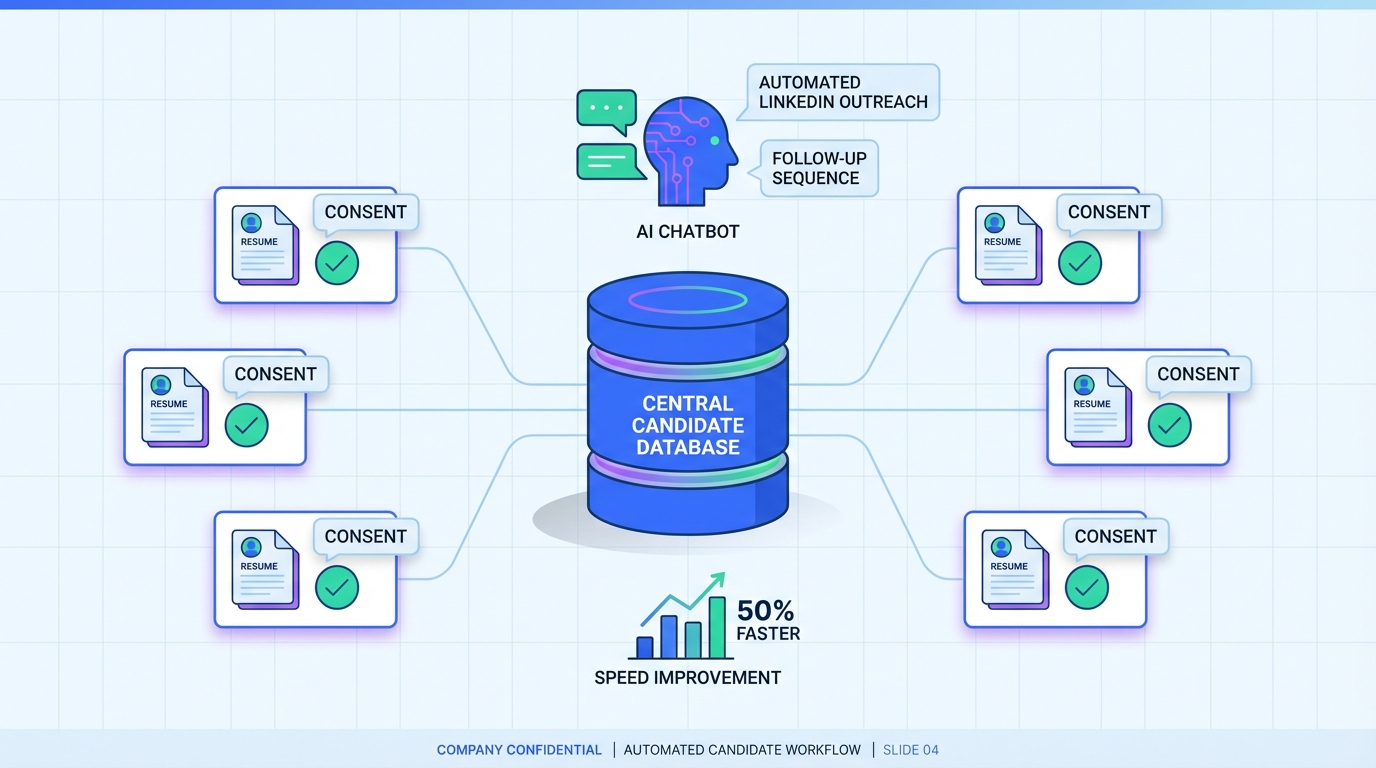
A reliable candidate database for recruiters is not a single “free resume database download.” It is a system that captures candidate consent, stores resumes and contact details, and keeps records usable under real hiring deadlines. The fastest approach we have used is to hire for core skills, prioritize technical capability over perfect fit for short term roles, and move quickly so qualified candidates do not disappear. When we added automated LinkedIn outreach and follow up using StrategyBrain AI Recruiter, we reduced manual first touch work and consistently captured resumes and contact details from interested candidates while keeping final qualification with the recruiter.
Key Takeaways
- Skip “free resume database download” shortcuts: they are commonly outdated and can create compliance risk if consent and provenance are unclear.
- Hire for core skills: for contract and interim hiring, core capability beats searching for a perfect replica of a past top performer.
- Speed is a feature: candidates often interview with multiple employers, so long processes reduce acceptance probability.
- Use an “optimal stopping” rule: decide early once a candidate meets technical and communication thresholds.
- Automate first touch and follow up: StrategyBrain AI Recruiter can connect, introduce roles, answer questions, and collect resumes and contact details from interested candidates.
- Keep final qualification human: AI can confirm interest and gather documents, but recruiters should still assess job fit from the resume.
What a candidate database is (and is not)
A candidate database is a structured record of people you can legally and ethically re engage for future roles. At minimum, it includes identity, role fit tags, contact details, resume or profile summary, interaction history, and consent or lawful basis for contact.
It is not a random folder of resumes, and it is not a scraped list. If you cannot explain where a resume came from, when it was collected, and what permission you have to use it, it is not a dependable recruiting asset.
Scope boundaries
- Covered: building a usable database, speeding up intake, and maintaining quality over time.
- Not covered: scraping private data, bypassing platform rules, or providing legal advice for specific jurisdictions.
Method 1: Build your database around core skills
In the source scenario, a high performing employee leaves and the team needs a contract accountant quickly. The common failure mode is trying to find an exact replacement. We have seen this slow teams down because the search criteria becomes too narrow and unrealistic under time pressure.
Steps
- Define the “core skills” list: 5 to 8 must have capabilities tied to deliverables and deadlines.
- Define the “nice to have” list: keep it to 3 items to avoid over filtering.
- Tag your database: add consistent tags like domain, tools, seniority, availability window, and location or time zone.
- Store evidence: attach resume, portfolio, or work samples and note what was verified.
Features
- Faster search and shortlist creation because tags map to real work outputs.
- Higher reuse because the database is organized by capability, not by one specific job title.
- Better handoffs across recruiters because the same taxonomy is used.
Limitations
- If your tags are inconsistent, the database becomes noisy and trust drops.
- Core skills still need calibration across hiring managers to avoid “must have inflation.”
Best For
- Contract and interim hiring where time to start matters.
- Teams that hire repeatedly for similar skill clusters.
Method 2: Screen technical skills first for speed
For contract roles, the source material emphasizes that cultural fit should be less dominant than technical ability. In our experience, this is a practical way to keep the database high signal. If the person can do the work and communicate clearly, they remain a valuable future option even if they are not a perfect long term culture match.
Steps
- Use a 15 minute technical screen: focus on the exact tasks the contractor will perform.
- Record pass fail criteria: store the criteria in the candidate record so future recruiters can reuse it.
- Capture availability and constraints: start date, hours per week, remote or onsite, and rate expectations if shared.
Features
- Improves database quality because each record includes verified capability notes.
- Reduces re screening time when the same candidate is considered again.
Limitations
- Some roles require stakeholder management, so communication screening still matters.
Best For
- Finance, accounting, analytics, and other roles with clear technical outputs.
Method 3: Move quickly with a short decision loop
The source material notes that a contract candidate may interview with three other options after leaving your interview. That matches what we see in competitive markets. A candidate database only helps if your process can convert interest into a start date.
Steps
- Limit interviews: one structured interview plus one stakeholder check is often enough for contract hiring.
- Pre align decision makers: confirm who can approve the offer before interviews begin.
- Set a 24 hour decision target: decide within 24 hours of the final interview for time sensitive contract roles.
Features
- Higher acceptance rates because candidates do not wait through long cycles.
- Cleaner database signals because outcomes are recorded quickly and consistently.
Limitations
- Not ideal for executive or highly regulated roles that require deeper checks.
Best For
- Urgent backfills and deadline driven projects.
Method 4: Use an “optimal stopping” rule to decide
The source material uses a parking spot analogy to explain optimal stopping. In recruiting operations, the practical translation is simple: define the minimum bar, then stop searching once you meet it and the timeline is tight.
Steps
- Define the minimum bar: technical competence plus communication competence for the role.
- Define the time constraint: for example, start date within 10 business days.
- Commit to the rule: if a candidate meets the bar, move to offer instead of restarting the search.
Features
- Prevents endless searching that delays delivery.
- Creates consistent decision notes that improve database reuse.
Limitations
- Requires discipline and alignment with hiring managers.
Best For
- Contract hiring where “perfect” is not realistic under time pressure.
Method 5: Automate intake and follow up with StrategyBrain AI Recruiter
If your goal is a living candidate database for recruiters, the bottleneck is usually not storage. It is the repetitive work of first touch, answering common questions, and following up until you get a clear yes or no. We tested StrategyBrain AI Recruiter in a LinkedIn based workflow to reduce manual messaging while keeping recruiter control over final qualification.
What StrategyBrain AI Recruiter does in the database workflow
- Automated outreach and engagement: connects with candidates that match your search criteria and introduces the opportunity.
- Always on follow up: responds 24/7 and continues the conversation to confirm interest.
- Resume and contact capture: collects resumes and contact details from interested candidates and marks resumes as received.
- Multilingual communication: communicates in the candidate’s native language to reduce misunderstandings.
Steps
- Define your search criteria: role, seniority, location or time zone, and must have skills.
- Provide job context: company details, compensation, benefits, and interview expectations.
- Run automated outreach: let the AI handle initial messaging and common Q and A.
- Review captured resumes: recruiters review resumes and decide who advances to interviews.
- Write back outcomes: store disposition notes so the database improves over time.
Limitations (what we observed and how to handle it)
- AI does not replace final fit assessment: StrategyBrain AI Recruiter confirms interest and gathers documents, but recruiters should still evaluate match against requirements.
- Process design still matters: if your core skills list is unclear, automation will scale the wrong message. Fix the intake first.
Best For
- Recruiters who want to scale LinkedIn outreach without adding headcount.
- Teams managing multiple LinkedIn accounts and needing consistent follow up.
- Global hiring where multilingual messaging improves response quality.
Quick Comparison
| Approach | Speed impact | Cost | Best for | Main risk |
|---|---|---|---|---|
| “Free resume database download” | Fast to obtain, slow to use | Often marketed as free | Almost never recommended for serious hiring | Unknown provenance, outdated data, compliance risk |
| Core skills tagging | Fast shortlist creation | Low | Repeat hiring for similar roles | Inconsistent taxonomy reduces trust |
| Technical first screening | Faster pass fail decisions | Low | Contract and interim roles | Overlooking stakeholder skills if not included |
| Short decision loop | Higher acceptance probability | Low | Competitive markets | Requires stakeholder alignment |
| StrategyBrain AI Recruiter automation | Reduces manual first touch and follow up | Varies by plan | Scaling LinkedIn sourcing and intake | Still requires human final qualification |
Templates you can copy
Candidate record checklist (database minimum)
- Identity: name, location, time zone
- Contact: email or phone if provided, preferred channel
- Source: referral, inbound, LinkedIn conversation, event, past applicant
- Consent or lawful basis: note how you can re contact
- Core skills tags: 5 to 8 must have skills
- Evidence: resume received, portfolio link text, work sample notes
- Screen notes: technical screen outcome, communication notes
- Availability: start date, hours, contract length
- Status: new, contacted, interested, not interested, interviewed, offered, hired
Fast contract interview scorecard (copy and paste)
| Category | Pass criteria | Notes |
|---|---|---|
| Technical capability | Can explain and execute the core tasks | |
| Communication | Clear, concise, can clarify requirements | |
| Availability | Start date meets deadline | |
| Reliability signals | Concrete examples of delivery under time constraints |
Legal and ethical way to “find resumes for free”
If you are searching for ways to find resumes for free, focus on channels where candidates intentionally share information and you can document consent. Examples include inbound applicants, employee referrals, alumni networks, and candidates who provide resumes during direct conversations. Avoid any approach that looks like a free resume database download with unclear origin, because it can damage deliverability, brand trust, and compliance posture.
FAQ
Is a “free resume database download” a good way to build a candidate database for recruiters?
Usually no. If you cannot verify consent, source, and freshness, the resumes are hard to use and can create compliance and reputation risk. A better approach is building a database from candidates who intentionally apply, respond, or are referred.
What is the minimum data I should store in a candidate database?
Store contact details, resume or profile summary, source, consent or lawful basis, skills tags, and interaction history. Without source and consent notes, the record is less reusable and harder to audit.
How do I keep a candidate database from becoming outdated?
Use a status field and a last contacted date, then run a monthly refresh workflow. For high value skill clusters, send a short check in message to confirm availability and updated resume details.
How does StrategyBrain AI Recruiter help with database building?
It automates LinkedIn outreach, answers common candidate questions, follows up, and collects resumes and contact details from interested candidates. Recruiters then review the captured resumes and decide who advances.
Does StrategyBrain AI Recruiter replace recruiter judgment?
No. It can confirm interest and gather documents, but it does not determine whether a resume fully matches job requirements. Final qualification remains a recruiter responsibility.
Can I use automation for multilingual hiring?
Yes, if the system supports multilingual communication and you still review key details for accuracy. StrategyBrain AI Recruiter is designed for 24/7 multilingual candidate messaging to reduce misunderstandings across time zones.
How fast should I decide for a contract role?
For time sensitive contract hiring, aim to decide within 24 hours of the final interview. Candidates often have multiple parallel processes, so delays reduce acceptance probability.
What is the simplest decision rule when time is tight?
Use an optimal stopping rule: once a candidate meets the minimum bar for technical and communication skills and can start on time, move forward. Searching for a perfect match can cost more than it saves.
Conclusion
A high performing candidate database for recruiters is built on speed, structure, and trust. Start by tagging candidates around core skills, screen technical ability early, and shorten the decision loop for contract and interim roles. If you want to scale without adding headcount, use StrategyBrain AI Recruiter to automate LinkedIn first touch, follow up, and resume capture, then keep final qualification with your recruiting team.
Next step: copy the candidate record checklist above, apply it to your last 25 candidates, and identify where your process loses resumes, contact details, or decision speed. Fix that bottleneck first, then automate.