If you want a reliable candidate database for recruiters, start by combining role specific sourcing, structured screening notes, and compliant resume capture in one workflow. In practice, this means using a resume finder based on job requirements, storing candidate intent and contact details, and handling every free resume database download request with privacy and consent controls. In a real executive search case for Storm Guard Water Treatment in Richmond, BC, the hiring team needed a successor for a retiring president and interviewed 29 candidates over 6 months before selecting the right fit. That timeline shows why database quality matters more than raw volume. With StrategyBrain AI Recruiter, teams can automate LinkedIn outreach, collect resumes and contact details, and keep recruiters focused on final qualification and interviews.
Table of Contents
- What the Storm Guard case teaches
- What a candidate database should contain
- How to build the workflow step by step
- Where AI Recruiter adds practical value
- Recruiter checklist you can copy
- FAQ
- Conclusion
What the Storm Guard case teaches
Storm Guard Water Treatment was a small business with about 12 employees and a high stakes succession hire. The outgoing president planned retirement within the year, so the incoming leader needed strategic ability, industry context, and local network strength. The recruiting process lasted 6 months and included interviews with 29 candidates.
We use this case as a practical benchmark because it highlights two realities. First, leadership hiring often needs patience and high signal candidate data. Second, team confidence matters in small organizations, so recruiters need more than resumes. They need interview feedback, role fit notes, and communication history in one place.
In this case, consistent check ins with employees reduced transition risk. That is exactly where a modern candidate database for recruiters becomes strategic. It documents not only who can do the job, but who can lead in the specific context of the company.
What a candidate database should contain
A candidate database for recruiters is a structured talent record system that stores sourcing history, communication context, resume files, and qualification decisions. It is not just a folder of documents. It is a decision support layer for recruiters and hiring managers.
Core records to track
- Identity and contact: full name, location, preferred communication channel, and consent status.
- Role alignment: target functions, seniority, salary expectations, and mobility constraints.
- Qualification evidence: resume version, years of relevant experience, and interview summary.
- Engagement status: open to opportunities, timing, objections, and follow up commitments.
- Compliance record: data retention date, source of data, and removal requests.
Important term definitions
- Resume finder based on job: a sourcing method that filters candidates by required skills, role scope, and domain context before outreach.
- Free resume database download: exporting candidate resume files in bulk, which must follow permission, policy, and jurisdiction rules.
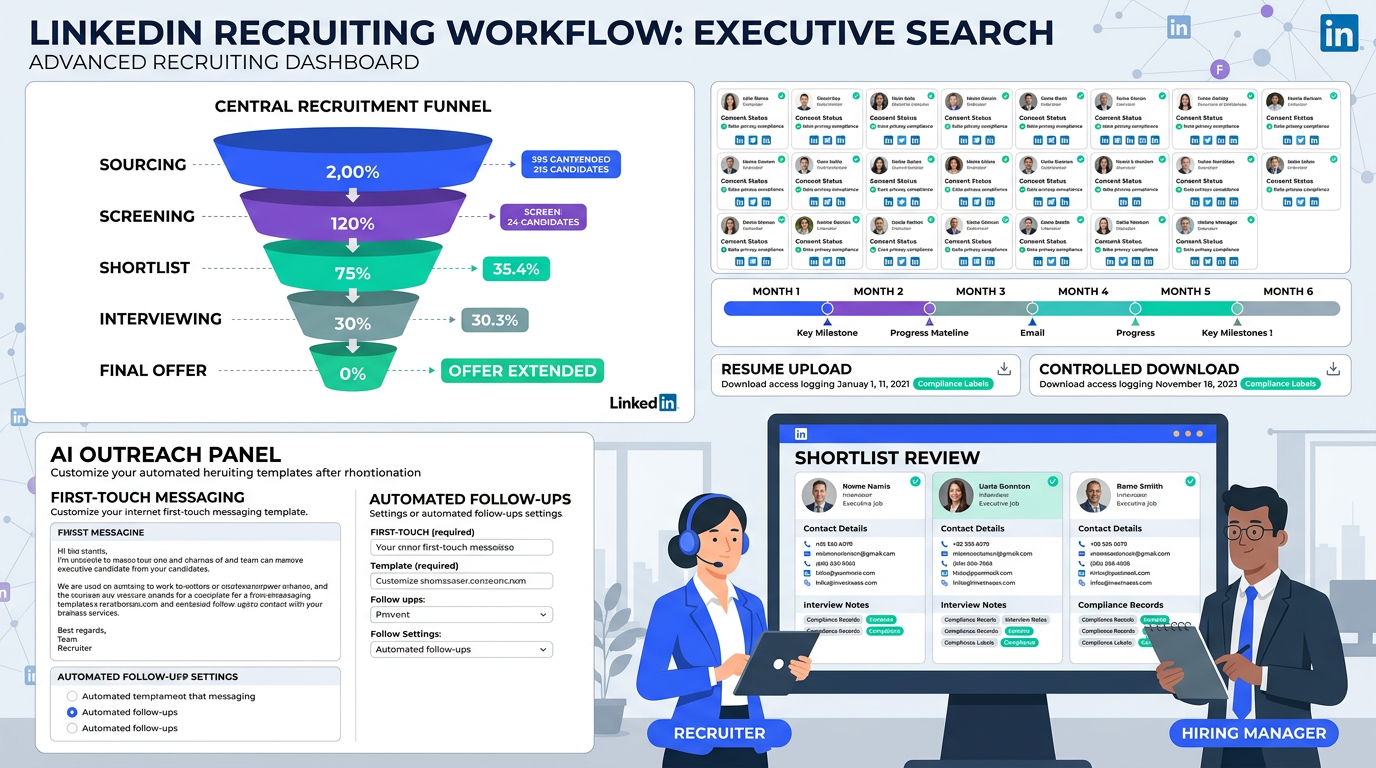
How to build the workflow step by step
- Define role critical signals. For executive and leadership roles, include strategic scope, culture fit indicators, and stakeholder management ability.
- Run role based sourcing. Use a resume finder based on job criteria, then prioritize candidates with evidence that maps to business goals.
- Automate first touch communication. Send structured introductions, answer role questions, and capture interest level early.
- Collect resumes and contact details. Accept resume submission by approved channels and label each profile by source and date.
- Review and shortlist manually. Recruiters complete final qualification after resume review and interview calibration.
- Protect data and document consent. Every free resume database download request should pass legal, policy, and purpose checks.
We recommend this sequence because it balances speed and judgment. Automation should handle repetitive tasks, while recruiters handle final fit decisions and stakeholder alignment.
Where AI Recruiter adds practical value
StrategyBrain AI Recruiter is designed for LinkedIn hiring workflows where volume and response time can overwhelm recruiters. In daily use, it can automate initial connection, role introduction, candidate Q and A, and intent confirmation before human interview stages.
Operational advantages inside the database workflow
- Automated outreach and follow up: candidates receive timely responses without waiting for recruiter availability.
- Multilingual communication: candidates can engage in their native language, which reduces misunderstanding in global hiring.
- Resume and contact capture: interested candidates can share documents and details, then records are marked for recruiter review.
- Scalable account operations: teams can manage more than 100 LinkedIn accounts for broader sourcing coverage.
From a process perspective, this improves database freshness and lowers manual friction. Product documentation reports up to 90% replacement of repetitive LinkedIn recruiting actions and costs as low as USD 2.40 per resume in suitable workflows. Recruiters still make final match decisions after reviewing resume evidence.
Known boundaries
- AI Recruiter identifies candidate interest and communication readiness, but does not finalize fit against every job requirement.
- Final qualification remains a human recruiter responsibility after resume review.
- Performance depends on role clarity, messaging quality, and response behavior in the target market.
Recruiter checklist you can copy
- [ ] Role brief includes must have skills, leadership scope, and compensation range.
- [ ] Candidate records include source, consent status, and last contact date.
- [ ] Resume finder based on job filters are documented and repeatable.
- [ ] Outreach templates answer role, company, and compensation basics.
- [ ] Resume and contact capture path is tested end to end.
- [ ] Free resume database download access is controlled and logged.
- [ ] Final qualification rubric is defined for recruiter review.
FAQ
Can I build a candidate database for recruiters without buying a full ATS?
Yes. You can start with a structured spreadsheet and communication playbook, then connect automation for outreach and resume intake. The key is consistent fields, clear qualification criteria, and compliance tracking from day one.
What makes a resume finder based on job effective?
It works when filters reflect actual role outcomes, not just keyword matching. Recruiters should combine skills, industry context, seniority level, and location constraints to improve shortlist quality.
Is free resume database download always allowed?
No. Downloading resumes in bulk can trigger privacy and policy risks if consent and usage scope are unclear. Always check legal requirements, client agreements, and retention policies before export.
How does AI Recruiter help with executive search style projects?
It accelerates sourcing and first stage communication so recruiters can spend more time on leadership assessment and stakeholder alignment. This is useful in long cycle hires where quality and context matter more than speed alone.
Does automation reduce recruiter quality?
Not when roles are clear and handoff points are defined. Automation handles repetitive communication, while recruiters retain decision control for shortlist quality and final interviews.
How should candidate data be protected?
Use encryption, role based access control, and isolated storage policies. Also document consent, data purpose, and retention windows for each candidate record.
Conclusion
A high performing candidate database for recruiters is built on structure, not volume. The Storm Guard succession search showed that 29 interviews over 6 months can be necessary when leadership fit is critical. Today, recruiters can preserve that quality bar while improving speed by combining role based sourcing, disciplined data capture, and StrategyBrain AI Recruiter for outreach and resume collection. Your next step is to standardize your database fields this week, deploy one role based sourcing workflow, and audit your download and consent process before scaling.