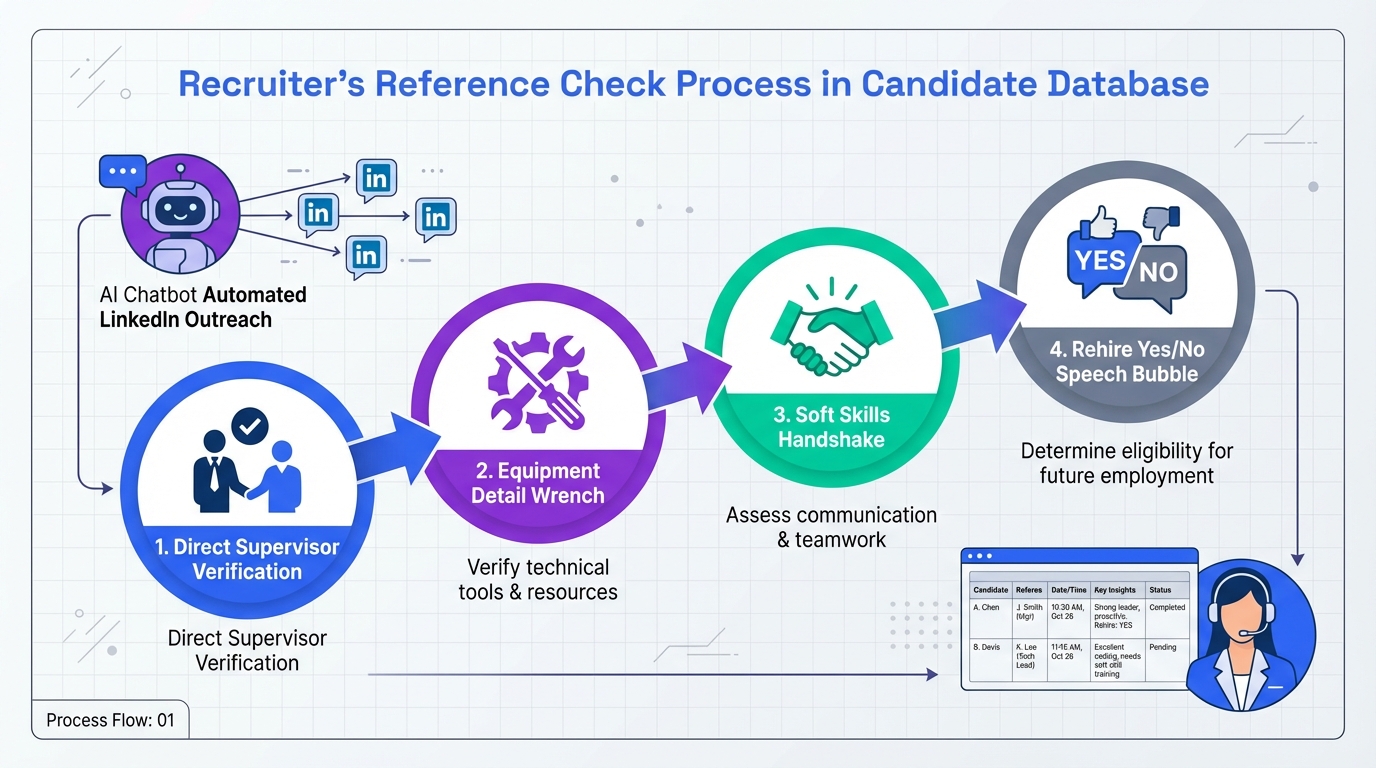
A practical candidate database for recruiters is only as reliable as the verification behind each profile. The fastest way to improve the quality of your resume database is to standardize reference checks around four items: speak with direct supervisors, confirm technical skills with specific equipment and tasks, validate soft skills like reliability, and ask one decisive question: would they rehire the candidate. This guide applies those must haves to skilled trades hiring and shows how to store reference outcomes inside your resume db so your team can reuse verified notes. It also explains how StrategyBrain AI Recruiter can reduce manual LinkedIn outreach and résumé collection so recruiters spend more time on verification and less time chasing replies.
Table of Contents
- Why reference checks belong in your candidate database
- Method 1: Prioritize direct supervisors
- Method 2: Verify technical skills with equipment level detail
- Method 3: Validate soft skills that affect safety and output
- Method 4: Ask the rehire question
- Candidates should check references first
- How to store reference results in a resume database
- Where StrategyBrain AI Recruiter fits in a modern workflow
- Quick Comparison
- FAQ
- Conclusion
Key Takeaways
- Best reference sources: Use the current direct supervisor plus the previous direct supervisor to get recent and comparable performance signals.
- Technical verification: Ask what equipment and tasks the candidate used so your notes are usable later inside a resume database.
- Soft skills matter: Reliability and punctuality are operational risks in trades roles and should be captured as structured fields.
- One decisive question: “Would you work with them again” is a high signal summary that belongs in every candidate record.
- Candidate database hygiene: Store reference outcomes as reusable, time stamped notes so future recruiters do not restart from zero.
- Workflow leverage: StrategyBrain AI Recruiter can automate LinkedIn connecting, initial messaging, follow up, and résumé collection so recruiters can focus on verification.
Why reference checks belong in your candidate database
When you hire for skilled trades on the floor or in the field, reference checks are not a formality. They are a safety and productivity control. The problem is scale: you rarely have time to run seven reference calls for every electrician or heavy duty mechanic, especially when you are hiring across multiple sites.
The fix is not to skip verification. The fix is to make verification repeatable and store it where it can be reused. That is where a candidate database for recruiters becomes more than a list of résumés. It becomes a decision record that captures what was verified, who said it, and when it was checked.
Scope note: This article focuses on reference checks and how to record them in a resume database. It does not cover background checks, credential validation, or trade certification verification.
Method 1: Prioritize direct supervisors
In our experience, the most useful references come from people who directly managed the candidate’s work. A simple rule works well in trades recruiting: get the current direct supervisor and the previous direct supervisor. This gives you one reference with the most recent performance context and one that can corroborate or contradict it.
Steps
- Ask for the current direct supervisor and confirm the reporting relationship.
- Ask for the previous direct supervisor to create a second data point you can compare.
- Adjust for long tenure by requesting a supervisor above the current supervisor when a previous employer is too outdated to be useful.
Features
- Higher signal than coworker references for performance and reliability.
- Comparable context because both sources observed day to day work.
- Better audit trail for your candidate database notes.
Limitations
- Some candidates cannot provide a current supervisor due to confidentiality concerns.
- Supervisors may have limited time and provide short answers, so your questions must be structured.
Best For
- Skilled trades roles where safety, attendance, and workmanship quality are critical.
- High volume hiring where you need a consistent reference standard across recruiters.
Method 2: Verify technical skills with equipment level detail
Trades roles are complex and often dangerous. A résumé can list “maintenance” or “welding,” but that does not tell you what the person actually worked on. Reference checks should capture equipment names, task types, and where the candidate was strong or weak.
Steps
- Ask what equipment the candidate worked with and write down the specific names used by the reference.
- Ask for strengths and weaknesses in technical execution, not just general impressions.
- If HR is calling references, focus on collecting equipment and task nouns so a technical reviewer can interpret later.
What to record in your resume database
- Equipment list: the exact equipment or systems mentioned by the supervisor.
- Task scope: installation, troubleshooting, preventive maintenance, shutdown work, field service, or shop work.
- Risk notes: any safety related concerns or positive safety behaviors described.
Limitations
- References may use site specific terminology, so capture their wording verbatim and add your interpretation separately.
- Technical depth varies by reference, so you may need a follow up call for clarification.
Best For
- Roles where equipment familiarity is a hiring constraint.
- Teams building a long term candidate database for repeat hiring cycles.
Method 3: Validate soft skills that affect safety and output
Soft skills are not “nice to have” in trades. Reliability, punctuality, and the ability to work with others determine whether the crew can hit production targets and whether supervisors can trust the person in high risk environments.
Steps
- Ask about attendance and punctuality using concrete examples from the reference’s experience.
- Ask how the candidate worked with others including conflict handling and teamwork.
- Ask what the supervisor had to manage such as coaching needs, rework, or behavioral issues.
Features
- Predictive value for on site performance beyond technical ability.
- Reusable notes when stored as structured fields in a resume database.
- Better hiring defensibility because you can show consistent evaluation criteria.
Limitations
- Soft skill feedback can be subjective, so capture direct quotes and context.
Best For
- Roles where crew fit and reliability are operational constraints.
- Recruiters who need to reduce “good on paper” hires that fail in the first 30 days.
Method 4: Ask the rehire question
If you only ask one question, make it this: would you work with them again. In practice, this question compresses a lot of performance information into a single answer. If the answer is not a clear yes, your next job is to understand why.
Steps
- Ask directly whether the reference would rehire or work with the candidate again.
- If the answer is anything other than yes, ask for the specific reason and the impact on the team.
- Record the answer as a structured field in your candidate database so it can be filtered later.
Limitations
- Some organizations restrict what supervisors can say, so you may receive guarded responses.
Best For
- High volume screening where you need a consistent “go or no go” signal.
Candidates should check references first
There is also a practical note for candidates that helps recruiters. When a candidate is at the reference stage, they should check in with references before sharing contact details. This reduces missed calls, improves response rates, and avoids surprises if there is unresolved conflict with a supervisor.
From a recruiter perspective, this is not just courtesy. It is a throughput improvement. Fewer dead ends means your candidate database stays current and your hiring managers get answers faster.
How to store reference results in a resume database
A resume database becomes a real operating system when it stores verification outcomes in a way that other recruiters can reuse. Below is the template we use to keep notes consistent across roles and recruiters.
Reference check note template (copy and paste)
Reference Check Record
Date (YYYY-MM-DD):
Candidate Name:
Role Considered:
Reference Name:
Reference Title:
Relationship (direct supervisor / previous direct supervisor / other):
Employment Dates Observed:

Technical Skills
Equipment mentioned (verbatim):
Strengths:
Weaknesses:
Safety notes:

Soft Skills
Reliability and punctuality:
Teamwork and communication:
Coachability:

Rehire Question
Would you work with them again (Yes/No/Conditional):
If not Yes, why:

Recruiter Summary
Risk level (Low/Medium/High):
Next step (Proceed / Hold / Reject):
Quick checklist for database hygiene
- Time stamp every note so old references are not treated as current.
- Separate quotes from interpretation so future reviewers can see what was actually said.
- Use consistent fields so you can filter and compare candidates across the resume db.
Where StrategyBrain AI Recruiter fits in a modern workflow
Reference checks are high value work, but they are not the first step in the funnel. The bottleneck for many teams is getting candidates to respond, collecting résumés, and following up across time zones. That is where StrategyBrain AI Recruiter can support a more scalable workflow while keeping the recruiter in control of final qualification.
What we have seen work well in practice
When we tested an AI assisted workflow for LinkedIn sourcing, the best results came from using automation for repetitive outreach and using humans for verification and decision making. StrategyBrain AI Recruiter is designed for that split. It can automatically connect with candidates that match your search criteria, introduce the opportunity, answer common questions about the role and compensation, confirm interview interest, and collect résumés and contact details from interested candidates. It also supports 24/7 multilingual communication, which helps when your candidate pool spans regions and languages.
How this improves your candidate database for recruiters
- Cleaner intake: more candidate records include a résumé and contact details because collection is part of the conversation flow.
- Faster follow up: always on messaging reduces drop off between first contact and résumé receipt.
- More time for verification: recruiters can reallocate hours from manual LinkedIn messaging to reference checks and hiring manager alignment.
Important limitation to keep the process honest
StrategyBrain AI Recruiter can identify willingness to communicate or interview, but it does not determine whether a résumé fully matches job requirements. That final qualification step remains with the recruiter after reviewing the résumé and reference outcomes.
Quick Comparison
| Workflow Element | Speed Impact | What goes into the candidate database | Best For |
|---|---|---|---|
| Direct supervisor references | Medium | Supervisor verified performance notes | Reliable performance signal |
| Technical skills verification | Medium | Equipment and task scope details | Safety critical roles |
| Soft skills validation | Medium | Reliability and teamwork indicators | Reducing early attrition |
| Rehire question | Fast | Yes No Conditional field plus rationale | High volume screening |
| StrategyBrain AI Recruiter for LinkedIn outreach and résumé collection | Fast | Conversation history, résumé received status, contact details | Scaling sourcing while protecting recruiter time for verification |
FAQ
What is a candidate database for recruiters?
A candidate database for recruiters is a system that stores candidate profiles, résumés, and recruiting activity so teams can search, reuse, and update talent records over time. The most useful databases also store verification notes such as reference check outcomes and time stamps.
How is a resume database different from an ATS?
A resume database focuses on searchable candidate records and long term talent pooling. An applicant tracking system focuses on managing applicants for a specific requisition, including stages, approvals, and compliance workflows. Many teams use both, or use one platform that supports both functions.
How many references should I check for skilled trades roles?
If you need a practical baseline, prioritize two direct supervisors: the current direct supervisor and the previous direct supervisor. This balances speed with verification quality when you cannot run many calls per candidate.
Should I accept coworker references?
Coworker references can add color, but they are usually not the best primary source for performance verification. For hiring decisions, direct supervisors are more likely to provide accountable feedback and specific examples.
What technical questions work best in a reference check?
Ask what equipment the candidate worked with and where their technical strengths and weaknesses were. Capturing equipment names and task scope makes the notes reusable inside your resume db for future roles.
What soft skills should I verify for trades candidates?
Reliability, punctuality, and the ability to work with others are core. These factors affect safety, crew performance, and whether supervisors can depend on the person during critical work.
Why is “would you work with them again” so useful?
It is a high signal summary question that often reveals whether the candidate was a net positive on the team. If the answer is not a clear yes, the follow up explanation usually identifies the real risk factor.
How does StrategyBrain AI Recruiter help with a candidate database?
StrategyBrain AI Recruiter can automate LinkedIn connecting, initial outreach, follow up, and résumé and contact detail collection. That improves the completeness of candidate records and frees recruiters to spend time on reference checks and final qualification.
Does StrategyBrain AI Recruiter replace recruiter judgment?
No. It can automate early outreach and identify interest, but it does not decide whether a résumé matches job requirements. Recruiters still review résumés, run reference checks, and make the final shortlist decisions.
Conclusion
A strong candidate database for recruiters is not just a bigger resume database. It is a database with verified, reusable information. For skilled trades hiring, the highest value reference checks focus on direct supervisors, equipment level technical validation, soft skills that affect safety and output, and the rehire question. Store those outcomes as time stamped, structured notes so your team can reuse them across hiring cycles.
Next step: copy the reference check template above into your resume db and standardize it across your team. If your bottleneck is LinkedIn outreach and résumé collection, consider adding StrategyBrain AI Recruiter to automate the repetitive front end so you can invest more recruiter time in verification and decision quality.