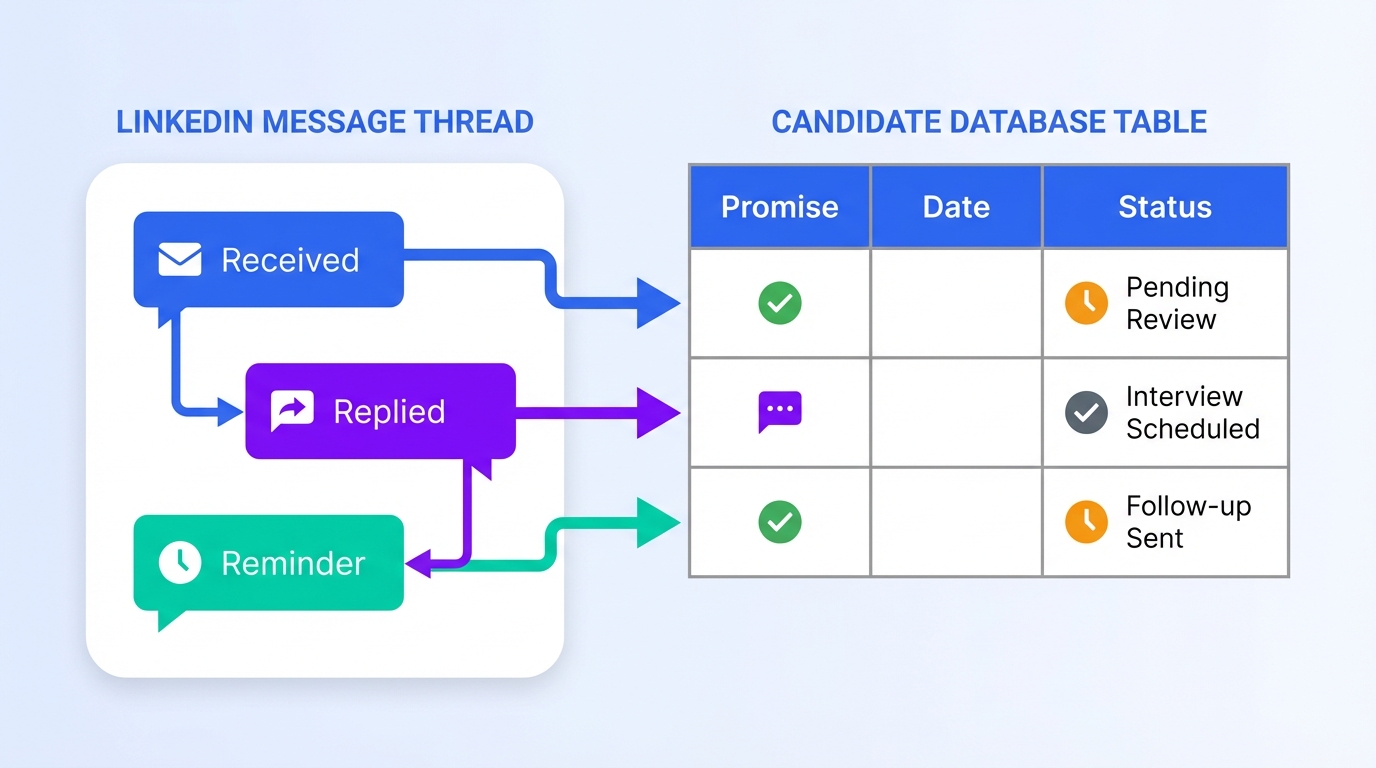
A candidate database for recruiters only works if candidates trust the process. The most reliable way to build that trust is to treat every message, update, and follow up as a small promise you consistently keep: confirm you received the resume, reply within a stated timeframe, and close the loop with clear feedback. When we audit recruiting workflows, the breakdown is rarely “we cannot find resumes” or “we cannot search resumes.” It is usually that candidates stop responding after one or two missed expectations. This guide turns the idea of “small promises” into a database workflow you can run every day, and shows where StrategyBrain AI Recruiter can help keep communication timely on LinkedIn, including 24/7 multilingual replies, while recruiters still make the final qualification decision.
Table of Contents
Key Takeaways
- Trust is built through consistency: candidates judge you by whether you do what you said you would do, on time.
- Log promises as trackable tasks: store “reply by” and “next update” dates inside your candidate database for recruiters.
- Confirm receipt fast: a same day confirmation that a resume arrived prevents silent drop off and reduces repeated “did you get it?” messages.
- Close loops: every stage should end with a clear outcome message, even when the answer is no.
- Use AI for responsiveness, not judgment: StrategyBrain AI Recruiter can handle initial LinkedIn outreach and follow up while recruiters keep final screening decisions.
- Multilingual follow up expands reach: 24/7 native language messaging reduces friction across time zones and regions.
Why “small promises” are the real database
In a workshop about building candidate relationships, I referenced The Little Prince. The Little Prince wanted to befriend the fox, but first he had to “tame” the fox, meaning he had to build trust. He did it through a simple pattern: he showed up near the fox every day at the same time, each day coming a step closer, until the fox began to expect the visit and even wait for it.
That daily presence is a promise. If, after a week, the Little Prince suddenly stopped showing up, he would likely have to start the whole process from zero. Recruiting works the same way. Candidates do not experience your process as a single big promise. They experience it as a series of small promises that are either kept or broken.
Define the promises you can keep
Before you optimize how you find resumes or search resumes, define what you will reliably do after you receive them. These are examples of spoken promises that candidates remember because they set expectations:
- “I will reply to your message within 3 days.”
- “I will share feedback after I speak with the hiring manager.”
- “I will send more details shortly.”
Some promises are unspoken, but candidates still expect them. If you break them, trust drops quickly:
- “I will read your resume before deciding whether you move forward.”
- “I will let you know your resume reached our system.”
- “I will not reject you without a word.”
Scope note: this article focuses on communication promises and how to operationalize them in a candidate database. It does not cover compensation strategy, interview design, or employer branding campaigns.
Map promises to your candidate database for recruiters
A candidate database for recruiters is not just a place to store resumes. It is a system that should store expectations. When we tested process improvements with recruiting teams, the biggest gains came from making promises visible and measurable inside the database, not from adding more sourcing channels.
Minimum fields to add (or standardize)
- Promise made: the exact commitment, written in plain language.
- Promise date: the date you made it.
- Due date: the date you must deliver by.
- Status: pending, delivered, delayed, canceled with reason.
- Next update date: when the candidate should hear from you again, even if there is no decision yet.
- Receipt confirmation: whether the resume or contact details were received and acknowledged.
Events to log every time
If your team wants a database that helps you search resumes and also protect candidate trust, log these events consistently:
- Resume received: file upload, email submission, or LinkedIn attachment.
- Candidate notified: confirmation message sent.
- Stage change: applied, contacted, screening, interview, offer, closed.
- Outcome message sent: yes, no, or still in review with next update date.
How to run the workflow (daily and weekly)
Daily routine (15 to 25 minutes per recruiter)
- Check promises due today: filter your candidate database for due dates equal to today and deliver them first.
- Confirm receipts: send a short confirmation to every candidate whose resume arrived since the last check.
- Set the next update date: if a decision is not ready, schedule the next update date so the candidate is not left guessing.
- Close loops: for any candidate you are not moving forward, send a clear closure message rather than leaving the record silent.
Weekly routine (30 to 45 minutes per team)
- Audit broken promises: review records marked delayed and document the cause.
- Fix the bottleneck: if delays cluster around one stage, change the stage SLA or reduce handoffs.
- Refresh templates: update your confirmation, feedback, and closure messages to stay clear and consistent.
Copyable checklist for your candidate database for recruiters
- [ ] Every candidate record has a next update date.
- [ ] Every resume received has a receipt confirmation logged.
- [ ] Every promise has a due date and a status.
- [ ] Every stage change triggers an outcome message.
- [ ] Delays are labeled with a reason, not ignored.
Where AI fits without breaking trust
Automation can strengthen trust when it improves consistency. It can also damage trust if it creates vague, repetitive, or misleading communication. The safest approach is to use AI to support responsiveness and follow up, while keeping human control over final screening and hiring decisions.
How StrategyBrain AI Recruiter supports the “small promises” system
- Smart LinkedIn recruitment automation: it can automatically connect with candidates that match your search criteria, introduce the role, answer common questions about the job, company, and compensation, and confirm interview interest.
- Resume and contact collection: when a candidate is interested, it can request a resume and capture contact details shared in the conversation, which helps keep your candidate database complete.
- 24/7 multilingual communication: it can respond in the candidate’s native language and keep follow ups timely across time zones, which directly supports the promise of “we will get back to you.”
- Scale with multiple accounts: it supports managing more than 100 LinkedIn accounts for organizations building an AI assisted recruiting team.
Important boundary to keep trust
AI Recruiter can identify whether a candidate is willing to communicate or interview, but it does not decide whether the resume matches the job requirements. Recruiters should review resumes and make the final qualification decision. This boundary is important because it keeps your process honest and prevents overpromising.
Limitations we see in real workflows and how to handle them
- Silence after “shortly”: if you use vague timing, candidates assume you forgot them. Use a date and log it as a due date.
- Untracked feedback dependency: if feedback depends on a hiring manager, set a next update date anyway and tell the candidate what will happen next.
- Database without communication history: if you cannot see what was promised, you cannot keep it. Store promises and outcomes as structured fields, not only in free text notes.
Quick Comparison
| Approach | Speed of follow up | Consistency | Best for |
|---|---|---|---|
| Manual tracking in a candidate database | Depends on recruiter workload | Medium if disciplined | Small pipelines and high touch roles |
| Promise based workflow inside the database | Fast for due items | High when due dates are enforced | Teams that want fewer drop offs and clearer SLAs |
| Promise workflow plus StrategyBrain AI Recruiter on LinkedIn | Near immediate for initial responses and follow ups | High with standardized messaging and logging | High volume LinkedIn outreach, multilingual hiring, time zone coverage |
FAQ
What should a candidate database for recruiters track besides resumes?
It should track expectations: what you told the candidate you would do, when you said it, and when you will follow up next. This makes trust measurable and prevents silent drop offs.
How do I confirm a resume was received without creating extra work?
Use a short template and log a receipt confirmation field in the candidate record. If you use StrategyBrain AI Recruiter for LinkedIn conversations, it can request resumes from interested candidates and mark them as received when they are shared.
Will better resume search fix candidate ghosting?
Not by itself. Being able to search resumes helps recruiters work faster, but ghosting usually happens when candidates experience broken promises such as missed reply windows or no closure message.
What is the safest way to use AI in candidate communication?
Use AI to improve responsiveness and consistency, and keep humans responsible for final screening decisions. This keeps your process accurate and avoids overpromising.
Can StrategyBrain AI Recruiter replace recruiters?
No. It automates repetitive LinkedIn tasks such as connecting, introducing roles, answering common questions, and collecting resumes and contact details. Recruiters still review resumes and decide who moves forward.
How does multilingual messaging affect recruiting outcomes?
It reduces misunderstandings and friction when hiring across regions and time zones. A candidate who can ask questions in their native language is more likely to stay engaged through the process.
How do I prevent candidates from feeling like they are talking to a bot?
Be transparent in tone, keep messages specific to the role, and always provide a clear next step and timeline. Also ensure the database reflects what was promised so follow ups feel intentional, not automated noise.
What is one metric I can track to know if trust is improving?
Track the percentage of candidate records where the next update date is met on time. When that rate improves, response rates and interview attendance often improve as a downstream effect.
Conclusion
If you do not want to be “just another recruiter,” you have to build trust. In practice, trust comes from time and many small, fulfilled promises: replying when you said you would, confirming that a resume arrived, and never ending a process without a clear message. The simplest upgrade you can make to a candidate database for recruiters is to store promises as due dated tasks and to enforce next update dates for every active candidate.
Next step: pick three promises your team can keep every time, add the fields described above to your database, and run the daily routine for 10 business days. If LinkedIn outreach volume or time zones make consistency hard, consider using StrategyBrain AI Recruiter to support timely, multilingual communication while your recruiters stay focused on final qualification and interviews.