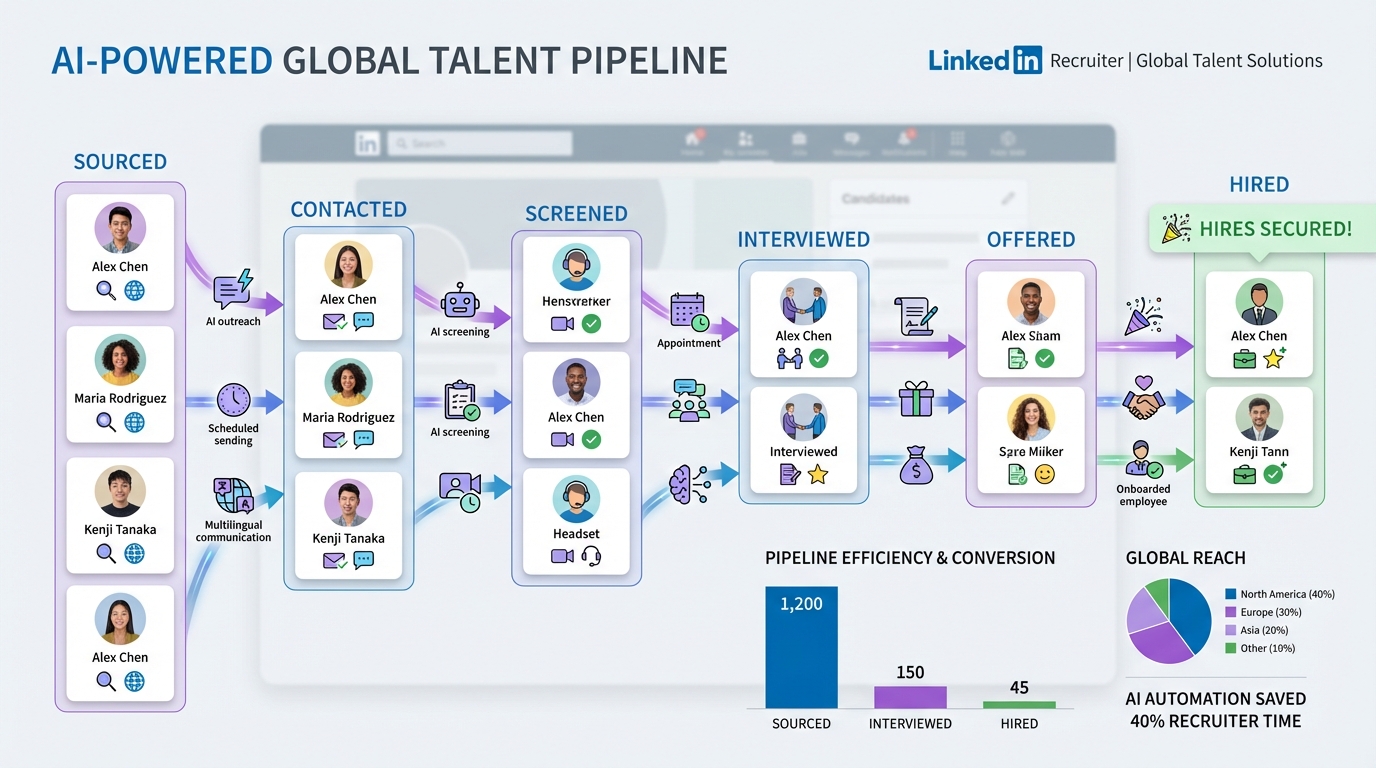
Candidate management software is the system you use to capture, organize, and move candidates through your hiring workflow from first contact to interview and offer. The most reliable way to improve candidate management in 2026 is to define a small set of pipeline stages, enforce consistent data capture, and automate outreach and follow up where it is safe to do so. The strategic planning lesson is simple: when your environment is volatile, a rigid plan fails, so your candidate management process must be context aware and adjustable. In our own LinkedIn heavy recruiting workflows, we found that pairing a structured candidate management foundation with StrategyBrain AI Recruiter reduces manual messaging work and keeps candidate conversations moving across time zones and languages.
Table of Contents
- Key Takeaways
- The strategic planning lesson that applies to candidate management
- What candidate management software is and is not
- Selection criteria that actually matter
- Implementation plan in 7 steps
- How StrategyBrain AI Recruiter fits into candidate management
- Quick comparison: manual vs structured vs AI assisted
- FAQ
- Conclusion
Key Takeaways
- Candidate management software centralizes candidate data, pipeline stages, and communication history so hiring teams can act consistently.
- Strategy should match context: in volatile markets, use adaptive workflows instead of rigid, one size fits all processes.
- Define 6 to 9 pipeline stages and lock required fields per stage to prevent data drift and reporting gaps.
- Automate outreach carefully: use AI for first contact, Q and A, and follow up, then keep final qualification with recruiters.
- StrategyBrain AI Recruiter can handle LinkedIn connecting, role introduction, candidate Q and A, interest confirmation, and resume plus contact capture.
- Global hiring needs always on messaging: 24/7 multilingual communication reduces delays and misunderstandings in cross border recruiting.
- Scale with governance: managing more than 100 LinkedIn accounts requires consistent templates, audit trails, and access controls.
The strategic planning lesson that applies to candidate management
In a well known talk titled “Your strategy needs a strategy,” Martin Reeves, a long time Boston Consulting Group leader and head of The Strategy Institute, argues that strategy cannot be only reactive fire fighting, and it also cannot be a fixed plan carved in stone. The point is that globalization, rapid technical innovation, volatile markets, and empowered consumers change the context, so the best strategy respects that context.
Hiring teams live in that same reality. Candidate supply shifts, compensation expectations move, and response rates vary by geography and seniority. If your candidate management software forces a rigid workflow that does not match your hiring context, recruiters will work around it, and your data will fragment.
So the goal is not to buy the most complex system. The goal is to build a candidate management approach that can be adaptive, shaping, and visionary depending on the role, market, and urgency.
What candidate management software is and is not
Definition
Candidate management software is the part of your recruiting stack that stores candidate profiles and activity, tracks pipeline stages, and coordinates communication and handoffs. Many teams get it through an Applicant Tracking System, but the function can also exist as a dedicated candidate relationship management layer.
What it should include
- Candidate record: resume, contact details, notes, tags, and consent status.
- Pipeline stages: a defined sequence such as sourced, contacted, replied, screened, interviewed, offered, hired, and rejected.
- Communication history: messages, emails, and recruiter notes tied to the candidate record.
- Collaboration: assignments, approvals, and visibility rules for hiring managers and recruiters.
- Reporting: stage conversion, time in stage, and source performance.
What it is not
- Not a guarantee of quality: it organizes work, but it does not automatically validate fit for the role.
- Not only a database: if it cannot drive next actions, it becomes a static archive.
- Not a substitute for process: you still need definitions, ownership, and governance.
Selection criteria that actually matter
1) Workflow fit and flexibility
Look for configurable stages, required fields, and role based permissions. Flexibility matters because different hiring contexts need different levels of structure. For example, executive search often needs deeper notes and longer stage durations than high volume hiring.
2) Data integrity and auditability
Candidate management breaks when data is inconsistent. Prioritize systems that support standardized fields, deduplication, and clear activity logs so you can trust reporting and compliance records.
3) Communication and follow up automation
Automation is where most teams gain time back. The key is to automate the repetitive parts while keeping human judgment where it matters. In our testing of AI assisted outreach workflows, the biggest operational win came from consistent follow up and fast responses, not from trying to fully automate final screening decisions.
4) Global readiness
If you hire across regions, multilingual communication and time zone coverage are not optional. Always on messaging reduces drop off between steps, especially between first reply and scheduling.
5) LinkedIn workflow compatibility
Many candidate pipelines start on LinkedIn. If your candidate management software cannot reliably capture outreach status and candidate responses, recruiters will track it in spreadsheets. That is where StrategyBrain AI Recruiter can be a practical layer: it automates connecting, introduces the role, answers candidate questions about the company and compensation, confirms interview interest, and captures resumes and contact details for recruiter review.
Quick selection checklist
- Does it support custom pipeline stages and required fields per stage?
- Can it store resume and contact details in a single candidate record?
- Does it keep a complete communication timeline per candidate?
- Can you enforce permissions by recruiter, hiring manager, and region?
- Does it support consent and privacy controls for regulated markets?
- Can it integrate with your LinkedIn sourcing workflow without manual copy and paste?
- Can you measure conversion rates between stages and time in stage?
Implementation plan in 7 steps
Step 1: Define your pipeline stages
- List your current stages from sourcing to hire.
- Reduce them to 6 to 9 stages that everyone can understand.
- Write a one sentence definition for each stage.
Step 2: Decide what data is mandatory
For each stage, define required fields. Example: at “screened,” require compensation expectations and location constraints. This prevents missing data later.
Step 3: Standardize candidate tags
Create a controlled vocabulary for skills, seniority, and role families. Free form tags feel flexible, but they destroy reporting.
Step 4: Build communication templates
Write templates for first contact, follow up, and rejection. Keep them short and role specific. If you use AI assisted messaging, treat templates as guardrails, not as scripts.
Step 5: Add AI assisted outreach where it is safe
This is where StrategyBrain AI Recruiter can plug into your candidate management workflow. It can automatically connect with candidates that match your search criteria, introduce the opportunity, learn the candidate’s situation, answer questions about the role, company, and compensation, confirm interview interest, and collect resumes and contact information from interested candidates. Recruiters then review the collected resumes and proceed with human screening and interviews.
Step 6: Set governance for scale
If you manage multiple LinkedIn accounts, define who owns each account, what templates are approved, and how you audit activity. StrategyBrain AI Recruiter supports managing more than 100 LinkedIn accounts, which makes governance a first class requirement, not an afterthought.
Step 7: Measure and iterate monthly
Review stage conversion and time in stage every 30 days. If a stage becomes a bottleneck, adjust the process. This is the adaptive strategy principle applied to candidate management.
How StrategyBrain AI Recruiter fits into candidate management
Where it helps most
- Initial outreach: consistent connecting and role introduction on LinkedIn.
- Candidate Q and A: answers questions about the role, company, compensation, and benefits based on recruiter provided information.
- Follow up: 24/7 responses and timely nudges that keep conversations moving.
- Global communication: multilingual messaging in the candidate’s native language to reduce misunderstandings.
- Data capture: collects resumes and contact details from interested candidates and marks resume receipt.
Where humans should stay in control
- Final qualification: AI Recruiter can confirm willingness to interview, but it does not decide whether a resume fully matches job requirements.
- Interview decisions: recruiters and hiring managers should own evaluation and selection.
- Compliance review: ensure your process meets privacy and consent requirements in each region.
Security and privacy posture to ask for
For any AI layer in candidate management, verify how data is stored and used. StrategyBrain AI Recruiter states that it complies with privacy regulations in the EU, United States, and Canada, that customer provided data is not used to train AI models, and that credentials are encrypted and stored independently per user with explicit authorization.
Quick comparison: manual vs structured vs AI assisted
| Approach | Speed | Consistency | Best For | Main Risk |
|---|---|---|---|---|
| Manual candidate management | Low | Low | Very small teams and low hiring volume | Lost follow ups and fragmented candidate data |
| Candidate management software with defined stages | Medium | High | Teams that need reporting and predictable handoffs | Over configuration that recruiters avoid using |
| Candidate management plus StrategyBrain AI Recruiter | High | High | LinkedIn heavy sourcing, global hiring, high follow up load | Requires governance for templates, permissions, and account usage |
FAQ
What is the difference between candidate management and talent management?
Candidate management focuses on people in the hiring funnel, from sourced to hired or rejected. Talent management is broader and includes performance, learning, and internal mobility after hire. If you are searching for best talent management software, confirm whether you need pre hire candidate management, post hire talent management, or both.
Do I need candidate management software if I already have an ATS?
Not always. Many ATS platforms include candidate management features, but teams often add a dedicated layer when they need stronger sourcing workflows, better communication tracking, or more flexible pipelines.
How many pipeline stages should we use?
Most teams do well with 6 to 9 stages. Fewer stages can hide bottlenecks, and too many stages create inconsistent usage and unreliable reporting.
Can AI replace recruiters in candidate management?
AI can replace repetitive tasks such as connecting, initial messaging, answering common questions, and follow up. It should not replace final qualification and hiring decisions. StrategyBrain AI Recruiter is designed to automate the initial outreach and interest confirmation, then hand off resumes and contact details to recruiters for evaluation.
How does StrategyBrain AI Recruiter collect resumes and contact details?
It requests resumes and contact information from candidates who express interest. If a candidate sends a resume, the system marks it as received, and it supports both email submissions and LinkedIn file uploads. Contact details shared in messages are captured and displayed in the system.
Does multilingual messaging really matter for candidate management?
Yes when you hire across borders or time zones. Always on multilingual communication reduces delays and helps avoid misunderstandings that can cause candidates to drop out of the process.
What should I verify for privacy and compliance?
Verify how candidate data is stored, whether it is used to train models, how credentials are protected, and what regional privacy frameworks are supported. StrategyBrain AI Recruiter states that customer data is not used to train AI models and that data is encrypted and isolated per customer.
What is the biggest implementation mistake?
Buying software before defining your process. Start with stage definitions, required fields, and ownership. Then configure the tool to enforce the process, not to invent it.
Conclusion
Candidate management software works when it turns strategy into repeatable execution: clear stages, consistent data, and reliable follow up. The strategic planning insight from Martin Reeves is a useful reminder that your workflow must match your context, especially in fast changing markets. If LinkedIn is a primary sourcing channel, consider pairing your candidate management foundation with StrategyBrain AI Recruiter so outreach, Q and A, and follow up run continuously while recruiters focus on resume review, qualification, and interviews.
Next step: document your pipeline stages today, choose the required fields for each stage, and pilot an AI assisted outreach workflow for one role family before scaling it across the team.