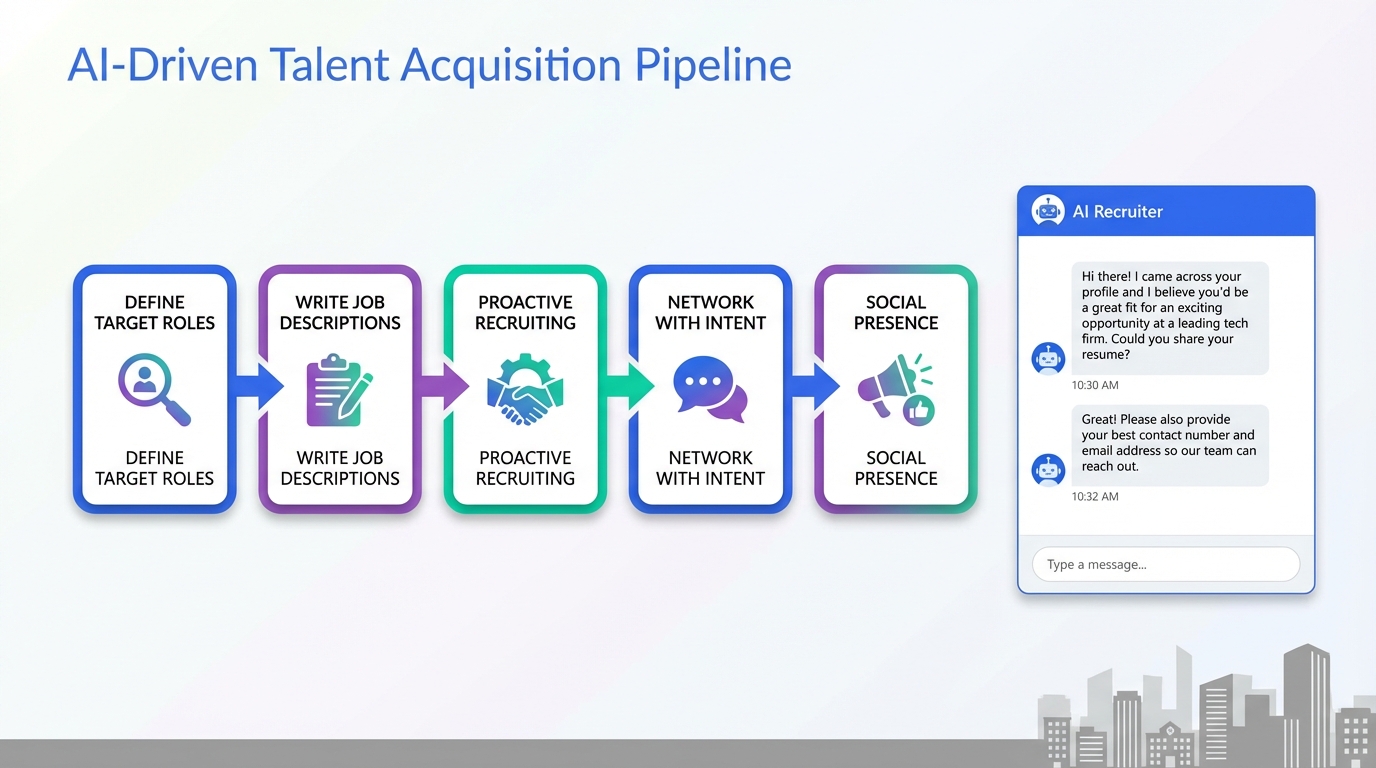
Candidate management software helps you build and maintain a reliable talent pipeline by capturing candidate profiles, tracking conversations, and keeping outreach consistent across roles and time. The most effective approach is to define your target talent, publish precise job descriptions, run proactive relationship recruiting, and use automation to keep candidates engaged without losing the human touch. In our recruiting operations, we see the biggest gains when teams pair a structured candidate management workflow with LinkedIn outreach automation that can connect, introduce roles, answer common questions, and collect re9sume9s and contact details for recruiter review. This guide explains a practical pipeline playbook, what to track inside candidate management software, and how StrategyBrain AI Recruiter fits into a modern candidate management process.
Table of Contents
- What candidate management software should track
- Step 1: Define the talent you actually need
- Step 2: Write job descriptions that screen instead of confuse
- Step 3: Run proactive relationship recruiting
- Step 4: Network with intent and log every touch
- Step 5: Strengthen social presence with a repeatable content loop
- How StrategyBrain AI Recruiter fits into candidate management
- Quick comparison: pipeline workflows
- Implementation checklist
- FAQ
- Conclusion
Key Takeaways
- Candidate management software works best with clear inputs: define target roles, must have skills, and hiring priorities before you scale outreach.
- Proactive recruiting is a pipeline multiplier: relationship recruiting reduces last minute sourcing when a role opens.
- Track conversations, not just resumes: message history, objections, and next steps are as important as a CV file.
- LinkedIn outreach can be systematized: StrategyBrain AI Recruiter can connect, introduce roles, answer questions, confirm interest, and collect re9sume9s and contact details for recruiter review.
- 24/7 multilingual messaging expands reach: always on responses reduce delays across time zones and languages.
- Be honest about automation limits: AI Recruiter can qualify interest, but final fit against requirements still needs recruiter review.
What candidate management software should track
Candidate management software is the system where your pipeline becomes usable. A spreadsheet can store names, but it rarely preserves context. In practice, the difference between a warm pipeline and a cold list is whether you can see what happened last time you spoke with someone and what should happen next.
At minimum, we recommend configuring your candidate management workflow to capture these fields for every prospect and applicant.
- Role family and level: for example, accounting and finance, engineering, operations, or human resources.
- Source and channel: LinkedIn outreach, referral, event networking, inbound application, or agency partner.
- Conversation history: messages, questions asked, objections raised, and what you promised to follow up with.
- Interest status: open to new opportunities, not now, or do not contact.
- Next step and due date: a specific action with a date, not a vague note.
- Documents and contact details: re9sume9 received status, email, phone, and preferred contact method.
This structure also makes it easier to evaluate what many teams call the best talent management software. The best tool is the one that keeps these details accurate and easy to act on.
Step 1: Define the talent you actually need
Pipeline building starts with clarity. If your team is not aligned on what you are hiring for, candidate management software will simply store confusion at scale.
What to do in a 45 minute alignment meeting
- List the recurring roles you hire every quarter and the roles that are hard to fill.
- Define must have requirements that are truly non negotiable, then separate them from nice to have skills.
- Agree on prioritization so recruiters know which pipeline segments deserve weekly attention.
Once you have this, your candidate management process becomes measurable. You can track pipeline coverage by role family and see where you are under sourced.
Step 2: Write job descriptions that screen instead of confuse
Vague job descriptions create vague pipelines. When the role description is unclear, candidates self select incorrectly and recruiters spend time clarifying basics in every conversation.
Job description quality rules we use
- Describe outcomes such as what success looks like in 90 days and 180 days.
- Explain the team context including who the role reports to and how it interacts with peers.
- Use plain language so candidates understand the work without internal jargon.
- Review with multiple stakeholders including the hiring manager and a peer role partner.
In candidate management software, store the final approved description as the source of truth. That way, outreach messages and screening notes stay consistent across recruiters.
Step 3: Run proactive relationship recruiting
Proactive recruiting is relationship recruiting. It means you build long term professional connections even when a candidate is not actively job searching and even when you do not have an immediate opening. Heather Parrot highlighted this approach on the LinkedIn Talent Blog and emphasized that it takes time, but it increases confidence that candidates will fit your culture and reduces emergency sourcing later.
This is where candidate management software and LinkedIn execution must work together. The software stores the relationship context, and your outreach system keeps the relationship alive.
How we operationalize proactive recruiting in candidate management
- Create a pipeline segment called future fit for each priority role family.
- Set a follow up cadence such as every 30 days for high priority prospects and every 60 days for secondary prospects.
- Log the reason to reconnect such as a new project, a promotion, a relocation, or a new opening.
When you do this consistently, candidate management becomes a living system rather than a database you only open when a requisition is urgent.
Step 4: Network with intent and log every touch
Industry events and networking functions can fill your pipeline with people who match your culture, but only if you follow up. The follow up is the part most teams drop, especially when recruiters are juggling multiple roles.
Make networking measurable
- Before the event: define 2 role families you want to meet and 1 message you will use to introduce your company.
- During the event: capture a short note on what the person cares about, not just their title.
- After the event: create a next step with a date inside candidate management software within 24 hours.
If you already use LinkedIn as your primary channel, this is also a natural place to use StrategyBrain AI Recruiter to keep conversations moving when you are offline. It can respond around the clock, in the candidatee28099s native language, and it can collect re9sume9s and contact details once interest is confirmed. Recruiters still decide who advances, but the relationship does not stall.
Step 5: Strengthen social presence with a repeatable content loop
Recruiting is increasingly digital. A strong social presence helps candidates understand your values and culture before they ever speak with a recruiter. It also supports candidate management because it gives you relevant content to share during follow ups.
A simple weekly loop that supports candidate management
- Post one culture signal such as a team win, a learning moment, or a behind the scenes process.
- Post one role signal such as what success looks like in a key role family.
- Use one conversation prompt that invites replies, then log meaningful replies in candidate management software.
This is not about volume. It is about consistency and relevance, so your pipeline stays warm.
How StrategyBrain AI Recruiter fits into candidate management
Candidate management software is where you organize and decide. StrategyBrain AI Recruiter is how you execute LinkedIn outreach and early stage conversations at scale while keeping your process consistent.
What we use it for in a real pipeline workflow
- Automated LinkedIn connection and introduction: it connects with candidates who match your search criteria and introduces the opportunity using your job and company details.
- Interest qualification: it asks about the candidatee28099s situation and confirms interview interest. It does not decide final fit against requirements, which remains a recruiter task.
- Question handling: it answers common questions about the role, company, compensation, and benefits based on the information you provide.
- Re9sume9 and contact capture: it requests re9sume9s and captures contact details from interested candidates, including email submissions and LinkedIn file uploads.
- 24/7 multilingual communication: it replies in any global language to reduce delays and misunderstandings across time zones.
- Team scaling: it supports managing more than 100 LinkedIn accounts so organizations can build AI powered recruiting teams.
In candidate management terms, this means fewer stalled conversations, more complete candidate records, and a cleaner handoff to recruiters for review and interviews.
Quick comparison: pipeline workflows
| Workflow element | Manual only | Candidate management software plus StrategyBrain AI Recruiter | What improves |
|---|---|---|---|
| Initial LinkedIn outreach | Recruiter sends messages one by one | AI Recruiter connects and introduces roles based on criteria | Consistency and throughput |
| Candidate Q and A | Delayed replies outside work hours | 24/7 responses using provided role and company details | Speed and candidate experience |
| Interest confirmation | Recruiter manually follows up | AI Recruiter confirms interview interest and next steps | Fewer dropped conversations |
| Re9sume9 and contact collection | Recruiter requests and tracks files manually | AI Recruiter requests re9sume9s and captures contact details | Cleaner candidate records |
| Final qualification | Recruiter reviews fit | Recruiter reviews fit after AI collects materials | Recruiter time saved on repetitive steps |
Implementation checklist
Use this checklist to turn the ideas above into a repeatable candidate management system.
- [ ] Define 3 priority role families and document must have requirements for each.
- [ ] Standardize job description templates and store approved versions in your candidate management software.
- [ ] Create pipeline stages that include relationship status and next step due dates.
- [ ] Set follow up cadences for future fit candidates at 30 days and 60 days.
- [ ] Log every networking touchpoint within 24 hours with a specific next step.
- [ ] Configure StrategyBrain AI Recruiter with company details, compensation, benefits, and candidate search criteria.
- [ ] Define a handoff rule: recruiter reviews every interested candidate after re9sume9 and contact details are captured.
FAQ
What is candidate management software?
Candidate management software is a system for organizing candidate profiles, tracking communication, and managing pipeline stages from first contact to interview and hire. It supports candidate management by keeping conversation history, documents, and next steps in one place.
Is candidate management the same as an ATS?
Candidate management is often a core part of an applicant tracking system, but teams also use standalone tools for relationship pipelines. The key difference is focus: candidate management emphasizes ongoing relationships and follow ups, not only active applicants.
How does proactive recruiting help a talent pipeline?
Proactive recruiting builds relationships before you have an urgent opening. That reduces time spent sourcing under pressure and increases the chance that candidates already understand your company and culture when a role opens.
How does StrategyBrain AI Recruiter support candidate management?
StrategyBrain AI Recruiter automates early LinkedIn outreach and conversation steps, including connecting, introducing roles, answering common questions, confirming interest, and collecting re9sume9s and contact details. Recruiters then review materials and decide who advances.
Can AI Recruiter decide whether a candidate is qualified?
No. AI Recruiter can confirm willingness to engage and interview, but it does not determine final fit against job requirements. Recruiters complete that qualification step after reviewing the re9sume9.
Does AI Recruiter support multilingual candidate communication?
Yes. It can communicate in any global language and respond 24/7, which helps teams hiring across countries and time zones reduce delays and misunderstandings.
How are re9sume9s and contact details captured?
When a candidate expresses interest, AI Recruiter requests a re9sume9 and contact information. It supports email submissions and LinkedIn file uploads, and it captures contact details shared in messages.
What should I avoid when building a pipeline?
Avoid vague job descriptions, inconsistent follow up, and storing candidates without context. If you cannot see the last conversation and the next step date, your pipeline will cool down quickly.
Conclusion
Candidate management software becomes truly valuable when it supports a disciplined pipeline process: define what you need, publish clear job descriptions, invest in proactive relationship recruiting, network with intent, and maintain a consistent social presence. To scale that process on LinkedIn without losing responsiveness, StrategyBrain AI Recruiter can automate connection, role introduction, Q and A, interest confirmation, and re9sume9 and contact capture, while recruiters keep control of final qualification and interviews.
Next step: pick one priority role family, implement the checklist above for 14 days, and measure how many warm conversations and complete candidate records you create inside your candidate management workflow.