The most effective candidate management software is not just a database. It is an operating model that links HR strategy and recruiter execution from the first workforce planning meeting to the final onboarding checkpoint. When this model is supported by a talent management system and a reliable candidate engagement software layer, hiring teams reduce handoff errors and respond faster to candidates. In our implementation work, we pair HR scorecards with StrategyBrain AI Recruiter so recruiters can automate early LinkedIn conversations, capture resume data consistently, and keep communication active in multiple languages while HR leads evaluation and final selection.
Table of Contents
- Key Takeaways
- Why HR and Recruitment Alignment Matters
- The Five Milestone Model
- How StrategyBrain AI Recruiter Fits the Workflow
- Metrics That Keep the Process Honest
- Implementation Steps
- Limitations and Risk Controls
- FAQ
- Conclusion
Key Takeaways
- Start earlier: Workforce planning should begin 3 to 6 months before peak hiring periods.
- Define terms clearly: Candidate management software tracks pipeline activity, while a talent management system covers broader workforce lifecycle planning.
- Use AI for repetitive front end tasks: StrategyBrain AI Recruiter can automate initial LinkedIn outreach, role introduction, and follow up communication.
- Keep human decision control: Final qualification and hiring decisions still require recruiter and hiring manager review.
- Track measurable outcomes: Response rate, interview acceptance rate, probation pass rate, and onboarding completion rate should be reviewed monthly.
- Protect candidate data: Compliance and secure data handling must be designed into every workflow.
Why HR and Recruitment Alignment Matters
Hiring quality drops when HR and recruitment run as separate tracks. We have seen this repeatedly in projects where recruiters receive vague job requirements, inconsistent interview criteria, and delayed feedback. A modern candidate management software setup fixes this by making each stage observable and accountable.
HR should lead role definition, competency mapping, and onboarding criteria. Recruiters should lead market outreach, candidate communication, and shortlist velocity. The system succeeds when both groups share the same evidence model, including interview scorecards and post hire checkpoints.
This structure is especially important for LinkedIn hiring where candidate speed expectations are high. A candidate engagement software layer helps maintain response consistency when recruiter bandwidth is limited.
The Five Milestone Model
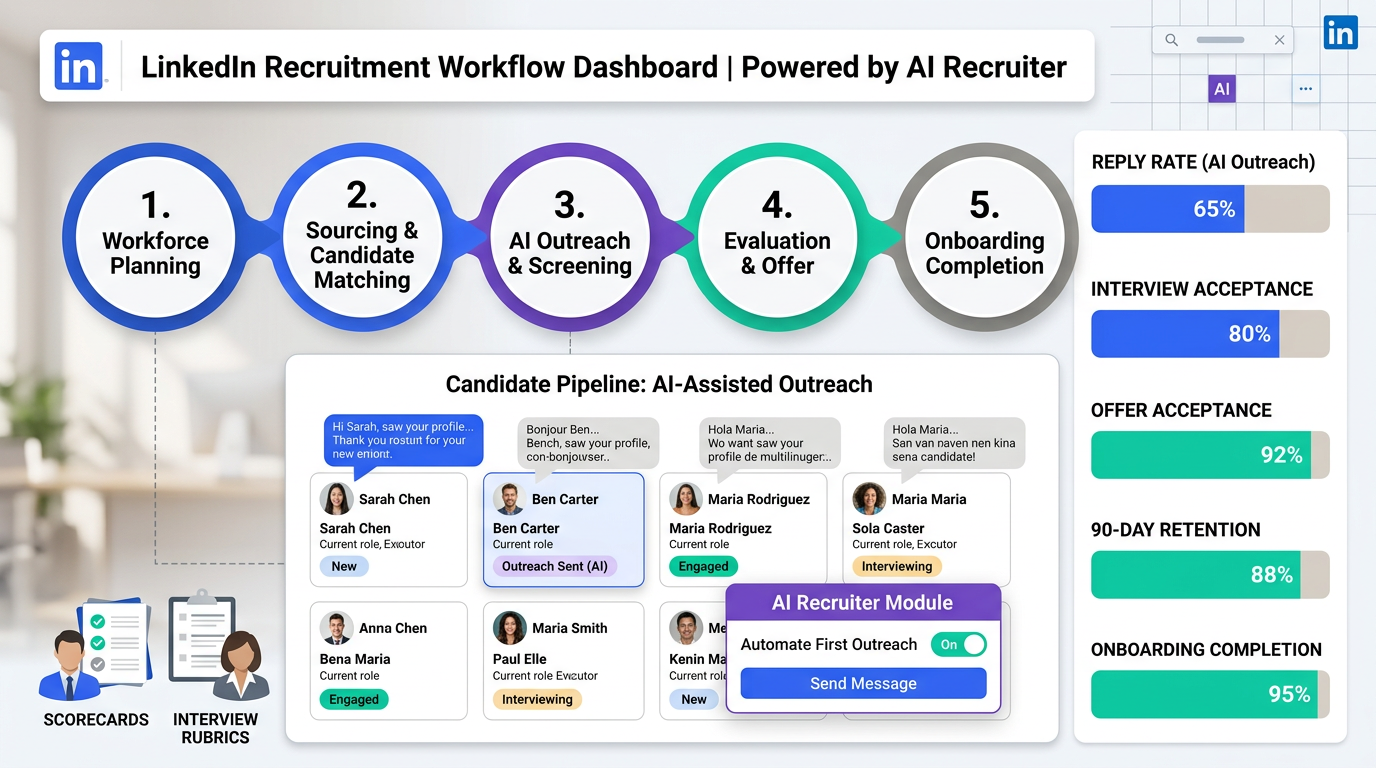
We rebuilt the process around five practical milestones so teams can run recruitment as an end to end operation instead of a single vacancy event.
1) Workforce Planning
Begin 3 to 6 months before expected demand. HR and leadership define skills gaps, internal mobility options, and role priorities. Output includes a role brief and competency map.
2) Interview Design and Calibration
HR creates interview rubrics and pass criteria. Recruiters validate market reality and compensation expectations. This reduces subjective screening and creates better candidate comparisons.
3) Hiring Decision
Recruiters present qualified candidates with structured evidence. Hiring managers and HR decide based on criteria alignment rather than resume volume.
4) Probation Review
At 90 days, teams evaluate early performance against onboarding goals. This is a critical quality checkpoint that many recruitment dashboards ignore.
5) Onboarding Completion
The process ends only when onboarding objectives are completed and role productivity is validated. This closes the loop between recruitment promises and workforce outcomes.
How StrategyBrain AI Recruiter Fits the Workflow
StrategyBrain AI Recruiter works best when it is embedded inside the milestone model instead of used as a standalone messaging tool.
In Workforce Planning
- Recruiters upload role details including compensation, benefits, and target profile criteria.
- The system prepares outreach logic aligned with defined candidate segments.
In Candidate Outreach and Engagement
- The platform automates LinkedIn connection and role introduction flows.
- It supports always on multilingual candidate communication to reduce delayed replies across time zones.
- It can ask screening intent questions and collect resumes and contact details from interested candidates.
In Team Scale
- Organizations can coordinate workflows across more than 100 LinkedIn accounts to expand sourcing coverage.
- Recruiters stay focused on shortlist quality and interview conversion instead of repetitive first touch tasks.
In our own pilot workflows, this model improved response consistency and reduced manual outreach load, while final fit decisions remained fully human led. That boundary is important for both quality and compliance.
Metrics That Keep the Process Honest
A candidate management software rollout fails when teams only report top of funnel activity. You need metrics across the full lifecycle.
| Stage | Metric | Target Definition | Owner |
|---|---|---|---|
| Outreach | First reply rate (%) | Qualified first replies divided by total targeted outreach | Recruitment |
| Screening | Interview acceptance rate (%) | Accepted interviews divided by qualified candidates contacted | Recruitment + HR |
| Selection | Offer acceptance rate (%) | Accepted offers divided by total offers sent | Hiring Manager + HR |
| Probation | 90 day retention rate (%) | Employees retained at day 90 divided by new hires | HR |
| Onboarding | Onboarding completion rate (%) | Employees completing onboarding objectives on time | HR + Department Lead |
We recommend reviewing these metrics monthly and running a formal process retrospective every quarter.
Implementation Steps
- Map your hiring workflow. Document each handoff from workforce planning to onboarding completion and assign clear owners.
- Define scorecards and data fields. Standardize competency ratings, interview notes, and pass criteria in one shared framework.
- Configure StrategyBrain AI Recruiter. Set role context, candidate criteria, and communication rules for LinkedIn outreach and follow up.
- Set compliance rules before launch. Confirm data retention practices, access permissions, and privacy controls in each hiring jurisdiction.
- Run a 30 day pilot. Start with one role family, compare against baseline metrics, and adjust prompts and qualification questions.
- Scale only after review. Expand to additional teams when probation and onboarding data confirm quality outcomes.
Limitations and Risk Controls
No candidate engagement software should be treated as an automatic hiring engine. StrategyBrain AI Recruiter can automate outreach and communication, but it does not replace human judgment on role fit, culture alignment, or legal hiring decisions.
- Risk: Over automation can create generic candidate experiences.
Control: Use role specific messaging and recruiter review checkpoints. - Risk: Poor job definitions produce poor candidate targeting.
Control: Require HR approval of role briefs before campaign launch. - Risk: Data handling gaps can create compliance exposure.
Control: Enforce encryption, access control, and documented consent practices.
FAQ
What is the difference between candidate management software and a talent management system?
Candidate management software focuses on sourcing, communication, screening, and pipeline progress for open roles. A talent management system is broader and includes development, performance, succession, and long term workforce planning.
Can AI Recruiter fully replace recruiters?
No. It automates repetitive front end tasks such as outreach and follow up. Recruiters and hiring managers still own final qualification, interviews, and hiring decisions.
How does this approach improve candidate engagement?
It reduces response delays and keeps communication consistent through automated, multilingual follow ups. Candidates receive faster answers, which improves interview conversion and experience quality.
Is this model suitable for global hiring teams?
Yes. The workflow supports multilingual candidate communication and can run across multiple LinkedIn accounts, which helps distributed teams maintain coverage across time zones.
What should we measure first after implementation?
Start with first reply rate, interview acceptance rate, and 90 day retention rate. These three indicators quickly show whether speed improvements are creating real hiring quality.
How long does it take to see results?
Most teams can observe early outreach and screening improvements within the first 30 days. Full quality validation requires at least one probation cycle.
Conclusion
Candidate management software delivers the strongest results when HR and recruiters run one shared system from planning to onboarding completion. That is the core lesson from this playbook. Use HR led role clarity, recruiter led market execution, and an AI layer like StrategyBrain AI Recruiter for repetitive communication and data capture. Then measure outcomes at each milestone, not just top funnel activity. If you start with one role family and run a disciplined 30 day pilot, you can improve speed without sacrificing hiring quality or trust.