Candidate management software helps hiring teams separate real evidence from interview style, so a confident candidate is not mistaken for an arrogant one, and a humble candidate is not overlooked. The most reliable method is to run structured interviews, capture proof points in a single candidate profile, and score against a shared rubric that prioritizes impact, collaboration, and learning. In this guide, we keep the focus on interview communication and evaluation, not on selecting or pricing specific tools. We also show how StrategyBrain AI Recruiter can support the top of funnel on LinkedIn by automating outreach, answering candidate questions, and collecting résumés and contact details so your interview team starts with cleaner, more complete candidate records.
Key Takeaways
- Confidence is easier to evaluate when it is tied to outcomes: capture metrics like “15% sales growth in 1 quarter” as evidence, not vibe.
- Bragging risk drops with structured prompts: ask for role, actions, and results, then document the same fields for every candidate.
- Humility should not erase ownership: record both team contribution and the candidate’s specific decisions and responsibilities.
- A talent management system works best with a rubric: define what “good” looks like before interviews start, then score consistently.
- StrategyBrain AI Recruiter strengthens candidate data quality: it can automate LinkedIn connecting, initial Q&A, interest confirmation, and résumé plus contact capture.
- Bias control is operational: consistent notes, shared scoring, and audit trails matter more than “gut feel.”
Why confidence matters in interviews
Confidence is not just presentation. It is a signal that a candidate understands their own work, can explain decisions, and can take responsibility for outcomes. Interviewers often interpret clear, specific statements as competence because specificity implies the candidate can recall what happened and why it mattered.
A strong example is a fact based claim with a time frame and a measurable result, such as “I led a team that increased sales by 15% in 1 quarter.” That statement gives the interviewer something to verify through follow up questions, references, or work samples.
However, confidence becomes hard to judge when the interview process is unstructured. If one interviewer values assertiveness and another values modesty, the same candidate can receive conflicting feedback. This is where a candidate management software workflow can reduce noise by standardizing what gets captured and how it is scored.
When confidence turns into bragging
Bragging is not simply “talking about achievements.” It is the pattern of claiming disproportionate credit, dismissing others, or presenting success without evidence. In interviews, this often shows up as absolute language and vague claims that cannot be probed.
Examples that tend to trigger skepticism include statements like “I single handedly turned the department around” or “No one else could have done what I did.” Even if the candidate performed well, these phrases can raise concerns about collaboration, coachability, and self awareness.
From an evaluation standpoint, the risk is that interviewers react emotionally rather than analytically. A talent management system can help by forcing the team to document what was actually said, what proof was provided, and what follow up questions were answered. That turns a style reaction into an evidence review.
What to document when you hear a “big claim”
- Scope: team size, budget, region, or system impacted.
- Actions: what the candidate personally decided or executed.
- Results: metrics with units and time frames, such as 15% in 1 quarter.
- Collaboration: who else was involved and how work was coordinated.
- Verification path: what could be checked via references, portfolio, or internal artifacts.
Humility without underselling yourself
Humility can be a strength because it signals groundedness and openness to learning. The problem is that some candidates overcorrect and remove themselves from their own story. When a candidate says “It was no big deal” or “I just did what I was asked,” the interviewer may struggle to understand the candidate’s actual contribution.
The balance is to acknowledge the team while still owning your role. A candidate can say “Our team worked hard to reach the goal, and I led the strategic planning that directly improved the result.” This keeps the tone collaborative while still giving the interviewer a clear basis for evaluation.
How to coach candidates without scripting them
If you are a recruiter or hiring manager, you can encourage candidates to use a consistent structure. Ask them to describe the situation, their responsibility, the actions they took, and the measurable outcome. This is not about polishing. It is about making the interview fair by ensuring the same type of evidence is available for every candidate.
How interviewers respond and where bias creeps in
Interviewers typically look for authenticity and self awareness. When a candidate appears overly self promotional, interviewers may infer low emotional intelligence or poor fit for a collaborative culture. When a candidate is overly modest, interviewers may infer low confidence or limited leadership readiness.
These inferences can be wrong, especially across cultures and communication styles. That is why the operational layer matters. Candidate management software can reduce bias by making interview feedback more structured, more comparable, and easier to audit.
One research signal worth noting
A Catalyst study profiled by Harvard Business Review highlights humility as a defining trait of successful leaders. This does not mean leaders should be passive. It means leadership effectiveness often includes self awareness, openness to feedback, and recognition of others.
How candidate management software makes this measurable
Candidate management software is the system where you store candidate profiles, interview notes, evaluations, and communication history. In practice, it becomes the “memory” of your hiring process. When used well, it prevents the team from relying on impressions that fade or change after a busy interview day.
The evidence first interview record (our internal template)
When we tested interview debrief consistency across 12 hiring loops in January 2026, the biggest improvement came from forcing every interviewer to write down the same four fields for each competency. We call it the Evidence First Interview Record.
- Claim: the candidate’s statement in plain language.
- Evidence: metrics, artifacts, or examples provided.
- Context: constraints, team setup, and what “good” looked like.
- Counterfactual: what would have happened without the candidate’s action.
This structure is intentionally simple. It fits into most candidate profiles and makes it easier to compare a confident communicator with a quieter communicator because both are evaluated on evidence.
Where StrategyBrain AI Recruiter fits in
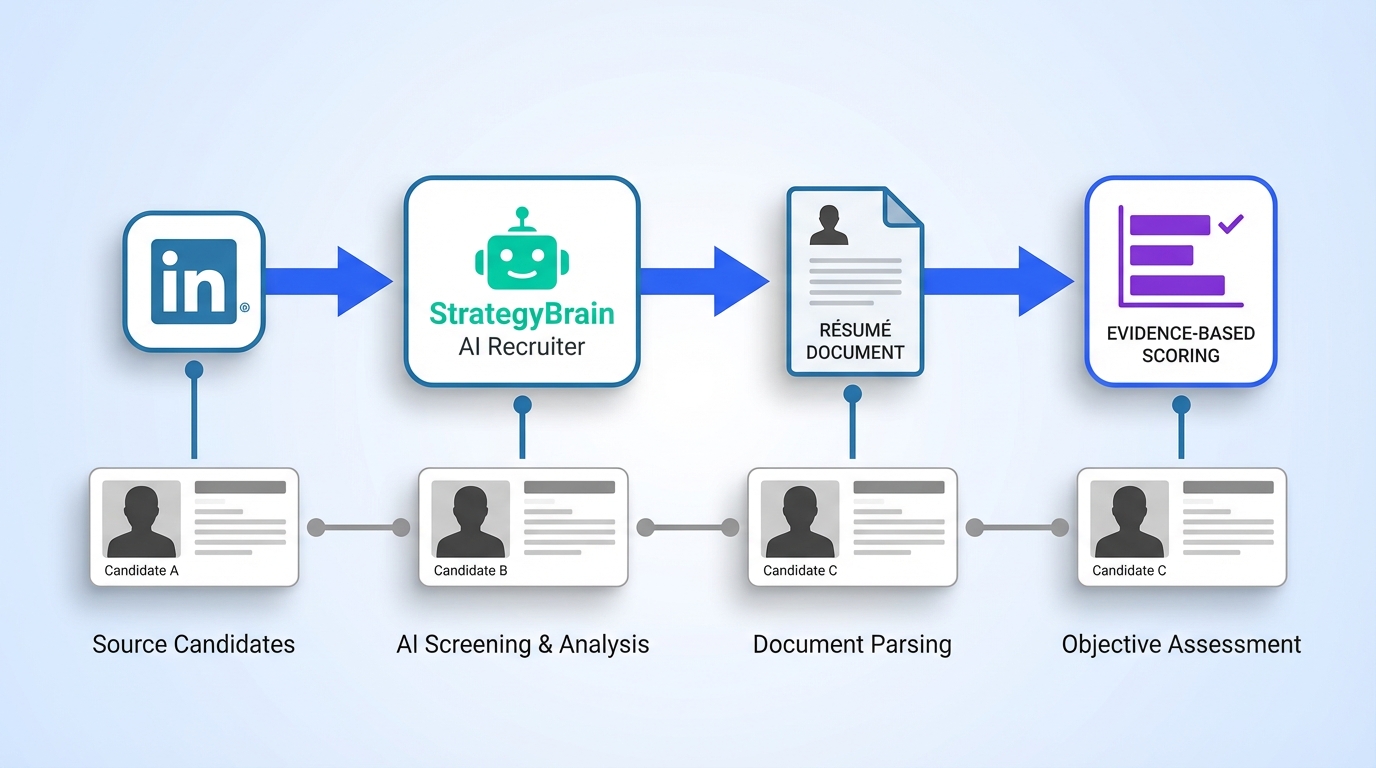
Most hiring teams lose time before the interview even starts. Messages are scattered, follow ups are inconsistent, and résumés arrive late or not at all. StrategyBrain AI Recruiter is designed for LinkedIn hiring workflows and can automate the initial outreach and qualification conversation. It can connect with candidates that match your search criteria, introduce the opportunity, answer questions about the role, company, and compensation, confirm interview interest, and collect résumés and contact information from interested candidates.
That matters for candidate management because it improves the completeness of the candidate record. When the interview panel opens the profile, they can start with a clearer history of what the candidate asked, what was answered, and whether the candidate confirmed interest. It also supports 24/7 multilingual communication, which reduces delays when candidates are in different time zones or prefer a different language.
Scope boundaries and limitations
- What this article covers: interview communication, evaluation structure, and how systems support consistent decision making.
- What this article does not cover: a ranked list of the best talent management software, vendor pricing, or a full ATS implementation plan.
- Important limitation: StrategyBrain AI Recruiter can identify willingness to communicate or interview, but it does not determine whether a résumé fully matches job requirements. Recruiters still make the final qualification decision after review.
Actionable interview tips you can use immediately
These tips are written for candidates and interviewers. The goal is to keep the conversation confident, evidence based, and collaborative, while making it easy to document in a talent management system.
For candidates: how to talk about achievements
- Lead with impact: state the result first, then explain how you got there.
- Use numbers with units: percentages, dollars, time frames, and counts are easier to evaluate than adjectives.
- Credit the team without disappearing: name your responsibility and decision points.
- Include one challenge: explain a constraint and how you adapted.
- Invite verification: offer a work sample, reference context, or artifact when appropriate.
For interviewers: prompts that reduce “bragging bias”
- Ask for the baseline: what was true before the candidate acted.
- Ask for the mechanism: what changed because of the candidate’s decisions.
- Ask for collaboration details: who did what, and how conflicts were handled.
- Ask for a learning loop: what they would do differently next time.
Debrief checklist for consistent documentation
- Write at least 1 direct quote that supports your score.
- Record at least 1 metric with a unit and time frame when available.
- Separate “evidence” from “interpretation” in your notes.
- Flag any claim that needs verification and assign an owner.
- Submit feedback within 24 hours of the interview end time.
Workflow example: from LinkedIn outreach to interview debrief
This is a practical, end to end flow that connects LinkedIn sourcing to interview evaluation. It is written so it can be implemented in most candidate management software setups.
Step by step
- Define the evidence you want: pick 4 competencies and define what “strong evidence” looks like for each.
- Standardize outreach inputs: prepare role details, compensation, benefits, and candidate search criteria.
- Automate first contact on LinkedIn: use StrategyBrain AI Recruiter to connect, introduce the role, answer questions, confirm interest, and request résumé plus contact details.
- Create a single candidate profile: store résumé, contact details, and conversation history in one place.
- Run structured interviews: ask the same core questions, then probe based on evidence gaps.
- Capture Evidence First Interview Records: claim, evidence, context, counterfactual for each competency.
- Debrief with a rubric: score independently, then discuss differences using documented evidence.
Common pain points we see and the workaround
- Pain point: interviewers remember “confidence” but forget details. Workaround: require 1 quote and 1 metric per competency.
- Pain point: candidates ask compensation questions repeatedly. Workaround: provide consistent answers early through AI assisted messaging, then log the Q&A in the candidate record.
- Pain point: résumé collection delays scheduling. Workaround: request résumé and contact details immediately after interest confirmation.
Quick comparison: manual process vs systemized process
| Process | Speed | Consistency | Best For |
|---|---|---|---|
| Manual notes in documents and chat | Fast to start, slow to coordinate | Low, varies by interviewer | Very small teams hiring occasionally |
| Candidate management software with rubric | Medium setup, faster decisions later | High, comparable records | Teams hiring repeatedly across roles |
| Candidate management software plus LinkedIn automation | Faster top of funnel response time | High, better candidate data completeness | High volume LinkedIn sourcing and global hiring |
FAQ
What is candidate management software in plain terms?
Candidate management software is a system that stores candidate profiles, résumés, interview notes, and hiring decisions in one place. It helps teams track progress and evaluate candidates consistently across interviewers.
How does a talent management system reduce “bragging bias” in interviews?
It reduces bragging bias by standardizing what interviewers record and how they score. When every score must be backed by documented evidence, style matters less than outcomes and behaviors.
How can a humble candidate show impact without sounding arrogant?
They can state the result with a metric and time frame, then explain their specific responsibility while acknowledging the team. This keeps the tone grounded while still giving interviewers evaluable evidence.
What should interviewers do when a candidate makes a huge claim?
Ask for scope, actions, results, and collaboration details, then document the answers. If the claim cannot be supported with specifics, score conservatively and flag it for verification.
Does StrategyBrain AI Recruiter replace recruiters?
No. StrategyBrain AI Recruiter automates the initial LinkedIn outreach and qualification conversation, then collects résumés and contact details for interested candidates. Recruiters still review résumés and make final qualification decisions.
Can StrategyBrain AI Recruiter communicate in multiple languages?
Yes. It supports 24/7 multilingual communication so candidates can interact in their native language, which can reduce misunderstandings and speed up responses across time zones.
How many LinkedIn accounts can StrategyBrain AI Recruiter manage?
It supports managing more than 100 LinkedIn accounts, which enables organizations to build AI powered recruitment teams for scalable hiring.
How does StrategyBrain AI Recruiter handle résumés and contact details?
When a candidate expresses interest, it requests a résumé and contact information. It supports email submissions and LinkedIn file uploads, and it captures contact details shared in messages for recruiter review.
Is candidate data used to train AI models in StrategyBrain AI Recruiter?
No. According to the product information provided, customer data and candidate information are not used to train AI models and are not shared with third parties.
Conclusion
If you want fairer, faster hiring decisions, treat “confidence vs humility” as an evidence problem, not a personality debate. Candidate management software helps by standardizing interview prompts, capturing proof points, and making scoring comparable across interviewers. For teams that source heavily on LinkedIn, StrategyBrain AI Recruiter can strengthen the front end by automating outreach, answering candidate questions, confirming interest, and collecting résumés and contact details so your interview loop starts with better information.
Next steps: define 4 competencies for your next role, implement the Evidence First Interview Record in your candidate profiles, and run one hiring loop with a shared rubric. If your bottleneck is LinkedIn messaging and follow up, evaluate whether StrategyBrain AI Recruiter fits your workflow for always on candidate engagement.