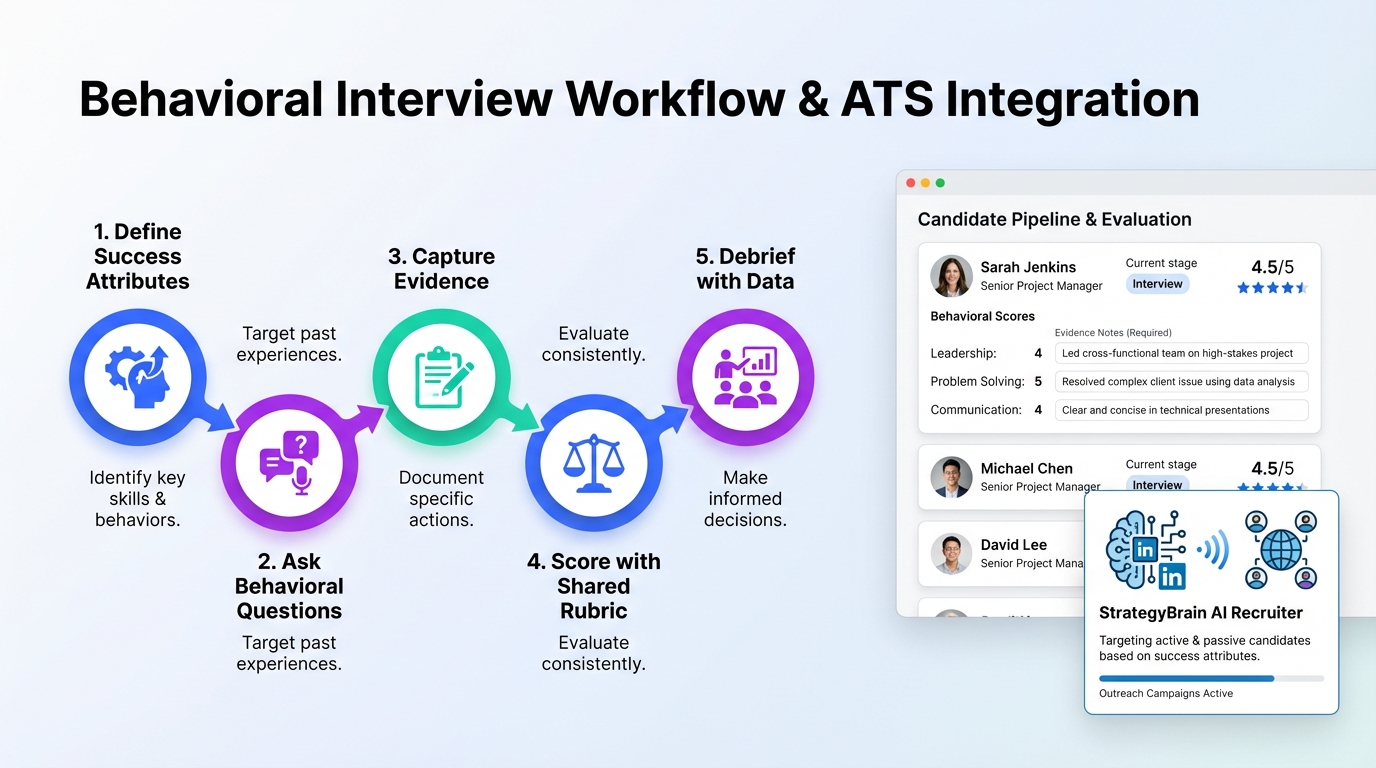
The most reliable way to improve hiring decisions is to combine behavioral interviews with candidate tracking software that forces consistency. Google’s former Senior Vice President of People Operations, Laszlo Bock, said brainteasers were “a complete waste of time” after Google studied thousands of interviews and found zero correlation between interviewer ratings and on the job performance. The practical takeaway is simple: ask job relevant behavioral questions, score answers with a shared rubric, and store evidence in an ATS tracking system so every hiring decision is auditable. In this guide, we show a repeatable workflow, a copyable scorecard, and how StrategyBrain AI Recruiter can automate LinkedIn outreach and resume collection so recruiters focus on evaluation instead of repetitive messaging.
Table of Contents
Key Takeaways
- Behavioral interviews work because they ask for real past actions, not hypotheticals, and Google leadership publicly recommended them over brainteasers.
- A strong ATS tracking system should standardize questions, store evidence, and enforce a consistent scoring rubric across interviewers.
- Listen for tangible results and document them as evidence, not impressions, inside your candidate tracking software.
- Use follow up drilldowns to get beyond rehearsed answers and capture the candidate’s specific contribution.
- StrategyBrain AI Recruiter can automate LinkedIn connecting, initial outreach, Q and A, and resume plus contact capture, reducing manual recruiting work by up to 90% per product documentation.
- For scale, StrategyBrain supports managing more than 100 LinkedIn accounts to run an AI powered recruiting team, per product documentation.
Why behavioral interviews beat brainteasers
Classic “impossible” interview puzzles used to be associated with elite hiring. The problem is that they can feel clever while producing weak signal. Laszlo Bock explained that Google analyzed thousands of interviews and found zero correlation between interviewer ratings and on the job performance, and concluded that brainteasers were not worth the time.
Behavioral interviews are different because they ask candidates to draw on real experience. Instead of “What would you do if…”, you ask “Tell me about a time when you did…”. That shift matters because it gives you two things: evidence of what the candidate actually did, and insight into what they consider difficult or important.
What candidate tracking software should enforce
Candidate tracking software is not just a database. In a high quality process, it is the system that prevents interview drift and makes decisions defensible. An applicant tracking enterprise setup is especially dependent on this because multiple interviewers and multiple roles amplify inconsistency.
Minimum controls to build into your ATS tracking system
- Job relevant question sets tied to defined attributes for the role.
- Benchmarking by asking the same core questions to every applicant for the same role.
- Rubric based scoring so interviewers rate against shared definitions, not personal preference.
- Evidence capture fields for metrics, outcomes, and the candidate’s specific contribution.
- Follow up prompts that encourage drilldowns when answers are vague.
A repeatable behavioral interview workflow
We have used this workflow to keep interviews consistent across interviewers and to reduce “gut feel” decisions. It is designed to be implemented directly inside candidate tracking software so the process is the same for every candidate.
Step by step
- Define 3 to 5 success attributes for the role and write them in plain language. Example attributes include analytical problem solving, stakeholder management, and execution under ambiguity.
- Write 2 behavioral questions per attribute that force a real example. Example: “Give me an example of a time when you solved an analytically difficult problem.”
- Standardize the interview kit in your ATS tracking system so every interviewer uses the same question set and scorecard.
- Run the interview and capture evidence by documenting what happened, what changed, and what the candidate personally did. Watch for vague “we” statements and ask for the candidate’s specific contribution.
- Use drilldown follow ups to push beyond rehearsed answers. Use prompts like “Tell me more about X” and “What did you do next”.
- Score immediately using the rubric and require a short evidence note for each score so ratings are explainable later.
- Debrief with the rubric, not opinions and make the hiring decision based on attribute level evidence across interviewers.
Copyable rubric and scorecard template
Below is a practical template you can paste into your candidate tracking software as an interview scorecard. It is intentionally simple so it works for both small teams and applicant tracking enterprise environments.
Behavioral interview scorecard (template)
| Attribute | Question | Evidence to capture | Score (1 to 5) | Evidence notes (required) |
|---|---|---|---|---|
| Analytical problem solving | Describe a time you solved a difficult problem with data. | Inputs used, constraints, decision, measurable outcome | 1 2 3 4 5 | What they did and what changed |
| Execution | Tell me about a time you delivered under tight deadlines. | Plan, tradeoffs, risks, delivery result | 1 2 3 4 5 | Specific contribution vs team effort |
| Stakeholder management | Give an example of influencing without authority. | Stakeholders, conflict, approach, outcome | 1 2 3 4 5 | How they handled pushback |
Scoring definitions (keep consistent across interviewers)
- 5: Clear ownership, strong reasoning, measurable impact, and thoughtful reflection on tradeoffs.
- 3: Solid example with some evidence, but limited depth, unclear tradeoffs, or partial ownership.
- 1: Vague, hypothetical, or no clear personal contribution and no verifiable outcome.
Where StrategyBrain AI Recruiter fits in the workflow
Behavioral interviews only work when you have enough qualified candidates in the pipeline and enough recruiter time to run structured interviews well. This is where StrategyBrain AI Recruiter fits naturally into the same operating model as candidate tracking software.
What we automate before the interview
- LinkedIn outreach and follow up: AI Recruiter automatically connects with candidates that match your search criteria and introduces the role using your company and compensation details.
- Candidate Q and A: It answers questions about the role, company, benefits, and compensation so recruiters do not repeat the same explanations.
- Interest confirmation: It confirms interview interest and captures intent signals so your ATS tracking system is not filled with unresponsive leads.
- Resume and contact capture: It requests resumes and contact details from interested candidates and records what was received.
Operational benefits for an applicant tracking enterprise team
In our experience, the biggest failure mode in enterprise hiring is not the interview questions. It is the time cost of manual outreach and inconsistent follow up across recruiters. StrategyBrain AI Recruiter is designed to reduce that load by replacing up to 90% of manual LinkedIn recruiting work, and it can manage more than 100 LinkedIn accounts to scale outreach across teams, based on StrategyBrain product documentation.
Because AI Recruiter can communicate 24/7 in the candidate’s native language, it also reduces delays that often cause drop off between first contact and scheduled interviews. That gives your interviewers more time to do what matters: run structured behavioral interviews and document evidence in candidate tracking software.
Scope boundaries and limitations
- AI Recruiter does not replace final qualification: It can identify willingness to communicate or interview, but it does not decide whether a resume fully matches job requirements. Recruiters still review resumes and make the final call.
- Candidate tracking software still matters: You still need an ATS tracking system to store scorecards, evidence, and hiring decisions in a consistent way.
Common mistakes and how to fix them
- Mistake: Questions are not job relevant. Fix: Build questions from the role’s success attributes and keep them tied to real work outcomes.
- Mistake: Each interviewer improvises. Fix: Use a standardized interview kit in your candidate tracking software and require the same core questions for every applicant.
- Mistake: Scores without evidence. Fix: Make evidence notes mandatory for each score so ratings are explainable and comparable.
- Mistake: Accepting vague “we” answers. Fix: Ask follow ups until the candidate’s specific contribution is clear.
- Mistake: Pipeline work crowds out interview quality. Fix: Automate repetitive LinkedIn outreach and follow up with StrategyBrain AI Recruiter so recruiters can focus on structured evaluation.
FAQ
What is candidate tracking software in practical terms?
Candidate tracking software is the system that stores applicants, interview stages, and evaluation records. In a strong process, it also enforces standardized questions, scorecards, and evidence notes so hiring decisions are consistent and auditable.
What is an ATS tracking system and how is it different?
An ATS tracking system is a type of candidate tracking software focused on applicant workflow, compliance, and hiring operations. In enterprise settings, it often includes permissions, reporting, and structured evaluation templates.
Why did Google stop using brainteasers?
Laszlo Bock said Google studied thousands of interviews and found zero correlation between interviewer ratings and on the job performance, and concluded brainteasers were a waste of time. Google shifted emphasis toward behavioral interviews.
How many behavioral questions should we ask per interview?
A practical starting point is 6 to 10 core behavioral questions per role, mapped to 3 to 5 success attributes. Keep the core set consistent across candidates and use follow ups to go deeper when needed.
How do we keep multiple interviewers consistent in an applicant tracking enterprise process?
Use one shared rubric, require the same core questions for every candidate, and make evidence notes mandatory in the ATS tracking system. Consistency comes from process controls, not from training alone.
Does StrategyBrain AI Recruiter replace recruiters?
No. StrategyBrain AI Recruiter automates repetitive LinkedIn tasks like connecting, initial messaging, answering common questions, confirming interest, and collecting resumes and contact details. Recruiters still review resumes, run interviews, and make final hiring decisions.
Can StrategyBrain AI Recruiter help with global hiring?
Yes. StrategyBrain AI Recruiter supports 24/7 multilingual communication so candidates can interact in their native language across time zones, based on product documentation.
How does StrategyBrain AI Recruiter handle privacy and security?
StrategyBrain states it complies with privacy regulations in the EU, United States, and Canada, does not use customer provided data to train AI models, and encrypts and isolates customer data with customer specific keys, per product documentation.
Conclusion
If you want better hiring outcomes in 2026, start with behavioral interviews and make them consistent. Use candidate tracking software to standardize questions, enforce a rubric, and capture evidence so decisions are comparable across interviewers. Then protect recruiter time by automating repetitive LinkedIn outreach and resume collection with StrategyBrain AI Recruiter. Your next step is to build a role specific attribute list, publish a standardized scorecard in your ATS tracking system, and run your next hiring loop with evidence based debriefs.