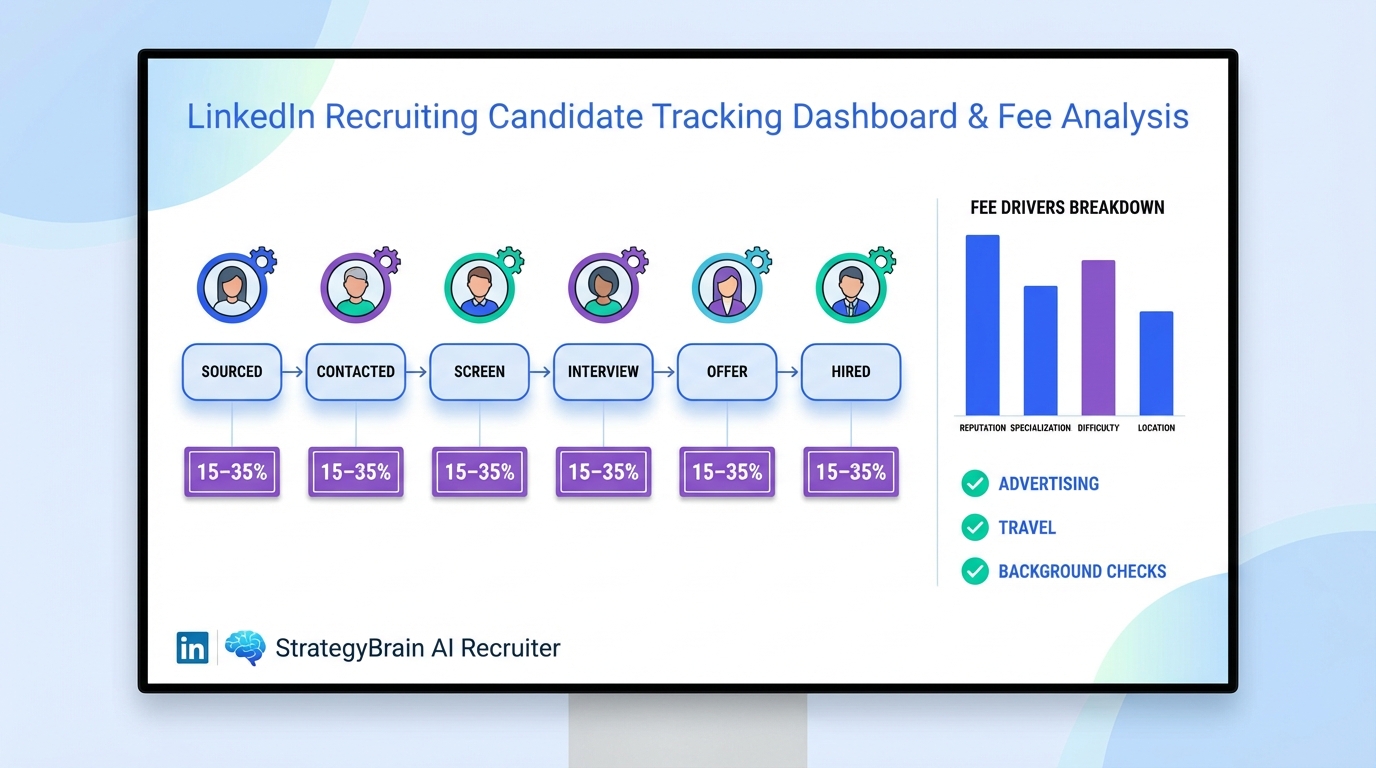
If you want predictable hiring costs, the most reliable setup is a clear fee agreement plus a candidate tracking tool that logs every stage, owner, and cost line item. In Canada, headhunter fees are commonly priced as 15% to 35% of the candidate’s first year salary, with an average around 20%, and some recruiters may charge a flat fee for lower level roles. This article explains what drives those numbers, what extra costs to confirm upfront, and how to operationalize the process with an applicant tracking system for small business or a lightweight recruitment tracker. We also connect the workflow to LinkedIn execution, where StrategyBrain AI Recruiter can automate initial outreach, answer candidate questions, and capture résumés and contact details so your tracking stays complete.
Table of Contents
Key Takeaways
- Typical Canada headhunter fee: 15% to 35% of first year salary, with an average around 20% (Source: Red Seal Recruiting, accessed 2026-02-25).
- Flat fees exist: Some recruiters use a flat fee for lower level roles (Source: Red Seal Recruiting, accessed 2026-02-25).
- Track more than stages: A candidate tracking tool should also track fee terms, add on costs, and decision timestamps to prevent surprises.
- Ask about extras upfront: Advertising, travel, and background checks can be billed separately (Source: Red Seal Recruiting, accessed 2026-02-25).
- Small teams can start simple: A spreadsheet recruitment tracker can work if you enforce ownership and weekly hygiene.
- LinkedIn outreach is often the bottleneck: StrategyBrain AI Recruiter can automate connecting, initial messaging, follow up, and résumé collection so your pipeline data stays current.
What a candidate tracking tool should track for agency hiring
A candidate tracking tool is any system that records where each applicant is in your hiring process and what actions happened at each step. In agency or headhunter assisted hiring, tracking needs to cover more than interview stages because the fee is tied to outcomes and timing.
In our own recruiting operations, the failures we see most often are not “we forgot the candidate,” but “we cannot reconstruct what happened,” which makes it hard to challenge an invoice, explain a rejection, or improve the funnel.
Minimum fields we recommend
- Candidate identity: name, role, location, source, and who owns the relationship.
- Stage history: each stage change with a date and the person who moved it.
- Agency terms: percentage or flat fee, what counts as a placement, and any guarantee window if applicable.
- Cost ledger: fee estimate, plus add on costs such as advertising, travel, and background checks when they apply.
- Decision notes: short, factual notes that explain pass or fail criteria.
Scope boundaries
This guide focuses on tracking and cost clarity for headhunter assisted hiring and LinkedIn heavy sourcing. It does not provide legal advice, and it does not attempt to standardize contract clauses because those vary by firm and role.
Canada headhunter fees explained
In Canada, headhunters, also called executive recruiters or recruitment agencies, commonly charge a fee based on a percentage of the candidate’s first year salary. The percentage range cited in the source material is 15% to 35%, with an average around 20%. The same source also notes that some headhunters may charge a flat fee, especially for lower level positions.
From a tracking perspective, the key is that percentage based pricing makes your “cost per hire” sensitive to compensation changes. If the offer changes late in the process, your fee estimate changes too, so your recruitment tracker should update automatically or be reviewed at offer stage.
What drives headhunter fees in practice
Fees vary because the work varies. The source material highlights several drivers that influence what a headhunter charges. When we map those drivers into a candidate tracking tool, we can predict where time and cost will spike.
1) Recruiter expertise and reputation
Headhunters with a strong track record placing candidates in high level roles may command higher fees. In a tracking system, we recommend recording the agency, the lead recruiter, and the role level so you can compare outcomes across partners over time.
2) Industry specialization
Specialized industries can require specialized recruiters. If you are using an applicant tracking system for small business, add a field for “domain specialization required” so you can segment performance and avoid comparing unlike roles.
3) Difficulty of the search
Hard to fill roles can require more time and resources, which can increase fees. Your recruitment tracker should capture “hard to fill” signals such as required certifications, remote location, or niche tooling, then tie those signals to time to shortlist.
4) Location factors
Roles in remote or less desirable locations can command higher fees. In practice, we track location as a structured field, not free text, so we can report on which locations consistently extend time to hire.
Extra costs to confirm before you sign
Beyond the percentage or flat fee, the source material notes that additional costs may appear in the recruitment process. Examples include advertising costs, travel expenses, and background checks. The operational takeaway is simple: confirm what is included and what is billed separately before the search starts.
Practical checklist you can copy into your candidate tracking tool
- Fee basis: percentage of first year salary or flat fee.
- What triggers the fee: accepted offer, start date, or another milestone.
- What is excluded: advertising, travel, background checks, assessments.
- Approval workflow: who must approve add on costs before they are incurred.
- Invoice mapping: which fields in your recruitment tracker must match the invoice line items.
5 ways to track candidates and costs (from simple to scalable)
Below are five practical methods we have used or audited for small teams. Each method can work if you enforce consistent stage definitions and ownership. The difference is how reliably the system stays current when hiring volume increases.
Method 1: Spreadsheet recruitment tracker (fastest to start)
This is the quickest option when you need a candidate tracking tool today. It is also the easiest to break when multiple people edit it without rules.
Steps
- Create a single source of truth: one sheet, one owner, one weekly review time.
- Standardize stages: for example Sourced, Contacted, Screen, Interview, Offer, Hired, Rejected.
- Add cost columns: fee type, fee percent, estimated fee, and add on costs.
- Log every stage change: include date and who moved it.
Limitations
- No built in permissions or audit trail unless you enforce it manually.
- Follow ups can be missed when reminders are not automated.
Method 2: Kanban board for pipeline visibility
A Kanban board is a visual recruitment tracker where each candidate is a card moved across columns. It is great for visibility, but cost tracking is often an afterthought unless you add custom fields.
Best for
- Teams that need a shared view of workload and bottlenecks.
- Roles with a simple interview loop.
Method 3: Applicant tracking system for small business (ATS)
An ATS is software designed to manage applicants, stages, and communications. For small businesses, the value is consistency: structured stages, templates, and reporting. If you use agencies, ensure the ATS can store fee terms and export a cost report per hire.
What to configure first
- Stage definitions: keep them stable so reports remain comparable.
- Source taxonomy: agency, referral, inbound, LinkedIn, and so on.
- Cost fields: fee model and add on costs.
Method 4: CRM style candidate tracking tool (relationship first)
If you recruit continuously, a CRM style approach can outperform a job based ATS because it treats candidates as long term relationships. This is useful when you want to re engage silver medalists and reduce agency dependence over time.
Limitations
- Requires discipline to avoid duplicate records and stale data.
- Reporting can be harder if the system is not designed for hiring metrics.
Method 5: LinkedIn execution plus automation with StrategyBrain AI Recruiter
Many teams already have a tracking system, but the pipeline goes stale because outreach and follow up are manual. StrategyBrain AI Recruiter is designed to handle the repetitive LinkedIn steps that cause that staleness. It can automatically connect with candidates within your criteria, introduce the role, answer questions about the company, compensation, and benefits, confirm interview interest, and collect résumés and contact information from interested candidates.
In our experience, this matters for tracking because the best recruitment tracker is only as accurate as the last interaction. When messaging happens consistently, stage movement becomes a routine update instead of a weekly cleanup project.
What it automates
- Initial outreach: connecting and starting the conversation.
- Qualification for interest: confirming whether the candidate wants to proceed.
- Information capture: collecting résumés and contact details shared in messages.
- Follow up: responding 24 hours a day in the candidate’s native language.
Important limitation to track correctly
StrategyBrain AI Recruiter can identify willingness to communicate or interview, but it does not decide whether the résumé fully matches job requirements. Your team still needs a structured review step in the applicant tracking system for small business or recruitment tracker.
Where StrategyBrain AI Recruiter fits in a LinkedIn workflow
LinkedIn hiring often fails at the same point: the recruiter cannot keep up with message volume, time zones, and follow ups. StrategyBrain AI Recruiter is built specifically for LinkedIn recruiting and can run conversations continuously, including multilingual communication. It also supports managing more than 100 LinkedIn accounts for organizations that want to scale outreach through an AI powered recruiting team.
A simple operating model we recommend
- Define search criteria: role, seniority, location, and must have skills.
- Provide job context: company details, compensation, and benefits so candidate questions can be answered consistently.
- Automate outreach and follow up: let the AI handle the first conversations and reminders.
- Review the captured résumés: recruiters screen for fit and schedule interviews.
- Update your candidate tracking tool: ensure each candidate record includes the latest status and any documents received.
Quick comparison
| Method | Setup time | Cost tracking | Best for |
|---|---|---|---|
| Spreadsheet recruitment tracker | 30 minutes | Manual | Very small teams hiring occasionally |
| Kanban board | 1 hour | Partial | Pipeline visibility and weekly standups |
| Applicant tracking system for small business | 1 to 7 days | Structured | Repeatable hiring with reporting needs |
| CRM style candidate tracking tool | 3 to 14 days | Variable | Ongoing talent pools and re engagement |
| StrategyBrain AI Recruiter for LinkedIn execution | Depends on account and role setup | Improves data freshness by automating outreach | Teams where LinkedIn messaging and follow up are the bottleneck |
FAQ
What is a candidate tracking tool in recruiting?
A candidate tracking tool is a system that records each candidate’s stage, interactions, and decisions across the hiring process. It can be a spreadsheet recruitment tracker, a Kanban board, or an applicant tracking system for small business.
How much does it cost to hire a headhunter in Canada?
The source material states that headhunters in Canada typically charge 15% to 35% of the candidate’s first year salary, with an average around 20%. Some may charge a flat fee for lower level roles.
What extra costs should we ask about besides the headhunter fee?
The source material lists advertising costs, travel expenses, and background checks as potential additional costs. Ask what is included, what is billed separately, and what requires pre approval.
Can a recruitment tracker help us negotiate agency fees?
Yes, because it gives you a factual record of timelines, stage movement, and outcomes. While it does not guarantee lower fees, it improves your ability to compare partners and discuss process efficiency with evidence.
What is the difference between an ATS and a recruitment tracker?
An ATS is dedicated software for managing applicants, communications, and reporting. A recruitment tracker is the broader concept and can be as simple as a spreadsheet or board, as long as it tracks stages and actions consistently.
How does StrategyBrain AI Recruiter help with candidate tracking?
StrategyBrain AI Recruiter automates LinkedIn outreach, follow up, and early conversations, then captures résumés and contact details from interested candidates. That makes it easier to keep your candidate tracking tool current because fewer interactions are missed.
Does StrategyBrain AI Recruiter replace recruiter judgment?
No. It can confirm interest and collect information, but it does not determine whether a résumé fully matches job requirements. Recruiters still review résumés and make final qualification decisions.
Is StrategyBrain AI Recruiter multilingual?
Yes. The product information states it can communicate in any global language and respond 24 hours a day, which is useful for international hiring and time zone coverage.
How does StrategyBrain AI Recruiter handle data privacy?
The product information states that customer provided data is not used to train AI models, and that credentials and candidate data are encrypted and isolated per customer. For compliance needs, confirm your internal requirements and document them in your hiring workflow.
Conclusion
Headhunter fees in Canada are commonly structured as 15% to 35% of first year salary, with an average around 20%, and flat fees can appear for lower level roles. The practical way to stay in control is to run the process through a candidate tracking tool that records fee terms, add on costs, and stage history, then review it weekly.
Next steps: choose the lightest system your team will actually maintain, add the cost and terms fields before the search starts, and if LinkedIn outreach is slowing you down, consider integrating StrategyBrain AI Recruiter into the workflow so follow ups, résumé capture, and early qualification stay consistent.