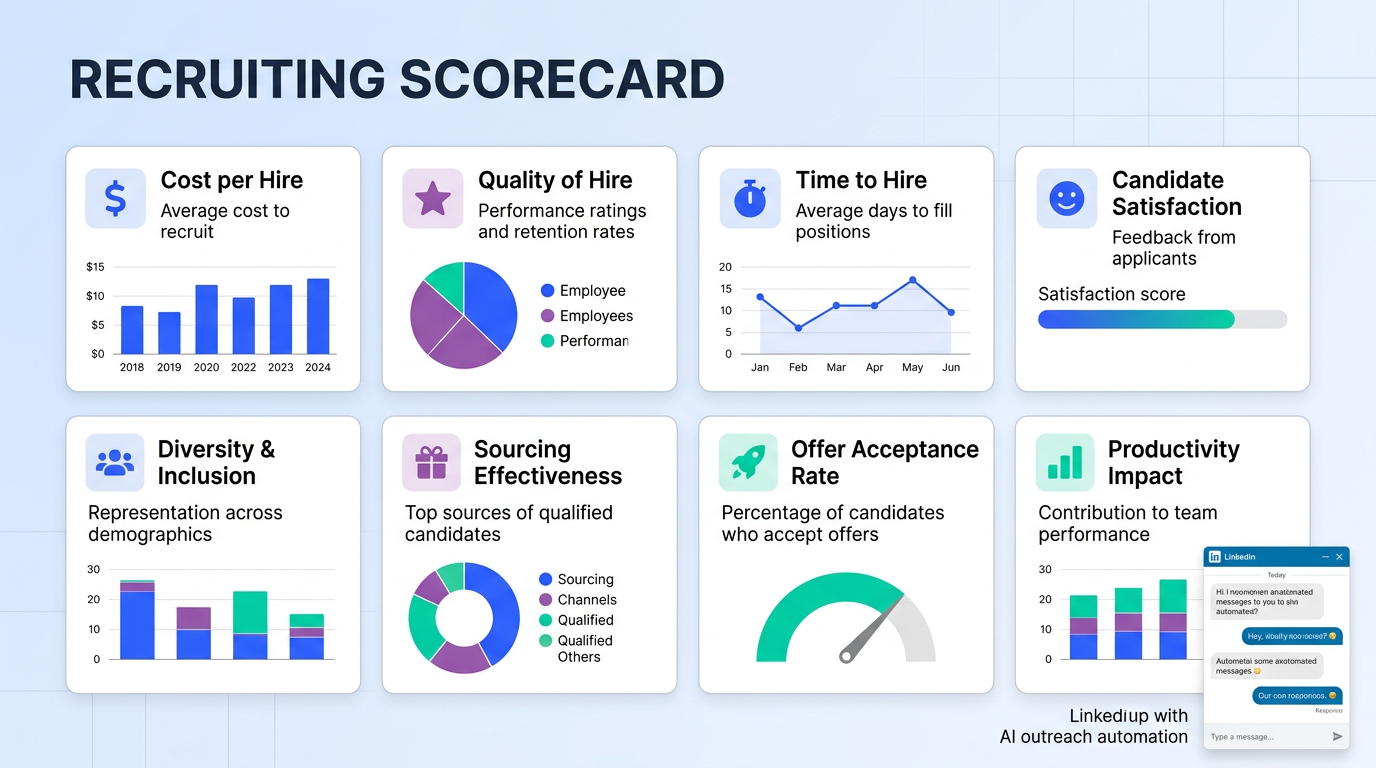
If you are choosing or auditing a candidate tracking tool, the fastest way to get value is to treat it as a measurement system, not a filing cabinet. Start by defining a recruiting scorecard, then track eight core metrics: cost per hire, quality of hire, productivity impact, time to hire, candidate satisfaction, rewards alignment, and a short list of business specific measures like diversity and time to productivity. In our recruiting operations work, we have found that teams improve faster when the metrics are reviewed on a fixed cadence and tied to specific process changes. This guide explains what to measure, how to calculate each metric, and where StrategyBrain AI Recruiter can reduce manual LinkedIn outreach and follow up by automating initial conversations and capturing resumes and contact details. This article does not cover payroll analytics, background checks, or legal advice.
Key Takeaways
- Make measurement non optional: a candidate tracking tool works best when every hiring goal has a defined metric and owner.
- Cost per hire needs a business case: convert recruiting outcomes into dollars so leaders can compare investments.
- Quality of hire is the anchor metric: if you only track one, track new hire performance outcomes.
- Time to hire is both speed and coordination: delays often come from interview scheduling and slow decision loops.
- Candidate satisfaction is measurable: survey applicants and new hires to find friction points in the process.
- Automated outreach changes the funnel: StrategyBrain AI Recruiter can handle initial LinkedIn messaging and follow up so recruiters focus on final qualification.
Why metrics matter in candidate tracking
Candidate tracking is only as useful as the decisions it enables. When teams say their hiring is slow or expensive, the root problem is usually that the process is not instrumented. A candidate tracking tool should make it easy to answer basic questions like which sources produce strong hires, where candidates drop off, and how long each stage takes.
Mid year is also a practical checkpoint. If you wait until the end of the year, you lose the chance to correct course while roles are still open and teams are still feeling the impact of vacancies.
Metric 1: Make metrics a requirement
Agree upfront that you cannot improve what you do not measure. This is the foundation of a recruiting scorecard. For every major hiring goal, define a metric, define how it is calculated, and assign an owner who reviews it on a schedule.
In practice, this means your candidate tracking tool should support consistent stage definitions, timestamps, and source attribution. Without those basics, downstream metrics become debates instead of signals.
What to set up first
- Stage definitions: applied, screened, interview, offer, accepted, started.
- Required fields: source, role, location, recruiter, hiring manager.
- Review cadence: weekly for pipeline health, monthly for cost and quality trends.
Metric 2: Cost per hire
Cost per hire is where recruiting becomes legible to finance. The goal is not to minimize spend at all costs. The goal is to understand what you are paying for outcomes and to build a business case for investing in better hiring.
How to calculate cost per hire
- Internal costs: recruiter time, hiring manager time, interview time, tools.
- External costs: job ads, agencies, assessments, background checks.
- Formula: total recruiting costs for a period divided by number of hires started in that period.
Also track the cost of a bad hire. Even if you do not publish that number broadly, it helps leaders understand why quality of hire and retention are not optional.
Metric 3: Quality of hire
If you only measure one metric, measure quality of hire. In operational terms, quality of hire is the relative success rate of new hires on the job. Many teams approximate it using a combination of performance review outcomes, ramp time, and manager satisfaction.
Practical proxies for small teams
- 90 day manager rating: a simple 1 to 5 scale with defined anchors.
- Time to productivity: days from start date to first measurable output.
- Retention checkpoint: still employed at 180 days, yes or no.
For an applicant tracking system for small companies, the key is consistency. A simple, repeatable proxy beats a complex model that nobody maintains.
Metric 4: Productivity impact
After quality of hire, the next question is whether hiring and retention are improving workforce productivity. One classic approach is revenue per employee, calculated as total revenue divided by number of employees. The point is not to reduce people. The point is to understand whether hiring decisions are improving output per headcount over time.
Use this metric carefully. It is most meaningful when compared within the same business model and when you control for major changes like pricing, product launches, or acquisitions.
Metric 5: Time to hire
Time to hire is the number of days from the start of the process to the moment an offer is accepted. Track it by role family and by hiring manager, because bottlenecks are often local. Fast recruiting is not only sourcing speed. It is also interview availability and decision discipline.
What to track inside your candidate tracking tool
- Days in each stage: applied to screened, screened to interview, interview to offer.
- Interview scheduling lag: days from request to confirmed time.
- Offer turnaround: days from final interview to offer sent.
Where StrategyBrain AI Recruiter can help is earlier in the funnel. By automating initial LinkedIn outreach, answering candidate questions, and following up 24/7 in the candidate’s native language, it can reduce the time spent waiting for first responses and basic qualification signals, while recruiters keep control of final resume based qualification.
Metric 6: Candidate satisfaction
Candidate satisfaction is a measurable signal of process quality. Periodically survey a sample of applicants and new hires to understand whether communication was clear, timelines were respected, and feedback loops were reasonable.
A simple survey you can copy
- Clarity: I understood the role and next steps at each stage. 1 to 5.
- Speed: The process moved at a reasonable pace. 1 to 5.
- Respect: Communication was professional and timely. 1 to 5.
- Overall: I would recommend applying again. 1 to 5.
Always include one open text question asking what you should change. That is where the most actionable insights appear.
Metric 7: Rewards and incentives
People do what is measured, and they do it faster if it is also rewarded. If you care about quality of hire, you need to measure it and align incentives so that speed does not override fit. This applies to recruiters, hiring managers, and anyone involved in referrals.
In smaller organizations, rewards do not need to be complex. The key is to avoid rewarding only volume metrics like number of candidates contacted, because that can degrade candidate experience and brand perception.
Metric 8: Other measures to track
Beyond the core metrics, track what matters most to your business. Common examples include diversity, new hire retention rates, and time to productivity. Also track mission critical roles separately, because the cost of vacancy is often higher and the sourcing strategy is different.
Examples of business specific metrics
- Source quality: which sources yield top performers and high satisfaction for both hiring teams and candidates.
- Pipeline health: qualified candidates per open role, measured weekly.
- Conversion rates: outreach to reply, reply to screen, screen to interview, interview to offer.
How to build a simple recruiting scorecard
This is the practical template we recommend when a team wants to operationalize metrics inside a candidate tracking tool without creating reporting overhead.
Step by step
- Pick 5 metrics: cost per hire, time to hire, quality of hire proxy, candidate satisfaction, and one business specific metric.
- Define calculations: write the formula in one sentence for each metric and store it in your internal documentation.
- Set owners: one person owns each metric and reports it monthly.
- Set thresholds: define what good and bad looks like for your context, then revise quarterly.
- Link to actions: every metric should map to a process change you can actually make.
Quick checklist
- Stage timestamps are captured consistently for every candidate.
- Source is required for every candidate record.
- Hiring managers agree on what counts as screened and interviewed.
- Monthly review meeting is scheduled for the next 6 months.
- One improvement action is assigned after each review.
Where StrategyBrain AI Recruiter fits in a modern workflow
Most candidate tracking tools and ATS platforms are strong at organizing applicants after they enter your pipeline. The friction often happens earlier, especially on LinkedIn, where recruiters spend hours connecting, introducing roles, answering repeat questions, and chasing follow ups.
StrategyBrain AI Recruiter is designed to automate that initial LinkedIn workflow. It can automatically connect with candidates that match your search criteria, introduce the opportunity, learn about the candidate’s situation, answer questions about the role, company, and compensation, confirm interview interest, and collect resumes and contact details from interested candidates. It also supports 24/7 multilingual communication and can be managed across more than 100 LinkedIn accounts for scalable hiring teams.
How this supports your metrics
- Time to hire: faster first response and more consistent follow up can reduce early funnel delays.
- Candidate satisfaction: timely replies and clear next steps reduce uncertainty for candidates in different time zones.
- Recruiter productivity: recruiters spend less time on repetitive outreach and more time on final qualification and interviews.
- Cost per hire: lower manual effort per qualified conversation can improve unit economics, especially for high volume roles.
Important limitation to plan for
AI Recruiter can identify willingness to communicate or interview, but it does not determine whether a resume fully matches job requirements. Recruiters still need to review resumes and make final qualification decisions. That boundary is useful because it keeps accountability with the hiring team.
FAQ
What is a candidate tracking tool?
A candidate tracking tool is software that records candidate information and hiring stages so teams can manage pipeline activity and measure outcomes like time to hire and source quality. It is often a subset of an applicant tracking system for small companies, or a lightweight alternative.
Which recruiting metric should I track first?
Start with time to hire and a simple quality of hire proxy, because they reveal both speed and outcome quality. Then add cost per hire once your stage data is consistent.
How do I measure time to hire correctly?
Define a single start point and end point, then apply it consistently. A common definition is days from process start to offer accepted, with stage level timestamps to diagnose bottlenecks.
How can candidate tracking improve candidate experience?
It improves candidate experience when it enforces timely communication, clear stage transitions, and consistent follow up. Measuring candidate satisfaction with a short survey helps you find where candidates feel ignored or confused.
Does StrategyBrain AI Recruiter replace an ATS?
No. StrategyBrain AI Recruiter focuses on automating initial LinkedIn outreach, conversation, and follow up, including collecting resumes and contact details. You can still use your existing ATS or candidate tracking tool for downstream stages and reporting.
Can StrategyBrain AI Recruiter communicate in multiple languages?
Yes. It supports 24/7 multilingual communication and can respond in the candidate’s native language, which helps reduce delays and misunderstandings across time zones.
Is candidate data used to train AI models in StrategyBrain AI Recruiter?
No. Based on the product documentation provided, customer provided data is not used to train AI models and is used only to personalize communication for the customer’s AI instance.
What should small companies prioritize in an applicant tracking system?
Small companies should prioritize consistent stage tracking, source attribution, and simple reporting that supports weekly and monthly reviews. Complexity that nobody maintains usually reduces data quality and decision speed.
Conclusion
A candidate tracking tool delivers real value when it helps you measure and improve hiring, not when it simply stores candidate records. Build a small scorecard, track the eight metrics above, and review them on a fixed cadence so you can change the process based on evidence.
Next step: choose 5 metrics to start, define the formulas in writing, and ensure your pipeline stages capture timestamps and sources. If LinkedIn outreach is your biggest bottleneck, consider adding StrategyBrain AI Recruiter to automate initial conversations and follow up while your team focuses on resume review and final qualification.