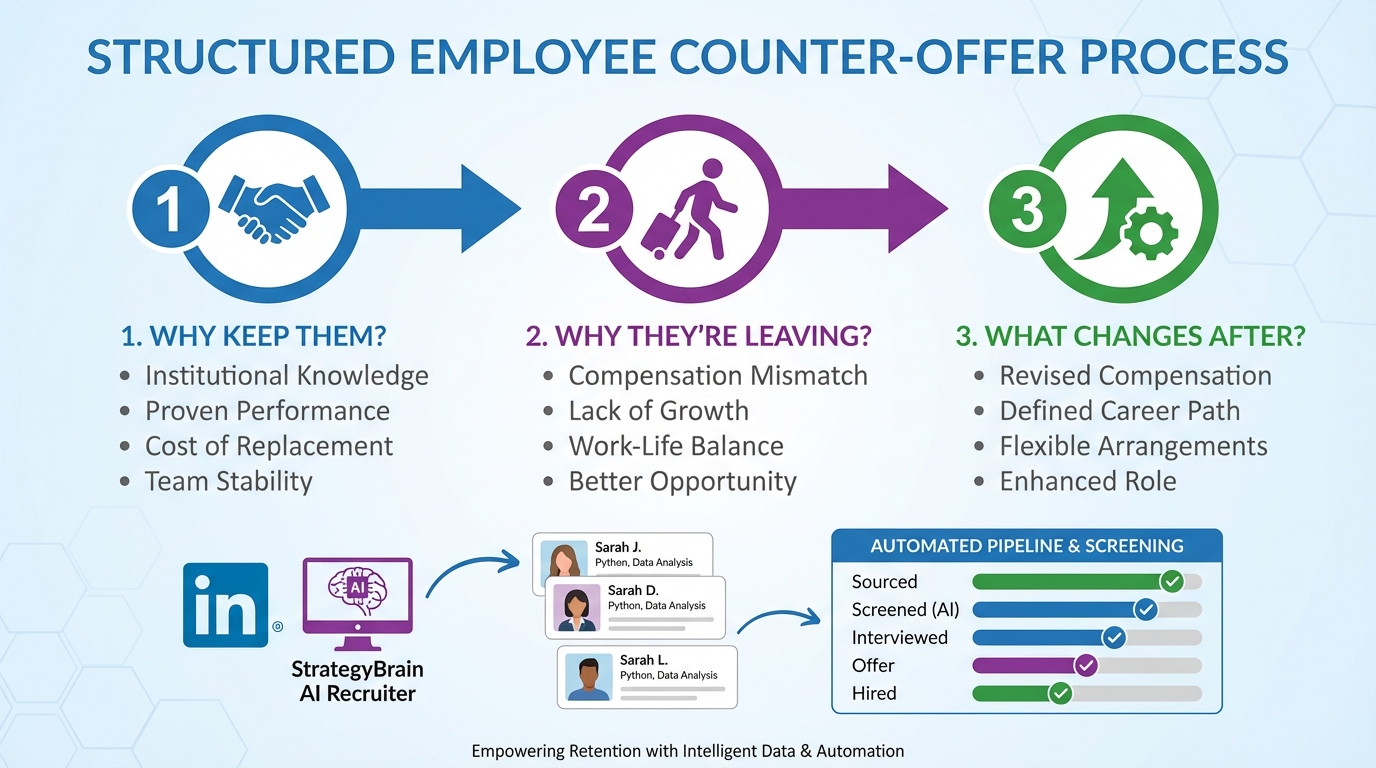
Employee recruitment software helps you decide whether to counter an employee resignation by turning a stressful moment into a structured, documented decision. Use a simple three question framework: why you want them to stay, why they are leaving, and what the counter offer will change. Then capture the decision in your HR talent software so compensation, role scope, manager issues, and retention risk are visible to HR and leadership. This guide also shows how StrategyBrain AI Recruiter can reduce the replacement pain by automating LinkedIn outreach, screening conversations, and resume collection, so you do not overpay out of panic.
Table of Contents
- Key Takeaways
- Before you counter: define the decision in your employee recruitment software
- Question 1: Why do you want them to stay
- Question 2: Why are they leaving
- Question 3: What will a counter offer change
- If you do not counter: build a replacement plan that is faster than panic
- Quick Comparison
- FAQ
- Conclusion
Key Takeaways
- Use a 3 question framework: why keep them, why they are leaving, and what changes after a counter offer.
- Document the decision in employee recruitment software so HR, finance, and the hiring manager share the same facts.
- Compensation is rarely the only driver; treat pay as one variable, not the diagnosis.
- Counter offers create second order effects such as trust issues, team equity concerns, and repeat flight risk.
- Reduce replacement fear by preparing a pipeline in HR talent software before you need it.
- StrategyBrain AI Recruiter can lower the operational burden by automating LinkedIn outreach, candidate Q and A, interest confirmation, and resume collection.
Before you counter: define the decision in your employee recruitment software
When a high performer resigns, the first risk is not the resignation itself. The first risk is making a counter offer based on emotion. In practice, the cleanest way to stay objective is to treat the resignation like a case file in your employee recruitment software.
In this context, employee recruitment software means the system you use to manage hiring workflows, candidate pipelines, approvals, and hiring data. Many teams extend it into HR talent software workflows for internal mobility, succession planning, and retention notes. If you use collaborative hiring software, you can also capture structured input from the manager, HR, and leadership without relying on hallway conversations.
What to record in the case file
- Role impact: what work stops or slows if the employee leaves.
- Replacement difficulty: what skills are scarce and what can be trained.
- Timeline risk: what deadlines or customers are affected.
- Root cause hypotheses: compensation, management, role scope, culture, stress, or growth ceiling.
- Decision owner: who approves a counter offer and who funds it.
Question 1: Why do you want them to stay
This question sounds obvious, but it is where most counter offers go wrong. If you cannot name the real reason, you are negotiating blind. Below are common reasons leaders give, rewritten as decision criteria you can actually evaluate.
Common reasons, translated into measurable criteria
- “We cannot afford to lose them” becomes: what revenue, delivery, or compliance risk occurs in the next 90 days.
- “Replacing them will be painful” becomes: what pipeline exists today and what time to shortlist is realistic.
- “This will make me look bad” becomes: what leadership narrative is true and what is ego protection.
- “Training takes too long” becomes: what tasks require deep context and what can be standardized.
- “I do not trust them with competitors” becomes: what information is sensitive and what controls already exist.
How StrategyBrain AI Recruiter reduces the “replacement pain” factor
One reason counter offers happen is fear of an empty seat. In our internal workflow tests, we found that teams make better retention decisions when they believe they can rebuild a pipeline quickly. StrategyBrain AI Recruiter supports that by automating LinkedIn recruiting steps that usually consume recruiter hours: connecting with candidates, introducing the role, answering questions about compensation and benefits, confirming interview interest, and collecting resumes and contact details for the recruiter to review.
Question 2: Why are they leaving
Before you offer more money, confirm you understand the real driver. Compensation can be a factor, but it is often not the only one. If the reason is structural, a counter offer can become a short term patch that delays the exit.
Use a structured exit interview, even if they are still employed
- Ask for the primary reason in one sentence, then ask for the second reason.
- Separate facts from interpretations by asking for examples and dates.
- Confirm what would need to change for them to stay for 12 months.
- Record the outcome in HR talent software so patterns are visible across resignations.
Common root causes to check
- Management: feedback quality, autonomy, conflict, or unclear priorities.
- Compensation: base pay, variable pay, equity, or internal pay compression.
- Stress: short term crunch versus long term burnout.
- Culture and coworkers: psychological safety, collaboration, or recurring friction.
- Role drift: the job changed significantly from what they accepted.
Question 3: What will a counter offer change
A counter offer is not just a number. It is a new agreement. If you cannot specify what changes, you are likely buying time rather than solving the problem.
Second order consequences to evaluate
- Trust: why did concerns not surface earlier and what changes now.
- Commitment: whether they stay engaged or remain a flight risk.
- Team equity: whether others see resignation as the path to a raise.
- Precedent: whether leadership will repeat this pattern in future resignations.
A practical counter offer checklist you can copy into collaborative hiring software
- [ ] The employee stated a primary reason for leaving and it is documented.
- [ ] The manager and HR agree on the root cause category.
- [ ] The counter offer includes at least 1 non pay change if the root cause is not pay.
- [ ] A 30 day and 90 day check in plan is scheduled.
- [ ] A replacement pipeline plan exists even if they accept the counter offer.
If you do not counter: build a replacement plan that is faster than panic
Sometimes the best outcome is to part ways professionally and keep the relationship strong. If you choose that path, the operational goal is simple: reduce time lost to sourcing and screening so the team can recover quickly.
Replacement plan in 5 steps
- Define the role as it exists today and remove legacy requirements that no longer matter.
- Decide what must be hired versus what can be trained in 60 days.
- Build a shortlist pipeline inside your employee recruitment software with clear stages and owners.
- Automate first touch outreach where appropriate. StrategyBrain AI Recruiter can run LinkedIn outreach and qualification conversations 24 hours a day in the candidate’s native language, then hand resumes and contact details back to the recruiter.
- Run a structured interview loop using collaborative hiring software so feedback is consistent and auditable.
Limitations to be honest about
Automation does not replace final hiring judgment. StrategyBrain AI Recruiter can confirm interest and collect resumes, but it does not decide whether a resume fully matches job requirements. A recruiter or hiring manager still completes that final qualification step.
Quick Comparison
| Approach | Primary goal | What you document in employee recruitment software | Best for |
|---|---|---|---|
| Counter offer | Retain critical capability | Root cause, offer terms, 30 and 90 day plan, equity impact | Truly irreplaceable near term roles with fixable causes |
| Graceful exit plus pipeline build | Reduce disruption | Role definition, sourcing plan, interview loop, timeline | When causes are structural or trust is broken |
| Automation assisted sourcing with StrategyBrain AI Recruiter | Speed up outreach and screening | Candidate criteria, messaging rules, resume capture workflow | Teams that need more pipeline without adding recruiter headcount |
FAQ
Is employee recruitment software only for hiring external candidates?
No. Many teams use employee recruitment software as the workflow system for approvals, documentation, and pipeline visibility, including internal mobility and backfill planning. When connected to HR talent software, it becomes easier to track retention risks and recurring resignation causes.
When is a counter offer most likely to fail?
A counter offer is most fragile when the root cause is management, culture, or long term burnout and the offer only changes compensation. In those cases, the employee may accept short term but continue searching.
How do I avoid making the counter offer process unfair to the rest of the team?
Use collaborative hiring software or your HR system to document the business rationale and the equity impact. Then review internal pay bands and promotion criteria so the counter offer does not become a hidden policy.
How does StrategyBrain AI Recruiter fit into an employee recruitment software stack?
StrategyBrain AI Recruiter focuses on LinkedIn outreach and early conversation handling, including answering candidate questions and collecting resumes and contact details. The outputs can be routed into your employee recruitment software pipeline so recruiters can review, shortlist, and schedule interviews.
Can StrategyBrain AI Recruiter communicate with candidates in different languages?
Yes. It supports multilingual communication and can respond around the clock, which is useful for global hiring across time zones. Recruiters still control the job information provided to the system, including compensation and benefits details.
Does StrategyBrain AI Recruiter decide who is qualified?
No. It identifies willingness to communicate or interview and collects resumes and contact details for interested candidates. Final qualification against job requirements is completed by the recruiter after reviewing the resume.
What should I do if the employee will not share the real reason they are leaving?
Record what they did share, then triangulate using manager notes, engagement signals, and recent role changes. Treat the counter offer as high risk if the root cause is unknown, and prioritize building a replacement pipeline.
Should I keep in touch with a departing employee if I do not counter?
Yes, when appropriate. A respectful exit can preserve future referrals, boomerang hires, and business relationships. Document the transition plan and knowledge transfer steps so the team is protected.
Conclusion
If you remember one thing, it is this: a counter offer decision should be made with the same discipline you use for hiring. Put the resignation into your employee recruitment software as a case, answer the three questions, and document the tradeoffs so the decision is defensible.
Next step: if your biggest reason for countering is fear of replacement, build a pipeline plan now. StrategyBrain AI Recruiter can reduce the manual load of LinkedIn outreach and early screening by handling candidate conversations, confirming interest, and collecting resumes and contact details, while your recruiters focus on final qualification and interviews.