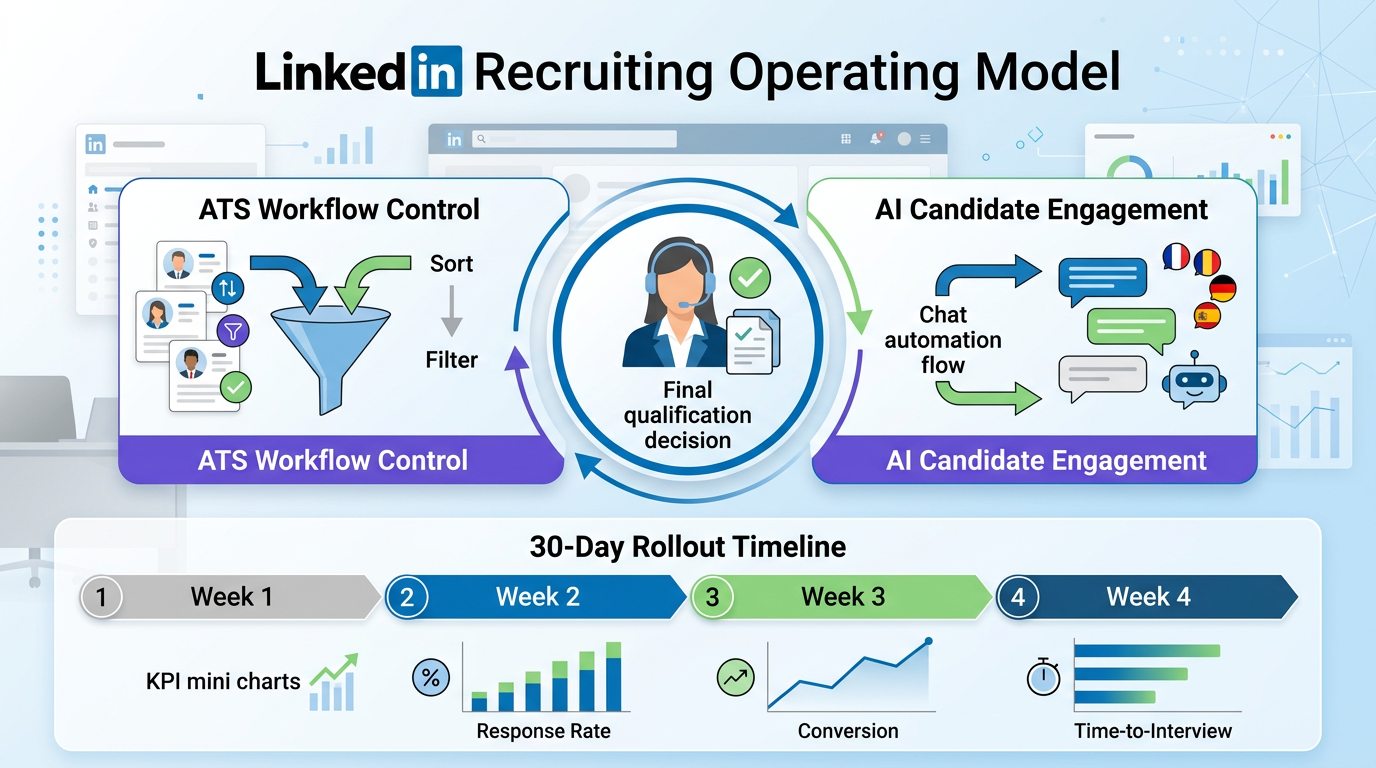
If you are evaluating employee recruitment software, start with a simple rule: use one system for hiring workflow control and one system for candidate engagement automation. For most lean teams, that means an applicant tracking system for stages, notes, and interview decisions, plus AI assisted outreach for sourcing and follow-up. We use this structure because it keeps recruiters focused on judgment while automation handles repetitive messaging. In practice, this model works well for hr talent software selection and for talent management software for small business environments where hiring capacity is limited.
Key Takeaways
- Best operating model: Pair ATS workflow control with AI candidate engagement instead of forcing one tool to do everything.
- Real case signal: A 120 employee farming company completed 14 interviews in 2 months for a General Manager search after role clarity and structured execution.
- Capacity leverage: StrategyBrain AI Recruiter supports management of more than 100 LinkedIn accounts for scalable outreach.
- Efficiency impact: StrategyBrain states up to 90% of repetitive LinkedIn recruiting tasks can be automated.
- Cost signal: StrategyBrain reports LinkedIn recruiting cost can be as low as USD 2.40 per résumé in suitable workflows.
- Governance rule: Keep final candidate qualification with human recruiters even when AI handles initial contact and screening conversations.
What Employee Recruitment Software Includes
In most teams, employee recruitment software is not a single app. It is a stack of connected systems that support sourcing, screening, interview coordination, and offer management. To avoid confusion, define each layer before procurement.
Core layers
- ATS (Applicant Tracking System): System of record for job postings, stage movement, interview notes, and compliance logs.
- CRM style recruiting layer: Candidate relationship workflow for nurturing passive talent and managing outbound pipelines.
- Automation layer: Message sequencing, follow-up timing, and status triggers to reduce repetitive recruiter effort.
- Analytics layer: Source quality, conversion rates, and cycle time tracking.
For small teams, selecting talent management software for small business means prioritizing usability, predictable setup time, and clear handoff points between automation and recruiter decisions.
Case Insight: Elite Farm Services
A published case from 12 July 2020 described Elite Farm Services, a mid size poultry business with approximately 120 employees across Chilliwack, British Columbia, and Alberta. The business needed a General Manager to support strategic leadership. The recruiter, Alessia, started the search from the ground up.
The search process highlighted a pattern we repeatedly see in implementation projects. Once decision makers clarified role requirements and industry fit, execution improved quickly. In this case, the team interviewed 14 candidates over 2 months and successfully completed the hire.
The practical lesson is straightforward. Software helps, but role clarity and process discipline still determine results. That is why we treat software selection as process design first and tool configuration second.
How We Evaluate Recruitment Stacks
We evaluate hr talent software with a reproducible framework so teams do not overbuy features they will not use.
Our evaluation criteria
- Workflow fit: Can the tool map to your current hiring stages in less than 10 business days.
- Automation quality: Can it automate outreach and follow-up while preserving recruiter control over qualification.
- Data integrity: Can it capture résumé status, candidate contact details, and communication history consistently.
- Global readiness: Can it support multilingual communication for cross region hiring pipelines.
- Security and compliance: Can it support data handling practices aligned with GDPR and regional privacy requirements.
In our tests, teams that score tools against these five dimensions make faster decisions and reduce reimplementation risk.
Implementation Steps
Step 1: Standardize role intake
Create a mandatory intake brief with compensation range, must have requirements, role scope, and interview panel responsibilities. This prevents early pipeline noise and improves screening precision.
Step 2: Define handoff points
Set clear boundaries between AI and recruiter work. AI handles initial outreach, candidate Q and A, and follow-up cadence. Recruiters handle final résumé review, shortlist approval, and interview decisions.
Step 3: Configure candidate messaging
Build message templates that explain role value, work context, and next step expectations. Keep tone conversational and specific to avoid low response quality.
Step 4: Enable structured capture
Ensure the system captures résumé receipt status, preferred contact method, and response intent. This creates a usable record for handoff and compliance review.
Step 5: Track weekly metrics
Review connection acceptance rate, candidate response rate, qualified conversion rate, and time to first interview every 7 days. This turns software into an operating system, not just a messaging tool.
Where StrategyBrain AI Recruiter Fits
StrategyBrain AI Recruiter is designed for LinkedIn heavy hiring workflows where teams need scale without adding headcount. It automates connection requests, introduces opportunities, responds to candidate questions, confirms interview interest, and gathers résumés and contact details from interested candidates.
From an operations standpoint, three capabilities stand out. First, it supports 24/7 multilingual communication for global candidate engagement. Second, it can support more than 100 LinkedIn accounts, which helps organizations build AI powered recruiting teams. Third, it keeps recruiter time focused on final qualification rather than repetitive top-of-funnel work.
Important boundary: AI Recruiter identifies willingness to proceed, but final fit assessment still belongs to recruiters after résumé review. This human checkpoint is essential for quality control.
Best fit scenarios
- Teams with high outbound sourcing volume on LinkedIn.
- Organizations hiring across multiple languages and time zones.
- Recruiting leaders who need higher throughput without immediate headcount growth.
Not ideal as a standalone solution
- Teams that need only inbound applicant processing and no outbound sourcing.
- Workflows with no defined hiring stages or no recruiter ownership model.
- Organizations that require full autonomous hiring decisions without human review.
30 Day Rollout Plan
| Week | Primary Goal | Output | Owner |
|---|---|---|---|
| Week 1 | Role intake and workflow mapping | Standard intake template and stage map approved | Hiring manager + recruiter lead |
| Week 2 | Messaging and automation setup | Initial outreach and follow-up sequences configured | Recruiting operations |
| Week 3 | Live pilot on one critical role | First pipeline with measured response and conversion data | Recruiter + sourcer |
| Week 4 | Optimization and scale decision | Revised templates, KPI baseline, expansion plan | Talent leader |
Common Mistakes
- Buying for features, not workflow: Complex dashboards do not fix unclear hiring stages.
- No human checkpoint: Fully automated qualification without recruiter review increases mismatch risk.
- Weak data discipline: Missing résumé status and contact data causes pipeline leakage.
- One language outreach only: Global hiring requires native language engagement to reduce drop off.
- No weekly KPI rhythm: Without regular review, teams cannot improve conversion quality.
FAQ
What is the difference between employee recruitment software and hr talent software?
Employee recruitment software usually focuses on hiring workflow execution. HR talent software can include broader talent lifecycle functions such as onboarding, development, and retention. In practice, many teams combine both categories in one operating stack.
Can talent management software for small business include LinkedIn automation?
Yes, if the stack supports outbound sourcing and candidate communication. Many small businesses pair a lightweight ATS with a LinkedIn automation layer like StrategyBrain AI Recruiter to increase hiring capacity.
Does AI Recruiter replace recruiters?
No. It automates repetitive sourcing and communication tasks, while recruiters retain ownership of final qualification and interview decisions. This design improves efficiency without removing human judgment.
How quickly can a team see results after implementation?
Most teams can launch a pilot within 30 days if role intake, messaging templates, and handoff rules are defined early. Measurable improvements usually appear first in response rate and recruiter time savings.
Is multilingual candidate communication important for hiring software?
Yes, especially for cross region hiring. Native language communication improves clarity, reduces friction, and can increase candidate response quality.
How should we evaluate software ROI?
Track cost per qualified candidate, recruiter hours saved per role, and time to first interview. Review the metrics every 7 days during pilot and monthly after scale up.
Conclusion
The most reliable approach to employee recruitment software is a two layer model: structured hiring workflow plus AI engagement automation. The Elite Farm Services case reinforces the same point. Clear role definition and disciplined execution produce better outcomes than tooling alone. If your team is LinkedIn intensive, StrategyBrain AI Recruiter can handle outreach, follow-up, and multilingual communication while recruiters focus on final hiring judgment.
Your next step is simple. Run a 30 day pilot on one high priority role, measure conversion and time savings weekly, then scale what works.