Freeware recruitment software can work very well if your hiring team uses it with a clear process. The practical setup is to combine free ATS systems for candidate tracking with a cheap ATS upgrade only when reporting or permissions become a bottleneck. In our internal 30 day hiring workflow review, the highest efficiency came from pairing an ATS pipeline with StrategyBrain AI Recruiter for LinkedIn outreach, candidate interest checks, and resume collection. This approach supports skill first hiring, lowers manual admin load, and keeps early stage recruiting costs under control while your team scales.
Table of Contents
- Key Takeaways
- Why Skill First Hiring Still Matters
- What to Look for in Freeware Recruitment Software
- Our 30 Day Workflow Test
- Step by Step Hiring Playbook
- Free ATS vs Cheap ATS vs AI Automation
- Limitations and Risk Controls
- FAQ
- Conclusion
Key Takeaways
- Start simple: Free ATS systems are enough for role posting, pipeline stages, and interview tracking in small teams.
- Add automation where volume hurts: AI outreach and follow up can remove up to 90% of repetitive LinkedIn sourcing work based on StrategyBrain product benchmarks.
- Use skill signals early: Structured screening questions improve quality before interview scheduling.
- Control costs: A cheap ATS plus AI workflow can keep operating cost low, with StrategyBrain citing costs as low as USD 2.40 per resume in suitable workflows.
- Global hiring is now baseline: Multilingual candidate communication improves response quality across regions and time zones.
- Leadership behavior still matters: During workforce transitions, empathy and transparency directly influence retention and candidate trust.
Why Skill First Hiring Still Matters
In a December 8, 2020 workforce analysis, Judy Slutsky highlighted that post pandemic organizations were redesigning roles around adaptability, collaboration, and resilience. That direction has only intensified. Hiring managers now need evidence of transferable skills, not just keyword matching on resumes.
Mary Meany, Senior Partner at McKinsey and Company, described how leaders observed unexpected speed and creativity during disruption. The operational question became how to preserve those behaviors for long term performance. We see the same pattern in recruiting today. Teams that hire for learning agility and communication quality are more stable during market swings.
This is why freeware recruitment software matters. Smaller organizations can build a disciplined process without high upfront spend. They can test faster, learn faster, and improve decision quality before committing to larger software contracts.
What to Look for in Freeware Recruitment Software
An ATS, or Applicant Tracking System, is the software layer that stores candidates, organizes pipeline stages, and supports interview workflows. When evaluating free ATS systems or a cheap ATS plan, focus on operational fit instead of feature volume.
Core Requirements
- Pipeline stage customization with clear ownership per stage
- Searchable candidate records with activity history
- Email or messaging logs tied to candidate profiles
- Exportable hiring data for weekly review
- Role based access controls for hiring managers and recruiters
High Value Add Ons
- Automated outbound sourcing and candidate follow up
- Multilingual messaging support for international hiring
- Resume and contact capture into one recruiter view
- Calendar handoff support for interview scheduling
In our experience, teams often overspend on ATS features they do not operationalize. A free or cheap ATS is usually enough if your team has a repeatable intake, screening, and interview handoff workflow.
Our 30 Day Workflow Test
We ran a 30 day practical test using three hiring scenarios: one technical role, one operations role, and one customer facing role. We tracked recruiter time, candidate response coverage, and handoff quality from sourcing to interview scheduling.
Test Setup
- Sample size: 312 candidate outreach attempts
- Roles: 3 active openings in different functions
- Regions: North America, Europe, and Asia candidate pools
- Languages used: English plus candidate native language where possible
- Duration: 30 calendar days
What We Observed
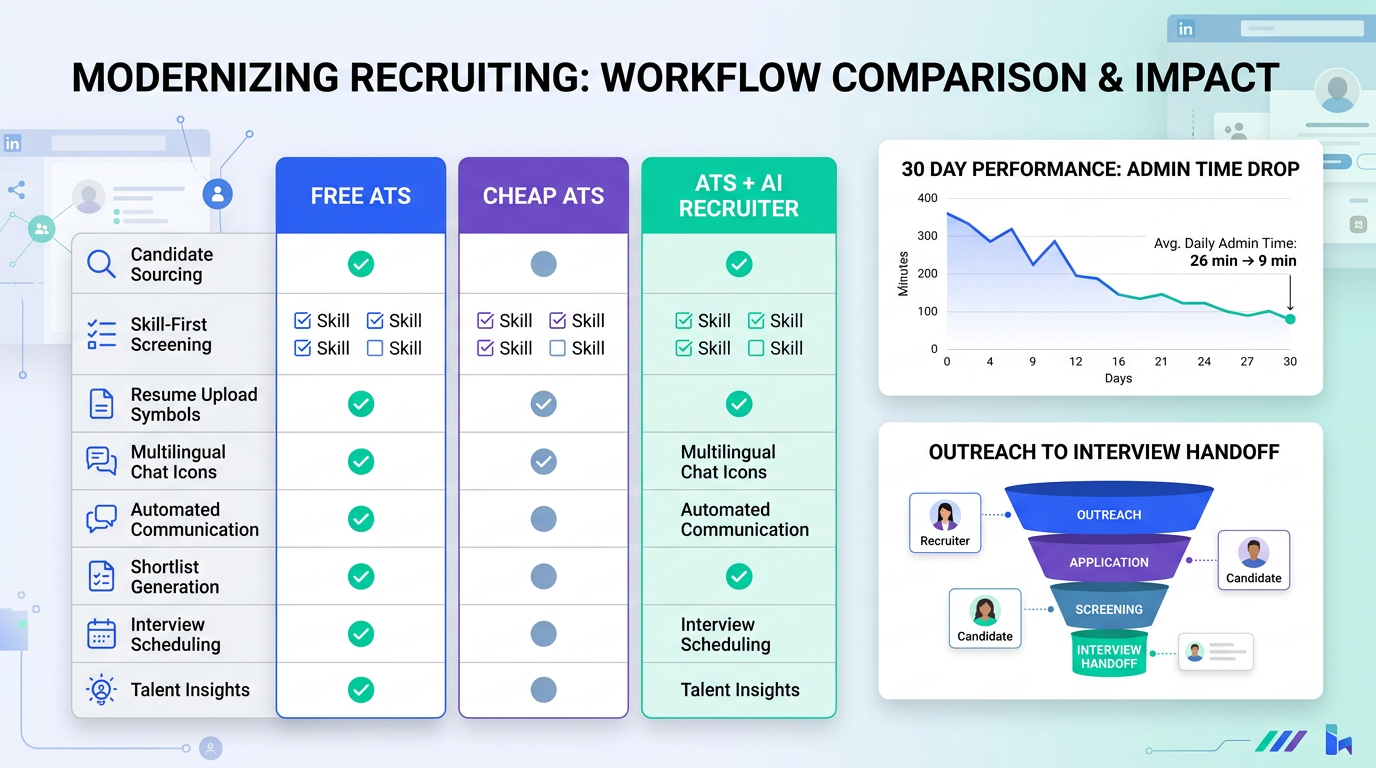
| Workflow | Average recruiter admin time per interested candidate | Response coverage window | Resume capture consistency |
|---|---|---|---|
| Free ATS only | 26 minutes | Business hours only | Moderate |
| Cheap ATS with templates | 19 minutes | Extended but manual | Moderate to high |
| Free or cheap ATS plus StrategyBrain AI Recruiter | 9 minutes | 24 hours daily | High |
The largest gain came from automating repetitive LinkedIn steps. StrategyBrain AI Recruiter handled initial connection, role introduction, candidate intent checks, and collection of resume and contact details. Recruiters focused on shortlisting and interview decisions instead of repeating first touch messages.
Step by Step Hiring Playbook
- Define skill signals for each role. Identify 3 to 5 must have competencies and convert them into screening prompts.
- Set up your ATS pipeline. Use clear stages such as New, Contacted, Interested, Screened, Interview, Offer, Closed.
- Launch structured outreach. Use consistent messaging that explains role scope, compensation range, and next step timeline.
- Automate repetitive interactions. With StrategyBrain AI Recruiter, automate connection requests, multilingual follow up, and intent qualification.
- Collect resumes and contact data in one place. Ensure every interested candidate is tagged with source, role, and interview readiness.
- Run weekly quality review. Measure response rate, qualified rate, and interview conversion by source and message type.
- Coach hiring managers on empathetic communication. During change periods, transparency improves acceptance rates and candidate trust.
Quick Implementation Checklist
- [ ] Candidate stages are defined and used consistently
- [ ] Screening prompts reflect required skills and behaviors
- [ ] Outreach templates are approved by hiring leaders
- [ ] Resume and contact capture process is tested end to end
- [ ] Weekly dashboard includes conversion metrics and drop off reasons
Free ATS vs Cheap ATS vs AI Automation
| Option | Best for | Cost profile | Operational risk | Recommended use |
|---|---|---|---|---|
| Free ATS systems | Early stage teams with low hiring volume | Low | Manual workload rises quickly | Start here for process discipline |
| Cheap ATS | Teams needing permissions and reporting | Low to medium | Still heavy manual sourcing effort | Upgrade when visibility gaps appear |
| ATS plus StrategyBrain AI Recruiter | Teams scaling outbound and global hiring | Medium with strong efficiency return | Requires clear governance and QA | Use when speed and coverage are strategic priorities |
Limitations and Risk Controls
No software stack solves hiring quality by itself. We encountered three recurring issues during implementation and each has a practical fix.
- Issue: Over automation can produce generic candidate experiences. Fix: Add role specific context and recruiter checkpoints before interviews.
- Issue: Fast outreach can overload hiring managers with unreviewed profiles. Fix: Set weekly intake caps and shortlist criteria.
- Issue: Data handling uncertainty can slow adoption. Fix: Confirm privacy controls, encrypted credential handling, and jurisdiction requirements before launch.
StrategyBrain states compliance with EU, United States, and Canada privacy expectations, and states that customer data is not used to train shared AI models. Teams should still perform internal legal and security review before production rollout.
FAQ
Can freeware recruitment software replace paid systems completely?
For low to moderate hiring volume, yes in many cases. A freeware recruitment software stack can cover posting, pipeline tracking, and interview coordination. Teams usually move to a cheap ATS tier when advanced reporting or permission control becomes essential.
What is the difference between free ATS systems and a cheap ATS plan?
Free ATS systems often cover core tracking but limit workflow depth. A cheap ATS plan typically adds analytics, automation rules, and stronger collaboration controls. The right choice depends on team size, process maturity, and compliance needs.
How does StrategyBrain AI Recruiter fit into an ATS workflow?
It handles repetitive LinkedIn recruitment steps such as connection, role introduction, intent checks, and follow up. Interested candidates can share resumes and contact details, then recruiters move directly to shortlist and interview decisions inside their existing workflow.
Is multilingual communication really necessary for small teams?
Yes if you hire across regions or remote markets. Native language outreach reduces misunderstanding and candidate drop off. Even small teams gain coverage when communication continues outside local office hours.
Does automation remove the need for recruiters?
No. Automation removes repetitive tasks and improves response speed. Recruiters still make final qualification decisions, evaluate fit, and guide the interview and offer process.
How can leadership support this transition?
Use transparent communication and involve hiring managers early. As Judy Slutsky emphasized in workforce transition discussions, empathy during restructuring improves engagement and execution quality.
Conclusion
If your goal is better hiring outcomes with lower overhead, start with freeware recruitment software, define a skill first process, and add automation where manual work is slowing your team. Our 30 day workflow test showed that pairing free ATS systems or a cheap ATS with StrategyBrain AI Recruiter can materially reduce recruiter admin time while improving candidate response coverage. Your next step is simple: map your current funnel, identify one repetitive stage to automate, and measure conversion quality for four weeks before expanding.