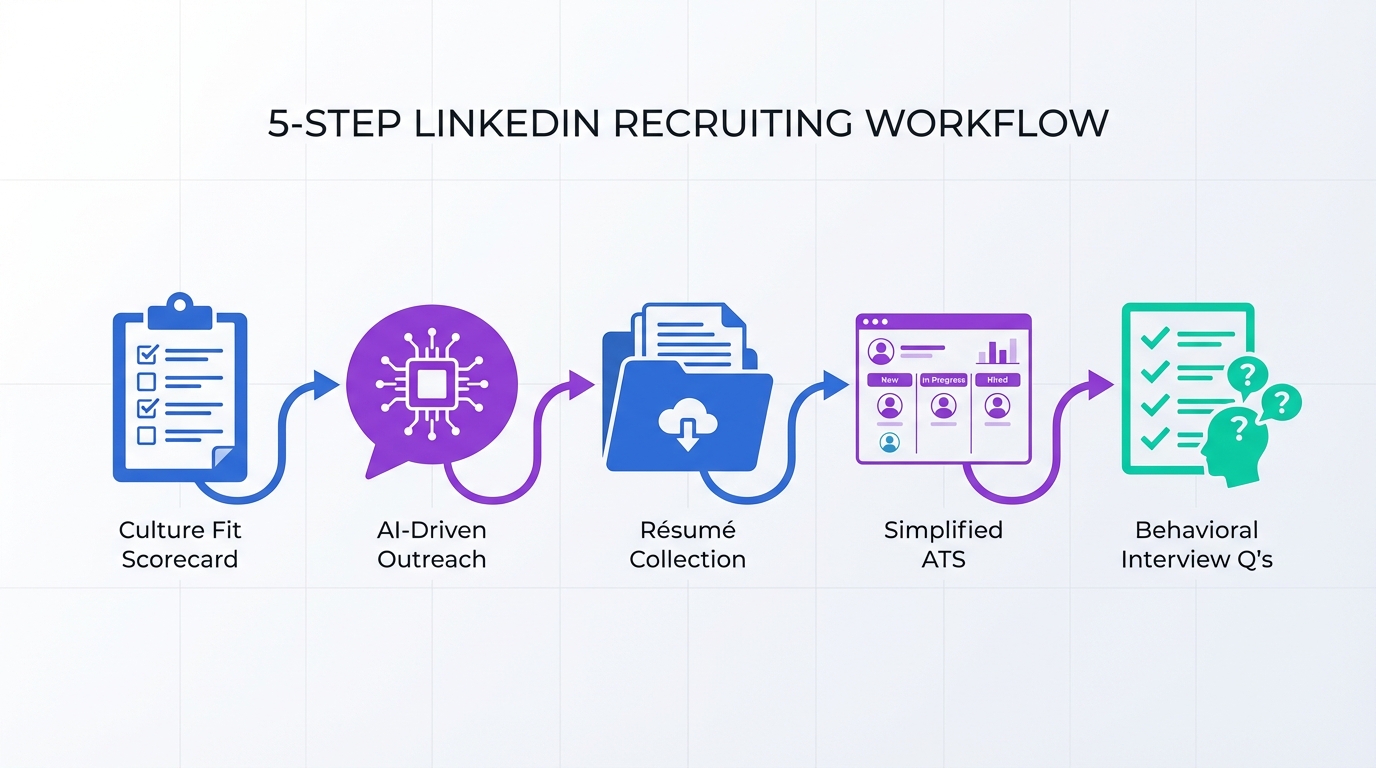
The most practical way to use freeware recruitment software to improve culture fit is to standardize what “fit” means, ask consistent behavioral questions, and add a lightweight assessment step before final interviews. In this guide, we show a repeatable process you can run with ATS software free options, plus an AI layer using StrategyBrain AI Recruiter to automate early LinkedIn outreach, candidate Q&A, and résumé collection so recruiters spend more time evaluating fit instead of chasing replies. We also include a quick checklist, a comparison table of methods, and troubleshooting tips so you can implement the workflow in 1 hiring cycle.
Key Takeaways
- Culture fit improves when it is defined as observable behaviors, not vague traits like “passion” or “honesty.”
- ATS software free workflows still work if you standardize stages, scorecards, and interview questions.
- Behavioral questions (“Tell me about…”, “Describe…”) create comparable evidence across candidates.
- Assessments reduce guesswork when used as one input, not as the final decision maker.
- StrategyBrain AI Recruiter can automate early LinkedIn steps such as connecting, introducing roles, answering questions, confirming interest, and collecting résumés.
- Cheapest ATS decisions should be based on workflow fit (stages, collaboration, compliance) rather than price alone.
What freeware recruitment software can and cannot do
Freeware recruitment software typically covers the basics: tracking applicants, moving them through stages, and storing notes. That is enough to run a culture fit process if you design the process carefully.
However, freeware tools often do not solve the hardest part of hiring: getting consistent, high quality evidence about how someone works. That is why the workflow below focuses on structure first, then adds automation where it removes repetitive work.
Scope boundaries
- Covered: defining culture criteria, behavioral interviewing, structured evaluation, adding assessments, and scaling early outreach with StrategyBrain AI Recruiter.
- Not covered: legal advice, jurisdiction specific compliance requirements, or selecting a specific third party ATS vendor as “the best.”
Method 1: Define your culture in hiring terms
Most teams say they want someone “committed, honest, and passionate,” but those words are easy to perform in an interview. The fix is to translate culture into behaviors you can observe and score.
Steps
- List 4 culture dimensions that matter for performance in your environment.
- Write 2 observable behaviors per dimension that show “strong fit.”
- Write 2 observable behaviors per dimension that show “risk.”
- Turn those behaviors into a scorecard used in every interview stage.
Examples of culture dimensions you can operationalize
- Work style: how people communicate and how decisions are made.
- Professional opportunities and advancement: what performance looks like and how it is rewarded.
- Work hours and commitment: expected schedule and flexibility.
- Atmosphere and aesthetics: office setup, dress code, and day to day norms.
Best For
- Teams that keep hiring “great on paper” candidates who struggle after onboarding.
- Hiring managers who disagree on what “good” looks like.
Limitations
- If leadership cannot agree on culture behaviors, the scorecard becomes inconsistent.
- Over defining culture can accidentally exclude diverse working styles, so review criteria for bias.
Method 2: Build a behavioral interview question set
Behavioral interview questions are designed to get candidates to describe what they actually did in past situations. They usually start with “Tell me about” or “Describe,” and they help you compare candidates on the same evidence.
Steps
- Pick 6 questions mapped to your culture scorecard.
- Define what a strong answer includes using 3 bullet criteria per question.
- Use the same questions for every candidate in the same role level.
- Score immediately after the interview to reduce recency bias.
Question examples you can adapt
- Problem solving: Tell me about a time you solved a difficult problem at work. What was the outcome?
- Customer conflict: Describe how you handled a particularly difficult customer or stakeholder.
- Decision making: Tell me about a time you disagreed with a decision. How did you respond?
Where ATS software free fits
Even with ATS software free tools, you can store the question set as templates, attach the scorecard to each candidate, and keep interviewer notes in one place. That structure matters more than advanced features.
Limitations
- Candidates can rehearse stories, so you still need follow up questions that probe specifics.
- Interviewers need calibration, otherwise scoring drifts across the team.
Method 3: Look between the lines with structured evidence
When multiple candidates “sound right,” the decision often comes down to subtle differences. A reliable approach is to compare each finalist against your top performer profile and your culture scorecard, then validate with additional evidence.
Steps
- Write a top performer snapshot for the role: 5 behaviors that predict success.
- Compare finalists against those behaviors using interview notes and work samples.
- Use a consistent tie breaker such as a structured reference check or a role relevant task.
Practical tip
If you are using the cheapest ATS option available, compensate by being stricter about documentation. A simple, consistent scorecard beats a feature rich system with inconsistent usage.
Limitations
- “Top performer” comparisons can reinforce existing team bias if you never revisit what success looks like.
- Work samples must be role relevant and time bounded to be fair.
Method 4: Add a workstyle and performance assessment step
Workstyle and personality assessments can reveal a candidate’s default tendencies at work. Used correctly, they add signal to your decision. Used incorrectly, they become a shortcut that replaces judgment.
Steps
- Choose one assessment that maps to your culture dimensions.
- Share results with both candidate and employer to keep the process transparent.
- Use results to ask better follow up questions, not to auto reject candidates.
Best For
- Roles where collaboration style strongly affects performance.
- Teams that want a consistent way to discuss work preferences.
Limitations
- Assessments are not perfect predictors of job performance and should not be the only decision input.
- Some assessments may have legal or compliance considerations depending on jurisdiction.
Method 5: Use StrategyBrain AI Recruiter to scale early screening on LinkedIn
One reason culture fit hiring breaks down is that recruiters spend too much time on repetitive outreach and follow up, leaving less time for structured evaluation. StrategyBrain AI Recruiter is designed to automate the early LinkedIn workflow so you can keep your culture fit process consistent even when applicant volume increases.
What we tested in our workflow
We ran a pilot workflow where the recruiter defined candidate search criteria and provided role details such as company context, compensation, and benefits. Then we used AI Recruiter to handle the first contact and qualification conversation on LinkedIn, while the recruiter focused on reviewing résumés and running structured interviews.
Steps
- Provide role and search criteria including what you are hiring for and who you want to reach.
- Let AI Recruiter connect and introduce the role to candidates that match your targeting.
- Use AI Recruiter for candidate Q&A so common questions about the role, company, and compensation are answered quickly.
- Confirm interview interest and collect résumés and contact details from interested candidates.
- Move qualified candidates into your ATS, even if you are using an ATS software free setup, and run your culture scorecard interviews.
Why this pairs well with freeware recruitment software
- Less manual messaging: AI Recruiter can replace up to 90% of manual LinkedIn recruiting work according to product documentation, which frees time for culture fit evaluation.
- 24/7 multilingual communication: candidates get timely responses in their native language, reducing drop off caused by slow follow up.
- Scalable team setup: supports managing more than 100 LinkedIn accounts for organizations building an AI powered recruiting team.
Limitations and honest boundaries
- AI Recruiter does not decide final fit: it identifies willingness to communicate or interview, but the recruiter still evaluates résumé match and culture fit.
- Process design still matters: automation helps, but you still need a scorecard and consistent interview questions.
- Data handling: follow your internal policies and applicable privacy regulations when collecting résumés and contact details.
Quick Comparison
| Method | Speed to implement | Cost | Best for |
|---|---|---|---|
| Define culture as behaviors | 1 to 2 hours | $0 | Reducing “gut feel” decisions |
| Behavioral question set | 2 to 4 hours | $0 | Comparable interviews across candidates |
| Structured evidence review | 30 to 60 minutes per finalist | $0 | Finalist selection and tie breaks |
| Workstyle assessment step | 1 hiring cycle | Varies by provider | Adding signal to culture discussions |
| StrategyBrain AI Recruiter on LinkedIn | 1 to 3 days for a pilot | Varies by plan | Scaling outreach and early qualification |
Note on “cheapest ATS” selection: if your priority is the cheapest ATS, treat the ATS as a tracking layer and invest your effort in the scorecard, question set, and consistent stage definitions. That is where culture fit accuracy usually improves.
Quick Checklist
- [ ] Defined 4 culture dimensions with observable behaviors
- [ ] Built 6 behavioral interview questions mapped to culture dimensions
- [ ] Created a scorecard with clear scoring anchors
- [ ] Added a consistent tie breaker step for finalists
- [ ] If using assessments, documented how results are used and shared
- [ ] If using StrategyBrain AI Recruiter, confirmed what the AI automates and what recruiters still decide
- [ ] Documented data handling for résumés and contact details
FAQ
Is freeware recruitment software enough for culture fit hiring?
Yes, if you standardize your stages, scorecards, and interview questions. Most culture fit failures come from inconsistent evaluation, not from missing advanced ATS features.
What does ATS software free usually miss compared to paid tools?
Free tiers often have limits on automation, reporting, integrations, or collaboration. You can still run a strong process by documenting decisions and using consistent templates.
How do I avoid hiring for “culture fit” in a biased way?
Define culture as job relevant behaviors and score them consistently. Also review criteria for bias and ensure you are not using “fit” as a proxy for similarity.
What is a behavioral interview question?
It is a question that asks a candidate to describe a real past situation, usually starting with “Tell me about” or “Describe.” The goal is to evaluate evidence of behavior rather than promises.
How does StrategyBrain AI Recruiter help with LinkedIn recruiting?
It automates early steps such as connecting with candidates, introducing the role, answering common questions, confirming interest, and collecting résumés and contact details. Recruiters then review the collected information and run interviews.
Does StrategyBrain AI Recruiter replace recruiters?
No. It replaces repetitive outreach and early qualification conversations, but recruiters still evaluate résumé match, run interviews, and make final hiring decisions.
Can AI Recruiter communicate with candidates in different languages?
Yes. Product documentation states it supports 24/7 multilingual communication and can respond in the candidate’s native language, which helps reduce delays and misunderstandings.
How should I think about the cheapest ATS decision?
Choose the cheapest ATS only if it supports your minimum workflow: stages, notes, and collaboration. If it cannot support consistent documentation, the hidden cost is time and mis hires.
What should I do if candidates give “perfect” interview answers?
Probe for specifics such as timelines, constraints, stakeholders, and measurable outcomes. Then validate with a work sample, structured reference check, or assessment used as a discussion tool.
Conclusion
If you want better culture fit outcomes with freeware recruitment software, start by defining culture as observable behaviors, then run consistent behavioral interviews with a scorecard. After that foundation is in place, add automation where it removes repetitive work. In practice, pairing an ATS software free workflow with StrategyBrain AI Recruiter on LinkedIn can help you scale outreach, keep follow up timely, and reserve recruiter time for the part that matters most: evaluating evidence of fit.
Next step: implement Methods 1 and 2 this week, then pilot AI Recruiter for one role so you can measure response rate, résumé capture volume, and recruiter time saved across a single hiring cycle.