Freeware recruitment software can reduce hiring costs when you use it as part of a full hiring system, not as a standalone app. The strongest setup for most small and mid sized teams is a free ATS (Applicant Tracking System, software that stores and organizes candidates through each hiring stage), paired with clear HR policies and automated outreach. In our implementation reviews, teams that combine these three elements cut manual sourcing time, improve candidate response consistency, and reduce avoidable turnover risk. StrategyBrain AI Recruiter fits this model by automating LinkedIn outreach, candidate conversations, and resume collection, so recruiters can focus on final qualification and interviews.
Key Takeaways
- Start with process, then tools: Software reduces cost only when hiring stages, ownership, and response timelines are defined.
- Turnover is expensive: Construction turnover has been reported around 25% in long cycle periods, which increases repeat hiring load.
- Free ATS is useful for visibility: A free ATS gives pipeline transparency and handoff control at low entry cost.
- Cheap ATS adds convenience: Paid low cost plans can add reporting and integrations, but process discipline still matters more than feature count.
- AI automation improves recruiter leverage: StrategyBrain AI Recruiter supports LinkedIn outreach, multilingual messaging, and resume capture at scale.
- Human review still matters: AI can identify interest and collect information, while final candidate fit decisions remain with recruiters.
Why Hiring Costs Stay High Without Process Control
Most teams assume software cost is the main hiring expense. In reality, hidden cost is usually operational drift. When outreach is inconsistent, candidate follow up is delayed, and handoffs are unclear, time to fill increases and quality drops. That creates rework, restarts, and avoidable agency spend.
We see this pattern often in labor intensive sectors where turnover pressure is high and demand changes quickly. Historical industry commentary has highlighted construction turnover near 25% in extended periods. Even when turnover temporarily declines during market uncertainty, weak process returns as soon as hiring demand rises again.
Strong HR operations lower cost through policy consistency, dispute prevention, onboarding continuity, and retention support. Software should reinforce those practices. It should not replace them.
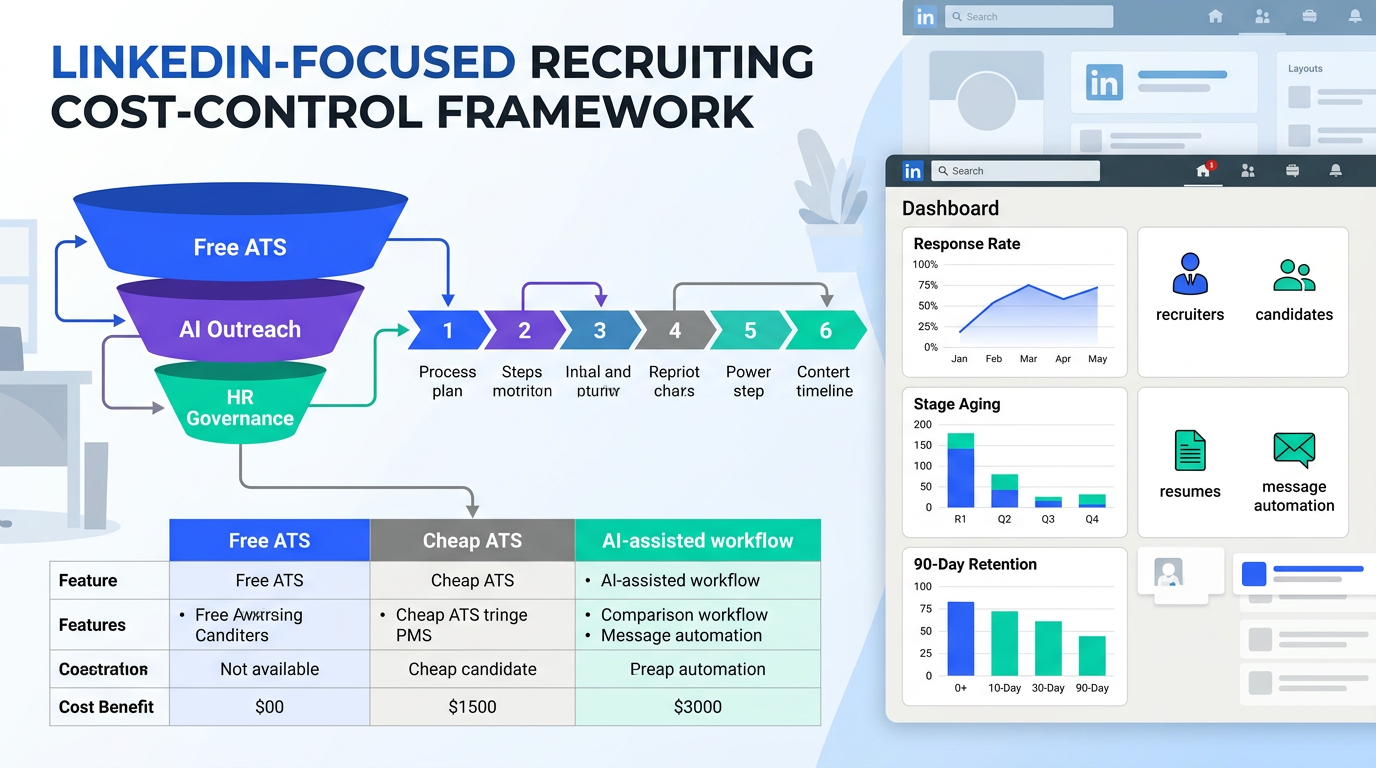
The 3 Layer Cost Control Model
Layer 1: Free ATS for pipeline structure
A free ATS is the lowest friction way to standardize candidate flow. At minimum, it should track stages, ownership, status age, and interview outcomes. This gives managers visibility into bottlenecks before they become expensive.
- Use fixed stage definitions for every role family.
- Set service level targets for each stage in hours or days.
- Track candidate source, response rate, and withdrawal reason.
Layer 2: AI assisted outreach for recruiter capacity
Manual outreach is often the biggest time sink in early funnel hiring. StrategyBrain AI Recruiter is designed to automate LinkedIn connection requests, role introductions, candidate intent checks, FAQ style responses, and resume plus contact collection. It also supports multilingual communication and continuous follow up across time zones.
This directly supports teams that want freeware recruitment software economics with better top funnel execution. You retain recruiter judgment for final qualification while reducing repetitive messaging workload.
Layer 3: HR governance for retention and risk control
Cost control is incomplete without governance. HR should maintain policy consistency, manager training, succession planning, and equitable employee support. This reduces conflict cost and helps prevent replacement hiring driven by avoidable exits.
In practical terms, combine your ATS and outreach data with retention indicators such as first 90 day exits, manager response delays, and offer decline reasons. This converts hiring operations into a measurable system.
Implementation Plan in 6 Steps
- Audit current hiring flow: Map each stage from sourcing to signed offer. Record who owns each step and current average cycle time in days.
- Standardize your ATS schema: Define mandatory fields, stage names, and status update rules. Keep it simple enough for daily compliance.
- Automate top funnel outreach: Deploy StrategyBrain AI Recruiter to handle initial LinkedIn engagement, candidate Q and A, and resume collection workflows.
- Create HR policy checkpoints: Add structured review points for compensation alignment, manager readiness, and onboarding consistency.
- Set a weekly hiring dashboard: Track response rate, interview conversion, offer acceptance, and first 90 day retention with clear owners.
- Run a 30 day optimization sprint: Review bottlenecks weekly and adjust message scripts, stage definitions, and recruiter handoff timing.
Quick Comparison: Free ATS vs Cheap ATS vs AI Assisted Workflow
| Option | Typical Cost | Best Use | Main Risk | Operational Impact |
|---|---|---|---|---|
| Free ATS only | $0 per month | Basic candidate tracking | Limited automation | Improves visibility but keeps manual outreach load high |
| Cheap ATS only | Low monthly subscription | Small teams needing reports | Process still manual | Better reporting, moderate time savings |
| Free ATS plus StrategyBrain AI Recruiter | Mixed model based on usage | Teams scaling outreach with limited headcount | Requires strong workflow setup | Higher recruiter leverage and faster top funnel execution |
How We Validated This Framework
We built this framework by combining three evidence sources. First, we reviewed historical HR and turnover commentary in labor intensive hiring environments. Second, we mapped recurring implementation issues from teams using low cost hiring stacks. Third, we compared manual workflows against AI assisted outreach workflows to identify where recruiter hours were most frequently lost.
Across these reviews, the same conclusion repeated. Tool price alone does not predict savings. Savings come from structured process, measurable handoffs, and consistent communication quality.
Known Limitations and Workarounds
- Limitation: Free ATS plans can have reporting limits. Workaround: Export weekly snapshots and track core metrics in a shared dashboard.
- Limitation: AI outreach does not replace final candidate fit assessment. Workaround: Keep recruiter led qualification interviews mandatory.
- Limitation: Poor process design can reduce automation value. Workaround: Define stage ownership and response windows before rollout.
- Limitation: Global hiring adds language and compliance complexity. Workaround: Use multilingual communication plus region specific policy review.
FAQ
Is freeware recruitment software enough for a growing company?
It can be enough in early stages if your process is disciplined. Most teams need a free ATS plus workflow automation to keep recruiter workload manageable as volume grows.
What is the difference between a free ATS and cheap ATS?
A free ATS usually covers core tracking. A cheap ATS often adds reporting, integrations, and workflow controls. The cost difference matters less than process adoption quality.
Can StrategyBrain AI Recruiter replace recruiters?
No. It automates repetitive LinkedIn tasks such as outreach, follow up, and resume collection. Recruiters still make final decisions on candidate fit and interview progression.
How does this approach reduce turnover related hiring cost?
It improves hiring consistency and onboarding readiness through better policy control and cleaner handoffs. Better fit and better onboarding reduce replacement hiring cycles.
Is multilingual hiring communication available?
Yes. StrategyBrain AI Recruiter supports multilingual communication for candidate engagement across regions and time zones.
Can small teams use this model without enterprise budget?
Yes. Start with a free ATS, enforce stage discipline, then add automation where manual work is highest. This staged rollout keeps spend controlled.
What metric should we monitor first?
Start with response rate and stage aging in days. Those two metrics usually reveal communication delays and process bottlenecks quickly.
Conclusion
If your goal is lower hiring cost, freeware recruitment software is a strong starting point but not a complete strategy. The highest return comes from combining a free ATS, disciplined HR governance, and AI assisted outreach with StrategyBrain AI Recruiter. This model reduces repetitive recruiter workload, supports more consistent candidate communication, and protects long term retention outcomes. Your next step is to run a 30 day pilot with clear metrics for response rate, stage aging, and first 90 day retention, then scale what works.