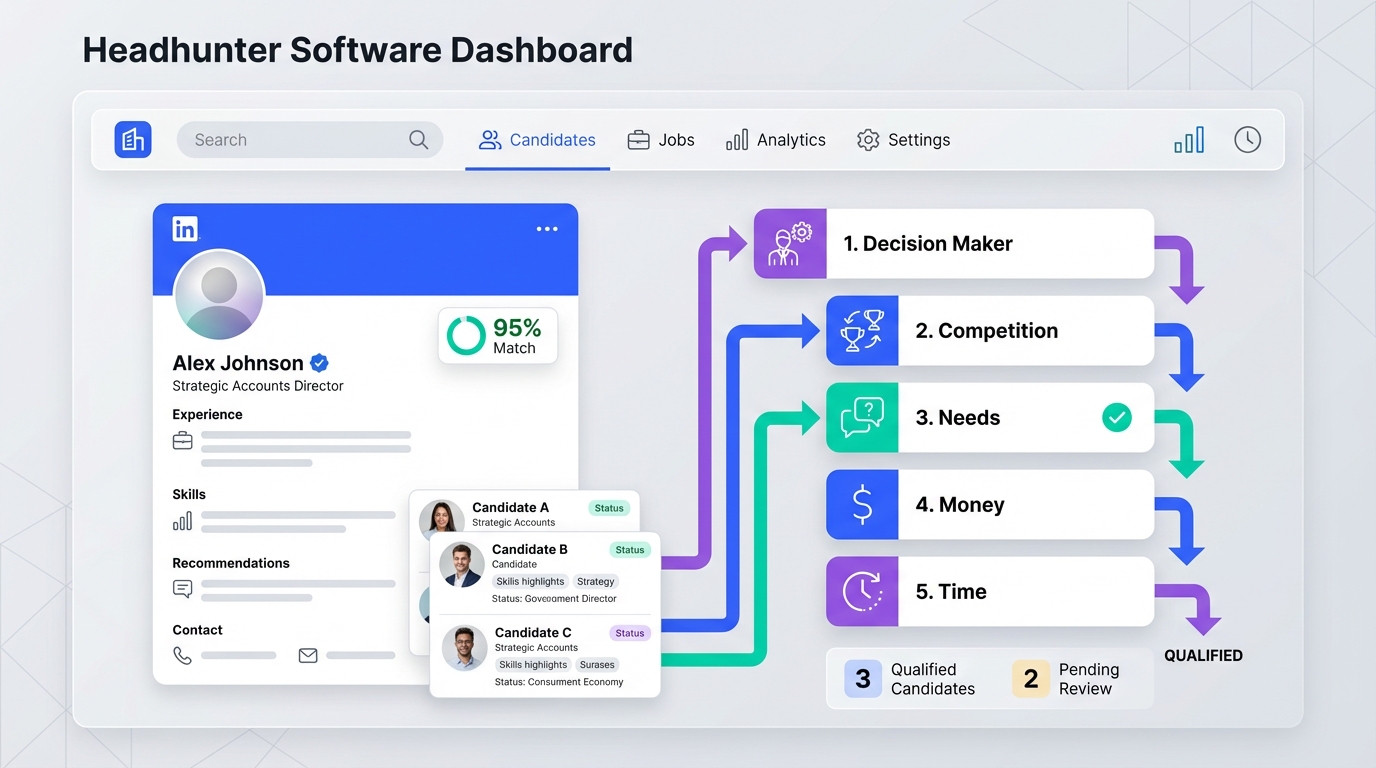
The most practical way to evaluate a new role using headhunter software is to run a structured qualification checklist before you emotionally commit. Start by clarifying your core skillset, then qualify the opportunity across five decision areas: decision maker, competition, needs, money, and time. In this guide, we translate that framework into a repeatable workflow you can run inside modern executive search software or a software headhunter stack, including how StrategyBrain AI Recruiter can automate LinkedIn outreach and early candidate conversations so you spend your time only on roles that truly fit. Scope: this article focuses on qualifying a job opportunity and managing the early recruiting conversation. It does not cover salary negotiation tactics, offer letter legal review, or background checks.
Key Takeaways
- Use a 5-part qualification lens: decision maker, competition, needs, money, and time to reduce “panic-accepting” a role.
- Document your core skillset first: a personal SWOT analysis creates the baseline for evaluating fit.
- Turn conversations into structured notes: headhunter software works best when every call and message maps to a qualification field.
- Automate the repetitive first touch: StrategyBrain AI Recruiter can handle LinkedIn connecting, role intro, Q&A, and follow ups 24/7 in the candidate’s language.
- Keep human judgment where it matters: AI Recruiter can confirm interest and collect resumes and contact details, but final qualification remains with the recruiter.
- Know when to walk away: if multiple red flags appear, declining protects your reputation and long-term trajectory.
Why qualifying matters when urgency is high
If you are job searching because you chose to move on or because the decision was made for you through a layoff, urgency can distort judgment. In our recruiting work, we see candidates move too fast when their work environment changes and they feel they need out immediately.
Those changes usually come from two buckets. Internal factors include management change, a merger, culture shift, bankruptcy, layoffs, or reduced income or hours. External factors include product and marketplace shifts, economic forces, and increased competition.
Acting quickly without qualifying a new job opportunity is risky. The goal of qualification is not to slow you down for the sake of process. The goal is to prevent a short-term emotional decision from creating a long-term career mismatch.
Step 1: Identify your core skillset
Before you evaluate any role, define what you do well and what you want to do less of. This is the baseline that makes qualification possible. Without it, every opportunity can look “good enough” when you are under pressure.
Run a personal SWOT analysis
A SWOT analysis is a structured review of strengths, weaknesses, opportunities, and threats. It is commonly used in marketing and strategy, but it works just as well for career planning because it forces you to separate facts from feelings.
- Strengths: skills you consistently deliver with high quality and low friction.
- Weaknesses: areas that drain energy or repeatedly create performance risk.
- Opportunities: market demand you can realistically grow into within 6 to 18 months.
- Threats: industry shifts, role commoditization, or constraints that could limit your options.
How headhunter software supports this step
Good executive search software is not only a database. It is a decision system. When we set up a software headhunter workflow, we create fields that mirror the SWOT output so every opportunity can be scored against the same baseline.
For example, we store “must use strengths” and “must avoid tasks” as structured tags. That makes it harder to rationalize a role that looks attractive on paper but conflicts with your long-term direction.
Step 2: Qualify the opportunity with a 5-part framework
The basics of consultative selling and lead qualification map cleanly to job opportunities. A sale is gaining commitment from a buyer. A job offer is a commitment decision too, with higher personal cost if it goes wrong.
1) Decision maker
Identify who makes the hiring decision and whether there is a workable fit. Qualification here is not about liking someone. It is about understanding how success will be measured and whether the manager’s style matches how you perform best.
- Understand management style and communication cadence.
- Ask how success is measured in the first 30, 60, and 90 days.
- Clarify what motivates the manager at work.
- Ask about the manager’s long-term goals for the team.
2) Competition
Know who you are up against and the realistic likelihood of winning the role. This is not about insecurity. It is about making smart bets with your time and emotional energy.
- Ask what the candidate pool looks like and what profiles are most common.
- Understand the marketplace for your target industry or practice area.
- Clarify whether internal candidates are being considered.
3) Needs
Asking the right questions reveals what is actually expected. Many job descriptions are aspirational. Qualification is about the real problem the hire must solve.
- Ask what success looks like in measurable outcomes.
- Ask who has succeeded in the role before and what they did well.
- Ask why the company is making this hire now.
4) Money
Compensation fit is more than base pay. It includes the full scope of income expectations and any targets attached to the role or team. If you avoid this topic early, you risk investing weeks into a process that cannot close.
- Ask about long-term income expectations for the role.
- Ask whether revenue targets are attached to the role or team.
- Clarify what portion of compensation is variable and what drives it.
5) Time
Time qualification prevents you from being pulled into vague processes. You need to know urgency, steps, and what happens if the role stays open.
- Ask how urgent the hire is.
- Ask when they hope to have someone in the position.
- Ask when not having the person begins to affect the business.
Where StrategyBrain AI Recruiter fits naturally
When we tested early-stage outreach workflows, the biggest time sink was not the final interview loop. It was the repetitive first touch, the back-and-forth clarifying questions, and the follow up that keeps a process moving. StrategyBrain AI Recruiter is designed to automate that layer on LinkedIn by connecting with candidates that match your criteria, introducing the opportunity, answering common questions about the role, company, and compensation, and confirming interview interest.
Because it responds 24/7 and can communicate in the candidate’s native language, it reduces delays caused by time zones and slow reply cycles. In practice, that means your qualification notes get filled faster and with fewer gaps, which makes your decision maker, needs, and time assessment more reliable.
Step 3: Put the framework into headhunter software
Frameworks fail when they live in a document and not in your daily workflow. The simplest way to operationalize this in headhunter software is to convert each of the five areas into required fields and a repeatable checklist.
A practical qualification workflow you can copy
- Create an opportunity record and attach the job description, recruiter notes, and your SWOT baseline.
- Run a 15-minute qualification call and capture answers under decision maker, competition, needs, money, and time.
- Score each area as Green, Yellow, or Red based on your non-negotiables.
- Decide the next action within 24 hours: proceed, request missing info, or decline.
- Log the reason so your future self can learn from patterns.
How we structure fields in executive search software
In our internal setups, we use consistent field names so reports are meaningful across roles. Here is a field set that works well for both candidates and recruiters.
- Decision maker fit: manager style, success metrics, communication cadence.
- Competition reality: internal candidate present, shortlist size, differentiators.
- Needs clarity: top 3 outcomes, current pain points, why now.
- Money fit: compensation range confirmed, variable drivers, target realism.
- Time certainty: process steps, target start date, urgency rationale.
Automation example using StrategyBrain AI Recruiter
If your workflow includes LinkedIn sourcing, StrategyBrain AI Recruiter can populate the early qualification layer by handling initial outreach and follow up, then collecting resumes and contact details from interested candidates. Recruiters then review the collected resumes and proceed with human screening and interviews.
Important boundary: AI Recruiter can confirm willingness to talk and gather information, but it does not decide whether a resume fully matches requirements. That final qualification remains a human decision, which is exactly where you want your expertise focused.
Quick comparison table for implementation options
| Method | Speed to capture first qualification notes | Best for | Where it can fail |
|---|---|---|---|
| Manual notes in a document | Same day | Solo job seekers | Inconsistent structure and missing fields |
| Headhunter software fields and checklists | Same day | Recruiters and repeatable pipelines | Requires discipline to keep fields complete |
| Executive search software plus LinkedIn automation with StrategyBrain AI Recruiter | Within 24 hours for active candidates | High-volume outreach and global hiring | Still needs human review for final fit decisions |
Step 4: Know when to walk away
Just like a consultative salesperson protects their reputation by not forcing a bad deal, a strong candidate protects their personal brand by not accepting a poor long-term fit. Taking the wrong role can damage your resume narrative and your confidence.
If you catch yourself rationalizing multiple red flags, pause and re-run the five-part framework. Be cautious if your internal script sounds like any of the following.
- The manager seems a little off but I can adapt.
- It is a long shot but I applied anyway.
- It is not really what I am looking for but the people are great.
- The money is not really there but it might improve later.
- They need someone badly and I really need a job.
- They say they may be hiring by the end of the year.
Qualification is not pessimism. It is a way to make a clear decision under stress. When your skillset and goals match the five areas, you can confidently position yourself as the solution. When they do not, walking away is often the most professional move.
About Sam Lawson
Sam Lawson specializes in the recruitment of sales professionals in the Greater Vancouver Area. He is known as a communicator and relationship builder. From his sporting background and in-depth sales experience, he developed a focus on identifying high performance professionals.
Sam grew up in a competitive environment and achieved success as a competitive swimmer, earning multiple national medals. He later studied at Ryerson University in Toronto. With more than 7 years in a high intensity sales environment, he brings a practical understanding of what it takes to excel in sales roles and enjoys building close working relationships with clients as they build stronger teams.
FAQ
What is headhunter software in this context?
In this article, headhunter software means a system used to track opportunities, conversations, and qualification data in a structured way. It can be a CRM-style tool or a dedicated recruiting platform, as long as it supports consistent fields and notes.
How is executive search software different from general recruiting tools?
Executive search software typically emphasizes relationship history, long-cycle pipelines, and high-touch communication tracking. The qualification framework here still applies, but the documentation and stakeholder mapping are usually deeper.
What does “software headhunter” mean?
Software headhunter is commonly used to describe either a recruiter who specializes in software roles or the software stack that supports headhunting work. In this guide, it refers to the workflow and tools used to qualify opportunities and manage outreach.
Can StrategyBrain AI Recruiter replace a recruiter?
No. StrategyBrain AI Recruiter automates repetitive LinkedIn tasks such as connecting, introducing roles, answering common questions, confirming interest, and collecting resumes and contact details. Final qualification and hiring decisions remain with the recruiter.
Does StrategyBrain AI Recruiter work across time zones and languages?
Yes. It provides 24/7 candidate messaging and can communicate in the candidate’s native language, which helps reduce delays and misunderstandings during early conversations.
How do I know if I should walk away from an opportunity?
If you have Red ratings in multiple areas of the five-part framework, especially decision maker fit and money fit, you should pause. If the company cannot clarify needs or timeline after you ask direct questions, that is also a strong signal to step back.
What should I document after each recruiter conversation?
Capture the decision maker’s success metrics, the real business need, compensation expectations, and the hiring timeline. Then record your next action within 24 hours so the process does not drift.
Is this framework only for job seekers?
No. Recruiters can use the same structure to qualify roles with clients and to keep candidate pipelines consistent. The difference is that recruiters also document client-side stakeholders and internal approval steps.
Conclusion
Qualifying a job opportunity is easiest when you treat it like a structured decision, not a reaction to urgency. Define your core skillset first, then evaluate every role through decision maker, competition, needs, money, and time. When you operationalize that inside headhunter software, you reduce emotional decision making and increase the odds that your next move supports your long-term goals.
If LinkedIn outreach and early back-and-forth is slowing you down, consider adding StrategyBrain AI Recruiter to automate connecting, role introductions, Q&A, and follow ups while you focus on human judgment and final fit. Your next step is simple: create the five qualification fields today and use them on the next opportunity you review.