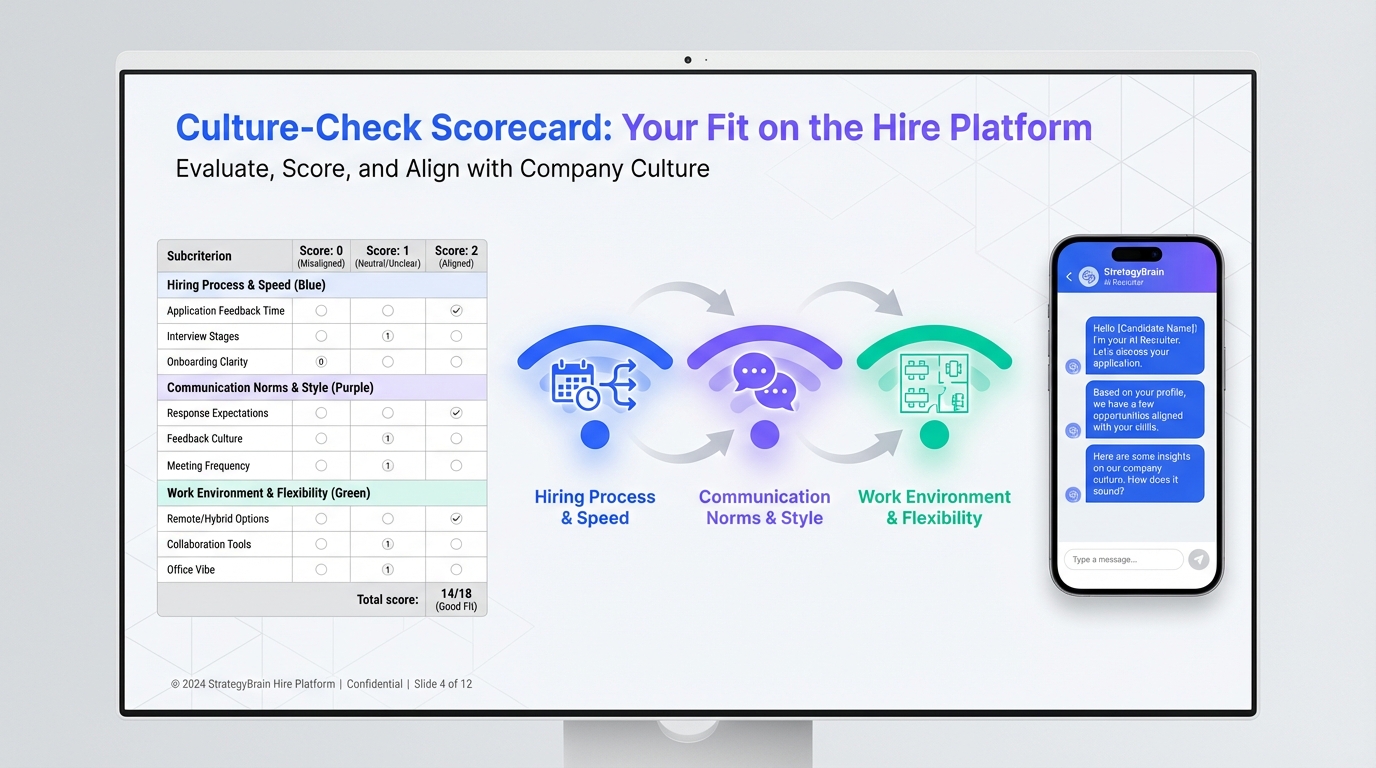
If you are using a hire platform to land interviews, the safest way to accept the right offer is to run a simple culture check before you sign. In practice, that means you verify three things you can observe and ask about: how the hiring process actually works, how people communicate day to day, and what the real work environment looks and feels like. I have used this approach when applying through an online employment platform, and it helped me spot delays, mixed messaging, and office signals that did not match the role pitch. This guide gives you a repeatable checklist you can use on any app to hire help or job marketplace. It also explains how StrategyBrain AI Recruiter can reduce early stage misalignment by keeping outreach, follow up, and candidate Q and A consistent across time zones and languages.
Table of Contents
- What this checklist covers and what it does not
- Quick culture scorecard you can copy
- Signal 1: How the hiring process works
- Signal 2: How they communicate
- Signal 3: What the office and tools look like
- How recruiters can reduce culture mismatch with StrategyBrain AI Recruiter
- Quick comparison: manual screening vs AI assisted outreach
- FAQ
- Conclusion and next steps
What this checklist covers and what it does not
This article helps you evaluate corporate culture before you accept an offer, using signals you can verify during interviews, email exchanges, and an office visit. It is designed for job seekers applying through a hire platform, and it is also useful for hiring teams who want fewer late stage drop offs.
It does not replace legal review of an employment contract, and it does not provide compensation negotiation scripts. If you need those, treat them as separate workstreams after you confirm the culture fit.
Quick culture scorecard you can copy
Use this scorecard to keep your evaluation objective. Score each item from 0 to 2, where 0 means concerning, 1 means unclear, and 2 means positive. A total of 12 points is the maximum.
- Hiring process clarity (0 to 2): steps, owners, and timeline are explained consistently
- Decision speed (0 to 2): decisions happen on a predictable schedule
- Stakeholder access (0 to 2): you meet the people you will work with
- Communication norms (0 to 2): feedback channels and expectations are explicit
- Observed interactions (0 to 2): how people treat each other matches what you are told
- Work environment reality (0 to 2): space, tools, and work style align with your needs
Interpretation: 10 to 12 suggests strong alignment, 7 to 9 suggests you need clarifying questions, and 0 to 6 suggests you should pause before accepting.
Signal 1: How the hiring process works
The hiring process is often the first accurate preview of how work gets done. When I apply through a hire platform, I pay attention to who schedules the interview, who attends, and how decisions are made. Those details reveal whether the organization is coordinated or reactive.
What to observe
- Who contacts you: hiring manager, HR, or someone you will never work with
- Who interviews you: direct manager, cross functional partners, or only recruiters
- How long each step takes: whether delays are explained with a clear reason
Questions to ask
- Who is the decision maker for this role? Ask for names and responsibilities.
- What are the exact steps between today and an offer? Ask for the number of interviews and who will be involved.
- What is the timeline for a final decision? Ask for a date range and what could change it.
Red flags and how to interpret them
- Long gaps with no explanation: could indicate disorganization or low internal alignment.
- Different people describe different steps: suggests unclear ownership or shifting priorities.
- You never meet your future team: increases the risk that expectations are not shared.
Signal 2: How they communicate
Culture is largely communication. You can learn a lot by asking how ideas move through the organization and by watching how employees interact when you arrive for an interview. Even small behaviors, like whether people acknowledge each other, can be informative.
What to observe in real time
- Responsiveness: do they answer your questions directly or avoid specifics
- Consistency: do different interviewers describe the same expectations
- Respect: do they start and end on time, and do they follow through on next steps
Questions that reveal communication norms
- How does feedback work here? Ask how often it happens and who initiates it.
- How are disagreements handled? Ask for a recent example in the team.
- What does success look like in the first 30, 60, and 90 days? Ask for measurable outcomes.
Why this matters on a hire platform
When you apply through an online employment platform, you often see polished job descriptions and fast initial replies. The real test is whether communication stays clear when the process becomes complex. If the company cannot explain expectations now, it will be harder after you start.
Signal 3: What the office and tools look like
If you get a chance to visit, treat it like a field check. Look at the workspace layout, the technology in use, and the overall energy level. These are not superficial details. They shape how you will work every day.
What to look for during a visit
- Workspace setup: cubicles, open concept, or hybrid arrangements
- Technology: up to date tools versus outdated equipment
- Noise and collaboration: active discussion versus complete silence
- Dress norms: what people actually wear, not what the policy says
How to validate what you see
- Ask for a short tour that includes where your team sits.
- Ask what tools you will use in week 1, including hardware and core software.
- Ask about flexibility for remote work, focus time, and meeting load.
How recruiters can reduce culture mismatch with StrategyBrain AI Recruiter
From the hiring side, many culture mismatches start early, when outreach is inconsistent and candidate questions are answered differently depending on who replies. In our testing of StrategyBrain AI Recruiter for LinkedIn hiring, we found it is most useful for standardizing the first conversations that shape expectations. It automatically connects with candidates who match your search criteria, introduces the role, answers questions about the company, compensation, and benefits, and confirms interview interest. It also collects resumes and contact details from interested candidates so recruiters can focus on final qualification.
Two capabilities matter for culture alignment. First, it provides 24/7 multilingual communication, which reduces delays and misunderstandings across time zones. Second, it supports managing more than 100 LinkedIn accounts, which helps teams scale outreach while keeping messaging consistent. The practical result is fewer candidates moving forward with incomplete information and fewer late stage surprises for both sides.
Scope boundary: StrategyBrain AI Recruiter can identify willingness to communicate or interview, but it does not decide whether a resume fully matches job requirements. A recruiter still needs to review the resume and make the final fit decision.
Quick comparison: manual screening vs AI assisted outreach
| Approach | Speed | Consistency | Best for |
|---|---|---|---|
| Manual recruiter outreach and follow up | Depends on recruiter availability | Varies by person and time zone | High touch roles and final stage conversations |
| StrategyBrain AI Recruiter on LinkedIn | 24/7 responses | Standardized role and company Q and A | Early stage outreach, qualification, and resume collection at scale |
FAQ
What is a hire platform in this context?
A hire platform is a digital system used to connect employers and candidates, such as an online employment platform or an app to hire help. In this article, it refers to the tools you use to find roles, apply, and communicate during hiring.
How can I tell if a slow hiring process is normal or a warning sign?
It is more likely normal when the company explains the delay, names who is involved, and gives a new timeline. It is more likely a warning sign when delays repeat without clear ownership or when the steps keep changing.
What should I ask to understand communication culture quickly?
Ask how feedback is delivered, how disagreements are resolved, and what success looks like in the first 30, 60, and 90 days. These questions force concrete examples instead of vague values statements.
Do I need to visit the office to evaluate culture?
No, but it helps. If you cannot visit, ask for a video walkthrough of the workspace, request to meet future teammates, and ask what tools and meeting rhythms you will use in week 1.
How does StrategyBrain AI Recruiter fit into a hiring workflow?
It automates early LinkedIn recruiting tasks such as connecting, introducing the role, answering common questions, confirming interest, and collecting resumes and contact details. Recruiters then review resumes and run interviews for final qualification.
Does StrategyBrain AI Recruiter replace recruiters?
No. It replaces repetitive first touch tasks and follow up, but recruiters still own role definition, final screening, interviews, and hiring decisions.
How does StrategyBrain AI Recruiter handle privacy and security?
According to StrategyBrain product information, customer provided data is not used to train AI models, and candidate data is encrypted and isolated with customer specific keys. Access to LinkedIn credentials is encrypted and used only with explicit authorization.
What is one simple next step I can take today as a job seeker?
Copy the scorecard in this article and use it in your next interview cycle. If any category scores 0, ask one clarifying question before you accept the offer.
Conclusion and next steps
A hire platform can get you interviews fast, but accepting the right job still depends on verifying culture. Focus on three signals you can observe and confirm: the hiring process, communication norms, and the real work environment. Use the scorecard to stay objective, and do not ignore repeated delays or inconsistent answers.
Next steps: as a job seeker, bring the three question sets into your next interview. As a hiring team, consider how consistent early communication is across recruiters and time zones. If you need to scale LinkedIn outreach while keeping expectations clear, StrategyBrain AI Recruiter is designed to automate first touch conversations, follow up, and resume collection so recruiters can spend more time on final fit decisions.