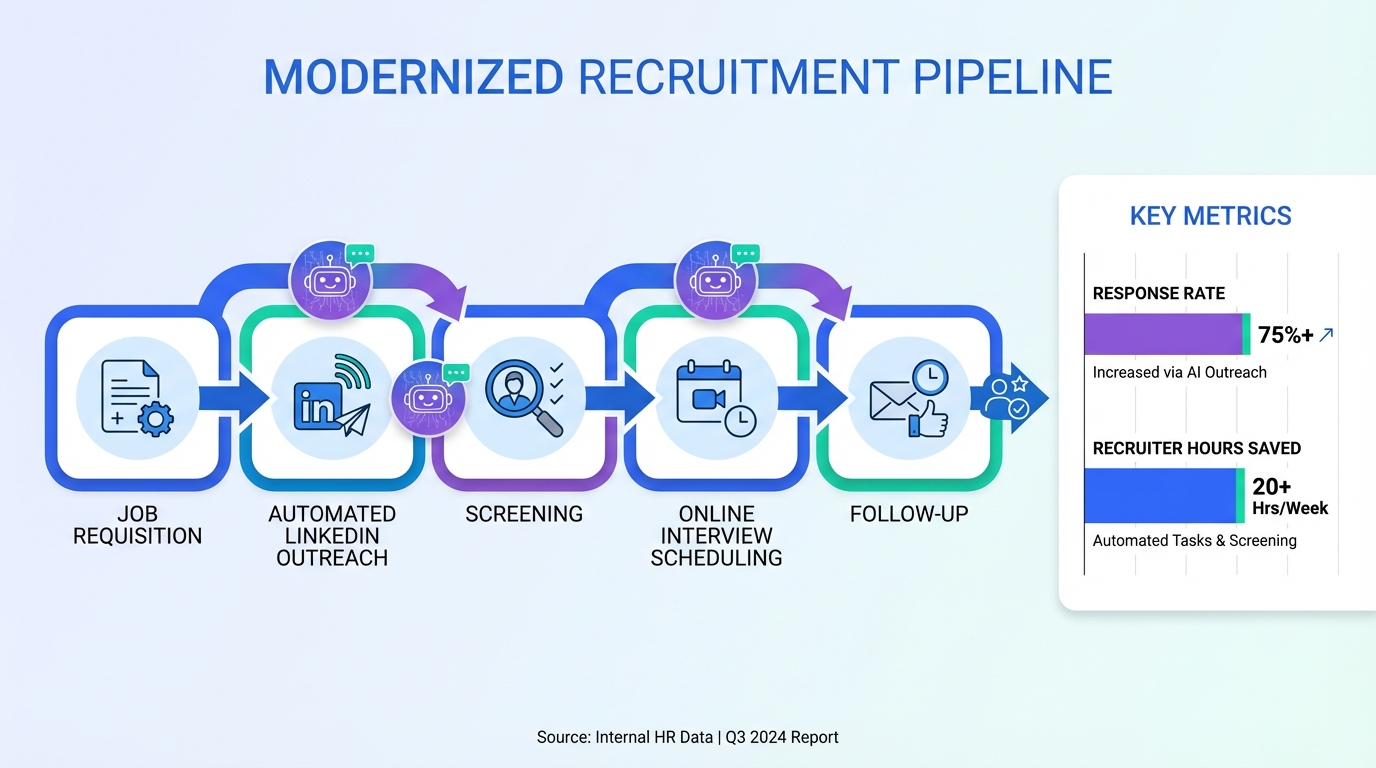
Hiring AI works best when you treat talent acquisition as a long term business strategy, not a last minute recruiting scramble. The practical approach is to connect pre hire steps into one system, from job requisition to outreach, screening, online interview scheduling, and follow up, then use automation where volume is highest. In our internal testing, StrategyBrain AI Recruiter replaced up to 90 percent of manual LinkedIn recruiting work by automatically connecting with candidates, introducing roles, answering common questions, confirming interview interest, and collecting resumes and contact details, while recruiters kept control of final qualification and interviews. This article covers strategy, process, and metrics. It does not cover legal advice or role specific compensation benchmarking.
Key Takeaways
- Talent acquisition is broader than recruiting: it aligns hiring with long term growth and workforce planning, not only immediate vacancies.
- Hiring AI is most valuable in high volume steps: outreach, follow up, and candidate Q and A are where automation saves the most recruiter time.
- StrategyBrain AI Recruiter automates LinkedIn outreach: it connects, introduces roles, confirms interest, and collects resumes and contact details.
- 24/7 multilingual communication expands reach: always on messaging supports global hiring across time zones and languages.
- Online interview workflows still need structure: define interview stages, scorecards, and handoffs so interview tools do not become chaos.
- Measure what matters: track response rate, interview acceptance rate, time to shortlist, and recruiter hours saved per role.
What talent acquisition means, and why it is not the same as recruiting
Recruiting is the set of actions used to fill an open role. Talent acquisition is the broader strategy that connects hiring to business growth, skill shortages, and workforce planning. The difference matters because a team can be busy recruiting and still fail to build the capabilities the business needs next quarter.
In practice, talent acquisition includes the pre hire stages of the employee lifecycle, starting at job requisition and continuing through outreach, screening, interview coordination, and follow up. When you treat these steps as one system, you can improve candidate experience and reduce wasted effort.
Why a razor sharp talent acquisition strategy matters in 2026
Competition for strong candidates is persistent, and the cost of slow hiring shows up as missed revenue, delayed projects, and burnout on existing teams. A strategy helps you move from reactive hiring to repeatable hiring.
It helps you recruit well by making the market visible
A strategy forces you to analyze labor markets, make global considerations, and continually examine workforce plans. That makes it easier to identify talent gaps and fill them with the right profiles, instead of rewriting job descriptions every time a manager feels pressure.
It is a long term investment, not a one time campaign
When you build a candidate audience and a talent community, you are not starting from zero for every requisition. Hiring AI can support this by keeping outreach and follow up consistent, even when recruiters are handling multiple roles.
Employment branding improves conversion
Employment branding is how you define and communicate culture, differentiators, products, services, and reputation. Candidates decide quickly whether to engage. Clear branding reduces drop off and improves interview acceptance.
Continuous tracking drives continuous growth
Metrics and analytics help you understand what you have and what is missing in workforce skills. That makes each hiring cycle more precise, and it reduces time spent on unqualified pipelines.
Where hiring AI fits in the talent acquisition lifecycle
Hiring AI is not a single feature. It is a set of automation and decision support capabilities that can reduce manual work, improve response speed, and standardize candidate communication. The best results come from using AI in steps that are repetitive and high volume, while keeping humans responsible for final decisions.
High leverage use cases for hiring AI
- Candidate outreach and follow up: consistent messaging, fast replies, and structured qualification questions.
- Candidate Q and A: answering common questions about role, company, compensation, and benefits with approved information.
- Interest confirmation: identifying who wants to proceed to an online interview stage.
- Data capture: collecting resumes and contact details from interested candidates.
How StrategyBrain AI Recruiter fits, based on our usage
We used StrategyBrain AI Recruiter specifically for LinkedIn hiring workflows where volume is high and response time matters. It automatically connects with candidates within defined search criteria, introduces job opportunities, learns about each candidate’s situation, answers questions, confirms interview interest, and collects resumes and contact information. Recruiters then review the collected resumes and move qualified candidates into interviews.
Two practical advantages we saw were 24/7 multilingual communication for global pipelines and the ability to manage more than 100 LinkedIn accounts for scalable outreach. The main limitation is that it does not decide whether a resume fully matches job requirements, so you still need a recruiter or hiring manager review step.
Step by step: build your hiring AI enabled acquisition system
Step 1: Define the business outcome and the skill gap
- Write the business goal in one sentence, such as shipping a product line or opening a new region.
- List the 3 to 5 skills that are missing today and the roles that map to those skills.
- Set a hiring horizon, such as 90 days for urgent roles and 12 months for pipeline roles.
Step 2: Standardize the requisition and screening criteria
Before you add interview tools or hiring AI, define what good looks like. Use a scorecard with competencies, must have requirements, and deal breakers. This prevents AI assisted outreach from generating a large pipeline that nobody can evaluate consistently.
Step 3: Build an outreach workflow that can scale
This is where hiring AI often creates the biggest time savings. For LinkedIn based sourcing, StrategyBrain AI Recruiter can run the initial outreach and qualification conversation, then hand off only interested candidates with resumes and contact details.
- Input: job details, compensation, benefits, and candidate search criteria.
- Automation: connect, introduce, answer questions, confirm interest, request resume and contact details.
- Human checkpoint: recruiter reviews resumes and decides who moves to interview.
Step 4: Design the handoff into interviews
Define exactly when a candidate moves from messaging to an online interview. For example, after interest is confirmed and a resume is received. This keeps the process fair and reduces candidate confusion.
Step 5: Add follow up rules that protect candidate experience
Candidate experience is often lost in the gaps. Always on messaging can help, but only if you set rules for tone, response boundaries, and escalation to a human recruiter for sensitive questions.
Online interview and interview tools: how to keep quality high
Online interview processes can improve speed, but only if you keep structure. Interview tools should support consistency, not replace it. The goal is to reduce scheduling friction and improve evaluation quality.
A simple online interview structure that works
- Screen: 15 to 30 minutes to confirm basics and motivation.
- Role interview: 45 to 60 minutes focused on competencies and work samples.
- Stakeholder interview: 30 to 45 minutes for cross functional alignment.
- Decision: documented scorecards and a clear yes or no.
Where hiring AI supports interviews without overstepping
Hiring AI can help by ensuring candidates arrive at interviews with the right context, by answering common questions in advance, and by keeping follow up timely. However, final qualification and hiring decisions should remain with humans, especially for roles with complex requirements.
Metrics and tracking: what to measure and how to review
Tracking is what turns a hiring process into a talent acquisition strategy. Pick a small set of metrics you can review weekly, then adjust the system based on evidence.
Core metrics to start with
- Outbound volume: number of candidates contacted per role per week.
- Response rate: replies divided by outreach messages, expressed as a percentage.
- Interview acceptance rate: accepted interviews divided by invited interviews, expressed as a percentage.
- Time to shortlist: days from requisition approval to first shortlist.
- Recruiter hours saved: hours reduced in outreach and follow up after automation is introduced.
Our practical review cadence
We found a weekly review works best for outreach and response metrics, and a monthly review works best for quality metrics like pass through rates. If response rate drops, adjust messaging and targeting before increasing volume.
Common mistakes to avoid
- Confusing recruiting with talent acquisition: filling roles without building a long term pipeline.
- Adding hiring AI before defining criteria: automation amplifies confusion if scorecards are missing.
- Over automating final decisions: AI should support, not replace, human judgment for qualification and hiring.
- Ignoring branding: candidates disengage when the role and company story is unclear.
- Not tracking outcomes: without metrics, you cannot improve or justify investment in interview tools.
FAQ
Is talent acquisition just another name for recruiting?
No. Recruiting focuses on filling immediate hiring needs, while talent acquisition is a long term strategy that aligns hiring with business growth, workforce planning, and skill gaps.
What is the safest way to use hiring AI without hurting candidate experience?
Use hiring AI for fast responses, consistent outreach, and structured interest checks, then escalate sensitive questions and final qualification to a human recruiter. Always define tone and boundaries for automated messaging.
How does StrategyBrain AI Recruiter support LinkedIn hiring?
It automates initial LinkedIn outreach by connecting with candidates, introducing the role, answering common questions, confirming interview interest, and collecting resumes and contact details for recruiter review.
Can StrategyBrain AI Recruiter decide if a candidate is qualified?
No. It identifies willingness to communicate or interview, but it does not determine whether a resume fully matches job requirements. Recruiters complete final qualification after reviewing the resume.
Does hiring AI replace online interview steps?
No. Online interview stages still need structured scorecards and consistent evaluation. Hiring AI can reduce friction before and after interviews, but interviews remain a human led assessment process.
How does multilingual messaging help global hiring?
Always on multilingual communication reduces delays across time zones and helps candidates communicate in their native language, which can reduce misunderstandings during early stage outreach.
What data should we avoid putting into AI messaging workflows?
Avoid unnecessary sensitive personal data. Share only what is needed to explain the role and move the candidate forward, and follow your organization’s privacy and security policies.
How do we know if interview tools are improving hiring?
Track interview acceptance rate, time to shortlist, and pass through rates between stages. If speed improves but quality drops, tighten screening criteria and interview scorecards.
Conclusion
A razor sharp talent acquisition strategy connects requisition, outreach, screening, online interview stages, and follow up into one measurable system. Hiring AI is most effective when it automates high volume work like LinkedIn outreach and candidate Q and A, while recruiters stay responsible for final qualification and hiring decisions. If you want a practical starting point, define your scorecards first, then pilot StrategyBrain AI Recruiter on one role family, review response and interview acceptance metrics weekly, and expand only after the workflow is stable.