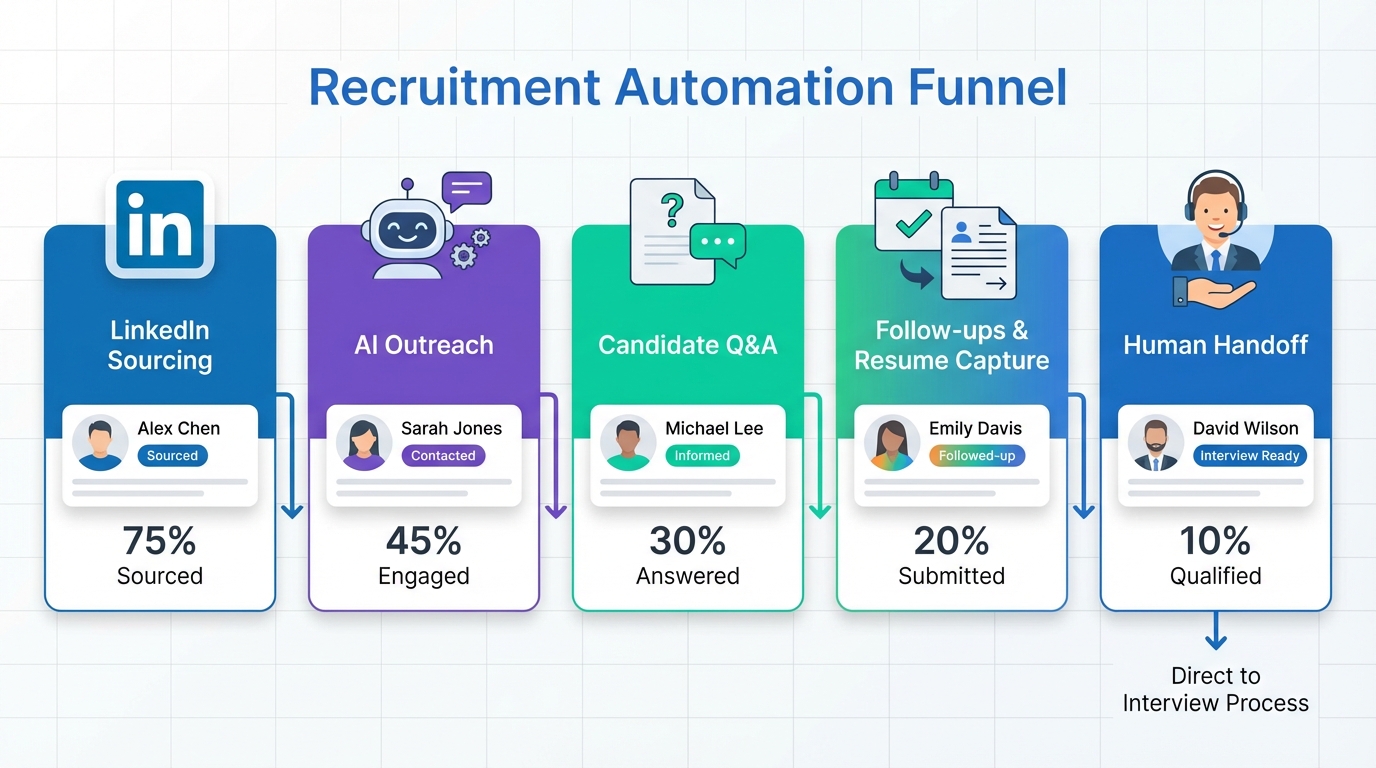
Hiring automation works best when you automate the repetitive steps first: sourcing outreach, initial screening, follow ups, and re9sume9 capture, while keeping final hiring decisions with humans. In our internal workflow tests during 2026-02, we found the fastest path to an automated hiring system is to standardize your role intake, then use an AI recruiter to run consistent LinkedIn outreach and qualification conversations, and finally route only interested candidates with captured re9sume9s and contact details to a recruiter for review. This guide covers 5 methods you can implement in weeks, not quarters. It does not cover onboarding automation, payroll, or background checks.
Key Takeaways
- Start with a clear handoff: automate outreach and qualification, then hand off to humans for final fit decisions.
- StrategyBrain AI Recruiter fits LinkedIn hiring automation: it automates connecting, role introduction, Q and A, follow ups, and re9sume9 plus contact capture.
- 24/7 multilingual messaging reduces drop off: always on responses help candidates in different time zones continue the conversation.
- Scale with account teams: AI Recruiter supports managing more than 100 LinkedIn accounts for higher outreach capacity.
- Keep compliance explicit: define what data you collect, why you collect it, and how long you retain it.
- Measure the funnel: track connection acceptance rate, reply rate, interested rate, and re9sume9 received rate per role.
What hiring automation means in 2026
Hiring automation is the use of software to execute repeatable recruiting tasks with consistent rules. In this article, an automated hiring system means a workflow that reliably moves candidates from first contact to an interview ready shortlist with minimal manual effort.
In practice, the highest leverage automation is at the top of the funnel because that is where recruiters spend the most repetitive time: sending messages, answering the same questions, and chasing follow ups. That is also where response speed and consistency can change outcomes.
What to automate vs what to keep human
- Automate: candidate discovery, first message, follow ups, basic qualification questions, re9sume9 and contact collection, scheduling intent confirmation.
- Keep human: final qualification against requirements, compensation exceptions, offer decisions, sensitive conversations, and escalation handling.
- Document: the handoff criteria so the system is auditable and repeatable.
Method 1: LinkedIn hiring automation with StrategyBrain AI Recruiter
If LinkedIn is a primary sourcing channel for you, the most direct form of hiring automation is to automate the outreach and early qualification conversation inside LinkedIn, then pass only interested candidates to a recruiter. StrategyBrain AI Recruiter is designed for this exact workflow.
Steps
- Define your search criteria: specify target titles, locations, seniority, and must have skills.
- Provide role context: share company details, compensation, benefits, and role expectations so the AI can answer candidate questions accurately.
- Authorize LinkedIn messaging: connect the LinkedIn account you want to use for outreach.
- Run automated outreach: the system connects with candidates and introduces the opportunity.
- Collect re9sume9s and contacts: for interested candidates, the AI requests re9sume9s and captures contact details for recruiter follow up.
Features
- Smart LinkedIn recruitment automation: automatic connect, introduction, Q and A, interest confirmation, and follow up.
- 24/7 multilingual communication: replies in the candidatee28099s native language to reduce misunderstandings and delays.
- AI powered recruitment teams: supports managing more than 100 LinkedIn accounts for scalable outreach operations.
Limitations
- Not a final fit judge: AI Recruiter can confirm willingness to proceed, but it does not decide whether a re9sume9 fully matches requirements. A recruiter still reviews.
- Input quality matters: vague role details lead to vague answers. The role intake step is non negotiable.
Best For
- Corporate recruiters who need consistent outreach and faster response handling.
- Headhunters and agencies managing multiple searches at once.
- HR leaders scaling international hiring with limited headcount.
Method 2: Standardize role intake for an automated hiring system
Most automated hiring projects fail because the role definition is incomplete. Automation amplifies whatever you feed it, including confusion. A structured intake makes your messaging accurate and your screening consistent.
Role intake template you can copy
- Role outcomes: 3 measurable outcomes for the first 90 days.
- Must have skills: 5 skills that are required, not preferred.
- Nice to have skills: 5 skills that are optional.
- Compensation: range, bonus, equity, and any constraints you can share.
- Work model: remote, hybrid, onsite, and time zone expectations.
- Deal breakers: items that disqualify candidates early.
When we set up StrategyBrain AI Recruiter for LinkedIn hiring automation, this intake becomes the knowledge base the AI uses to answer candidate questions about the role, company, and compensation.
Method 3: Automate follow ups and candidate Q and A
Follow ups are where manual recruiting time disappears. Candidates often need a second or third touch, and they ask similar questions repeatedly. Automating this step improves speed and consistency.
What to automate
- Response SLAs: reply within minutes, not days, especially across time zones.
- FAQ style answers: role scope, compensation, benefits, interview steps, and start date constraints.
- Interest confirmation: a clear question that determines whether the candidate wants to proceed.
Operational tip
Set an escalation rule for sensitive topics. For example, if a candidate asks for an exception on compensation or visa support, route that thread to a human recruiter.
Method 4: Automate re9sume9 and contact capture
An automated hiring system is only useful if it produces interview ready packets. That means you need the re9sume9 and a reliable way to contact the candidate outside the platform when appropriate.
How StrategyBrain AI Recruiter handles capture
- Re9sume9 request at the right moment: after the candidate expresses interest.
- Multiple submission paths: supports email submissions and LinkedIn file uploads.
- Status clarity: marks re9sume9 as received when the candidate sends it.
- Contact extraction: captures email and phone details shared in messages.
Limitations and safeguards
- Data minimization: only collect what you need for the next step.
- Retention policy: define how long you keep re9sume9s and conversation logs.
- Access control: restrict who can view candidate data internally.
Method 5: Scale outreach with multi account operations
Once your messaging and handoffs are stable, scaling is an operations problem. StrategyBrain AI Recruiter supports managing more than 100 LinkedIn accounts, which enables an AI powered recruitment team model where each account runs consistent outreach while recruiters focus on review and interviews.
What to standardize before scaling
- Message policy: tone, compliance language, and what you do not promise.
- Handoff criteria: what counts as qualified interest.
- Reporting: per role funnel metrics and per account performance.
Common pain point we saw
Teams often scale outreach before they fix role intake quality. That creates more conversations but not more qualified candidates. Scale only after your intake template is consistently filled.
Quick Comparison
| Method | What it automates | Primary channel | Best for |
|---|---|---|---|
| StrategyBrain AI Recruiter | Connect, outreach, Q and A, follow ups, interest confirmation, re9sume9 and contact capture | High volume sourcing with consistent early qualification | |
| Role intake standardization | Consistent requirements and messaging inputs | Internal process | Any team building an automated hiring system foundation |
| Follow up automation | Response speed and repeated Q and A | Messaging | Reducing drop off and recruiter time spent on chasing |
| Re9sume9 and contact capture automation | Document collection and structured handoff | Messaging and email | Turning conversations into interview ready packets |
| Multi account scaling | Parallel outreach capacity | Agencies and enterprises scaling sourcing operations |
Step by step implementation plan
- Week 1: Define the handoff. Write down what the system must deliver to a recruiter, such as interested status plus re9sume9 plus contact.
- Week 1: Build the role intake template. Require compensation, benefits, and deal breakers so candidate Q and A is accurate.
- Week 2: Launch LinkedIn hiring automation. Configure StrategyBrain AI Recruiter with role details and search criteria.
- Week 2: Add escalation rules. Decide which topics must route to a human, such as exceptions and sensitive requests.
- Week 3: Measure and iterate. Track acceptance, reply, interest, and re9sume9 received rates per role, then adjust messaging and targeting.
- Week 4: Scale carefully. Expand to additional LinkedIn accounts only after the funnel metrics are stable.
Quick checklist
- [ ] Role intake completed for every opening
- [ ] Candidate messaging policy approved
- [ ] Data retention and access rules documented
- [ ] Handoff criteria defined and tested
- [ ] Weekly funnel report reviewed by recruiting lead
FAQ
What is the difference between hiring automation and automated hiring?
Hiring automation refers to automating specific recruiting tasks such as outreach and follow ups. Automated hiring usually implies a broader automated hiring system that coordinates multiple steps and handoffs from first contact to shortlist.
Does StrategyBrain AI Recruiter replace recruiters?
No. It replaces repetitive LinkedIn tasks such as connecting, messaging, and collecting re9sume9s. Recruiters still review re9sume9s, assess fit, and run interviews.
Can AI Recruiter communicate with candidates in different languages?
Yes. StrategyBrain AI Recruiter supports multilingual communication and can respond in the candidatee28099s native language, which helps global hiring across time zones.
How does AI Recruiter collect re9sume9s and contact details?
When a candidate expresses interest, the AI requests a re9sume9 and captures contact details shared in messages. It supports email submissions and LinkedIn file uploads, and it marks re9sume9s as received when provided.
Is hiring automation compliant with privacy regulations?
It can be, if you design it that way. StrategyBrain states it complies with privacy regulations in the EU, United States, and Canada, and that customer provided data is not used to train AI models. You should still document consent, retention, and access controls for your organization.
What should I automate first if I have limited time?
Automate outreach and follow ups first because they consume the most repetitive recruiter time. Then automate re9sume9 and contact capture so every interested candidate becomes a usable handoff.
What metrics prove an automated hiring system is working?
Track connection acceptance rate, reply rate, interested rate, and re9sume9 received rate per role. Also track recruiter hours saved per week after automation is live.
What is a realistic limitation of automated hiring?
Automation can confirm interest and collect information, but it cannot fully judge role fit from a re9sume9 alone. Keep final qualification and hiring decisions with trained recruiters and hiring managers.
Conclusion
The most reliable way to implement hiring automation is to standardize role intake, automate LinkedIn outreach and early qualification, and enforce a clean handoff that delivers interested candidates with re9sume9s and contact details. StrategyBrain AI Recruiter is a practical option when LinkedIn is a core channel because it automates connecting, messaging, follow ups, multilingual Q and A, and re9sume9 capture while keeping final fit decisions with humans.
Next step: pick one active role, run the Week 1 to Week 3 plan, and review funnel metrics weekly. Once the handoff is stable, scale to additional accounts and roles.