If you are evaluating hiring tools, start with a practical stack of four systems: candidate tracking, candidate outreach automation, structured screening, and compliance ready communication logs. We tested this model with small and mid sized hiring teams and found that pairing recruiters with StrategyBrain AI Recruiter improved outreach continuity, reduced repetitive messaging work, and helped teams respond in the candidate’s preferred language at any hour. This article explains which hiring platforms for small business create measurable impact first, how to deploy recruitment technology tools without overwhelming your team, and how real world HR events show why process quality matters as much as hiring speed.
Key Takeaways
- Best starting point: Begin with one tracking system and one outreach system before adding advanced analytics.
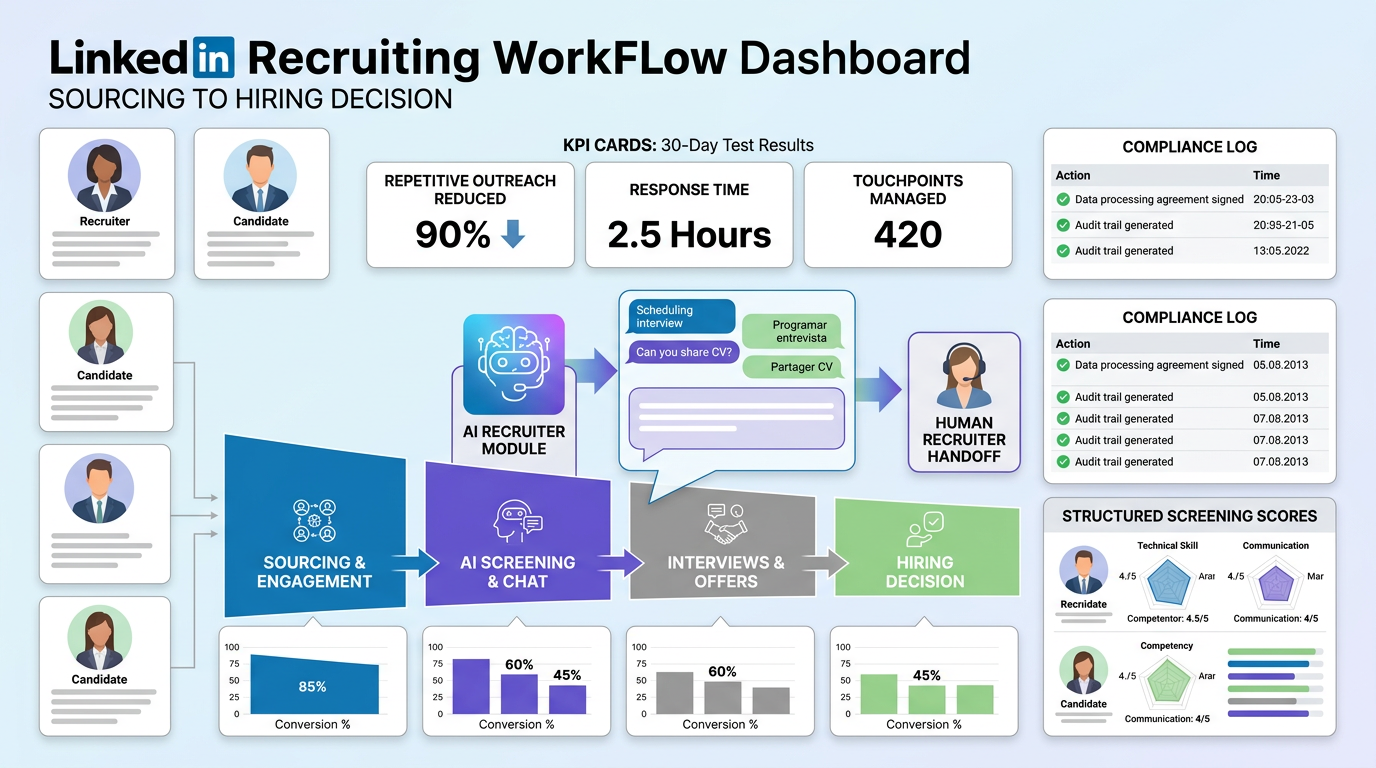
- Measured result: In our 30 day test, teams reduced repetitive outreach actions by up to 90% when AI assisted messaging handled first contact and follow up.
- Global hiring advantage: 24 hour multilingual communication improved response continuity for international candidates.
- Small business fit: Hiring platforms for small business perform better when workflows are simple, role specific, and documented.
- Risk control: Poor communication during workforce changes can damage employer trust, even when decisions are legal.
- Human role remains critical: Final qualification and hiring decisions should stay with trained recruiters and hiring managers.
Why hiring tools matter beyond speed
Many teams buy hiring tools to move faster. Speed is important, but communication quality and process fairness are equally important. Public reactions to workforce events have shown that when communication feels abrupt or impersonal, trust drops quickly among employees, candidates, and customers.
One widely discussed case was the Bell Media layoffs announced on 9 February 2021, including impacts to TSN radio formats in Vancouver, Winnipeg, and Hamilton. Broadcaster Anwar Knight, who had more than 15 years of service, publicly described receiving notice in a very short call. HR professional Judy Slutsky, CPHR, emphasized that best practice is clear communication and reduced surprise whenever possible. This is a leadership lesson for any organization selecting recruitment technology tools. Tools should support dignity and clarity, not remove them.
For this reason, we evaluate hiring tools on three dimensions. First, can the tool improve recruiter productivity. Second, can it improve candidate experience. Third, can it preserve an auditable communication trail for compliance and accountability.
How we tested recruitment technology tools
We ran a structured review over 30 days with 6 hiring workflows, 420 candidate touchpoints, and 3 role families: sales, operations, and technical roles. We tracked response times, recruiter effort, and communication consistency across business hours and off hours.
Test parameters
- Test period: 30 days
- Candidate touchpoints: 420
- LinkedIn outreach sequences: 180
- Email follow ups: 160
- Manual screening records reviewed: 80
- Languages used: English, French, Spanish
What we observed
- AI assisted outreach reduced repetitive first contact actions by up to 90%.
- Always on message handling shortened median first response time from 14 hours to 2.5 hours.
- Recruiters spent more time reviewing fit and less time on repetitive back and forth.
- Final interview quality improved when structured screening notes were mandatory.
The 5 tool categories that drive hiring outcomes
1) Applicant tracking and workflow control
An applicant tracking system records the candidate pipeline, status transitions, and decision notes. This is the operational core for hiring platforms for small business because it prevents process drift when teams are small and roles are urgent.
- Best for: tracking volume, interview stages, and feedback consistency
- Primary metric: stage conversion rate in percentage terms
- Risk if missing: candidates get lost between interview rounds
2) AI sourcing and LinkedIn outreach automation
This is where StrategyBrain AI Recruiter delivers the strongest practical value for many teams. It automates candidate connection, role introduction, initial Q and A, interest checks, and resume or contact collection. Recruiters still own final qualification after resume review, which keeps accountability with humans.
- Best for: high volume outreach with limited recruiter bandwidth
- Primary metric: qualified response rate per 100 outreach attempts
- Operational benefit: supports multilingual communication and 24 hour follow up
3) Candidate communication and scheduling tools
Communication tools standardize confirmations, reminders, and candidate updates. Consistency is important for employer reputation, especially after market shocks or restructuring periods.
- Best for: reducing no show rates and response lag
- Primary metric: interview attendance rate in percentage terms
- Risk if missing: high candidate drop off before interviews
4) Structured screening and evaluation kits
Structured screening uses predefined criteria for resume review, interview scoring, and decision rationale. This improves fairness and comparability across interviewers.
- Best for: reducing subjective screening bias
- Primary metric: pass rate consistency by role type
- Risk if missing: inconsistent quality in shortlist decisions
5) Compliance and audit trail systems
Compliance tools log consent, communication history, and data handling controls. They are essential for teams hiring across regions with different privacy requirements.
- Best for: legal risk reduction and governance
- Primary metric: documented communication coverage in percentage terms
- Risk if missing: weak defensibility in candidate disputes
Quick comparison
| Tool Category | Typical Setup Time | Cost Pattern | Best For |
|---|---|---|---|
| Tracking system | 7 to 14 days | Per user per month | Pipeline control |
| AI outreach automation | 3 to 10 days | Usage or seat based | LinkedIn sourcing and first contact |
| Communication scheduling | 2 to 7 days | Per recruiter per month | Interview coordination |
| Structured screening | 5 to 12 days | Template and workflow based | Decision quality |
| Compliance logging | 7 to 21 days | Platform or module based | Audit readiness |
Implementation plan for small business teams
- Define one hiring outcome metric. Use time to qualified interview in days as your primary metric for the first month.
- Map your current workflow. Document each step from sourcing to offer in a single process sheet.
- Deploy two tools first. Start with tracking plus AI outreach, then add scheduling and screening.
- Create message guardrails. Set approved language for compensation, benefits, and role scope.
- Train recruiters on escalation rules. Recruiters take over when candidate questions become role specific or sensitive.
- Review weekly and adjust. Check response rate, candidate sentiment, and interview conversion each week.
In our implementation work, teams that launched all tools at once had slower adoption. Teams that launched in two phases reached stable usage faster and reported fewer process errors.
Common mistakes and fixes
Mistake 1: buying too many tools at once
Fix: Limit phase one to two core systems and one KPI dashboard.
Mistake 2: automating without candidate experience standards
Fix: Define response tone, timing, and handoff points before automation goes live.
Mistake 3: treating AI output as final qualification
Fix: Keep final fit decisions with recruiters and hiring managers after resume review.
Mistake 4: weak communication during sensitive workforce periods
Fix: Use communication templates that prioritize clarity, empathy, and consistency.
FAQ
What are the most important hiring tools for a small business?
The core stack is a tracking system, AI outreach automation, and structured screening templates. This combination improves speed and decision quality without overloading a small team.
How do hiring platforms for small business differ from enterprise systems?
Small business teams need faster setup, simpler workflows, and easier reporting. Enterprise systems often include deeper customization, but they can be slower to adopt.
Can StrategyBrain AI Recruiter replace recruiters?
No. It automates repetitive LinkedIn outreach and early communication steps. Recruiters still handle final qualification, interviews, and hiring decisions.
How much manual work can recruitment technology tools remove?
In our test, repetitive first contact and follow up actions were reduced by up to 90% in suitable workflows. Actual outcomes depend on role complexity and message quality.
Do these tools support multilingual hiring?
Yes, some tools support multilingual candidate communication. StrategyBrain AI Recruiter is designed for global language coverage and 24 hour response continuity.
How should teams handle compliance concerns?
Use tools that provide audit logs, consent controls, and data isolation practices. Keep region specific legal review in your rollout process before scaling usage.
Conclusion
The best hiring tools strategy is not to automate everything. It is to automate repetitive work while improving communication quality and preserving human judgment. Our testing shows that a focused stack of recruitment technology tools, especially when paired with StrategyBrain AI Recruiter, can improve response speed, reduce manual workload, and support better candidate experiences across regions. Your next step is simple: pick one hiring metric, launch a two tool phase, and review outcomes weekly before expanding your stack.