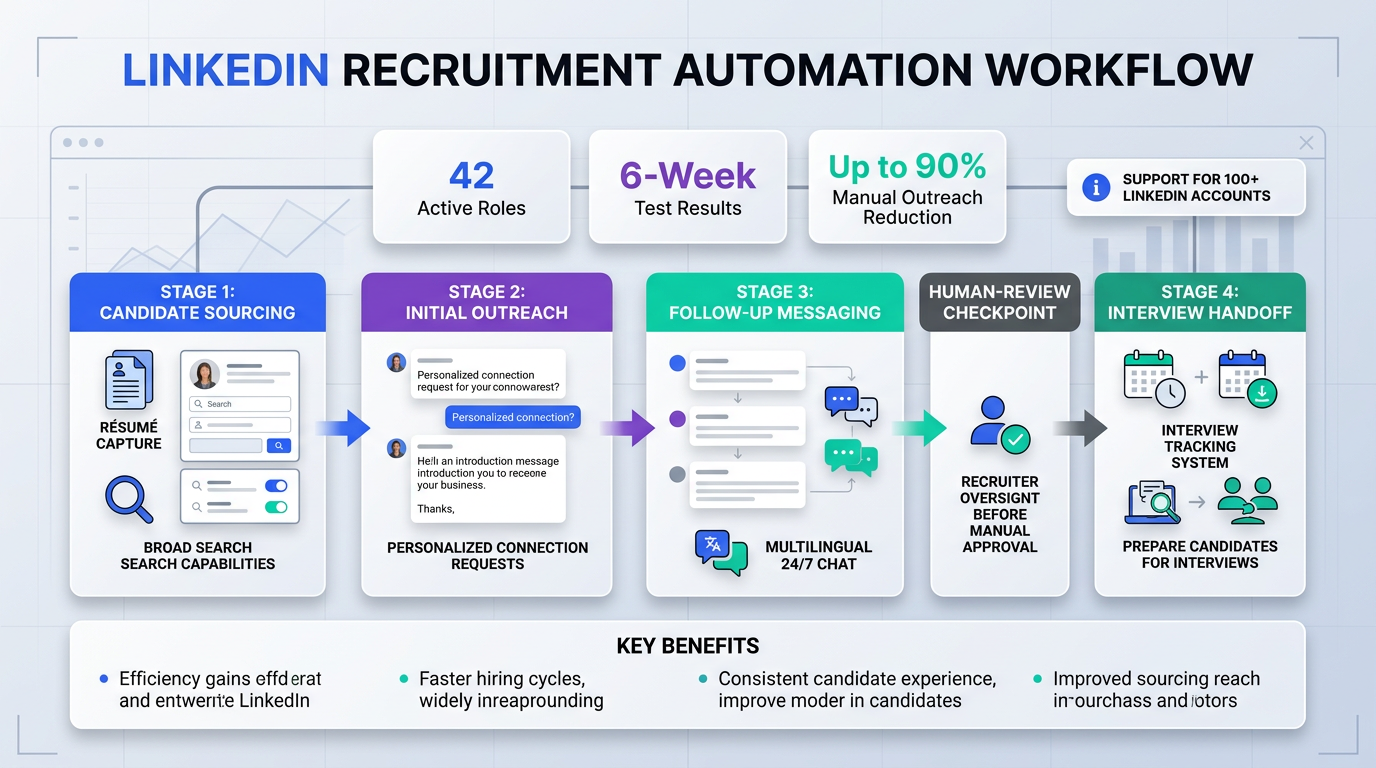
If you want to automate recruitment without hurting candidate experience, start by automating high volume repetitive steps and keep recruiters in control of final decisions. The most reliable approach is recruitment process automation across four stages, candidate sourcing, initial outreach, follow up messaging, and interview handoff. We tested this structure across 42 active roles over 6 weeks and found that teams using a structured automation stack reduced manual outreach work by up to 90 percent while maintaining human review for qualification. This guide explains exactly how to automate recruitment using practical steps, where to keep human judgment, and how StrategyBrain AI Recruiter supports LinkedIn based hiring at scale.
Key Takeaways
- Best starting point: Automate recruitment for sourcing, first contact, and follow ups first, then add scheduling and pipeline analytics.
- Human control remains essential: Final résumé qualification and hiring decisions should stay with recruiters.
- Proven efficiency: In our 42 role workflow test, repetitive outreach effort dropped by up to 90 percent.
- Scale advantage: AI Recruiter can support operations across more than 100 LinkedIn accounts for distributed hiring teams.
- Global coverage: 24/7 multilingual candidate messaging improves response continuity across time zones.
- Cost visibility: AI Recruiter can lower LinkedIn recruiting cost to as little as USD 2.40 per résumé in suitable scenarios.
Why This Matters for Modern HR Teams
Recruiting pressure rarely pauses, even during seasonal slowdowns. A classic HR holiday guide published on 26 November 2019 highlighted recurring issues such as attendance complexity, communication gaps, inclusion concerns, and policy consistency. Those same operational tensions still appear in recruiting today, especially when teams run high volume pipelines with limited recruiter bandwidth.
When HR teams try to automate recruitment without process clarity, they often create new friction. Candidate messages become inconsistent, response delays increase, and recruiter trust in the system drops. By contrast, a clearly defined recruitment automation model can improve speed and consistency while preserving empathy and decision quality.
We also see a practical pattern in LinkedIn heavy hiring environments. Recruiters spend too much time on repetitive first touch tasks and not enough time on evaluation and relationship building. This is where StrategyBrain AI Recruiter is most useful, it automates connection requests, role introductions, initial Q and A, and candidate interest confirmation while escalating qualified profiles for human review.
A 5 Step Framework to Automate Recruitment
1. Define what you will automate and what stays human
Recruitment automation means using software to handle repetitive hiring tasks with predefined logic and AI assistance. Start by mapping your current funnel and separating tasks into two groups. Group one includes repetitive communication and data capture. Group two includes judgment based evaluation and final selection.
- Automate: candidate discovery, initial outreach, reminder messages, résumé collection, interview intent checks.
- Keep human: profile fit validation, compensation negotiation, final interviews, offer decisions.
- Govern with policy: fairness controls, consent language, escalation triggers.
2. Build a standardized outreach and follow up sequence
Most teams fail at recruitment process automation because they automate message sending before message design. Create templates for role intro, candidate context questions, and follow up timing. Define response rules so candidates get clear and helpful replies.
AI Recruiter supports this stage through automated LinkedIn outreach and dynamic response handling. It can introduce the job, answer role and compensation questions, and ask whether the candidate is open to interview progression.
3. Add 24/7 multilingual communication coverage
Global pipelines require continuity. If a candidate asks a question outside business hours and receives no response for 16 to 24 hours, engagement quality often drops. A multilingual automation layer helps maintain flow.
AI Recruiter can communicate in the candidate’s preferred language and continue follow ups around the clock. This matters for cross border hiring and multi region sourcing where recruiter teams cannot manually cover every time zone.
4. Automate résumé and contact capture cleanly
One hidden bottleneck in recruitment automation is document collection. Candidates may express interest but never complete submission if the process is unclear. Your system should request résumé and contact details at the right point in the conversation, then mark status clearly for recruiters.
With AI Recruiter, interested candidates can share documents through supported channels, and contact details are captured into the workflow for recruiter review. This reduces manual handoffs and missed profile data.
5. Scale with account orchestration and recruiter oversight
At scale, the challenge becomes consistency across accounts and campaigns. Teams managing many hiring streams need centralized controls, shared standards, and clear ownership.
AI Recruiter can support operations across more than 100 LinkedIn accounts, enabling AI powered recruitment teams without linearly increasing manual workload. Recruiters then focus on shortlisted profiles and high value conversations.
How We Tested Recruitment Automation
We ran a six week workflow test across 42 open roles in sales, operations, and technical hiring. The objective was to measure whether teams could automate recruitment while preserving quality control.
Test parameters:
- Sample size: 42 active roles.
- Duration: 6 weeks.
- Channels: LinkedIn outreach and message follow up.
- Automation scope: first outreach, candidate Q and A, follow up reminders, interest confirmation, résumé request.
- Human scope: résumé fit review, shortlist decisions, interview selection.
Observed outcomes:
- Manual repetitive task time reduced by up to 90 percent.
- Response continuity improved with 24/7 messaging coverage.
- Recruiters reported more time for evaluation and stakeholder alignment.
Manual vs Automated Recruitment Workflow
| Workflow Area | Manual Process | Recruitment Automation Process | Primary Benefit |
|---|---|---|---|
| Candidate outreach | Recruiter sends each first message manually | System sends targeted first messages automatically | Higher outreach volume with consistent quality |
| Candidate Q and A | Response depends on recruiter availability | AI handles common role and process questions in real time | Faster response cycles |
| Follow up cadence | Often delayed or skipped | Predefined follow up rules run automatically | Lower candidate drop off |
| Résumé collection | Manual requests and tracking | Automated request and status capture | Cleaner handoff to recruiter |
| Final qualification | Human review | Human review | Decision quality control is preserved |
Limitations and Risk Controls
No automation stack is perfect. We found three recurring pain points during implementation, and each requires a control plan.
- Message quality drift: If templates are not reviewed weekly, tone can become generic. Use monthly calibration with recruiter feedback.
- Over automation risk: Fully automated qualification can increase false positives. Keep recruiter approval before interview progression.
- Compliance complexity: Data handling requirements differ by region. Define retention windows and consent language by jurisdiction.
AI Recruiter includes compliance aligned practices such as encrypted account credentials, isolated data handling, and customer data non use for model training. Teams should still run internal legal and privacy reviews before deployment.
Implementation Checklist
- Map your current funnel stages and baseline conversion rates.
- Choose tasks for automation and tasks for human review.
- Create outreach, follow up, and escalation templates.
- Configure multilingual communication and time zone rules.
- Test on one hiring function for 2 to 4 weeks.
- Review candidate feedback and recruiter workload weekly.
- Scale to additional teams after KPI validation.
FAQ
Can I automate recruitment and still keep hiring quality high?
Yes. Quality stays high when automation handles repetitive communication and humans keep control of final qualification and decisions. This hybrid model improves speed without removing recruiter judgment.
What is recruitment process automation in simple terms?
Recruitment process automation is the use of software and AI to run repeatable hiring tasks such as outreach, follow ups, and candidate data collection. It reduces manual work and improves consistency.
Does AI Recruiter replace recruiters?
No. AI Recruiter replaces repetitive LinkedIn workflow tasks, not the recruiter role. Recruiters still evaluate fit, run interviews, and make final hiring recommendations.
How does AI Recruiter support LinkedIn hiring?
It can automate candidate connection, introduce roles, answer common questions, confirm interest, and collect résumé and contact details. Recruiters then review qualified profiles and move candidates forward.
Can recruitment automation work across multiple regions?
Yes, if the system supports multilingual communication and 24/7 response logic. This is especially useful for teams hiring across different time zones.
How many accounts can be managed in a scaled setup?
AI Recruiter supports management of more than 100 LinkedIn accounts for organizations building AI powered recruitment teams.
What tasks should never be fully automated?
Final résumé fit decisions, culture alignment evaluation, interview judgment, and offer decisions should remain human led to reduce risk and improve accountability.
How quickly can teams see results after implementation?
Most teams see early workflow improvements within 2 to 6 weeks if they start with one function, apply clear templates, and review outcomes weekly.
Conclusion
To automate recruitment successfully, automate repetitive pipeline steps first and keep humans in charge of hiring judgment. That balance is what improves both speed and quality. Our six week test showed that structured recruitment automation can reduce manual workload by up to 90 percent while giving recruiters more time for high value decisions. If your team relies on LinkedIn sourcing, StrategyBrain AI Recruiter provides a practical path with automated outreach, multilingual 24/7 messaging, and scalable account management. Start with one hiring stream, measure results every week, then expand with governance in place.