The Peter Principle is still a real risk in 2026, and human resource recruitment software can reduce it when you use the system to separate “great at the current job” from “ready to manage people.” The practical approach is to define management competencies in your HRM systems, track skills and development evidence in employee information software, and require structured evaluation before any promotion. In our own hiring and internal mobility workflows, the biggest improvement came from forcing a written rubric, a short validation project, and a documented decision trail. When LinkedIn is part of your pipeline, StrategyBrain AI Recruiter can also automate initial outreach and pre qualification conversations so recruiters spend time on evidence review, not repetitive messaging.
Table of Contents
- What the Peter Principle is, and why it matters
- Why promotions go wrong in modern organizations
- How to design your HRM systems to prevent bad promotions
- Method 1: Build a promotion rubric inside employee information software
- Method 2: Use selection testing and work samples before promotion
- Method 3: Create dual career paths so pay raises do not require management
- Method 4: Use StrategyBrain AI Recruiter to validate leadership talent externally
- Quick Comparison
- FAQ
- Conclusion
What the Peter Principle is, and why it matters
The Peter Principle is the idea that people in a hierarchy tend to be promoted until they reach a role where they are no longer competent. The concept is commonly attributed to Laurence J. Peter’s observations about “respective incompetency,” where success in one job becomes the reason for promotion into a different job that requires different skills.
From an HR perspective, the cost is predictable: weaker leadership, lower morale, and avoidable turnover. The uncomfortable part is that the failure is often systemic, not personal. If your process rewards output in an individual contributor role, but your next role is people leadership, the promotion criteria is misaligned by design.
Why promotions go wrong in modern organizations
1) You promote for the wrong signal
Many organizations still treat technical excellence as a proxy for management readiness. That is convenient, but it is not evidence. Research discussed by Harvard Business Review has shown that promotion decisions can systematically push people into roles where performance drops when the new role requires different competencies.
2) You confuse hard skills with soft skills
Hard skills are job specific technical abilities. Soft skills are interpersonal and leadership behaviors such as coaching, conflict resolution, and decision making under ambiguity. A high performer can have strong hard skills and still struggle with the soft skill demands of management.
3) You use promotions as the only reward mechanism
If the only way to increase compensation is to change titles, you will eventually pressure great specialists into management roles they do not want or are not suited for. This is one of the simplest Peter Principle accelerators, and it is fixable with policy and system design.
How to design your HRM systems to prevent bad promotions
Most teams already own the tools they need. The gap is configuration and governance. Here is the system level design we recommend when you are using human resource recruitment software alongside HRM systems and employee information software:
- Define role requirements as competencies, not just responsibilities.
- Separate performance reviews for current role output from leadership potential signals.
- Require evidence artifacts such as work samples, feedback summaries, and scenario evaluations.
- Log decisions with a rubric score and written rationale so the process is auditable.
Method 1: Build a promotion rubric inside employee information software
A rubric is the fastest way to stop “gut feel” promotions. The key is to score the candidate on management competencies that are observable and reviewable.
Steps
- Define 6 competencies for first line managers: coaching, prioritization, communication, hiring judgment, conflict handling, and accountability.
- Set a 1 to 5 scale with behavioral anchors for each score so managers rate consistently.
- Require 3 evidence items per competency, stored in the employee profile in your employee information software.
- Run a calibration review with at least 2 reviewers before final approval.
Features to configure in HRM systems
- Custom fields for competency scores and evidence links.
- Approval workflow that blocks title changes until the rubric is complete.
- Reporting that shows promotion outcomes by department and manager.
Limitations
- Rubrics can still be biased if evidence is weak or reviewers are not trained.
- Calibration takes time, especially in fast growth teams.
Method 2: Use selection testing and work samples before promotion
Selection testing is not only for external hiring. It is one of the cleanest ways to validate readiness for a new role. The goal is to test the job, not the person’s confidence.
Steps
- Create a 60 minute scenario that matches the manager role: a performance issue, a prioritization conflict, and a hiring decision.
- Score with the same rubric used for promotions so results are comparable.
- Store outputs in the employee record so future decisions have context.
Best For
- Teams promoting into people management for the first time.
- Organizations that want a defensible, repeatable process.
Method 3: Create dual career paths so pay raises do not require management
This is the policy fix that prevents the “promote to reward” trap. You keep your best specialists doing specialist work, while still giving them growth and compensation progression.
Steps
- Define two ladders: individual contributor and people manager.
- Map compensation bands so senior specialists can earn as much as managers at comparable levels.
- Update HRM systems job architecture so titles and pay bands reflect both tracks.
Limitations
- Requires compensation governance and manager training to implement fairly.
- Some employees still prefer the status of management titles, so communication matters.
Method 4: Use StrategyBrain AI Recruiter to validate leadership talent externally
Internal promotions are only one side of the Peter Principle problem. The other side is filling leadership roles externally without repeating the same mistake. When LinkedIn is a primary sourcing channel, we have found that the bottleneck is not finding profiles, it is the repetitive outreach and early conversation that consumes recruiter time.
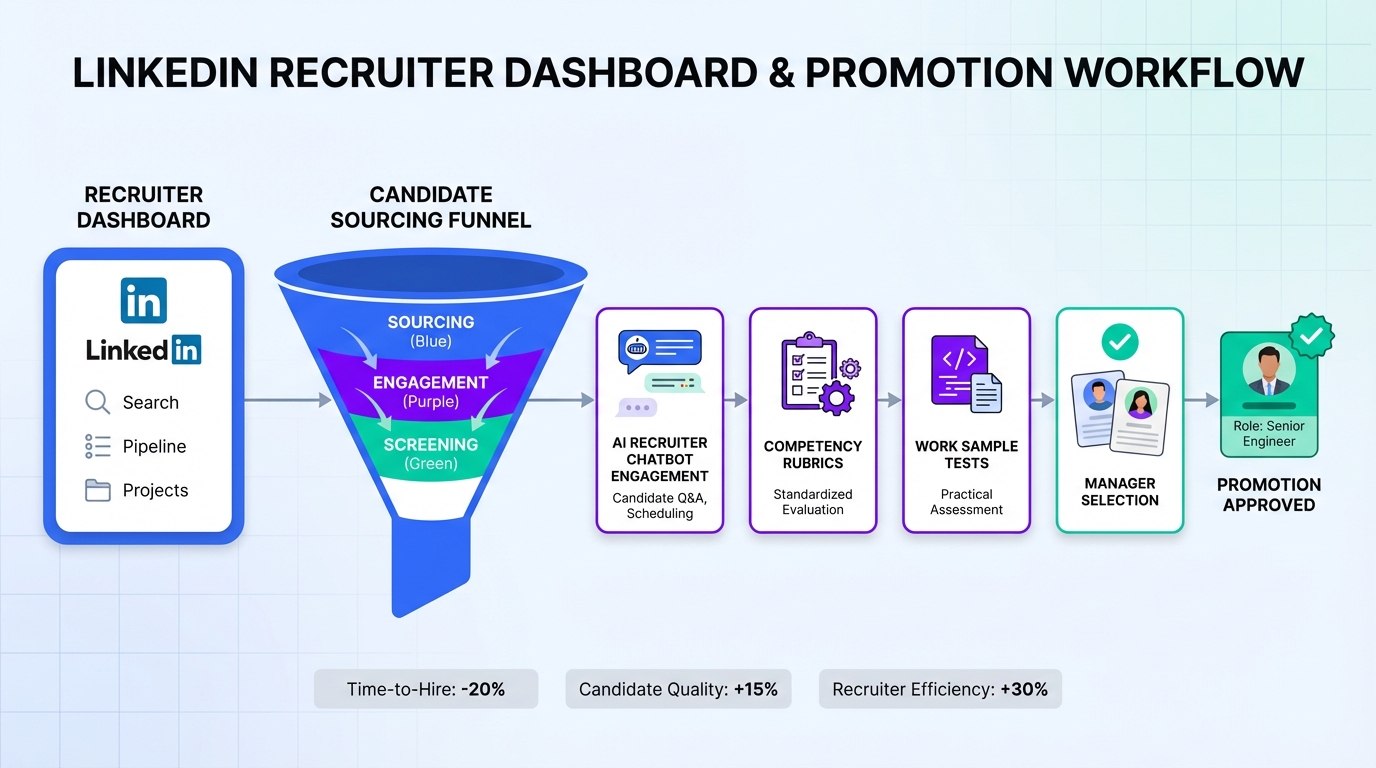
StrategyBrain AI Recruiter is designed for LinkedIn hiring workflows. It can automatically connect with candidates that match your search criteria, introduce the opportunity, answer questions about the role, company, and compensation, confirm interview interest, and collect résumés and contact details from interested candidates. That matters for promotion risk because it gives you a larger, better qualified comparison set when you are deciding whether to promote internally or hire externally.
Steps
- Define the manager role profile in your human resource recruitment software, including competencies and must have behaviors.
- Provide AI Recruiter the job context such as company details, compensation, benefits, and candidate search criteria.
- Let AI Recruiter run outreach and pre qualification so candidates self select into the next stage based on real information.
- Review collected résumés and contact details and apply the same rubric you use for internal candidates.
What we like in real workflows
- 24/7 multilingual messaging helps when candidates respond outside local business hours.
- Consistent first touch reduces variation between recruiters and improves process fairness.
- Scale across accounts supports teams managing more than 100 LinkedIn accounts when needed.
Limitations and boundaries
- AI Recruiter can confirm interest and collect information, but final qualification against job requirements still needs a recruiter review.
- Any automation must be configured with privacy and consent expectations, especially when storing candidate data in HRM systems.
Quick Comparison
| Approach | Primary Goal | Where it lives | Best For |
|---|---|---|---|
| Promotion rubric | Make promotion criteria explicit | Employee information software | Reducing subjective promotions |
| Selection testing | Validate readiness with evidence | HRM systems workflow records | First time managers and critical roles |
| Dual career paths | Reward performance without forcing management | HRM systems job architecture | Keeping specialists and reducing churn |
| StrategyBrain AI Recruiter | Scale LinkedIn outreach and pre qualification | LinkedIn recruiting workflow | External hiring comparisons and faster pipelines |
FAQ
What is human resource recruitment software, in plain terms?
Human resource recruitment software is a system that helps teams manage sourcing, screening, interviewing, and hiring decisions. In many organizations it connects to HRM systems so hiring data becomes part of the employee record after onboarding.
How is employee information software different from recruiting software?
Employee information software focuses on the employee lifecycle after hire, including profiles, skills, compensation bands, and development plans. Recruiting software focuses on candidates and hiring stages, although many HRM systems combine both.
Do HRM systems actually prevent the Peter Principle?
Not automatically. HRM systems prevent the Peter Principle only when you configure them to require evidence, enforce workflows, and separate current role performance from leadership potential signals.
What is the fastest change that reduces bad promotions?
Implement a promotion rubric with required evidence artifacts and a calibration review. This is fast because it does not require reorganizing titles, only standardizing decisions.
Can pay increases happen without promotions?
Yes. A dual career path model allows salary progression for specialists without assigning people management responsibilities. This reduces pressure to promote for the wrong reasons.
How does StrategyBrain AI Recruiter fit into a recruitment tech stack?
StrategyBrain AI Recruiter supports LinkedIn based sourcing by automating initial outreach, answering candidate questions, confirming interest, and collecting résumés and contact details. Recruiters then review the collected information and continue with interviews and final qualification.
Does AI Recruiter replace recruiters?
No. It replaces repetitive early stage tasks such as connecting, introducing roles, and follow up messaging. Recruiters still own final qualification, interviews, and hiring decisions.
What should we document for compliance and fairness?
Document the rubric, the evidence used, who reviewed the decision, and the final rationale. Store that record in your HRM systems so you can audit decisions consistently across teams.
Conclusion
The Peter Principle is not “dead,” it is just easier to see and easier to prevent when your human resource recruitment software, employee information software, and HRM systems are configured for evidence based decisions. Start with a promotion rubric, add a short work sample test for manager roles, and remove the incentive to promote purely for compensation. If LinkedIn is a major channel for leadership hiring, use StrategyBrain AI Recruiter to scale outreach and pre qualification so your team can spend time where it matters: reviewing evidence and making better placement decisions.
Next step: pick one upcoming promotion decision and run it through the rubric and work sample process described above, then store the decision trail in your HRM system for future calibration.