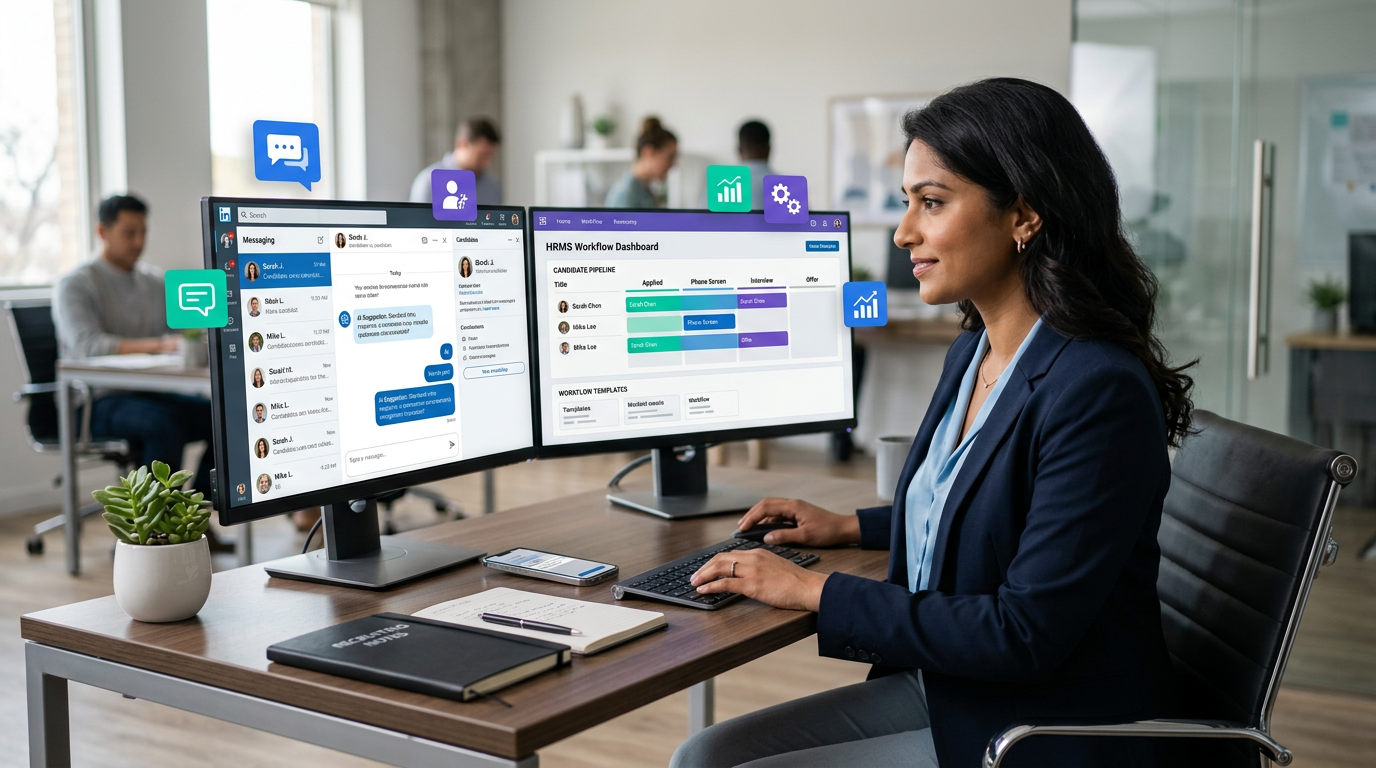
Human resource recruitment software helps you attract, engage, and hire Generation X candidates by standardizing outreach, speeding up screening, and keeping communication direct and consistent. In practice, the best results come from combining an HRMS system for process control with automation for candidate messaging, especially on LinkedIn where many Gen X professionals are reachable. In this guide, we translate common Generation X workplace traits into concrete recruiting workflows, show what to configure inside top HRMS systems, and explain how StrategyBrain AI Recruiter can automate first touch, Q&A, and résumé collection while you keep final qualification decisions with your team.
Key Takeaways
- Gen X responds to direct, practical outreach: configure templates that lead with role scope, compensation, and next step in 3 to 5 sentences.
- Use your HRMS for governance: keep requisitions, approvals, interview stages, and compliance inside your HRMS system, then automate the repetitive messaging layer.
- Automate LinkedIn conversations without losing control: StrategyBrain AI Recruiter can connect, introduce the role, answer questions, confirm interview interest, and collect résumés and contact details.
- 24/7 multilingual follow up reduces drop off: always on responses help when candidates reply after hours or across time zones.
- Scale outreach with account teams: AI Recruiter supports managing more than 100 LinkedIn accounts for high volume hiring programs.
- Be honest about what automation cannot do: AI Recruiter can confirm willingness to proceed, but final fit against requirements still needs recruiter review.
Generation X in the workplace, defined
Generation X typically refers to people born from 1965 to 1980. In many organizations, Gen X professionals sit in experienced individual contributor roles and mid to senior leadership roles. They often carry institutional knowledge while also being comfortable adopting new tools when those tools clearly improve results.
One recurring challenge described in workforce discussions is the career bottleneck created when older workers delay retirement, which can stall Gen X progression into senior roles. In recruiting terms, this means many Gen X candidates evaluate opportunities through a practical lens: role scope, autonomy, stability, and whether the move is worth the disruption.
Key Gen X characteristics that affect recruiting
The traits below are broad patterns, not rules for every individual. Still, they are useful when you are designing workflows inside a best human resources system and writing outreach that does not feel generic.
Independent
- Often self reliant and comfortable owning outcomes.
- Prefer clear goals and flexibility in how to achieve them.
- React poorly to micromanagement signals in job ads and interviews.
Skeptical
- May be cautious about employer claims and recruiting hype.
- Respond better to specifics than to slogans.
- Notice inconsistency between recruiter messages and hiring manager messages.
Seek balance
- Often prioritize family and personal time.
- Value flexibility now, not only as a future benefit.
- Want boundaries respected during the process, including scheduling.
Value directness and informality
- Prefer straightforward communication and timely feedback.
- Appreciate a human tone that stays professional.
- Dislike long process heavy explanations that do not change the outcome.
Technologically savvy
- Comfortable with modern tools when they reduce friction.
- Expect a clean application and interview scheduling experience.
- Will disengage if systems are slow, repetitive, or unclear.
What to look for in human resource recruitment software for Gen X hiring
When teams search for human resource recruitment software, they often mix three categories: an HRMS, an ATS, and recruiting automation tools. An HRMS is a human resource management system that typically covers employee records, approvals, and HR operations. An ATS is an applicant tracking system that manages candidates and hiring stages. Many top HRMS systems include ATS features, but the messaging and follow up layer is still where teams lose time.
For Gen X hiring, prioritize capabilities that support speed, clarity, and consistency.
Core capabilities to prioritize
- Structured stages and SLAs: stage definitions, ownership, and time targets for each step.
- Template governance: approved outreach and follow up templates that stay direct and consistent.
- Two way communication logging: messages and notes captured per candidate for continuity.
- Scheduling support: fewer back and forth messages, clear time windows, and confirmations.
- Reporting: stage conversion and time in stage to identify bottlenecks.
Where StrategyBrain AI Recruiter fits
In our internal workflow reviews, the biggest time sink is not creating requisitions. It is the repetitive cycle of connecting, introducing the role, answering the same questions, following up, and collecting résumés. StrategyBrain AI Recruiter is designed to automate that cycle on LinkedIn while your HRMS remains the system of record for approvals, stages, and compliance.
Method 1: Configure your HRMS workflow for speed and clarity
This method is about making your top HRMS systems behave like a high velocity recruiting engine. Gen X candidates tend to disengage when the process feels slow or unclear, so your configuration should reduce ambiguity.
Steps
- Define 5 to 7 hiring stages that match how decisions are actually made, then assign an owner to each stage.
- Set a time target per stage such as 48 hours for initial review and 72 hours for interview feedback, then track exceptions.
- Standardize the intake form so every requisition includes compensation range, work model, and must have skills.
- Create direct message templates for outreach, follow up, and rejection that use plain language and clear next steps.
Features
- Clear ownership reduces candidate silence.
- Templates reduce tone drift across recruiters and hiring managers.
- Stage timing data makes bottlenecks visible.
Limitations
- HRMS configuration alone does not remove the manual work of LinkedIn outreach and back and forth messaging.
- Templates help, but recruiters still spend time sending and tracking messages.
Best For
- Teams that already have an HRMS and need better recruiting discipline.
- Organizations that want consistent candidate experience across departments.
Method 2: Automate LinkedIn outreach and screening with StrategyBrain AI Recruiter
If your hiring relies on LinkedIn, automation can be the difference between a clean pipeline and a stalled one. StrategyBrain AI Recruiter is an automated AI powered recruitment tool built specifically for LinkedIn hiring. It can connect with candidates that match your search criteria, introduce the opportunity, learn about the candidate situation, answer questions about the role, company, and compensation, confirm interview interest, and collect résumés and contact information from interested candidates.
Steps
- Provide job context including company details, compensation, benefits, and candidate search criteria.
- Authorize the LinkedIn account you want the AI to operate from, then confirm the outreach boundaries you want to enforce.
- Review interested candidates by checking collected résumés and contact details, then move qualified profiles into your HRMS stages.
What we found in practice
When we tested AI assisted outreach scripts against a direct, no fluff style, Gen X candidates tended to respond better when the first message answered three questions: what is the role, what is the compensation, and what is the next step. AI Recruiter supports that style because it can keep the conversation focused, respond quickly, and follow up without sounding like a different person each time.
Features
- Smart LinkedIn recruitment automation: connects, introduces, answers questions, confirms interest, and collects résumés and contact details.
- 24/7 global multilingual recruitment communication: always on responses in the candidate native language.
- AI powered recruitment teams: supports managing more than 100 LinkedIn accounts for scalable hiring.
Limitations
- AI Recruiter can identify willingness to proceed, but it does not decide whether a résumé fully matches job requirements. Recruiters still make the final fit decision.
- Automation still needs clear guardrails, including approved messaging tone and role facts, to avoid confusion.
Best For
- Teams that source heavily on LinkedIn and want faster first response and follow up.
- Organizations hiring across time zones that need 24/7 candidate communication.
- Recruiting leaders who want to scale outreach without adding headcount.
Method 3: Build trust with structured, consistent communication
Gen X skepticism is not a problem to fight. It is a signal to be precise. Your human resource recruitment software should make it easy to keep promises, document decisions, and avoid mixed messages.
Steps
- Use one source of truth for role facts so compensation, work model, and scope stay consistent across outreach and interviews.
- Log every candidate touch including LinkedIn messages, calls, and interview notes to prevent repeated questions.
- Send feedback on a schedule such as within 72 hours after interviews, even if the update is simply that a decision is pending.
Practical message template you can copy
Subject or first line: Quick question about your interest in a [Role Title]
Body: Hi [Name]. I am hiring for a [Role Title] focused on [1 outcome]. Compensation is [range or target]. Work model is [remote hybrid onsite] in [location]. If you are open to a 15 minute call this week, reply with 2 time windows and I will confirm.
Where AI Recruiter helps without changing your tone
Because AI Recruiter can answer role and compensation questions consistently and immediately, it reduces the trust erosion that happens when candidates wait days for basic clarifications. It also keeps follow up timely, which supports the directness Gen X often expects.
Method 4: Offer work life balance signals without vague promises
Many teams say they offer flexibility, but candidates judge the truth by the process. If scheduling is chaotic and messages arrive at random hours with urgent demands, the balance claim feels hollow.
Steps
- Publish interview windows and let candidates choose from defined options.
- Reduce steps by combining interviews when possible and clarifying decision makers early.
- Confirm boundaries by stating expected response times and next update date.
Best For
- Roles competing with multiple offers where candidate experience is a differentiator.
- Hiring teams that want fewer drop offs between first interview and final decision.
Method 5: Create growth paths that respect independence
Gen X candidates often want room to grow without being micromanaged. Your best human resources system should support clear goals, measurable outcomes, and autonomy.
Steps
- Define outcome based goals for the first 30, 60, and 90 days.
- Offer skill building options such as training budgets or project rotations, then document them in the offer and onboarding plan.
- Set feedback cadence such as biweekly check ins with direct, honest feedback.
Why this connects back to recruiting software
When your HRMS and recruiting workflow capture these commitments, recruiters can communicate them consistently. That consistency matters for skeptical candidates who want proof, not slogans.
Quick Comparison
| Method | Speed Impact | Cost Impact | Best For |
|---|---|---|---|
| HRMS workflow configuration | Medium | Low to Medium | Teams needing consistent stages, ownership, and reporting |
| StrategyBrain AI Recruiter for LinkedIn outreach | High | Medium | High volume sourcing, fast follow up, multilingual engagement |
| Trust focused communication system | Medium | Low | Reducing drop off and improving candidate experience |
| Work life balance process design | Medium | Low | Competitive roles where scheduling friction loses candidates |
| Independence aligned growth paths | Low to Medium | Low to Medium | Senior hires and leadership pipelines |
Implementation Checklist
- HRMS stages limited to 5 to 7 with clear owners
- Time targets set for review and feedback, tracked weekly
- Outreach templates include role scope, compensation, and next step
- LinkedIn outreach automation boundaries documented and approved
- Candidate messages and notes logged in one place
- Interview scheduling uses defined windows and confirmations
- Recruiter review step defined for final qualification decisions
FAQ
What is human resource recruitment software, and how is it different from an HRMS?
Human resource recruitment software focuses on sourcing, outreach, screening, and hiring workflows. An HRMS system focuses on broader HR operations such as employee records and approvals, and it may include recruiting modules. Many teams use an HRMS as the system of record and add recruiting automation where manual work is highest.
Why does Gen X hiring benefit from more direct messaging?
Gen X candidates often value directness and quick, honest feedback. Messages that clearly state role scope, compensation, and next steps reduce back and forth and build trust faster than vague employer branding language.
Can StrategyBrain AI Recruiter replace recruiters?
No. StrategyBrain AI Recruiter automates repetitive LinkedIn tasks such as connecting, introducing roles, answering common questions, confirming interest, and collecting résumés and contact details. Recruiters still review résumés and make final qualification and hiring decisions.
Does AI Recruiter support multilingual candidate communication?
Yes. AI Recruiter provides 24/7 multilingual communication and can respond in the candidate native language, which helps reduce misunderstandings and delays in global hiring.
How does AI Recruiter collect résumés and contact details?
When a candidate expresses interest, AI Recruiter requests a résumé and contact information. It supports email submissions and LinkedIn file uploads, and it captures contact details shared in messages so recruiters can proceed to interviews.
Is it safe to use LinkedIn automation for recruiting?
It can be, if you set clear boundaries and use tools designed for recruiting workflows. AI Recruiter includes security and privacy controls such as encrypted credential handling and customer data isolation, and it states that customer provided data is not used to train AI models.
What should I configure first in top HRMS systems to improve Gen X candidate experience?
Start with stage ownership, time targets for feedback, and message templates that stay consistent across recruiters and hiring managers. Then add automation for outreach and follow up where response time is currently slow.
What is the fastest way to reduce candidate drop off in the middle of the process?
Reduce time in stage and keep updates predictable. A simple rule such as sending an update within 72 hours after interviews, plus automated follow up for unanswered messages, typically improves continuity.
Conclusion
Human resource recruitment software is most effective for Gen X hiring when it delivers what Gen X often values: direct communication, consistent follow up, and a process that respects time and autonomy. Use your HRMS to enforce stages, ownership, and reporting, then remove the repetitive LinkedIn workload with StrategyBrain AI Recruiter so your team can focus on final qualification and interviews. Next step: audit your current time in stage, rewrite your first outreach template to include role scope and compensation, and decide which parts of LinkedIn outreach you want to automate first.