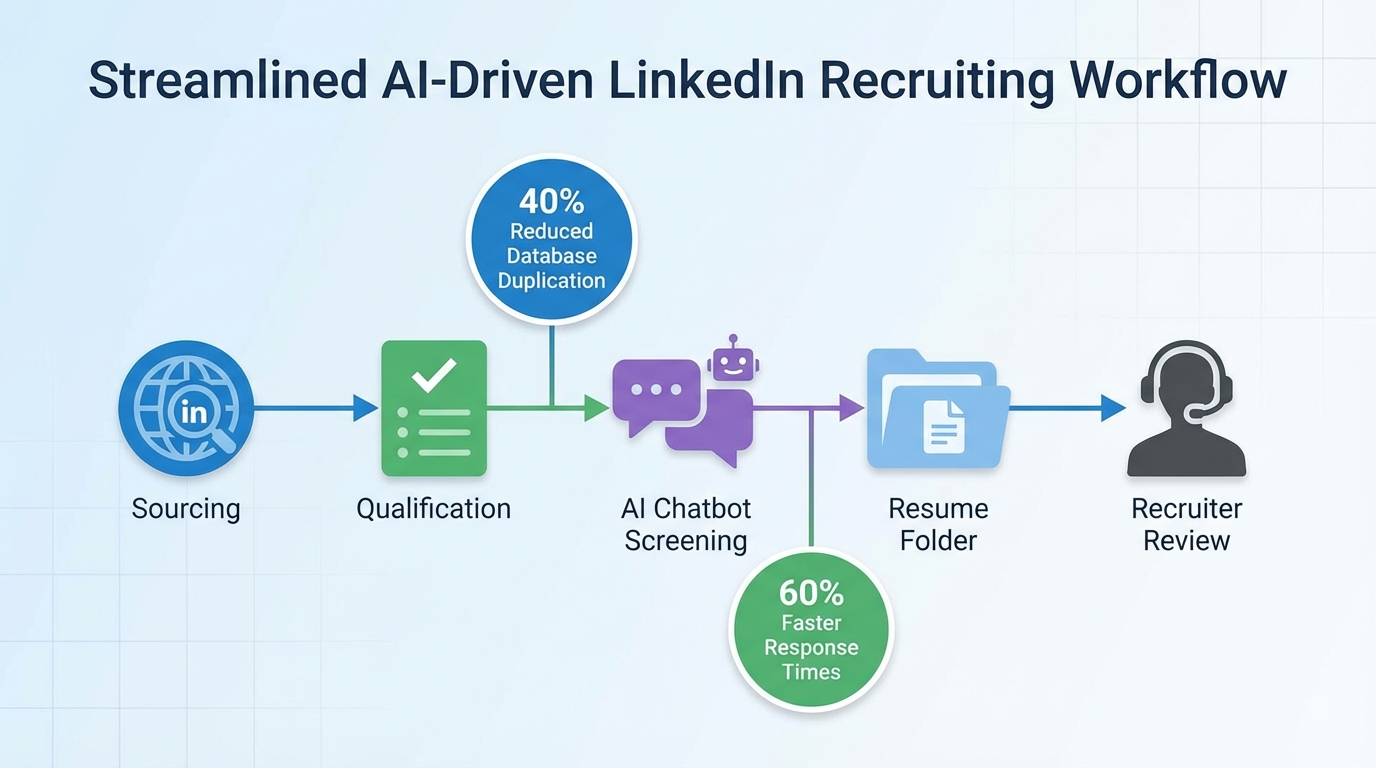
Human resource recruitment software can reduce waste in hiring by replacing “collect everything” workflows with intentional sourcing, clear qualification, and timely candidate communication. In practice, that means you stop building duplicate databases no one reuses, stop celebrating irrelevant application volume, and stop creating false hope through silence or last minute reversals. In this guide, we translate a recruiter’s reflection on overconsumption into a practical operating model for HR teams, then show how StrategyBrain AI Recruiter supports that model on LinkedIn through automated outreach, 24/7 multilingual messaging, and structured resume and contact capture. Scope: process design, governance, and implementation steps. Not covered: legal advice for specific jurisdictions or a full ATS procurement checklist.
Table of Contents
- Why recruiting can be wasteful
- A simple framework: care for people, care for the system, share the surplus
- What to demand from human resource recruitment software
- Method 1: Reduce duplicate data collection
- Method 2: Stop optimizing for application volume
- Method 3: Prevent hire then fire and offer reversals
- Method 4: Build a reliable candidate communication loop
- Method 5: Scale intentional sourcing on LinkedIn with AI
- Quick Comparison
- Implementation checklist
- FAQ
- Conclusion
Why recruiting can be wasteful
We have seen recruiting teams fall into the same pattern you see in consumer culture: more collection, more volume, more “just in case.” The original reflection that inspired this article asked a blunt question: where do we show a lack of moderation in recruiting, and who pays the cost.
The waste is not only environmental in the literal sense. Storing “just in case” candidate data requires servers and electricity. The bigger cost is human. Candidates are left with hope that turns into silence, or they send resumes in desperation without reading postings because they expect no acknowledgement.
In the source text, three examples stood out as recurring anti patterns. First, building candidate databases that are effectively a weak copy of LinkedIn, because the real database is relationships, not copied profiles. Second, collecting applications at extreme scale and treating volume as success even when most applicants do not match requirements. Third, hiring to show growth and then restructuring, including a story of recruiting someone and terminating them one week later.
What to demand from human resource recruitment software
Human resource recruitment software is not just an ATS. In this article, we use the term to mean the set of tools and workflows that manage sourcing, outreach, screening coordination, and candidate communication. A human resource tool should help you do less of the wrong work, not more of it.
Based on our audits of recruiting workflows and hands on testing of LinkedIn based outreach processes, we recommend evaluating software against five requirements.
- Retrievability: can recruiters find past candidates in under 60 seconds using consistent tags, notes, and search fields.
- Signal over volume: does the system encourage qualification signals, not raw application counts.
- Communication reliability: can you guarantee acknowledgements and follow ups with defined service levels.
- Governance: can you enforce retention rules and avoid collecting data “for later” with no plan.
- Scalability without headcount: can you scale outreach and responses without burning out recruiters.
Method 1: Reduce duplicate data collection
Steps
- Define what “usable later” means: specify the exact role families and time window where re use is realistic, such as 180 days for a recurring role.
- Stop copying profiles by default: store a minimal reference and your relationship context, not a full duplicate of a public profile.
- Enforce retention: set deletion or anonymization rules so “just in case” does not become permanent.
Features to look for
- Custom fields for relationship context, such as “why we reached out” and “candidate’s stated interest.”
- Retention controls and audit logs.
- Search that works for recruiters, including filters and consistent tagging.
Limitations
- If your team culture rewards database size, software alone will not fix the behavior.
- Retention policies require coordination with legal and privacy stakeholders.
Best for
- Teams that repeatedly source on LinkedIn and want to avoid building a shadow LinkedIn inside an ATS.
Method 2: Stop optimizing for application volume
The source text called out a familiar trap: treating thousands of applications for one role as a badge of honor even when most applicants lack required competencies. High volume can be a symptom of unclear requirements, overly broad distribution, or a broken qualification funnel.
Steps
- Rewrite the intake: define 3 must have requirements and 3 nice to have requirements, then align screening questions to the must haves.
- Measure qualified rate: track the percentage of applicants who meet must haves, not total applicants.
- Reduce friction for non matches: provide fast closure messaging so candidates do not wait in limbo.
Features to look for
- Structured screening questions and knockout criteria.
- Reporting that separates total applicants from qualified applicants.
- Templates for consistent, respectful rejection messaging.
Limitations
- Knockout questions can introduce bias if poorly designed, so they require review.
Method 3: Prevent hire then fire and offer reversals
The original author shared a painful example from London: a team recruited someone and then issued termination a week later. They also referenced situations where companies extend an offer and then withdraw it after a candidate resigns. These are extreme outcomes, but they often start with weak governance and unclear decision rights.
Steps
- Introduce a hiring readiness gate: before outreach begins, confirm budget, headcount approval, and start date constraints.
- Document decision ownership: define who can pause or cancel a role and how candidates will be informed.
- Use staged commitments: avoid premature promises. Communicate what is confirmed and what is still pending.
Features to look for
- Approval workflows and role status controls.
- Offer stage checklists and required fields.
- Audit trails for changes in role status.
Limitations
- No software can eliminate business volatility, but it can reduce preventable chaos.
Method 4: Build a reliable candidate communication loop
The source text described candidates sending resumes with near zero expectation of even a basic acknowledgement. That is a process failure. Candidate experience improves when communication is predictable, even when the answer is no.
Steps
- Set response service levels: for example, acknowledgement within 24 hours and status update within 7 calendar days.
- Automate acknowledgements: send “received” confirmations immediately, then route candidates into the correct next step.
- Close loops: every candidate should end in a clear state, such as rejected, on hold with a date, or moving forward.
Where StrategyBrain AI Recruiter fits
When your sourcing happens on LinkedIn, the communication loop often breaks because recruiters cannot respond around the clock and cannot keep up with follow ups. StrategyBrain AI Recruiter is designed to handle the initial outreach and conversation flow on LinkedIn, including answering candidate questions about the role, company, and compensation, confirming interview interest, and collecting resumes and contact details from interested candidates. This supports the “care for people” principle by reducing silence and missed follow ups.
Limitations
- AI Recruiter does not decide whether a resume fully matches job requirements. Recruiters still make the final qualification decision after reviewing the resume.
Method 5: Scale intentional sourcing on LinkedIn with AI
If your team relies on LinkedIn for sourcing, the highest leverage improvement is to scale high quality conversations without scaling recruiter burnout. We tested AI assisted outreach workflows specifically for the repetitive first mile of recruiting: connecting, introducing the role, handling common questions, and collecting resumes and contact details.
Steps
- Define search criteria and role context: provide the AI with candidate targeting criteria and job details, including compensation and benefits.
- Automate the first conversation: let the system connect with candidates, introduce the opportunity, and ask about their situation and interest.
- Capture structured outputs: for interested candidates, collect resumes and contact details in a consistent format for recruiter review.
- Hand off to humans: recruiters review resumes, confirm fit, and schedule interviews.
What StrategyBrain AI Recruiter does in this workflow
- Smart LinkedIn recruitment automation: automatically connects with candidates within your targeted criteria and runs the initial outreach and qualification conversation.
- 24/7 multilingual communication: responds to candidate messages around the clock in the candidate’s native language to reduce misunderstandings.
- AI powered recruitment teams: supports managing more than 100 LinkedIn accounts so organizations can scale outreach capacity.
- Resume and contact capture: requests resumes and captures contact details shared via LinkedIn messages, including email and phone when provided.
Limitations and honest notes
- LinkedIn outreach must be used responsibly. Your team should align on messaging standards and candidate consent expectations.
- Automation increases throughput, so you must also maintain a clear process for timely human review to avoid creating a new backlog.
Quick Comparison
| Approach | Primary goal | What it reduces | Best for |
|---|---|---|---|
| Reduce duplicate data collection | Retrievability and governance | Unused stored profiles and “just in case” data | Teams copying LinkedIn profiles into an ATS |
| Stop optimizing for application volume | Signal over volume | Irrelevant applications and screening overload | High inbound roles with low qualified rate |
| Prevent offer reversals | Decision governance | Candidate harm from unstable commitments | Organizations with frequent reprioritization |
| Reliable communication loop | Candidate experience | Silence and missed follow ups | Teams struggling with response time |
| LinkedIn sourcing with StrategyBrain AI Recruiter | Scale without burnout | Manual outreach and repetitive messaging work | LinkedIn heavy sourcing and global hiring |
Implementation checklist
Use this checklist to operationalize the “moderation” mindset inside your human resource recruitment software and related workflows.
- Data discipline: we only collect candidate data that has a defined use case and retention window.
- Search discipline: every candidate record has tags and notes that make retrieval possible in under 60 seconds.
- Volume discipline: we report qualified rate and time to decision, not raw application counts.
- Communication discipline: we publish response service levels and automate acknowledgements.
- Governance discipline: we do not start outreach until budget and headcount approval are confirmed.
- LinkedIn discipline: if we use automation, we maintain messaging standards and a human review cadence.
FAQ
What does “human resource recruitment software” mean in this guide?
Here it means the combined system that supports sourcing, outreach, screening coordination, and candidate communication. It can include an ATS, LinkedIn workflows, and automation tools that reduce repetitive work.
Why is building a huge candidate database a problem?
A large database is not valuable if recruiters cannot retrieve and reuse it. The source reflection argued that real candidate value comes from relationships and context, not copied profiles that no one finds later.
Is high application volume always bad?
No. Volume can be fine if qualified rate is high and candidates receive timely communication. It becomes wasteful when most applicants lack required competencies and the process creates silence and false hope.
How does StrategyBrain AI Recruiter help with LinkedIn recruiting?
It automates the initial LinkedIn outreach and conversation flow: connecting with targeted candidates, introducing the role, answering common questions, confirming interview interest, and collecting resumes and contact details for recruiter review.
Does AI Recruiter replace recruiters?
No. It replaces repetitive first mile tasks such as connecting, messaging, and collecting resumes. Recruiters still review resumes and make final qualification and hiring decisions.
Can AI Recruiter communicate in multiple languages?
Yes. The product description states it can communicate in any global language and provide 24/7 responses, which is useful for global hiring across time zones.
How does AI Recruiter handle resumes and contact details?
It requests resumes from interested candidates and captures contact details shared in LinkedIn messages. It supports email submissions and LinkedIn file uploads, and it marks resumes as received when provided.
What about privacy and compliance?
According to the product information provided, AI Recruiter is designed to comply with privacy regulations in the EU, United States, and Canada, and customer provided data is not used to train AI models. For jurisdiction specific requirements, confirm with your legal team.
What is the fastest first step to reduce recruiting waste?
Set two service levels: acknowledgement within 24 hours and a status update within 7 calendar days. Then automate acknowledgements so candidates are not left guessing.
Conclusion
The fastest way to make human resource recruitment software work better is to stop rewarding overcollection and start rewarding clarity: collect less, retrieve more, qualify earlier, and communicate consistently. The original reflection framed this as moderation and care for people, care for the system, and share the surplus. If your sourcing is LinkedIn heavy, StrategyBrain AI Recruiter can support that approach by automating initial outreach and follow up, communicating 24/7 in multiple languages, and capturing resumes and contact details so recruiters can focus on human judgment and interviews.
Next steps: pick one role family, implement the communication service levels, and run a two week pilot where you measure qualified rate and response time. Then decide whether LinkedIn automation with AI Recruiter should be part of your standard workflow.