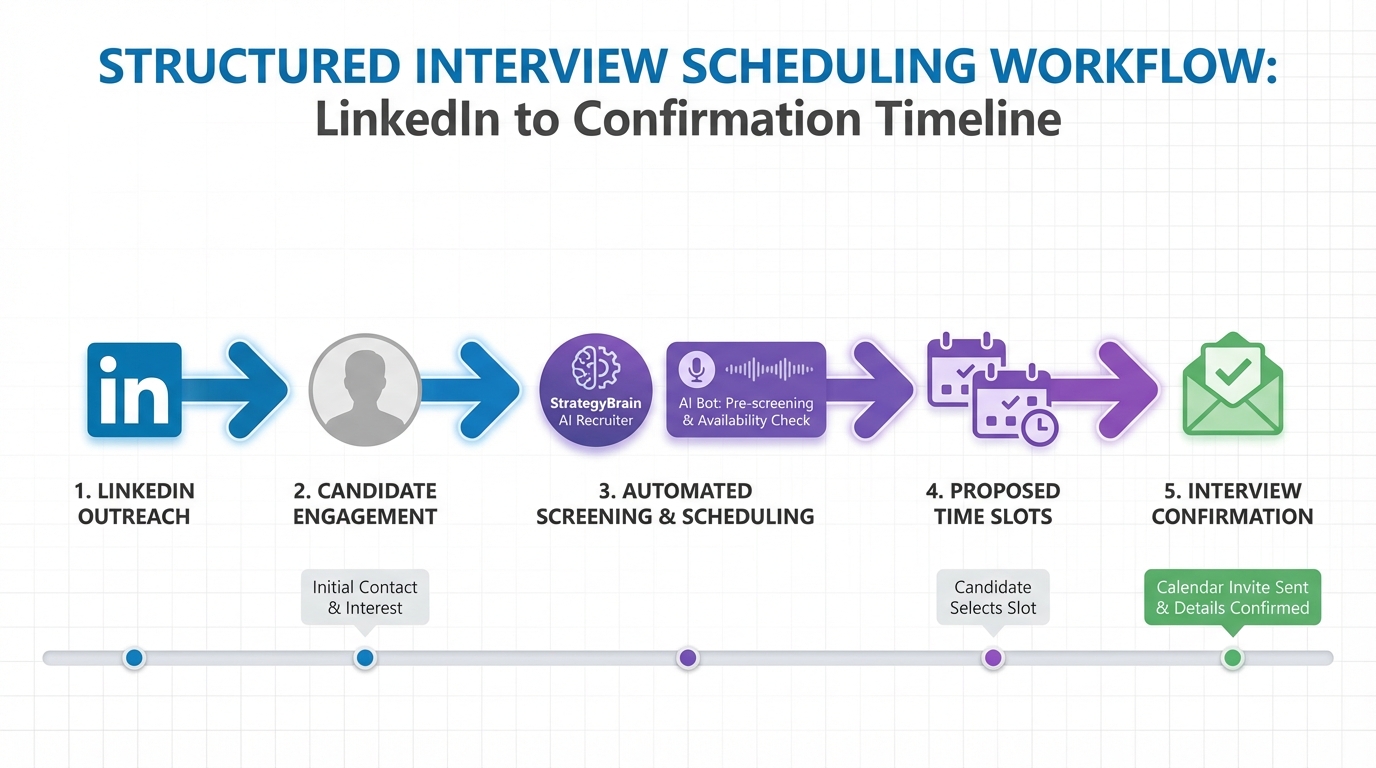
For nonprofit executive search, an interview scheduling app is most effective when it is treated as part of governance and candidate experience, not just a calendar add on. In practice, it reduces delays by standardizing how you ask “when can we meet”, capturing availability in one place, and keeping a clear audit trail of who was invited, when, and why. This article reframes four common leadership hiring questions into concrete scheduling and process decisions you can apply immediately, including how to expand beyond sector only candidates, improve diversity outcomes, and decide when outside search support is worth it. We also explain where StrategyBrain AI Recruiter fits, by automating early LinkedIn outreach and qualification so your team spends more time interviewing and less time chasing replies.
Key Takeaways
- Scheduling is a hiring lever: A consistent scheduling workflow reduces drop off and speeds up executive search decisions.
- Cross sector candidates need clarity: Standardized interview stages and time expectations help candidates from business or military backgrounds navigate nonprofit context.
- Diversity improves with structure: Removing identifying details during early review and using consistent interview panels reduces bias risk.
- External search is situational: Use outside support when the role is new, evolving, or requires confidential outreach.
- StrategyBrain AI Recruiter reduces manual work: It automates LinkedIn connecting, role introduction, Q and A, interest confirmation, and résumé collection before interviews.
- Multilingual coverage matters: 24/7 multilingual messaging can reduce time zone delays and misunderstandings in global searches.
What is the current state of the nonprofit jobs market
Succession planning has become more urgent for many nonprofits. Leadership transitions can feel disruptive, yet they also create a window to reset priorities and strengthen bench depth. At the same time, nonprofits often compete with for profit employers for experienced leaders, which increases the importance of a smooth, respectful hiring process.
In our experience supporting recruiting operations, the market pressure shows up in a simple place first: scheduling. When candidates are in demand, delays between stages can signal disorganization. That is where an interview scheduling app becomes more than convenience. It becomes a way to protect candidate experience and keep momentum.
What to do now
- Define your interview stages before outreach begins, including who attends each stage and the decision criteria.
- Set time boundaries for each stage, such as a 30 minute screening call and a 60 minute panel interview.
- Use one scheduling workflow for every candidate so the process is consistent and defensible.
Where StrategyBrain AI Recruiter fits
When the market is tight, response speed matters. StrategyBrain AI Recruiter can handle the early LinkedIn steps that usually slow teams down, including connecting with candidates, introducing the opportunity, answering role and compensation questions, confirming interview interest, and collecting résumés and contact details. That means your scheduling step starts with candidates who have already signaled interest, which reduces wasted calendar holds.
Can strong nonprofit leaders come from other sectors
Limiting leadership searches to nonprofit only backgrounds can shrink the pool unnecessarily. Many candidates are motivated by mission and public impact, especially after periods of disruption that prompt career reflection. Candidates from business or military environments may bring transferable strengths such as stakeholder leadership, operational discipline, and communications capability.
The practical challenge is not whether they can succeed. The challenge is onboarding them into a different operating context. Your interview design and scheduling cadence can help. A clear stage plan, shared in advance, reduces uncertainty and improves conversion from first conversation to final interview.
How to schedule cross sector candidates without friction
- Send a stage map that lists each interview, the attendees, and the purpose of the stage.
- Ask for availability in blocks such as three 60 minute windows across 5 business days, instead of single time slots.
- Reserve a mission context segment in the agenda so candidates can ask questions about governance, funding, and stakeholders.
Note on compensation conversations
Mission alignment is powerful, but it does not replace compensation clarity. Candidates may accept tradeoffs, yet they still expect reasonable compensation. If you delay compensation discussions until late stages, you risk late stage drop off and wasted scheduling cycles.
How can nonprofits increase diversity
Diversity is not only a values issue. It is also a performance issue. One widely cited view is that diverse teams bring broader knowledge and stronger outcomes, which is why leaders have both principled and business reasons to recruit for diversity.
For executive search, diversity outcomes often hinge on process details that are easy to overlook. Scheduling is one of them. If your process favors a narrow set of time zones, working hours, or informal networks, you can unintentionally reduce access for qualified candidates.
Process changes that support diversity
- Broaden where you source so applicants come from more than one channel.
- Remove identifying details during early review when feasible, such as name and address, to reduce bias risk.
- Use a diverse interview committee and keep questions consistent across candidates.
- Post salary ranges to reduce information asymmetry and support pay equity.
Scheduling tactics that reduce bias risk
- Offer at least 2 time bands per day, such as morning and late afternoon, to accommodate caregivers and different time zones.
- Standardize interview length so candidates receive comparable time and attention.
- Document reschedules with reasons, so exceptions do not become patterns.
How StrategyBrain AI Recruiter can help earlier in the funnel
If you rely heavily on LinkedIn outreach, consistency matters. StrategyBrain AI Recruiter can run outreach and follow up at scale across time zones, respond 24/7, and communicate in the candidate’s native language. That reduces the chance that language or response timing becomes an unintended barrier before you even reach the interview scheduling app stage.
Should nonprofits use executive recruiters
Outside executive search support can be valuable when the hire is high leverage, confidential, or hard to define. If the role is new or evolving, an experienced search partner can help clarify the profile and improve the quality of outreach. External support can also expand the candidate list by engaging people who are not actively applying.
That said, not every search requires an external firm. Some processes can be run internally when the role is well understood and the organization has the capacity to source, screen, and schedule consistently.
Decision checklist
- Use outside support if confidentiality is required, the role is ambiguous, or passive candidate outreach is essential.
- Run internally if you have a clear profile, strong sourcing channels, and the ability to keep scheduling moving without delays.
- Hybrid approach if you want external sourcing but internal interviews and final decisions.
Operational note
Even with external support, your internal scheduling discipline still matters. A search partner can bring candidates, but your team must convert interest into interviews quickly. That is where a well configured interview scheduling app and clear stage ownership make the difference.
A scheduling blueprint you can copy
Below is a practical workflow we have used to reduce scheduling churn in leadership hiring. It is written so you can implement it with any interview scheduling app, and it also maps cleanly to an online class booking system style flow where candidates pick from structured time slots and receive automated confirmations.
Step by step
- Define stages and owners: Assign one accountable owner per stage, including who sends invites and who confirms attendance.
- Set slot rules: Decide interview length, buffer time, and the maximum number of reschedules allowed without escalation.
- Collect availability once: Ask candidates for multiple windows in one request, using the same wording every time, including the plain language question “when can we meet”.
- Confirm logistics: Send agenda, attendee list, and any case materials at least 48 hours before the interview.
- Close the loop: After each stage, send a decision update within 2 business days, even if the update is simply that the process is ongoing.
Template you can paste into your outreach
Subject: Interview availability
Message: Thanks for your interest. To schedule the next step, please share three 60 minute windows over the next 5 business days, and note your time zone. Also tell us if you prefer morning or late afternoon. Once we confirm, we will send an agenda and attendee list.
How StrategyBrain AI Recruiter reduces scheduling waste
Scheduling waste often comes from inviting candidates who are not actually ready to proceed. StrategyBrain AI Recruiter is designed to qualify interest before scheduling by introducing the role, answering questions about the company and compensation, confirming interview interest, and collecting résumés and contact details. Recruiters then review the collected information and schedule interviews with candidates who have already opted in.
Quick comparison of scheduling approaches
| Approach | Speed | Process control | Best for |
|---|---|---|---|
| Email only scheduling | Slow when calendars are busy | Low | Very small searches with few stakeholders |
| Interview scheduling app with structured stages | Faster once configured | High | Executive searches with panels and multiple rounds |
| Scheduling app plus automated LinkedIn qualification | Fastest end to end | High | High volume outreach or competitive talent markets |
FAQ
What is an interview scheduling app in recruiting terms
An interview scheduling app is software that coordinates interview availability, sends invitations, and tracks confirmations in one system. In recruiting, it reduces manual back and forth and creates a consistent record of scheduling decisions.
How do I ask candidates “when can we meet” without sounding disorganized
Ask for availability in structured blocks and include the time zone. For example, request three 60 minute windows across 5 business days and confirm you will send an agenda once a time is selected.
Can an online class booking system work for interviews
Yes, the underlying pattern is similar: structured time slots, automated confirmations, and reminders. The key difference is that interviews often require multiple attendees and stage specific agendas.
How does StrategyBrain AI Recruiter support scheduling
StrategyBrain AI Recruiter automates early LinkedIn outreach and qualification by connecting with candidates, introducing the role, answering questions, confirming interest, and collecting résumés and contact details. That means you schedule interviews with candidates who have already engaged and opted in.
Does StrategyBrain AI Recruiter replace recruiter judgment
No. It identifies willingness to communicate or interview and gathers information, but it does not decide whether a résumé fully matches job requirements. Recruiters still make the final qualification decision after reviewing the résumé.
How can scheduling support diversity goals
Offer multiple time bands, standardize interview length, and document reschedules consistently. These steps reduce the chance that informal scheduling habits create unequal access.
When should a nonprofit use external executive search support
Consider external support when confidentiality is required, the role is new or evolving, or passive candidate outreach is essential. For well defined roles with internal capacity, an internal process can work well.
What is the biggest scheduling mistake in executive search
The biggest mistake is letting time between stages stretch without clear ownership. Candidates interpret silence as lack of alignment, so set decision timelines and communicate updates within 2 business days after each stage.
Conclusion
Nonprofit executive search is shaped by market competition, cross sector mobility, and rising expectations for fair and inclusive hiring. An interview scheduling app helps when it is paired with clear stages, consistent communication, and documented decisions, so candidates experience a process that feels intentional rather than improvised.
Next steps are straightforward. Map your stages, standardize how you ask “when can we meet”, and implement the scheduling blueprint above. If your bottleneck is earlier in the funnel, consider adding StrategyBrain AI Recruiter to automate LinkedIn outreach, follow up, and interest confirmation so your calendar time is spent on interviews, not chasing replies.