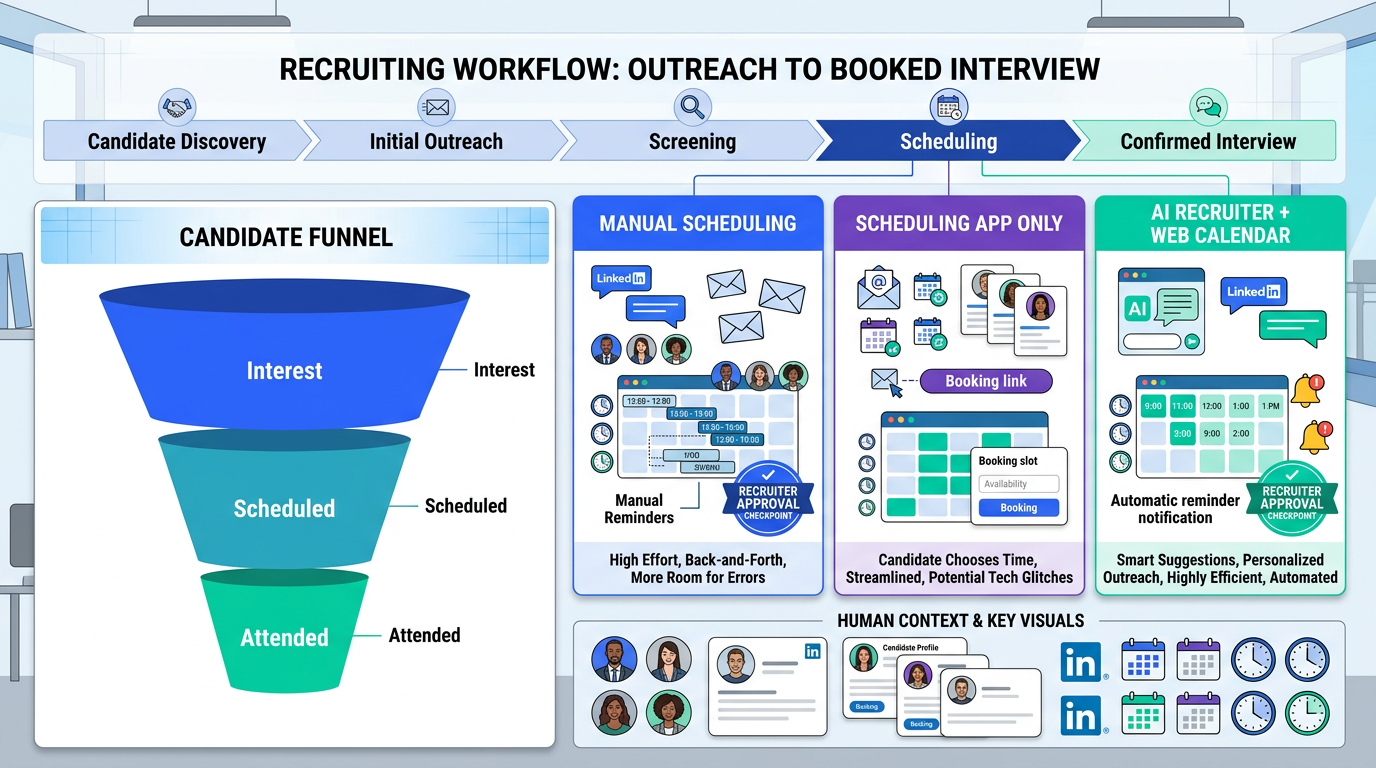
If you are evaluating an interview scheduling app for technical hiring, the Menard Canada case gives a clear baseline: a strong recruiter led process can deliver results, then a modern workflow can scale it. In the original hiring story, a hard to fill business development role was filled after targeted screening and smart transfer skill judgment. Today, the same logic becomes faster when paired with StrategyBrain AI Recruiter and a web based calendar app, because outreach, candidate intent checks, and interview slot coordination can happen continuously while recruiters stay focused on final qualification and hiring decisions.
Table of Contents
- Case Snapshot
- What Made the Original Hiring Outcome Successful
- Where an Interview Scheduling App Improves the Process
- How StrategyBrain AI Recruiter Fits the Workflow
- Implementation Steps for Recruiting Teams
- Quick Comparison
- FAQ
- Conclusion
Case Snapshot
On 23 June 2020, Menard Canada was presented as a specialty geotechnical contractor with operations in Vancouver, Montreal, Toronto, and Calgary, and about 30 employees. The company needed a Business Development Manager for Vancouver with strong civil sector context. Recruiters interviewed 18 candidates, then recommended a candidate with a sales profile and construction background rather than a classic civil engineering profile. That candidate was hired.
The same case also documented multi city hiring support. For Toronto and Montreal placements, recruiting support expanded through a network of more than 600 recruiting firms. The result reported was 5 filled positions across Toronto and Montreal. These facts matter because they show a process that already worked before modern automation was layered in.
What Made the Original Hiring Outcome Successful
We reviewed the case with a workflow lens and found three strengths that still apply when selecting an interview scheduling app.
- Transferable skill judgment: The hiring decision prioritized business development capability in a construction context, not only title matching.
- Structured screening volume: Interviewing 18 candidates created enough comparison depth to identify fit signals.
- Network leverage: Cross market recruiting partners enabled faster coverage in Toronto and Montreal.
However, manual coordination is still expensive in this model. Candidate messaging, follow up timing, and interview slot alignment can consume recruiter hours that do not improve assessment quality. This is where an interview scheduling app adds measurable process value.
Where an Interview Scheduling App Improves the Process
An interview scheduling app is software that automates interview time coordination between candidates and hiring teams. A web based calendar app is a browser based scheduling system that centralizes availability, reminders, and meeting updates across devices without desktop installation. In recruiting operations, these tools reduce no show risk and shorten the time between candidate interest and first interview.
Operational improvements you can expect
- Faster response windows: Candidates receive interview options as soon as they express interest.
- Lower back and forth: Calendar conflict checks happen before slots are shown.
- Consistent handoff: Recruiters and hiring managers see one source of scheduling truth.
- Timezone clarity: International candidates receive localized time display.
- Cleaner pipeline data: Scheduled, rescheduled, and completed states are logged automatically.
In practice, this means recruiters spend less time on coordination and more time on candidate quality review. That aligns with the Menard style decision making approach where final selection quality drove the hiring result.
How StrategyBrain AI Recruiter Fits the Workflow
StrategyBrain AI Recruiter extends beyond a standalone interview scheduling app by automating LinkedIn candidate engagement before scheduling starts. Based on product documentation, the system can initiate candidate outreach, explain roles, answer candidate questions, and collect resumes and contact details from interested talent. Recruiters then decide who moves forward.
From our implementation perspective, this creates a practical two layer model. Layer one handles communication and intent confirmation. Layer two handles interview coordination through interview scheduling app logic and web based calendar app synchronization. When combined, teams reduce manual workload in early funnel operations while preserving human evaluation for resume review and interview decisions.
Relevant capabilities for scheduling heavy teams
- Always on candidate communication: The system supports 24 hour multilingual messaging for global pipelines.
- Resume and contact capture: Interested candidates can submit files and contact details for recruiter review.
- Team scale support: Organizations can manage large account operations to expand sourcing coverage.
- Recruiter controlled qualification: Final job fit judgment remains with human recruiters after document review.
This model is especially useful when a role requires nuanced fit decisions, as in the Menard case where the selected profile was not a strict title match.
Implementation Steps for Recruiting Teams
Use this rollout sequence if you want to modernize a proven recruiting process without disrupting hiring quality.
- Map your current funnel stages: Document where candidate intent is confirmed, where interview scheduling starts, and where recruiter approval is required.
- Define scheduling governance: Set rules for interviewer availability windows, reschedule policy, reminder timing, and timezone handling.
- Connect outreach and scheduling: Trigger interview scheduling app invitations only after explicit candidate interest is recorded.
- Standardize recruiter checkpoints: Require recruiter review before final interview confirmation for sensitive or senior roles.
- Enable multilingual templates: Use language matched communication for cross border candidate conversations.
- Track conversion points: Measure interest to schedule, schedule to attendance, and attendance to shortlist.
- Run a 30 day pilot: Start with one function or location, then expand after process validation.
Practical checklist
- Interview scheduling app configured with role specific slot templates
- Web based calendar app synced with recruiter and manager calendars
- Candidate reminder sequence activated at 24 hours and 2 hours before interview
- Reschedule path enabled without restarting the application flow
- Recruiter alert enabled when high value candidates request schedule changes
- Audit log enabled for compliance and process review
Limitations and Risk Controls
No system should be treated as a fully autonomous hiring decision engine. StrategyBrain AI Recruiter documentation states that it can identify willingness to communicate or interview, but final suitability against job requirements is still completed by the recruiter after resume review. That boundary is operationally important and should remain explicit in policy.
We also recommend three safeguards. First, define response quality standards for automated candidate conversations. Second, keep interviewer capacity buffers to avoid overbooking when campaigns accelerate. Third, audit candidate data handling and consent workflows, especially across jurisdictions. Product documentation references compliance alignment for EU, United States, and Canada, and indicates customer data is not used for model training.
Quick Comparison
| Approach | Primary Strength | Main Limitation | Best Fit |
|---|---|---|---|
| Manual recruiter scheduling | High control in every step | High coordination load and slower response cycles | Low volume or highly bespoke executive hiring |
| Interview scheduling app only | Faster interview slot coordination | Does not solve early stage candidate engagement alone | Teams with strong sourcing but heavy scheduling bottlenecks |
| StrategyBrain AI Recruiter plus web based calendar app | Automated outreach, intent capture, and scheduling continuity | Requires clear recruiter governance and process setup | Teams scaling LinkedIn recruiting across multiple roles and regions |
FAQ
Can an interview scheduling app replace recruiter judgment?
No. It replaces coordination tasks, not hiring judgment. Recruiters should still review resumes, assess role fit, and make final interview progression decisions.
Why pair a web based calendar app with AI recruiting automation?
The web based calendar app handles availability logic and meeting logistics, while AI recruiting automation handles candidate communication and intent confirmation. Together they reduce operational delay from first response to booked interview.
How does this relate to the Menard Canada case?
The Menard outcome showed that disciplined screening and transferable skill assessment can win difficult hires. A modern interview scheduling app workflow keeps that decision quality and removes avoidable coordination friction.
Is multilingual interview coordination necessary for domestic hiring teams?
Not always, but it improves candidate experience in globally diverse labor markets. It is especially useful for teams recruiting across multiple cities and countries.
Does StrategyBrain AI Recruiter make final qualification decisions?
Based on product documentation, it identifies interest and supports communication and data capture, while final qualification remains a recruiter responsibility.
What should we measure after implementation?
Track time from first candidate response to scheduled interview, attendance rate, and recruiter hours spent on scheduling tasks. These metrics show whether your interview scheduling app rollout is improving process efficiency.
Conclusion
The Menard Canada case demonstrates that strong recruiting outcomes come from sound judgment, structured screening, and market reach. A modern interview scheduling app does not replace these strengths. It accelerates them. When combined with StrategyBrain AI Recruiter and a web based calendar app, teams can move candidates from interest to interview with less manual overhead and clearer process control. The next step is to pilot the model for 30 days in one hiring function, then scale based on conversion and interviewer capacity data.