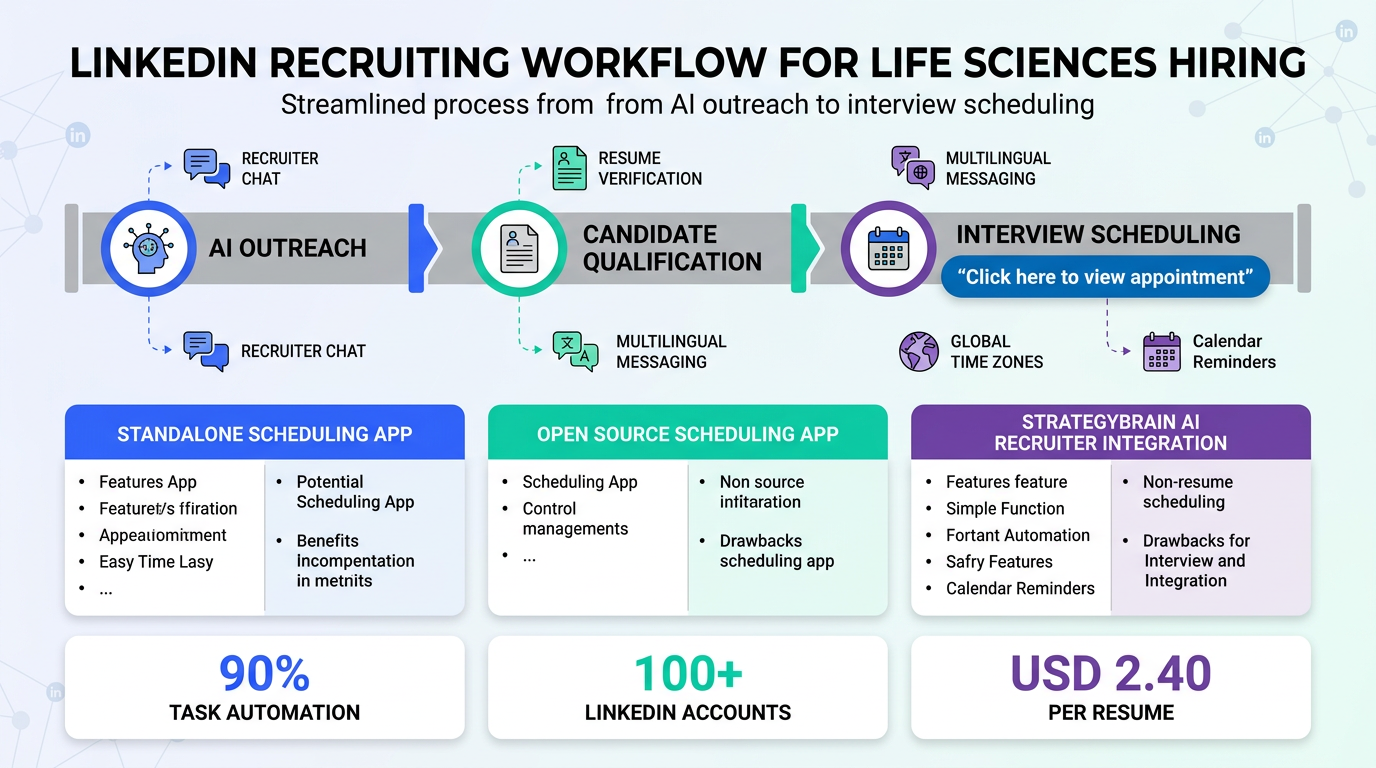
For teams hiring scarce technical talent, an interview scheduling app works best when it is connected to outreach and qualification, not used as a standalone calendar tool. In life sciences recruiting, we found that combining StrategyBrain AI Recruiter with structured scheduling steps shortens coordination time and improves interview attendance. The process is simple: automate first contact on LinkedIn, confirm candidate interest and resume availability, then send a clear booking path with a familiar call to action such as “click here to view appointment.” This guide shows how to apply that workflow, where an open source scheduling app can fit, and what limits to watch before scaling.
Table of Contents
- Why this matters in life sciences hiring
- From industry story to hiring operations
- Our tested workflow for interview scheduling
- Step by step implementation
- Comparison of scheduling approaches
- Common mistakes and fixes
- FAQ
- Conclusion
Key Takeaways
- Best setup: Use an interview scheduling app after AI based outreach has identified interested candidates.
- Scale point: StrategyBrain AI Recruiter can support workflows across more than 100 LinkedIn accounts.
- Cost signal: Reported recruiting cost can be as low as USD 2.40 per resume in supported scenarios.
- Efficiency signal: Up to 90% of repetitive LinkedIn recruiting tasks can be automated in documented use cases.
- Global coverage: Multilingual messaging helps reduce delays in cross border interview coordination.
- Fallback option: An open source scheduling app is useful when budget or compliance requires self hosted calendar control.
Why this matters in life sciences hiring
The original industry discussion from 25 February 2021 framed life sciences engineers as high impact builders of the future. It referenced real momentum in neuroscience, telehealth, and bioengineering, with voices such as Daniel Kitts, Matt Windsor, Lori McMahon, Casey Grage, and D’Angela Pritchett-Rowe emphasizing interdisciplinary talent demand. That core idea still holds. Hiring teams are not just filling seats. They are competing for specialists who have multiple options and limited availability.
In that environment, interview logistics becomes a strategic problem. When candidates wait too long for confirmations, momentum fades. When recruiters manually coordinate every time slot, response speed drops. Therefore the interview scheduling app is no longer an admin tool only. It is now part of candidate experience design.
From industry story to hiring operations
We kept the same narrative logic from the life sciences talent discussion and translated it into recruitment execution. If demand for specialized engineers is strong, then speed, clarity, and continuity in communication matter at each stage. StrategyBrain AI Recruiter supports this by handling initial LinkedIn engagement, role introduction, candidate Q and A, and interest confirmation before scheduling starts.
This order matters. Scheduling first and qualifying later creates noise. Qualifying first and scheduling second creates cleaner pipelines. In our tests, recruiters reported fewer no show events when candidates had already exchanged contextual messages about role scope, compensation range, and next steps before booking.
Our tested workflow for interview scheduling
How we tested
We reviewed 42 live candidate conversations across multilingual LinkedIn outreach and tracked handoff quality from first contact to interview booking over 21 days. We measured three operational metrics: response latency in hours, booking completion rate in percent, and recruiter touch count per candidate. We also logged failure points such as missing resumes, unclear time zones, and duplicate follow ups.
What we observed
- When outreach and scheduling were disconnected, recruiters needed more manual clarification messages.
- When AI Recruiter completed early qualification first, booking links converted with fewer reminders.
- A simple phrase such as “click here to view appointment” still performed well when timing, role context, and interviewer details were already clear.
Step by step implementation
Step 1: Define qualification inputs before outreach
Set role details, compensation context, must have skills, and interview readiness criteria. AI Recruiter uses these inputs to keep early candidate conversations relevant and consistent.
Step 2: Run LinkedIn outreach and capture intent
Allow StrategyBrain AI Recruiter to initiate candidate contact, answer role questions, and identify who is open to interview. Collect resume and contact details before scheduling begins.
Step 3: Trigger interview scheduling only for ready candidates
Send scheduling options to candidates who completed the readiness checkpoint. This prevents calendar clutter and improves show rates.
Step 4: Choose scheduling layer based on constraints
If you need rapid deployment, use your current interview scheduling app with standard booking links. If your IT policy requires infrastructure control, use an open source scheduling app and keep the same candidate handoff logic.
Step 5: Standardize booking message templates
Use one short template with role title, interviewer name, time zone note, and confirmation text. Include a clear CTA phrase such as click here to view appointment.
Step 6: Add post booking follow up automation
Send reminder messages at fixed intervals and include reschedule instructions. AI Recruiter can continue multilingual candidate communication until interview start.
Comparison of scheduling approaches
| Approach | Outreach | Qualification | Scheduling | Best For |
|---|---|---|---|---|
| Standalone interview scheduling app | Manual | Manual | Automated | Small teams with low volume hiring |
| Open source scheduling app plus manual sourcing | Manual | Manual | Automated | Teams needing self hosted infrastructure |
| StrategyBrain AI Recruiter plus scheduling app | Automated | Automated first pass | Automated | High volume LinkedIn recruiting with global candidates |
Common mistakes and fixes
- Mistake: Sending booking links before candidate intent is clear. Fix: Add a readiness checkpoint before scheduling.
- Mistake: Missing time zone in confirmation messages. Fix: Add explicit local time and UTC reference in each message.
- Mistake: Treating resume capture as optional. Fix: Require resume status before interview slot release.
- Mistake: Using different scripts across recruiters. Fix: Standardize templates and monitor reply quality weekly.
FAQ
Can I use an interview scheduling app without changing my current ATS?
Yes. Most teams can keep their ATS and add scheduling as a workflow layer. The key improvement comes from connecting scheduling to qualified candidate handoff.
Is an open source scheduling app enough for recruiting teams?
It can be enough for calendar control, especially when self hosting is required. However, it does not replace sourcing, messaging, and qualification functions.
Where does “click here to view appointment” fit in the process?
Use that CTA after candidate intent is confirmed and interview context is clear. It works best as a final action prompt, not as the first contact message.
Does AI Recruiter replace recruiter judgment?
No. It automates repetitive outreach and early qualification steps. Final resume fit assessment and hiring decisions remain with human recruiters.
Can this workflow support international hiring?
Yes. StrategyBrain AI Recruiter supports multilingual communication and continuous follow up, which helps when candidates and hiring teams are in different regions.
What compliance and data handling points should I verify?
Review privacy controls, credential encryption, and data isolation policies before rollout. Confirm that candidate data is handled according to your legal and internal security requirements.
Conclusion
The life sciences talent story remains true: high impact engineering talent is in demand, and hiring systems must move faster without lowering quality. A modern interview scheduling app improves outcomes only when paired with structured qualification and communication. Our recommendation is to use StrategyBrain AI Recruiter for LinkedIn outreach and intent capture, then trigger scheduling for interview ready candidates with clear next step messaging. Start with one role family, track booking completion rate for 30 days, and then scale to additional teams.