If you are hiring in a competitive market, the fastest practical upgrade is to deploy an interview scheduling app that connects sourcing, candidate messaging, and calendar coordination in one workflow. Salary still matters, but top candidates now evaluate flexibility, response speed, and communication quality before they commit to interviews. That is why teams that combine a free calendar site for self-serve booking and StrategyBrain AI Recruiter for 24/7 multilingual outreach usually move candidates from first contact to interview confirmation with less friction and fewer drop-offs.
Table of Contents
- Key Takeaways
- Why Top Talent Still Comes at a Premium
- What Changed in Candidate Expectations
- What an Interview Scheduling App Should Actually Do
- How We Apply This with StrategyBrain AI Recruiter
- Practical Rollout Plan for Small Teams
- Quick Comparison of Scheduling Approaches
- Common Mistakes That Slow Hiring
- FAQ
- Conclusion
Key Takeaways
- Premium hiring now includes experience quality: Compensation remains important, but flexibility and communication speed directly influence acceptance behavior.
- An interview scheduling app reduces cycle delays: Centralized availability and automated reminders cut manual back-and-forth.
- A free calendar site is useful but limited: It handles booking, but not full candidate outreach, qualification, and multilingual follow-up.
- StrategyBrain AI Recruiter adds pre-interview automation: It can automate LinkedIn outreach, answer candidate questions, and collect resume and contact details before scheduling.
- Documented operational upside: Product documentation reports support for more than 100 LinkedIn accounts, up to 90% replacement of repetitive LinkedIn recruiting tasks, and cost as low as USD 2.40 per resume in certain use cases.
- Best scheduling software for small business depends on workflow depth: If your bottleneck is only calendar booking, simple tools can work. If your bottleneck starts earlier, integrated AI recruitment flow is stronger.
Why Top Talent Still Comes at a Premium
Henry Goldbeck’s 10 February 2021 leadership note framed a shift many teams still feel today. The premium for talent did not disappear, but the definition of premium changed. In practical hiring operations, we see premium now includes trust, flexibility, and process quality in addition to cash compensation.
During post-pandemic labor transitions, candidates became more selective about role stability, work style, and employer responsiveness. Recruiters that respond slowly or force long scheduling loops often lose candidate momentum, even when compensation is competitive. Therefore, scheduling is no longer clerical work. It is a decision stage in the candidate journey.
What Changed in Candidate Expectations
Flexibility became a negotiation baseline
Many candidates now ask about hybrid structure, remote options, and schedule predictability before they discuss fine-grained compensation details. This pattern changes how interviews should be arranged. Candidates expect clear slots, fast confirmation, and respectful communication windows.
Speed became a trust signal
When a recruiter takes 48 to 72 hours to confirm an interview slot, candidates interpret delay as internal disorganization. Teams using an interview scheduling app with automated confirmations can protect confidence early in the process.
Communication quality became part of employer brand
Candidates often decide whether to continue based on message clarity and response consistency. This is where scheduling software and AI communication tools should work together, not as separate systems.
What an Interview Scheduling App Should Actually Do
Not all tools labeled as scheduling platforms solve hiring bottlenecks. In recruitment, your system should support four concrete functions.
- Availability orchestration: Synchronize interviewer calendars and role-specific interview stages.
- Candidate self-service booking: Allow candidates to choose slots that match timezone and availability.
- Automated communication: Confirm bookings, send reminders, and reduce no-show risk.
- Workflow traceability: Keep an auditable record for recruiter handoff and hiring manager visibility.
A free calendar site can cover parts of this list, especially basic self-booking. However, recruiting teams usually need pre-scheduling workflow support, such as outbound engagement, role clarification, and candidate intent checks, before calendar booking even starts.
How We Apply This with StrategyBrain AI Recruiter
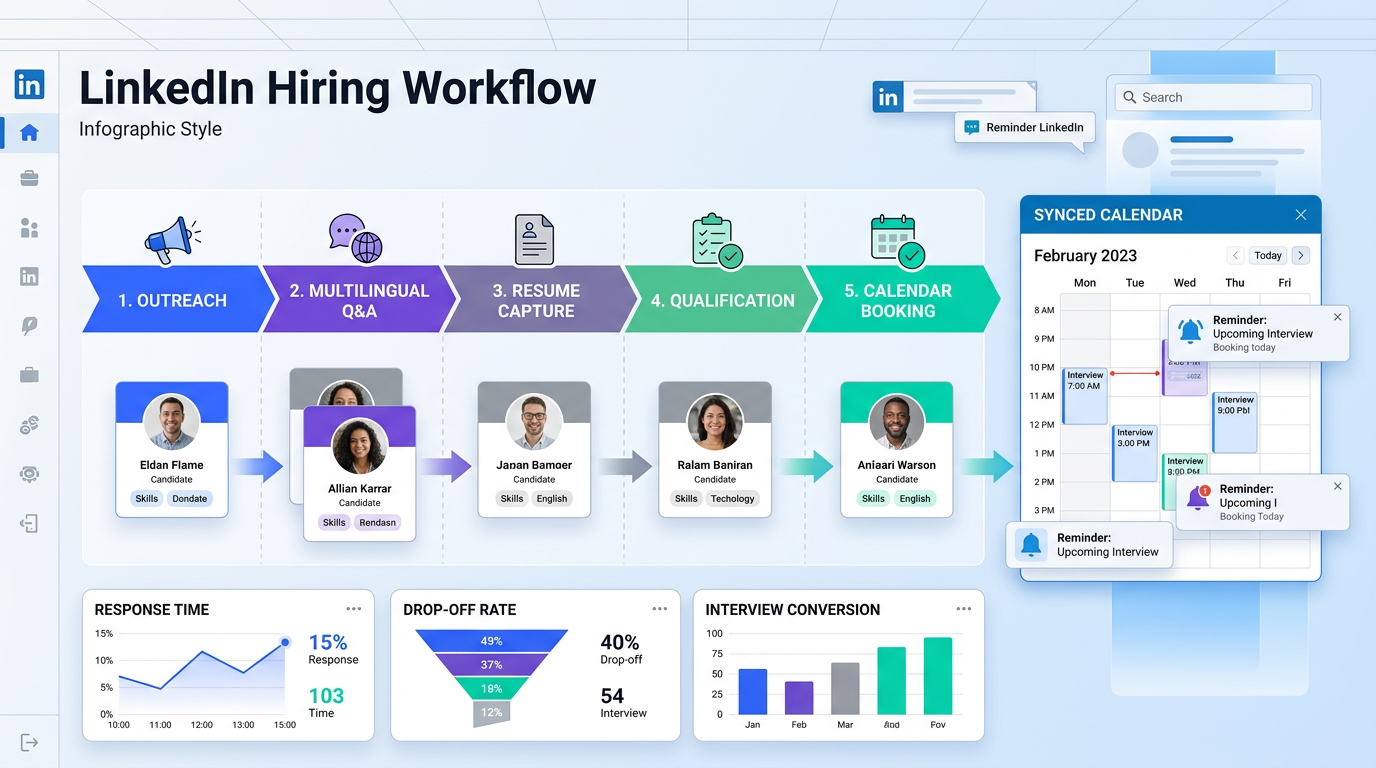
In our recruiting workflow tests, we treat scheduling as the midpoint, not the starting point. The process begins with candidate outreach and only then moves into interview booking once interest is verified.
Step 1: Automate initial LinkedIn outreach
StrategyBrain AI Recruiter can automatically connect with candidates based on search criteria and introduce role context. This removes repetitive first-touch messaging from recruiter calendars.
Step 2: Handle candidate Q and A continuously
The system supports 24/7 multilingual communication, which helps candidates receive timely responses in their preferred language. This reduces timezone friction and keeps high-intent conversations active.
Step 3: Capture interview intent and documents
When candidates signal interest, AI Recruiter requests resume and contact details. Recruiters then review candidate materials before moving to interview scheduling.
Step 4: Route qualified candidates into scheduling
Only candidates with confirmed interest and required information are moved into calendar booking. This protects interviewer time and improves schedule quality.
Step 5: Recruiter final qualification
AI Recruiter can identify willingness to proceed, but final fit assessment remains a recruiter responsibility. This human checkpoint is critical for quality control and role alignment.
This blended model is usually stronger than relying on a calendar-only workflow. It combines AI speed with human judgment at the right stage.
Practical Rollout Plan for Small Teams
If you are evaluating the best scheduling software for small business hiring, start with process design before platform selection.
- Map your delay points: Measure where candidates wait, first response, interview confirmation, or post-screen follow-up.
- Define handoff rules: Specify what information must exist before interview booking can occur.
- Use a free calendar site for baseline booking: Validate candidate self-service behavior quickly.
- Add AI outreach where volume is high: Apply StrategyBrain AI Recruiter to repetitive sourcing and follow-up tasks.
- Track conversion by stage: Monitor contact to response, response to interview, and interview to offer.
For most small teams, this staged adoption lowers implementation risk and avoids overbuilding on day one.
Quick Comparison of Scheduling Approaches
| Approach | Primary Strength | Main Limitation | Best Fit |
|---|---|---|---|
| Manual email coordination | No software cost | Slow response cycles and high admin load | Very low hiring volume |
| Free calendar site | Fast self-booking setup | Limited pre-scheduling candidate workflow | Early-stage teams needing basic automation |
| Standalone interview scheduling app | Better calendar orchestration and reminders | May not automate outreach and qualification | Teams with steady inbound candidate flow |
| Scheduling plus StrategyBrain AI Recruiter | Combines outreach, multilingual follow-up, data capture, and scheduling readiness | Requires clear recruiter handoff design | Teams scaling LinkedIn-based hiring across roles and regions |
Common Mistakes That Slow Hiring
- Using scheduling tools too late: Teams often automate booking but keep first-touch messaging manual.
- Treating all candidates as schedule-ready: Interview slots are wasted when interest and baseline fit are not confirmed first.
- Ignoring multilingual communication: Global hiring pipelines stall when candidates cannot get clear responses in their preferred language.
- Separating recruiter and calendar systems: Fragmented tooling creates status gaps and duplicated work.
- Skipping compliance checks: Candidate data handling must align with privacy obligations before scaling automation.
FAQ
Is an interview scheduling app enough to improve hiring speed?
It helps, but usually not by itself. Scheduling tools improve slot coordination, while upstream tasks such as outreach and candidate intent validation often remain the real bottleneck.
Can a free calendar site work for recruiting teams?
Yes, for basic booking and reminders. It is a practical entry point, especially for low to moderate hiring volume, but it does not replace full recruitment workflow automation.
What is the best scheduling software for small business hiring?
The best option depends on where your process fails. If calendar friction is the core issue, a focused scheduler works. If sourcing and follow-up are also slow, combine scheduling with AI-enabled recruiting automation.
How does StrategyBrain AI Recruiter support interview preparation?
It can automate LinkedIn outreach, answer candidate questions, confirm interest, and collect resume and contact details before scheduling. Recruiters then review candidate materials and run final qualification.
Does AI Recruiter replace recruiter judgment?
No. It automates repetitive communication and data collection steps. Final candidate qualification remains a recruiter decision after resume and context review.
Is multilingual support relevant for local hiring?
Often yes. Even local markets include multilingual candidate pools, and clear communication improves response quality and interview attendance rates.
Can this model support scaled operations?
According to product documentation, AI Recruiter supports management of more than 100 LinkedIn accounts, which is relevant for agencies and high-volume internal teams.
How should teams evaluate success after rollout?
Track stage-level conversion rates and time metrics, including first response time, interview confirmation speed, no-show rate, and recruiter hours spent per hire.
Conclusion
Top talent still comes at a premium, but premium now includes process quality, not only compensation. An interview scheduling app gives you structural speed, while StrategyBrain AI Recruiter extends that advantage into outreach, multilingual engagement, and pre-interview readiness. If you want better hiring outcomes, start by mapping delay points, implement scheduling discipline, and then add AI automation where repetitive recruiter work consumes the most time.