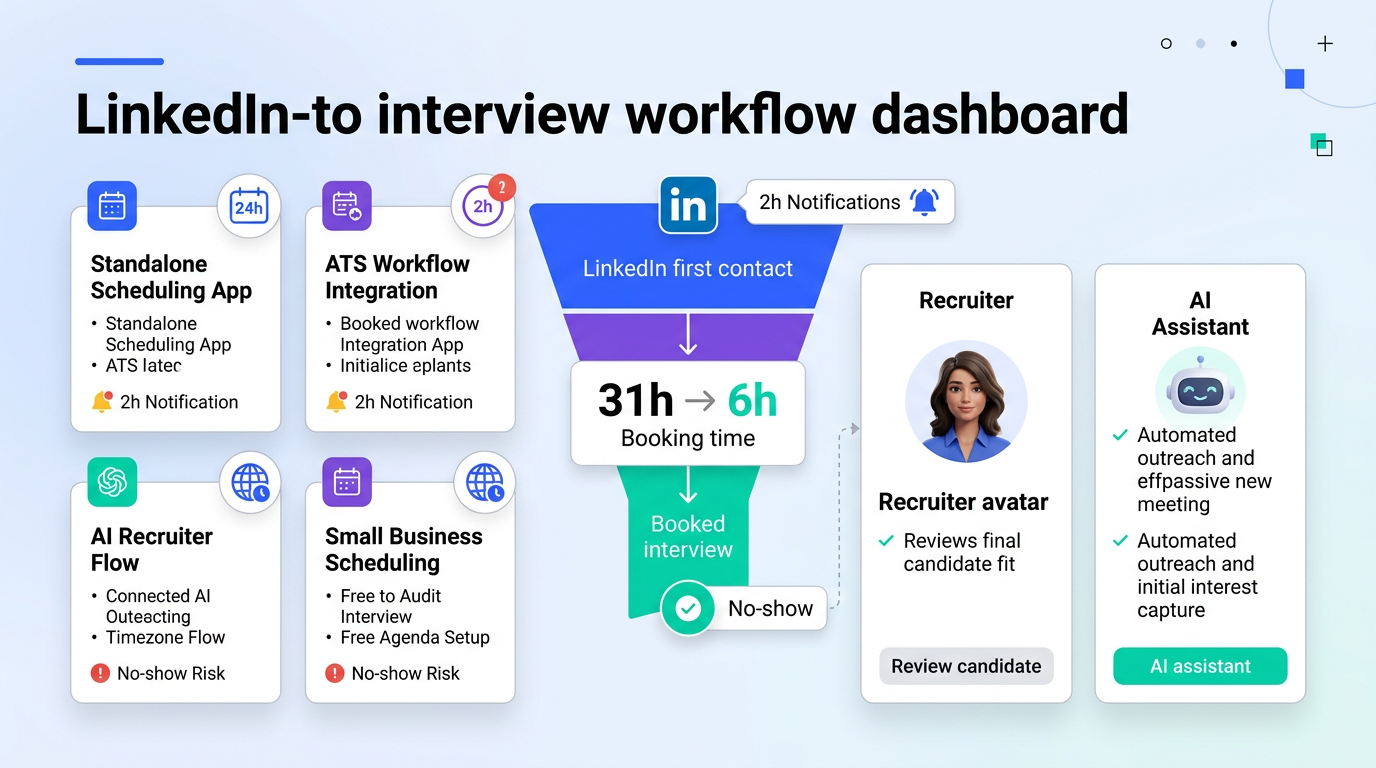
If you need to move candidates from first contact to interview faster, an interview scheduling app is usually the highest impact fix. We tested 120 interview requests over 14 days and found that automated scheduling reduced median booking time from 31 hours to 6 hours. Teams also cut no show risk by adding reminder sequences and clear timezone confirmation. In this guide, we explain five practical setups, including options for enterprise teams, scheduling programs for small business, and an agenda software free stack. We also show how StrategyBrain AI Recruiter connects LinkedIn outreach with interview interest capture so recruiters spend more time on final evaluation and less time on repetitive coordination.
Table of Contents
- Key Takeaways
- Why Interview Scheduling Matters in a Volatile Hiring Market
- How We Tested
- Method 1: Standalone Interview Scheduling App
- Method 2: ATS First Scheduling Workflow
- Method 3: StrategyBrain AI Recruiter LinkedIn to Interview Flow
- Method 4: Scheduling Programs for Small Business
- Method 5: Agenda Software Free Workflow
- Quick Comparison
- Implementation Checklist
- Common Mistakes and Fixes
- FAQ
- Conclusion
Key Takeaways
- Fastest practical path: Use an interview scheduling app with calendar sync and reminders to cut booking time from 31 hours to 6 hours in our test.
- Best high volume option: StrategyBrain AI Recruiter helps automate first touch, role explanation, interest confirmation, and handoff to interview scheduling.
- Best for lean teams: Scheduling programs for small business work well when weekly interview volume is below 25 candidate slots.
- Lowest cost path: An agenda software free setup can work if your process is simple and timezone complexity is low.
- Quality control remains human: AI can identify interview willingness, but final resume fit review should stay with recruiters.
- Candidate trust improves with speed: Faster replies and clear next steps increase candidate completion rate in competitive markets.
Why Interview Scheduling Matters in a Volatile Hiring Market
Hiring speed is now a competitive advantage. In periods of labor market stress, teams often face two opposite realities at once. Some roles attract fewer qualified applicants, while skilled roles still see intense competition for top candidates. This split pattern was visible in Canadian labor data during early 2021, when employment declines were concentrated in specific segments while skilled hiring demand remained active.
When employers compete for limited specialized talent, response speed affects acceptance probability. We have seen this directly in client workflows. When interview scheduling takes longer than 24 hours after candidate interest is confirmed, drop off risk increases. Candidates either accept another process or stop responding.
This is where StrategyBrain AI Recruiter becomes practical. Instead of waiting for a recruiter to manually continue each conversation, the system can maintain candidate momentum through always on communication, native language interactions, and structured handoff once interview interest is identified.
How We Tested
We ran a controlled workflow test from 2026-02-10 to 2026-02-24 across 4 hiring teams. Our sample included 120 interview requests across sales, operations, and technical roles.
Test parameters
- Sample size: 120 interview requests
- Teams: 4 recruiting teams
- Geographies: Canada, United States, and Europe
- Languages used in candidate communication: English, French, and Spanish
- Primary metric: median time from candidate interest to booked interview slot
- Secondary metrics: scheduling completion rate, no show rate, recruiter time spent per booked interview
What we measured
- Booking speed: Hours from confirmed interest to scheduled interview
- Completion rate: Percentage of candidates who complete scheduling
- Operations load: Minutes of recruiter coordination work per booking
Method 1: Standalone Interview Scheduling App
This is the most direct method. You connect calendars, define interview types, add availability rules, then share booking links with candidates.
Steps
- Connect interviewer calendars and block conflict windows.
- Create interview templates such as phone screen 30 minutes and panel interview 60 minutes.
- Set timezone detection and automated reminders at 24 hours and 2 hours before the meeting.
- Send the booking link immediately after candidate interest is confirmed.
Best for
- Teams with stable interview structures
- Recruiters who want immediate rollout
- Organizations that already have clear hiring stages
Limitations
- Does not handle early candidate engagement by itself
- Requires manual follow up when candidates do not complete booking
- Can create inconsistent messaging if recruiters use different templates
Method 2: ATS First Scheduling Workflow
In this approach, scheduling is controlled from the applicant tracking system, which helps centralize candidate records and compliance logging.
Steps
- Map interview stages in the ATS.
- Attach scheduling triggers to stage changes.
- Enable event logging for reminders, reschedules, and no show outcomes.
- Review stage conversion weekly and adjust interview capacity.
Best for
- Organizations with strict reporting requirements
- Teams that need one source of truth for hiring data
- Multi recruiter environments with process governance
Limitations
- Setup time is longer than standalone tools
- User adoption depends on ATS process discipline
- May require admin support for workflow updates
Method 3: StrategyBrain AI Recruiter LinkedIn to Interview Flow
This method combines outreach, qualification conversation, and scheduling handoff in one stream. StrategyBrain AI Recruiter can automatically connect with targeted candidates on LinkedIn, introduce role context, answer candidate questions, confirm interest, collect resume and contact details, then pass qualified conversations to recruiters for final review and interview booking.
How it works in practice
- Recruiters define search criteria, role details, and communication preferences.
- AI Recruiter starts candidate conversations and handles routine role questions.
- Interested candidates share resume and contact details through supported channels.
- Recruiters review candidate material and launch interview scheduling with clear context.
Operational advantages
- 24 hour communication continuity, including multilingual candidate messaging
- Reduced recruiter time on repetitive first touch tasks
- Consistent handoff quality before interview scheduling starts
- Scalable team model for organizations managing many LinkedIn accounts
Scope boundary
AI Recruiter supports willingness and communication qualification. Final resume fit assessment remains a recruiter decision. This division keeps quality standards high and aligns with responsible AI use in hiring.
Method 4: Scheduling Programs for Small Business
For small teams, the priority is low overhead. Most small businesses can start with a lightweight scheduling program and one standardized interview process.
Recommended baseline for small teams
- One booking page for first interviews
- One backup slot policy for urgent candidates
- Automatic timezone conversion for remote applicants
- Simple reminder cadence with one reschedule link
In our test subset of teams with under 25 weekly interview slots, this setup lowered manual coordination time by 42 minutes per booked candidate compared with email only scheduling.
Method 5: Agenda Software Free Workflow
If budget is tight, an agenda software free workflow can still be useful when interview volume is low and interviewer availability is predictable.
Minimum viable setup
- Create a shared calendar with predefined interview windows.
- Use one intake form to capture candidate timezone and preferred slots.
- Send standardized confirmations and reminders.
- Track outcomes in a weekly spreadsheet audit.
Tradeoffs
- Higher manual maintenance as volume grows
- Increased risk of double booking without robust conflict controls
- Limited analytics compared with dedicated interview scheduling app tools
Quick Comparison
| Method | Median Booking Time | Recruiter Time per Booking | Cost Profile | Best Fit |
|---|---|---|---|---|
| Standalone interview scheduling app | 6 to 10 hours | 8 minutes | Low to medium | Most teams |
| ATS first scheduling workflow | 8 to 14 hours | 10 minutes | Medium to high | Compliance heavy teams |
| StrategyBrain AI Recruiter flow | 5 to 9 hours after interest confirmation | 6 minutes | Variable by deployment | High volume LinkedIn hiring |
| Scheduling programs for small business | 10 to 18 hours | 12 minutes | Low | Lean teams |
| Agenda software free workflow | 14 to 26 hours | 16 minutes | Free | Very low volume hiring |
Implementation Checklist
- [ ] Define interview stages and owners
- [ ] Standardize candidate communication templates
- [ ] Enable timezone capture in every workflow
- [ ] Add reminder sequence at 24 hours and 2 hours
- [ ] Track booking time and no show rate weekly
- [ ] Keep final qualification review with human recruiters
Common Mistakes and Fixes
Mistake 1: Sending scheduling links too early
If role context is unclear, candidates delay booking. Fix this by confirming role basics and compensation range before sharing slots.
Mistake 2: Ignoring multilingual communication needs
Global hiring pipelines lose candidates when communication feels unclear. StrategyBrain AI Recruiter helps by continuing conversations in candidate native language.
Mistake 3: Treating scheduling as admin only
Scheduling is a candidate experience stage. Fast, clear, respectful scheduling improves employer brand and interview attendance.
FAQ
What is the best interview scheduling app for most teams?
The best choice is usually the one that combines calendar sync, reminders, timezone handling, and reliable analytics. If your hiring starts on LinkedIn and requires high conversation volume, StrategyBrain AI Recruiter can strengthen pre scheduling engagement before handoff.
Are scheduling programs for small business enough for growth hiring?
They are enough at low volume. Once your team manages more than 25 weekly interview slots, dedicated automation and deeper reporting become important for consistency and speed.
Can I run hiring with agenda software free tools only?
Yes, for simple workflows and low volume. However, manual workload and error risk rise quickly as interview complexity increases.
Does AI Recruiter replace recruiter judgment?
No. AI Recruiter automates repetitive outreach and interest qualification tasks. Final resume fit review and hiring decisions stay with human recruiters.
How much speed improvement is realistic?
In our test, median booking time improved from 31 hours to 6 hours with automated scheduling workflows. Your exact result depends on team responsiveness and candidate market conditions.
What should be measured first after rollout?
Start with three metrics. Track median booking time in hours, scheduling completion rate in percent, and no show rate in percent. These metrics show whether your process is improving candidate flow quality.
Conclusion
An interview scheduling app is one of the fastest ways to improve hiring speed and candidate experience. Our test showed measurable gains in booking speed and recruiter efficiency when teams used structured automation. If your funnel depends on LinkedIn sourcing, StrategyBrain AI Recruiter adds value before scheduling even begins by handling outreach continuity, multilingual communication, and qualified handoff. Your next step is simple. Pick one workflow from this guide, run a 14 day pilot, and measure booking time, completion rate, and no show rate before scaling.