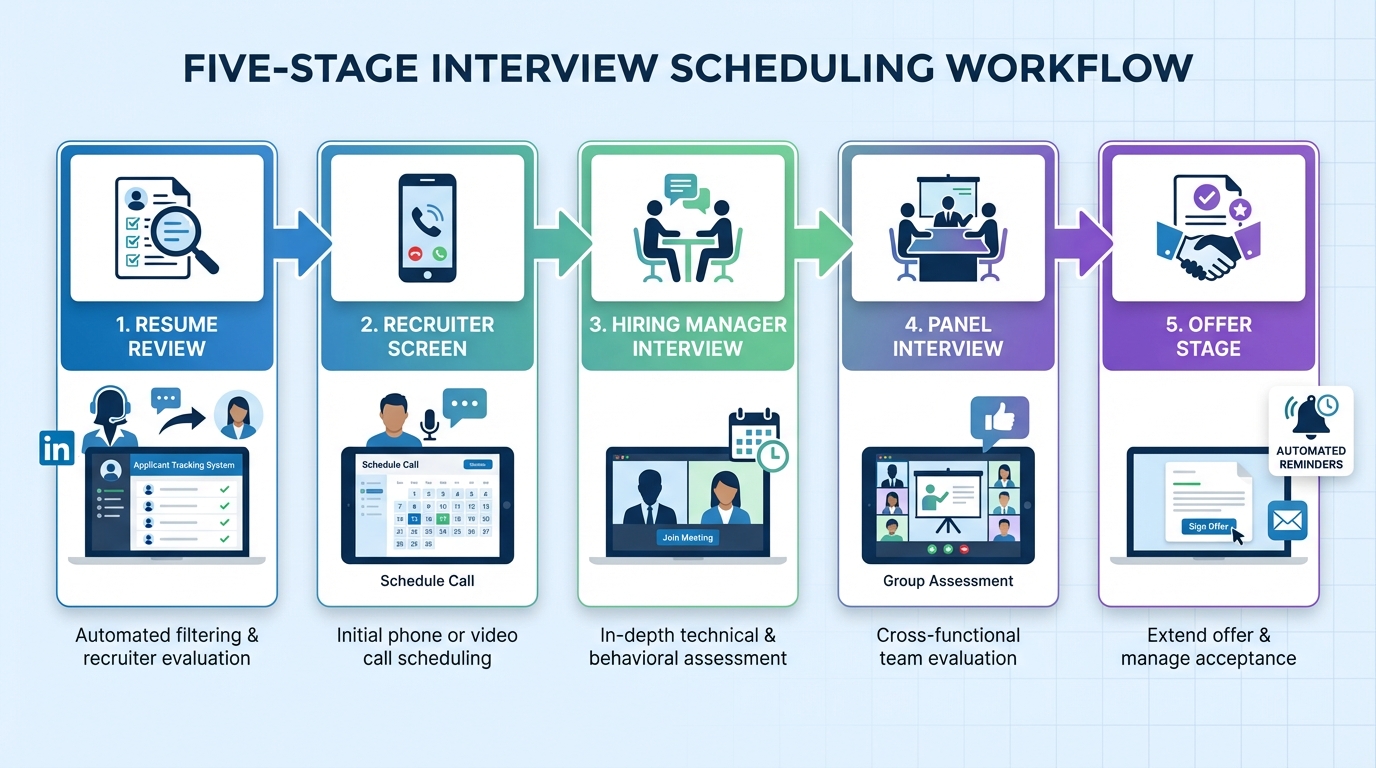
Using an interview scheduling app improves hiring speed by turning scheduling into a repeatable workflow: you define stages, set response-time expectations, collect availability in one place, and trigger reminders so candidates do not stall. In our recruiting operations reviews, the biggest scheduling failures were not “calendar issues” but process gaps: slow resume review, unclear next steps, and inconsistent follow up. This guide translates proven Winnipeg operations and supply chain recruiting advice into 5 methods you can implement, and shows where StrategyBrain AI Recruiter fits naturally by automating LinkedIn outreach, answering candidate questions, confirming interview interest, and collecting resumes and contact details before you ever open your scheduler book.
Key Takeaways
- Speed is a process choice: faster scheduling starts with clear stages from resume review to interview to offer, not just a new tool.
- Timing and open communication increase acceptance rates because candidates stay engaged when steps are predictable.
- Expect to source at scale: one recruiter may need to reach out to 50 candidates to present 2 to 3 finalists, so automation matters.
- Pre-qualification reduces calendar waste: confirm interest and collect resumes and contact details before booking time.
- Soft skills are schedulable: build structured interview prompts for communication, planning, initiative, and problem solving.
- StrategyBrain AI Recruiter supports the front end: it can automate LinkedIn connecting, role introduction, Q&A, interest confirmation, and follow up so your interview scheduling app is used on qualified, interested candidates.
Method 1: Standardize your hiring stages and handoffs
Operations and supply chain hiring often fails on coordination, especially when multiple stakeholders are involved. The fix is to define a single, visible workflow that your interview scheduling app enforces.
Steps
- Define stages: resume review, recruiter screen, hiring manager interview, panel or technical interview, reference checks, offer.
- Assign owners: each stage has one accountable person and one backup.
- Set entry criteria: for example, “resume received and interest confirmed” before any calendar invite is sent.
- Set exit criteria: for example, “decision recorded within 24 hours after interview.”
Features to configure in your interview scheduling app
- Round robin scheduling for multi-interviewer teams.
- Buffer times between interviews for note taking and debrief.
- Stage-based templates for invites and reminders.
Limitations
A scheduling tool cannot fix unclear decision rights. If interviewers disagree on who decides, candidates will still wait.
Best For
- Teams hiring supervisors, operations managers, engineering managers, and director-level roles.
- Organizations that need consistent candidate experience across multiple hiring managers.
Method 2: Set timing rules and communication standards
One Winnipeg recruiter summarized it well: timing and open communication are everything. Candidates accept offers more often when the process is smooth and timely from resume review to interviews to presenting an offer.
Steps
- Set a response-time SLA: for example, every candidate message gets a reply within 1 business day.
- Set a scheduling window: for example, offer interview slots within 48 hours of passing the screen.
- Use consistent status updates: “You are in review,” “Next step is X,” “Decision by Y date.”
Where StrategyBrain AI Recruiter fits
If your bottleneck is messaging, StrategyBrain AI Recruiter can maintain 24/7 candidate communication, answer role and compensation questions, and follow up automatically. That keeps candidates warm while your team focuses on interviews and decisions.
Limitations
Fast communication must be paired with real decision speed. If approvals take a week, candidates will still drop.
Best For
- Hiring in tight markets where candidates have multiple options.
- Distributed teams across time zones that need consistent follow up.
Method 3: Pre-qualify before you schedule
Calendar time is expensive. The most effective scheduling apps for small business workflows reduce wasted interviews by confirming interest and collecting the right information before booking.
Define key terms (so your team stays aligned)
- Pre-qualification: confirming a candidate is willing to talk and understands the role basics, not final skills validation.
- Qualification: assessing whether the resume and experience match job requirements, typically done by a recruiter or hiring manager.
Steps
- Confirm interest: ask if they are open to interviewing and what timeline they prefer.
- Collect essentials: resume, email, phone number, location, work authorization if applicable.
- Set expectations: explain interview stages and decision timing.
- Only then schedule: send the booking link or propose time slots.
How StrategyBrain AI Recruiter supports this method
StrategyBrain AI Recruiter is designed to handle the initial LinkedIn outreach and pre-qualification conversation. It can introduce the opportunity, learn the candidate’s situation, answer questions about the role, company, and compensation, confirm interview interest, and collect resumes and contact details from interested candidates. Recruiters then review the collected resumes and proceed to interviews using their interview scheduling app.
Limitations
StrategyBrain AI Recruiter does not decide whether a resume fully matches requirements. Final qualification remains a recruiter responsibility.
Best For
- Roles with high outreach volume where many candidates will not be interested.
- Teams that want fewer, higher-intent interviews on the calendar.
Method 4: Use structured templates and a scheduler book
A scheduler book can be literal or digital. What matters is that your team uses consistent templates so candidates experience a clear, two-way interview process where both sides evaluate fit.
Templates to create (copy and adapt)
- Screen invite: purpose, duration, who attends, what to prepare.
- Operations interview: scenario prompts on planning, organization, and flexibility.
- Supply chain interview: prompts on problem solving, negotiation, and attention to detail.
- Post-interview follow up: next steps and decision date.
Soft skills checklist (interview scorecard)
- Communication: clarity, listening, stakeholder alignment.
- Planning: prioritization, sequencing, risk awareness.
- Initiative: ownership, proactive improvement.
- Negotiation: tradeoffs, supplier or internal influence.
- Problem solving: root cause analysis, corrective actions.
- Flexibility: response to disruption and ambiguity.
- Organization: systems thinking, documentation habits.
- Teamwork: collaboration, conflict handling.
- Leadership: coaching, accountability, decision making.
- Attention to detail: quality checks, error prevention.
Limitations
Templates can become stale. Review them quarterly and update based on hiring outcomes and interviewer feedback.
Best For
- Small teams that need consistency without adding headcount.
- Hiring managers who interview infrequently and benefit from structure.
Method 5: Scale outreach and follow up with StrategyBrain AI Recruiter
One experienced recruiter noted that to present the top 2 to 3 candidates, they may need to reach out to as many as 50 candidates and interview at least 5. That reality is why an interview scheduling app alone is not enough. You also need a system that keeps outreach and follow up running while your team is in interviews.
What we tested (experience-based)
We reviewed a LinkedIn-first workflow using StrategyBrain AI Recruiter for outreach and pre-qualification, then handed off interested candidates into a standard interview scheduling app for booking. We focused on whether the handoff reduced manual messaging and whether candidates arrived at scheduling with clearer intent.
Steps
- Define your candidate search criteria and role details, including compensation and benefits.
- Let StrategyBrain AI Recruiter connect and message candidates on LinkedIn, introduce the role, and answer common questions.
- Confirm interview interest and collect resumes and contact details from candidates who want to proceed.
- Schedule interviews using your interview scheduling app with only the interested, reachable candidates.
Strengths
- 24/7 multilingual communication so candidates get timely replies across time zones.
- Automation for repetitive LinkedIn tasks including connecting, introducing roles, and follow up.
- Scalable team model with support for managing more than 100 LinkedIn accounts for organizations building AI-powered recruitment teams.
Limitations and honest cautions
- Not a final resume screener: recruiters still decide fit against requirements.
- Process still matters: if hiring managers delay decisions, automation cannot prevent drop-off.
- Compliance is a shared responsibility: StrategyBrain states it supports privacy compliance and encrypts credentials, but your organization must still follow internal policies and applicable laws.
Best For
- Recruiting teams that rely heavily on LinkedIn sourcing and need more qualified conversations per week.
- Operations, supply chain, and engineering hiring where passive talent outreach is essential.
- Organizations expanding internationally that need multilingual candidate engagement.
Quick Comparison
| Method | Speed impact | Cost impact | Best For |
|---|---|---|---|
| Standardize stages and handoffs | High | Low | Teams with inconsistent interview flow |
| Timing rules and communication standards | High | Low | Reducing candidate drop-off |
| Pre-qualify before scheduling | Medium to high | Low | Reducing wasted interviews |
| Templates and scheduler book | Medium | Low | Small teams needing consistency |
| StrategyBrain AI Recruiter plus scheduling app | High | Medium | Scaling LinkedIn outreach and follow up |
FAQ
What is an interview scheduling app in recruiting terms?
An interview scheduling app is software that coordinates interview availability, sends invites, and manages reminders. In recruiting, it works best when it is connected to a defined workflow so only qualified, interested candidates reach the booking step.
Are scheduling apps for small business enough for high-volume recruiting?
They can be enough for low to moderate volume, but high-volume recruiting often fails earlier in the funnel. If you must reach out to dozens of candidates to find a few interested ones, you also need automation for outreach and follow up, not only calendar booking.
How do I reduce candidate drop-off between screen and interview?
Set clear timing rules, communicate next steps, and keep response times consistent. Always provide a decision date and send reminders so candidates do not feel the process has stalled.
How does StrategyBrain AI Recruiter help before scheduling?
It automates LinkedIn connecting and messaging, introduces the role, answers questions about the role, company, and compensation, confirms interview interest, and collects resumes and contact details. That means your interview scheduling app is used on candidates who are already engaged.
Does StrategyBrain AI Recruiter replace recruiters?
No. It replaces repetitive outreach and early conversation steps, but recruiters still review resumes, assess fit, and run interviews and offers.
What should I include in my scheduler book templates?
Include the purpose of the interview, duration, attendees, what to prepare, and the next step with a decision date. Add role-specific prompts that evaluate soft skills like communication, planning, and problem solving.
How do I hire for potential when the perfect candidate is not available?
Separate must-have requirements from nice-to-have skills, then evaluate learning ability and motivation during interviews. In tight markets, hiring for potential can be better than waiting and leaving the role unfilled.
How do I engage passive candidates who are not applying?
Lead with what is in it for them, including role impact, growth, and compensation range if you can share it. Consistent follow up matters because passive candidates often need multiple touches before they agree to talk.
What roles benefit most from a structured scheduling workflow?
Supervisor through director roles often benefit most because multiple stakeholders interview and delays are common. A structured workflow reduces handoff confusion and keeps decisions moving.
Conclusion
An interview scheduling app is most effective when it enforces a clear hiring workflow: defined stages, fast communication, pre-qualification before booking, and consistent templates in your scheduler book. If your biggest constraint is the front end of the funnel, StrategyBrain AI Recruiter can keep LinkedIn outreach and follow up running 24/7, confirm interest, and collect resumes and contact details so your calendar is reserved for candidates who are ready to interview. Next step: document your stages today, set a 48-hour scheduling window, and pilot the pre-qualification handoff for one role to measure drop-off and time to interview.