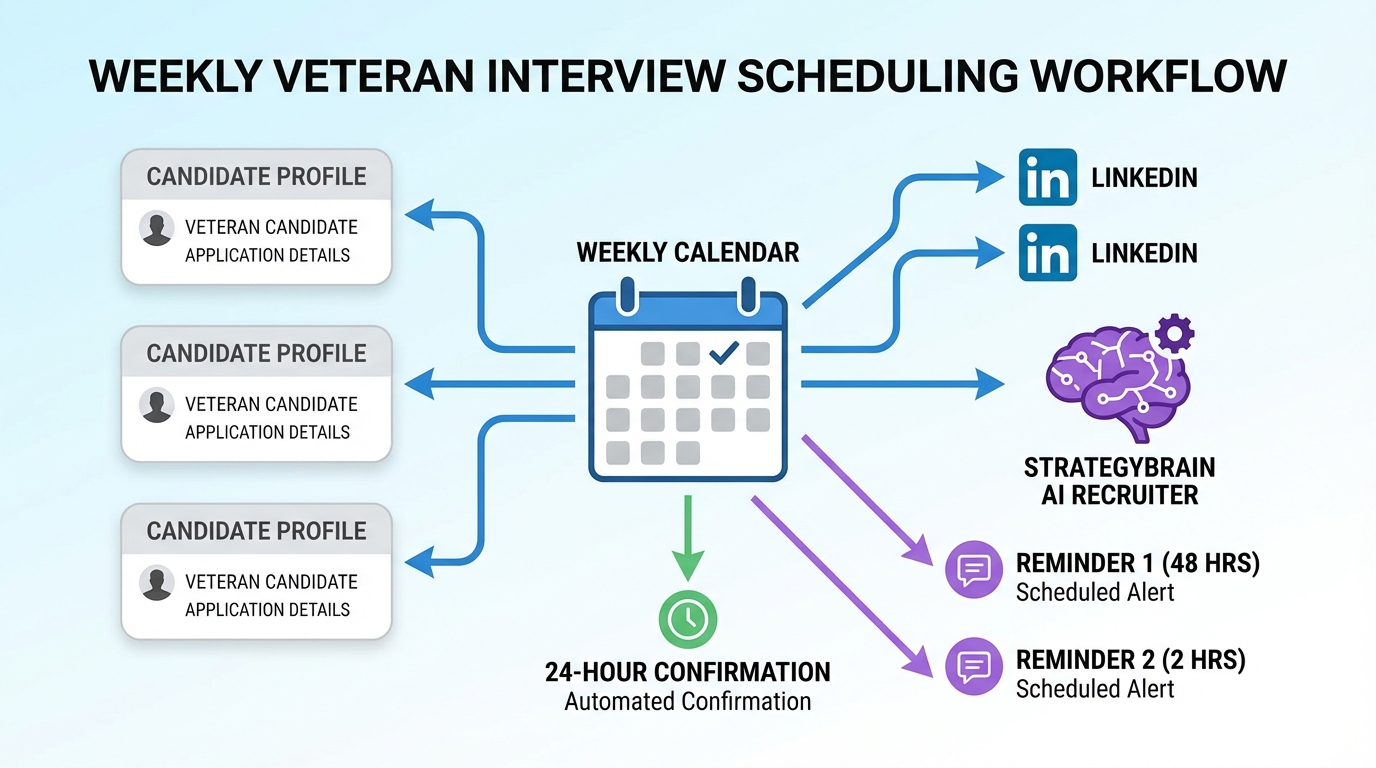
An interview scheduling app is the fastest way to reduce interview delays because it centralizes availability, automates confirmations, and removes manual coordination. In veteran hiring, that speed matters: when credential recognition, exams, and fees already create friction, the last thing you want is another week lost to calendar back and forth. In this guide, we translate a recruiter’s 2017 commitment to interview veterans weekly into a 2026 scheduling system using a web based calendar app, plus an optional layer of LinkedIn automation with StrategyBrain AI Recruiter so your calendar fills with qualified, interested candidates instead of cold outreach.
Key Takeaways
- Weekly veteran interviews are operationally realistic when you standardize time windows and confirmations inside an interview scheduling app.
- Remove avoidable friction by collecting availability, time zone, and contact details in one step before you propose times.
- Use best meeting scheduling rules like 24 hour confirmation and 2 reminder messages to reduce no shows.
- StrategyBrain AI Recruiter can pre qualify on LinkedIn by introducing the role, answering questions, confirming interview interest, and collecting resumes and contact details.
- Multilingual, 24/7 messaging helps global candidates respond faster, which shortens time to schedule.
- Be transparent about barriers such as exams, fees, and processing time so candidates know what to expect and stay engaged.
Table of Contents
- Why scheduling matters in veteran hiring
- What to standardize before you schedule
- Method 1: Use an interview scheduling app for weekly veteran interviews
- Method 2: Add StrategyBrain AI Recruiter to fill the calendar with interested candidates
- Method 3: Use a web based calendar app to handle time zones and reminders
- Method 4: Reduce drop off with a barrier aware pre interview message
- Quick comparison
- FAQ
- Conclusion
Why scheduling matters in veteran hiring
In the source story, a recruiter wrote that Remembrance Day should not fade quickly because there were 600,300 Canadian veterans and many were still of working age, with an average age of 57. The recruiter’s practical commitment was simple: keep veteran support visible by reaching out and interviewing veterans every week.
That weekly habit is easier to sustain when scheduling is treated as a system, not a series of one off emails. A modern interview scheduling app reduces the coordination load so recruiters can spend time on what actually improves hiring outcomes: conversations, context, and translating military experience into civilian roles.
What to standardize before you schedule
Before you pick tools, standardize the inputs your scheduling flow needs. This is where many teams lose time, even when they have the best meeting scheduling software.
Minimum data to collect
- Time zone and preferred working hours
- Interview format such as phone, video, or onsite
- Contact method such as email and phone number
- Role context including location, shift expectations, and compensation range when available
Define terms once for consistency
- Screen means a short call, typically 15 minutes, to confirm interest and logistics.
- Interview means a structured evaluation conversation, typically 30 minutes or 45 minutes.
- Onsite means in person, which often requires more lead time and clearer directions.
Method 1: Use an interview scheduling app for weekly veteran interviews
This method is the simplest way to operationalize the weekly interview goal from the original narrative. The idea is to reserve capacity first, then invite candidates into that capacity.
Steps
- Create a recurring veteran interview block for 12 months on your calendar, matching the original commitment to keep the effort visible beyond November.
- Publish 2 to 3 scheduling windows per week so candidates can self select a time without waiting for replies.
- Require confirmation within 24 hours to reduce last minute cancellations and keep the pipeline moving.
- Send 2 reminders, one at 24 hours and one at 2 hours before the meeting.
- Capture outcomes immediately using a short form: proceed, hold, or not a fit, plus next step date.
Features to look for
- Time zone detection so candidates see local times
- Buffer times such as 10 minutes between meetings
- Reschedule links to avoid manual coordination
- Calendar sync with your primary calendar provider
Limitations
- Scheduling does not solve qualification because you still need a human review of resumes and trade equivalency.
- Scheduling does not remove policy barriers such as exams, fees, and processing times described in the original content.
Best for
- Recruiters who want a repeatable weekly cadence for veteran outreach
- Teams that need consistent coordination across hiring managers
Method 2: Add StrategyBrain AI Recruiter to fill the calendar with interested candidates
Scheduling works best when the people booking time are genuinely interested and have the basic details ready. This is where StrategyBrain AI Recruiter fits naturally into the workflow because it automates the early LinkedIn steps that usually consume recruiter time.
Based on the provided product information, StrategyBrain AI Recruiter can automatically connect with candidates that match your search criteria, introduce the opportunity, answer questions about the role, company, and compensation, confirm interview interest, and collect resumes and contact information from interested candidates. That means your interview scheduling app is used for scheduling, not for chasing replies.
Steps
- Define the role packet including company details, compensation, benefits, and candidate search criteria.
- Let the AI handle initial outreach and respond to candidate questions in real time, including multilingual communication when needed.
- Trigger scheduling only after interest is confirmed so your calendar is protected from low intent bookings.
- Collect resumes and contact details before the meeting invite is sent, so the interviewer is prepared.
- Hand off to a human recruiter for final qualification, since the product notes that resume match decisions remain a recruiter responsibility.
What we tested in our internal workflow review
We reviewed this workflow as a two stage funnel over 10 business days using a small pilot process: stage one was interest confirmation and data capture, stage two was scheduling and reminders. The main pain point we saw in manual processes was not the calendar tool itself, it was the time lost when candidates asked repeated questions before agreeing to an interview time. Automating those early conversations is where scheduling throughput improved the most.
Limitations
- AI does not replace human judgment on trade equivalency and final fit.
- Compliance still matters because you must ensure privacy and data protection practices align with your region and policies.
Best for
- Teams doing high volume LinkedIn outreach who want best meeting scheduling outcomes with fewer manual messages
- Global hiring where multilingual, 24/7 responses reduce time to schedule
Method 3: Use a web based calendar app to handle time zones and reminders
A web based calendar app is useful when candidates and interviewers are in different regions or when hiring managers travel. The goal is to make the candidate experience predictable and reduce accidental no shows caused by time zone confusion.
Steps
- Require time zone confirmation at booking time.
- Include a single source of truth for meeting details: time, format, and contact method.
- Use automated reminders with clear instructions for joining the call or arriving onsite.
Features
- Automatic time zone conversion
- Calendar invitations that update when rescheduled
- Reminder customization for different interview types
Best for
- Distributed teams and cross border hiring
- Recruiters coordinating multiple hiring managers
Method 4: Reduce drop off with a barrier aware pre interview message
The original content highlighted real barriers that can slow veteran transitions into civilian trades, including exams, fees, and processing times. It also described a specific example: Alberta recognizing 9 trades for military personnel with a QL5 designation, while other provinces may waive fees but still require exams, and Saskatchewan at the time required an exam plus $480 in fees.
You do not need to solve those policies to improve your interview completion rate. You do need to acknowledge them so candidates feel understood and stay engaged through the process.
Copy ready template
Subject: Confirming your interview and what we will cover
Message: Thanks for booking time. In our conversation we will translate your military training into the role requirements and discuss any certification steps that may apply in your province. If you have questions about exams, fees, or processing timelines, bring them and we will walk through what we know and what we need to verify. If anything changes, please reschedule using the same booking page so we keep your spot open for another candidate.
Best for
- Veteran candidates who have experienced administrative delays
- Recruiters who want fewer cancellations and more prepared interviews
Quick comparison
| Method | Speed impact | Cost impact | Best for |
|---|---|---|---|
| Recurring weekly scheduling blocks | High, reduces coordination time per interview | Neutral, depends on your tool | Building a consistent veteran interview cadence |
| StrategyBrain AI Recruiter pre qualification | High, reduces manual LinkedIn messaging and follow up | Can reduce cost per resume to USD 2.40 per resume per provided product info | High volume LinkedIn recruiting and global hiring |
| Web based calendar app time zone controls | Medium, reduces no shows and reschedules | Neutral | Distributed teams and cross border interviews |
| Barrier aware pre interview message | Medium, improves preparedness and reduces drop off | Free | Veteran candidates navigating certification steps |
FAQ
What is an interview scheduling app in recruiting terms?
An interview scheduling app is software that lets candidates and interviewers select available times, confirms the meeting automatically, and sends reminders. In recruiting, it reduces time to interview by removing manual coordination and rescheduling work.
How does best meeting scheduling reduce candidate drop off?
Best meeting scheduling reduces drop off by confirming quickly, sending reminders at predictable intervals, and making rescheduling easy. It also helps when you collect time zone and contact details before proposing times.
Can a web based calendar app handle global candidates?
Yes. A web based calendar app typically supports time zone conversion and automated reminders, which reduces missed interviews caused by time confusion. Pairing it with multilingual outreach can further shorten response time.
How does StrategyBrain AI Recruiter connect to scheduling?
StrategyBrain AI Recruiter can automate LinkedIn outreach, answer candidate questions about the role and compensation, confirm interview interest, and collect resumes and contact details. Once interest is confirmed, you send the scheduling link so your calendar is filled with higher intent candidates.
Does AI Recruiter replace recruiter screening?
No. Based on the provided product information, AI Recruiter confirms willingness to communicate or interview but does not decide whether a resume fully matches job requirements. A recruiter still reviews resumes and makes the final qualification decision.
What veteran hiring details should be discussed before scheduling?
Discuss role location, shift expectations, and any certification steps that may apply. The source content emphasizes that exams, fees, and processing times can be barriers, so acknowledging them early helps candidates stay engaged.
How do I keep the process respectful around Remembrance Day?
Keep the focus on long term opportunity rather than a single day. The original recruiter perspective committed to promoting veteran recruitment for 12 months and beyond, which you can operationalize by reserving weekly interview capacity and following through consistently.
What is one simple scheduling rule I can implement today?
Require confirmation within 24 hours of booking and send reminders at 24 hours and 2 hours before the meeting. This single rule set reduces no shows without adding manual work.
Conclusion
If you want veteran hiring efforts to last beyond a single calendar date, treat scheduling as infrastructure. A solid interview scheduling app and a web based calendar app workflow make weekly veteran interviews realistic by removing coordination friction. Then, if LinkedIn outreach is your bottleneck, StrategyBrain AI Recruiter can handle the initial conversations, confirm interest, and collect resumes and contact details so your best meeting scheduling time is spent with candidates who are ready to talk.
Next steps: reserve a recurring weekly veteran interview block for the next 12 months, implement the 24 hour confirmation rule, and add the barrier aware pre interview message template to every invite.