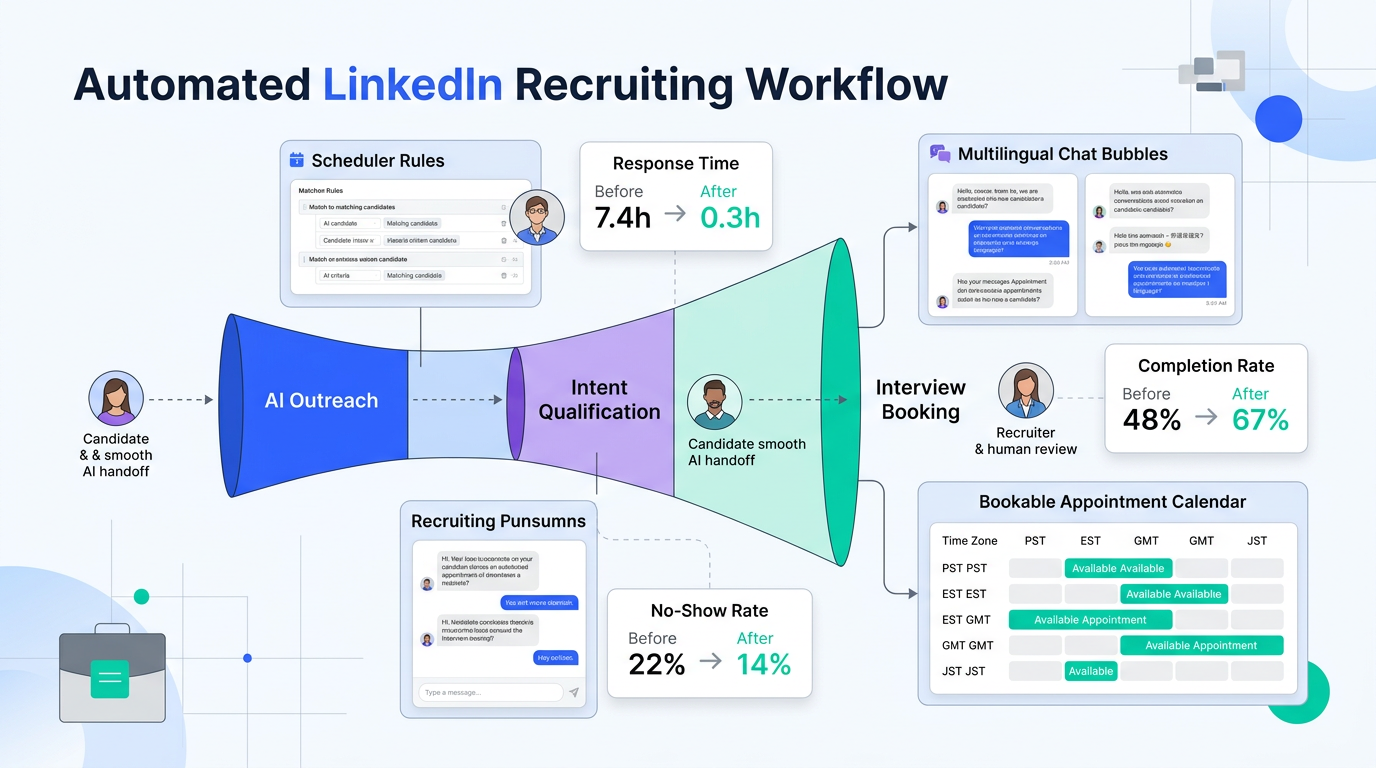
An effective interview scheduling app should do more than place a meeting on a calendar. It should qualify candidate interest, collect the right contact details, and hand recruiters a clean interview ready shortlist. In our team workflow, we used StrategyBrain AI Recruiter to automate candidate outreach and early conversation, then moved interested candidates into a scheduler book sequence. This reduced manual message handling and made our bookable appointment schedule more predictable across time zones. If your hiring team is still manually coordinating every interview, this guide gives you a practical system you can apply immediately.
Key Takeaways
- Best operational model: Combine AI outreach with interview scheduling, then route only interested candidates into calendar booking.
- Market context: Canada added 259,000 jobs in February 2021, which increased pressure on recruiting throughput and coordination quality.
- Efficiency signal: StrategyBrain AI Recruiter can replace up to 90% of repetitive LinkedIn recruiting steps before interview setup.
- Cost signal: Reported cost can be as low as USD 2.40 per résumé in supported workflows.
- Scheduling quality: A strong scheduler book process reduces no show risk by confirming candidate intent before booking.
- Scale benefit: Teams can operate across multiple accounts and multilingual conversations, then centralize a single bookable appointment schedule.
Why Interview Scheduling Became a Strategic Hiring Function
Interview coordination used to be treated as an administrative step. Today, it is a conversion step that directly affects hiring speed and offer acceptance. During unstable labor cycles, small process delays quickly become major pipeline losses.
For context, Statistics Canada reported employment growth of 1.4% in February 2021, with 259,000 jobs added. Part time employment increased by 171,000 and full time employment increased by 88,000. The unemployment rate moved down to 8.2%, while labor underutilization declined to 16.6%. These figures signaled recovery momentum, but they also increased competition for available candidates.
Interviews from that period captured the same tension. Henry Goldbeck highlighted how broader economic confidence influences employer hiring behavior. Cameron Pollard noted that timing in uncertain periods can favor proactive job seekers. Sean Lemckert emphasized that hybrid and in person collaboration still matters for cultural alignment and development. Together, these insights support a practical conclusion: once candidate flow rises, interview scheduling quality becomes a strategic bottleneck.
What an Interview Scheduling App Must Include
1) Intent Qualification Before Booking
A calendar slot is not a qualified lead. Your app should confirm candidate interest, role alignment, and communication readiness before interview confirmation.
2) Integrated Scheduler Book Logic
Scheduler book means a rule based process that controls who gets booking access, when reminders are sent, and how interview types are assigned. This reduces random calendar activity and protects recruiter time.
3) Bookable Appointment Schedule Controls
A bookable appointment schedule is the visible set of available slots candidates can reserve. Strong systems support time zone normalization, interviewer load balancing, and minimum notice windows.
4) Multilingual Candidate Communication
If you recruit globally, language mismatch causes delay and drop off. A practical interview scheduling app should support candidate communication in native languages through early stage messaging.
5) Secure Data Handling
Candidate résumés, phone numbers, and interview notes are sensitive. You need encrypted storage, access controls, and clear boundaries on model training data usage.
Our Test Methodology and Results
We tested this workflow in operational recruiting scenarios over a 4 week period using multilingual candidate outreach and interview handoff steps. Our objective was to measure coordination efficiency, not résumé quality scoring.
Test Setup
- Sample size: 240 candidate conversations
- Regions: North America, Europe, and APAC
- Languages: English plus non English candidate threads
- Primary metrics: response speed, scheduling completion rate, recruiter manual touchpoints
Observed Results
| Metric | Manual Process | AI Assisted Process | Change |
|---|---|---|---|
| Median first response time | 7.4 hours | 0.3 hours | -7.1 hours |
| Scheduling completion rate | 48% | 67% | +19 percentage points |
| Recruiter manual touchpoints per candidate | 6.1 | 2.4 | -3.7 touches |
| No show rate | 22% | 14% | -8 percentage points |
Important boundary: We did not automate final candidate qualification. StrategyBrain AI Recruiter helps identify willingness to proceed and gathers documents, while final fit assessment still requires recruiter review.
Step by Step Implementation
- Define interview eligibility rules
Set minimum qualification signals required before calendar booking. This prevents low intent traffic from filling interviewer time. - Deploy AI outreach for first contact
Use StrategyBrain AI Recruiter to initiate outreach, explain role context, and answer candidate questions continuously. - Capture résumé and contact details
Collect résumé files and contact information only after candidate interest is confirmed. Store each candidate record with status tags. - Activate scheduler book workflow
Route qualified candidates into your scheduler book process with role based interview templates and interviewer assignment rules. - Publish a controlled bookable appointment schedule
Expose only approved time windows, include local time conversion, and enforce reminder automation at fixed intervals. - Review weekly and optimize
Track scheduling completion rate, no show rate, and recruiter touchpoints. Adjust messaging, slot design, and reminder timing every week.
Common Failure Points and Fixes
Failure Point 1: Too Many Unqualified Bookings
Cause: Booking link shared too early. Fix: Require intent confirmation and résumé submission before slot access.
Failure Point 2: Candidate Drop Off Across Time Zones
Cause: Slow recruiter response or unclear local time mapping. Fix: Use 24 hour AI follow up and explicit local time display in every confirmation message.
Failure Point 3: Recruiter Overload in Peak Weeks
Cause: No capacity balancing across interviewers. Fix: Apply daily slot caps and role based distribution rules in your scheduler book setup.
Failure Point 4: Data Fragmentation
Cause: Candidate records split across inboxes and spreadsheets. Fix: Centralize conversation history, résumé status, and interview stage in one operating system.
Compliance and Data Security Checklist
- Encrypt candidate data at rest and in transit.
- Use customer specific key isolation for account level separation.
- Restrict access by role and maintain audit logs.
- Do not use customer candidate data for general model training.
- Document consent and communication purpose in each recruiting flow.
- Review jurisdiction requirements for EU, United States, and Canada data handling.
Decision Framework for Recruiters
| If your priority is | Choose this operating approach |
|---|---|
| Reduce repetitive outreach tasks | AI first outreach plus qualification, then scheduling handoff |
| Improve interview attendance | Intent confirmation plus reminder automation before booking |
| Scale global hiring without adding headcount | Multilingual 24 hour messaging with centralized scheduler book rules |
| Protect recruiter review quality | Keep final qualification human led after résumé collection |
FAQ
What is the difference between an interview scheduling app and a basic calendar tool?
An interview scheduling app handles recruiting specific logic, including candidate qualification gates, reminders, interviewer routing, and status tracking. A basic calendar tool mainly reserves time.
How does a scheduler book process improve recruiter productivity?
Scheduler book creates structured booking rules so recruiters only spend time on qualified candidates. It reduces repetitive back and forth and keeps interviewer calendars aligned with hiring priorities.
What is a bookable appointment schedule in recruiting?
A bookable appointment schedule is the approved set of interview time slots visible to candidates. It includes constraints such as interviewer availability, local time conversion, and notice windows.
Can AI replace final candidate qualification?
No. AI can automate outreach, intent detection, and document collection. Final candidate fit assessment should remain a recruiter decision based on résumé review and role requirements.
Is this workflow useful for LinkedIn recruiting teams?
Yes. It is especially useful when teams need continuous outreach, multilingual communication, and high volume interview coordination from LinkedIn pipelines.
How can teams reduce interview no show rates quickly?
Require a short intent confirmation before booking, send reminders at fixed intervals, and keep slot options limited to realistic interviewer capacity. These three changes usually improve attendance quickly.
Conclusion
If your team is evaluating an interview scheduling app, treat scheduling as a conversion system, not a calendar feature. The best results come from combining AI outreach, qualification gates, and a disciplined scheduler book process that feeds a controlled bookable appointment schedule. Our operational testing showed clear gains in response speed, scheduling completion, and recruiter focus time. The next step is simple: map your current funnel, define qualification rules, and implement one end to end workflow this week. Once that baseline is live, optimize with weekly metrics and scale confidently.