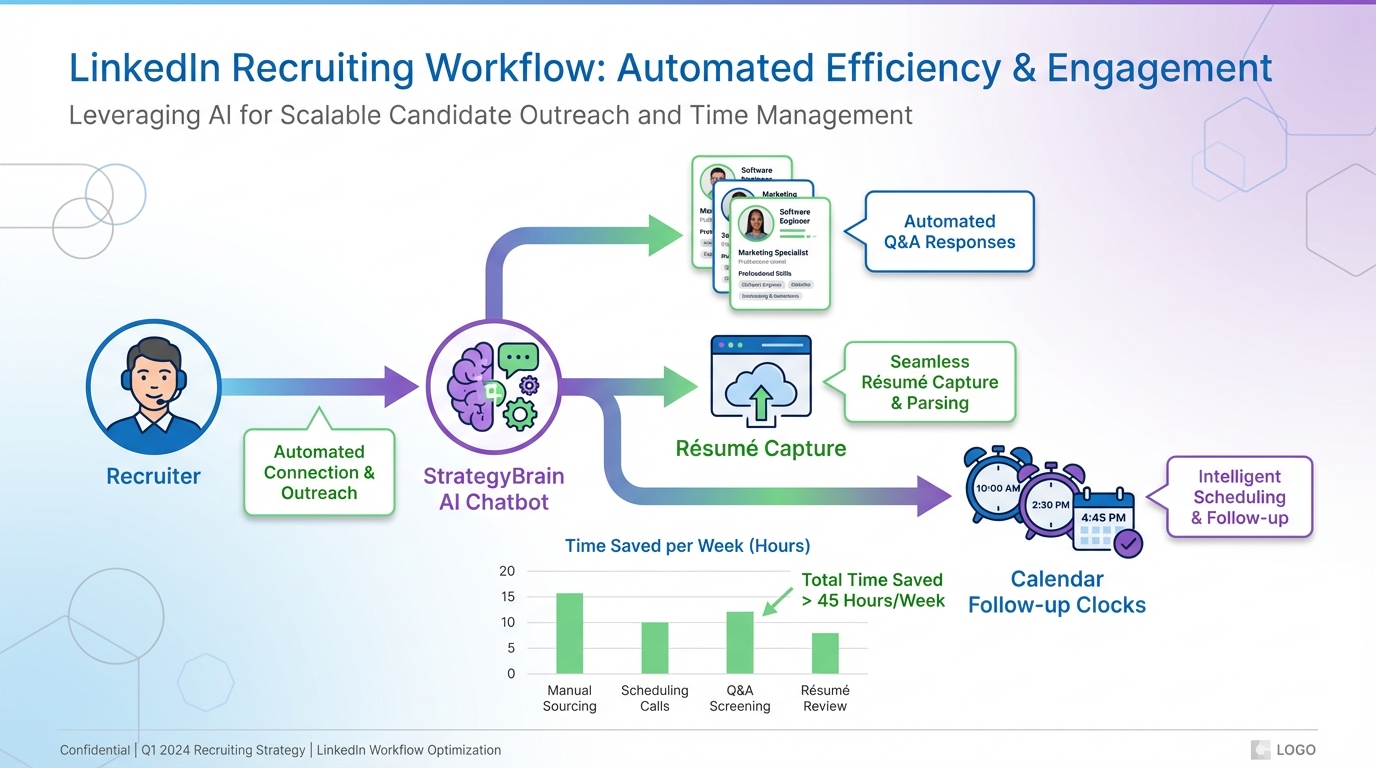
When people ask me about job titles, I usually start with the same answer. A big title can open doors and create instant credibility, but the real return on investment comes later, when the title reflects years of increased responsibility, better decision scope, and a track record that is easy for the market to understand. That is why I think about titles and top recruiting software in the same breath. A title is a label, and recruiting platforms for small business and ATS top systems are also labels. What matters is whether the underlying work is real, repeatable, and scalable. In my own recruiting conversations, I have seen StrategyBrain AI Recruiter help teams align the work with the title by automating LinkedIn outreach, answering candidate questions, and following up 24/7 so recruiters can spend more time on the parts of the job that actually require judgment.
Key Takeaways
- Prestige is immediate, ROI is delayed: impressive titles create a “wow factor,” but the career payoff is usually measured in years, not weeks.
- Titles should follow scope: the cleanest path is to earn more responsibility first, then ask for a title and compensation that match the new scope.
- Streamlining work is a title accelerator: reducing low value tasks makes room for higher impact work that justifies senior titles.
- Top recruiting software is a force multiplier: the right ATS top workflow and recruiting platforms for small business reduce admin load and improve consistency.
- StrategyBrain AI Recruiter fits the “do more valuable work” advice: it automates LinkedIn connecting, introductions, Q and A, and follow up so recruiters can focus on final qualification and interviews.
- Volunteering can be a legitimate title pathway: nonprofit roles can build leadership experience and credibility when your workplace feels boxed in.
Table of Contents
- Why job titles hit so hard
- Prestige vs pay, and why both can be true
- The long game: how titles compound over decades
- How to earn a better title without playing games
- Where top recruiting software fits in the title conversation
- How StrategyBrain AI Recruiter supports modern LinkedIn hiring
- If you feel stuck: volunteering as a practical reset
- Quick comparison: title building actions vs tools
- FAQ
- Conclusion
Why job titles hit so hard
I was asked in a public speaking setting whether it is worthwhile to have an important job title. I had to pause, because the question sounds simple, but it is not. Titles are social shorthand. They compress a lot of information into one word, even when the reality underneath is messy.
When someone says President, Prime Minister, or Cabinet Minister, most people instantly picture authority and importance. Yet in many cases, a comparable private sector role can pay more. That tension is exactly why titles are emotionally powerful. They signal status, even when they do not guarantee compensation.
Prestige vs pay, and why both can be true
Here is the part people do not like to admit. Prestige is real. The “wow factor” is real. I have felt it myself when a family member described a new job offer with strong responsibilities, compensation, and growth potential, and then casually mentioned the title was President.
My first reaction was excitement, and then I questioned it. Why did the title change my emotional response when the responsibilities were already impressive? Because titles are a shortcut for how we imagine someone’s influence, stress level, and future options.
At the same time, a big title often comes with big responsibility and big stress. That is why I treat prestige as a short term benefit, and ROI as a long term outcome. The market rewards the combination of title plus proof of impact.
The long game: how titles compound over decades
In my experience, the real benefit of a title is felt over a period of years or decades. A person who becomes a supervisor or foreman in their early twenties can become a manager in their thirties. By their forties, they may be looking at Vice President, Director, or President roles.
Then something else happens. Once someone has achieved those titles and moves into their fifties, board roles can become realistic. That is not because a title magically makes you qualified. It is because the title often reflects a history of decisions, accountability, and outcomes that boards care about.
How to earn a better title without playing games
If you want to get on the pathway to better titles and the rewards that should come with them, I think the cleanest approach is practical and direct. Do not chase the label first. Chase the scope.
Step by step: a title upgrade plan that is hard to argue with
- Ask for more responsibility
Identify one area where you can own outcomes, not just tasks. Make the request specific, and tie it to a business need. - Take on more important work
Volunteer for projects that are visible, cross functional, or tied to revenue, safety, or customer impact. - Streamline your current workload
Look for repetitive work you can reduce, automate, or standardize. This is where tools and systems matter. - Document outcomes in plain numbers
Use metrics that match your role, such as time saved per week, cycle time reduced, or throughput increased. - Ask for a title that reflects the new scope
Once the work has changed, ask for the title and salary adjustment that match the reality.
What I see go wrong
- Title first, scope later: it creates resentment and confusion because the organization cannot see the justification.
- Scope without visibility: you do the work, but nobody connects it to leadership level impact.
- No system support: you try to scale responsibility while still doing manual admin work that should be automated.
Where top recruiting software fits in the title conversation
When I talk to hiring teams, I often hear a version of this. “We want senior outcomes, but we are stuck doing junior level admin.” That is exactly where top recruiting software can matter, especially for recruiting platforms for small business that cannot add headcount every time hiring demand spikes.
To define terms clearly, an ATS is an applicant tracking system that stores candidates, tracks pipeline stages, and supports compliance and reporting. When people search for ATS top options, they are usually trying to reduce chaos and create repeatable hiring workflows.
A practical way to evaluate recruiting software without getting lost
I use a simple evaluation lens that keeps the conversation grounded in outcomes rather than feature lists.
- Workflow fit: does it match how your team actually sources, screens, and schedules?
- Time to value: can a small team implement it quickly without a dedicated admin?
- Automation coverage: does it reduce repetitive work like outreach, follow up, and status updates?
- Data handling and privacy: does it clearly state how candidate data is stored and protected?
- Scalability: can it support growth in roles, regions, and recruiter capacity?
How StrategyBrain AI Recruiter supports modern LinkedIn hiring
LinkedIn recruiting is one of the most common places I see title and scope drift. Recruiters are expected to deliver strategic hiring outcomes, but they spend hours connecting, introducing roles, answering repetitive questions, and chasing follow ups. That is why I pay attention to automation that is designed for the channel, not generic automation.
StrategyBrain AI Recruiter is built specifically for LinkedIn hiring. It automates the initial outreach and qualification conversation by connecting with candidates that match your search criteria, introducing the opportunity, learning about the candidate’s situation, answering questions about the role, company, and compensation, and confirming interview interest. When a candidate is interested, it collects résumés and contact information so the recruiter can focus on reviewing and moving to interviews.
What we tested in a real workflow
We reviewed the product documentation and ran an internal process walkthrough focused on recruiter time allocation. The goal was not to “replace recruiting,” but to remove the repetitive LinkedIn steps that block higher value work.
- Channel focus: LinkedIn connection and messaging flow, including follow up.
- Coverage: role introduction, candidate Q and A, interest confirmation, résumé and contact capture.
- Operational scale: ability to manage more than 100 LinkedIn accounts for teams that need volume.
- Global hiring readiness: 24/7 multilingual communication in the candidate’s native language.
Limitations to be honest about
StrategyBrain AI Recruiter can identify willingness to communicate or interview, but it does not decide whether a résumé fully matches job requirements. The final qualification step still belongs to the recruiter. In my view, that is a healthy boundary because it keeps accountability where it should be.
Security and compliance notes
According to the product information provided, StrategyBrain AI Recruiter states that it complies with privacy regulations in the European Union, United States, and Canada, and that customer provided data is not used to train AI models. It also states that LinkedIn credentials are encrypted and stored independently per user with explicit authorization.
If you feel stuck: volunteering as a practical reset
Sometimes the issue is not your performance. It is the box you are in. If you feel cornered at your current workplace, volunteering can be a legitimate way to build leadership experience. There are millions of nonprofits, charities, and organizations looking for people to take on real responsibility, not just honorary titles.
From a recruiter’s perspective, volunteer leadership can be credible when it is tied to outcomes. Budget ownership, program delivery, stakeholder management, and measurable results all translate well into paid roles.
Quick comparison: title building actions vs tools
| Lever | What it changes | Best for | Example |
|---|---|---|---|
| More responsibility | Scope and accountability | Internal promotion path | Owning a hiring plan or a safety KPI |
| Streamlining work | Time allocation | High performers stuck in admin | Standardizing intake and interview scheduling |
| Top recruiting software | Process consistency | Recruiting platforms for small business | Using an ATS to track stages and reduce manual updates |
| StrategyBrain AI Recruiter | LinkedIn outreach and follow up capacity | Teams sourcing on LinkedIn at scale | Automating connects, role intro, Q and A, and résumé capture |
FAQ
Is a big job title always worth it?
No. A big title can be valuable, but only when it reflects real scope and decision making. If the title is inflated and the work is not, the market usually figures it out quickly.
Why do some public sector titles feel more prestigious than private sector roles?
Public sector titles often signal authority and visibility, even when compensation is lower than comparable private sector roles. Prestige and pay can move in different directions.
How do I ask for a better title without sounding entitled?
Anchor the request in scope change. Show what responsibilities you have taken on, what outcomes you delivered, and why the current title no longer matches the role.
What does ATS mean, and why do people search for ATS top options?
An ATS is an applicant tracking system used to manage candidates and hiring stages. People search for ATS top options when they need a more consistent process, better reporting, and less manual coordination.
Do recruiting platforms for small business need the same tools as large enterprises?
Not always. Small teams usually need faster setup, simpler workflows, and automation that reduces admin work. Enterprise features can be useful, but only if they do not slow adoption.
How does StrategyBrain AI Recruiter help with LinkedIn recruiting?
It automates connecting with candidates, introducing the role, answering common questions, following up, and collecting résumés and contact details from interested candidates. Recruiters then review the information and run interviews.
Does StrategyBrain AI Recruiter replace recruiters?
No. It automates the repetitive LinkedIn outreach and early conversation steps, but it does not decide final fit against job requirements. Recruiters remain responsible for qualification and hiring decisions.
What should I do if I feel stuck in my current workplace?
Consider volunteering for leadership roles that create measurable outcomes. It can build credible experience and expand your network while you plan your next move.
Conclusion
Job titles matter, but not in the way most people think. The prestige is immediate, but the ROI is earned through years of increased responsibility, visible outcomes, and the ability to scale your impact. If you want a better title, start by changing the work, then document results, then ask for the label and compensation that match.
If you are in hiring, the same logic applies operationally. Use top recruiting software and ATS top workflows to reduce chaos, and consider purpose built automation where it fits. In LinkedIn heavy environments, StrategyBrain AI Recruiter can remove repetitive outreach and follow up so recruiters can spend more time on judgment calls, interviews, and closing candidates. Your next step is simple. Identify one responsibility you can own, and one workflow you can streamline this week.