A linkedin connection automation tool is most effective when it supports a recruiter led hiring strategy, not when it replaces judgment. If you want better recruiting outcomes, automate the first layer of LinkedIn work, including connection requests, role introductions, and follow up, then keep final qualification and interview decisions with your team. We use this model in linkedin automation consultation projects because it protects recruiter time and improves consistency. StrategyBrain AI Recruiter is designed for this exact split. It automates outreach, handles multilingual candidate communication around the clock, and gathers resumes and contact details so recruiters can focus on shortlist quality and hiring decisions.
Table of Contents
- Why this model works in uncertain hiring cycles
- What we learned from a real pandemic era recruiting case
- How a linkedin connection automation tool fits daily workflow
- Step by step rollout plan
- Quick comparison of recruiting approaches
- Risk controls, compliance, and candidate trust
- FAQ
- Conclusion
Key Takeaways
- Best operating model: Human strategy plus AI execution for repetitive LinkedIn tasks.
- Core benefit: Recruiters spend less time on outreach admin and more time on interviews.
- Real world anchor: CanWel maintained hiring momentum during the pandemic by staying disciplined on goals, employer brand, and compensation structure.
- AI Recruiter scope: Automated connection, job introduction, candidate intent checks, resume capture, and contact collection.
- Scale capability: AI team workflows can support more than 100 LinkedIn accounts for large hiring programs.
- Cost and efficiency claim: Product benchmarks indicate up to 90% manual task replacement and cost as low as USD 2.40 per resume, with outcomes varying by role and market.
Why This Model Works in Uncertain Hiring Cycles
Recruiting pressure increases when demand rises quickly and role quality expectations stay high. In that environment, manual outreach becomes the bottleneck. Recruiters still need to protect candidate quality, but they also need to keep pipelines full. This is why many teams now automate LinkedIn connection and first touch messaging while preserving human decisions for screening and interviews.
In practice, this model combines three layers. First, recruiters define target profiles and success criteria. Second, the automation system executes repetitive outreach and follow up with consistency. Third, recruiters review interested candidates and complete qualification manually. Because each layer has clear ownership, speed improves without weakening hiring standards.
What We Learned From a Pandemic Era Recruiting Case
On 2021-05-18, Julie Wong, Director of Human Resources at CanWel Building Materials, described a hiring reality many teams recognized. Business goals remained active even during disruption, and recruiting had to continue with adjusted execution. She noted that hiring demand extended across Canada and across role levels, from professional functions to warehouse operations.
She also explained that volume was not the real challenge. The real challenge was identifying candidates who matched internal cultural and behavioral expectations. This distinction still matters today. More applications do not automatically mean better hires. Therefore, a modern workflow should increase top of funnel speed while preserving careful evaluation standards.
CanWel also emphasized reputation, compensation discipline, and employee experience. The company pointed to long term stability, a 32 year operating history at that time, and recognition as a BC Top Employer in 2020. Practical employee programs included paid parking support, scholarship support for employees' children, tuition reimbursement, and a CAD 2,000 referral incentive. These details show that automation works best when the employer value proposition is already credible.
How a LinkedIn Connection Automation Tool Fits Daily Recruiting Workflow
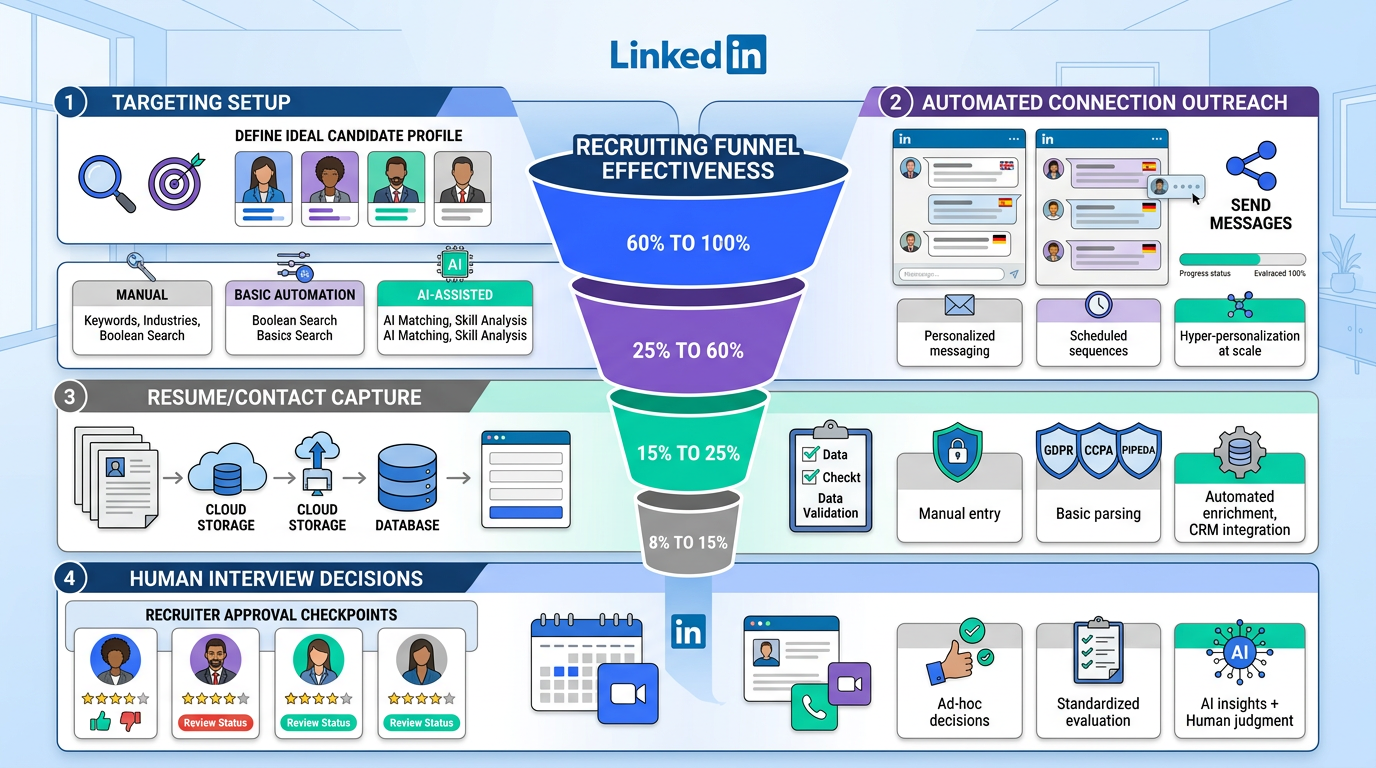
Stage 1: Targeting and Messaging Setup
Recruiters define candidate criteria, role requirements, compensation ranges, and employer narrative. In linkedin automation consultation engagements, this setup stage is where quality is won or lost. If targeting rules are weak, automation only scales poor outreach.
Stage 2: Automated Connection and First Conversation
StrategyBrain AI Recruiter can automate LinkedIn connection requests and initial role introductions. It can also ask about candidate interest, answer role questions, and continue follow up while recruiters are offline. Since this phase is repetitive and time consuming, automation creates immediate time savings for recruiter teams.
Stage 3: Intent Signal and Document Collection
When candidates show interest, the system requests resumes and captures contact details. Resume delivery can occur through LinkedIn file sharing or email based submission flows configured by the team. Recruiters then review submitted profiles and move qualified candidates to interview scheduling.
Stage 4: Human Qualification and Offer Decisions
This is where human expertise stays essential. AI Recruiter can identify willingness to engage, but final fit assessment remains a recruiter responsibility. Teams should evaluate technical alignment, compensation fit, communication quality, and decision speed before final recommendations.
Step by Step Rollout Plan
- Define success metrics: Set baseline for response rate, interested candidate rate, resume capture rate, and time to shortlist.
- Build target segments: Separate outreach by function, seniority, geography, and language to improve message relevance.
- Create approved message flows: Prepare connection notes, first message, follow up logic, and objection handling scripts.
- Start with one role family: Run a controlled pilot for 14 days and compare against your manual baseline.
- Review candidate quality weekly: Recruiters audit conversations and resumes to refine targeting and messaging.
- Scale only after quality holds: Expand to additional roles or regions once shortlist quality is stable.
Quick Comparison
| Approach | Connection Outreach Speed | Follow Up Coverage | Resume Capture Process | Best For |
|---|---|---|---|---|
| Fully Manual LinkedIn Recruiting | Low to medium | Business hours only | Manual tracking | Small volume specialist hiring |
| Basic Automation Scripts | Medium | Limited logic | Partial | Teams testing light automation |
| StrategyBrain AI Recruiter | High, with role based targeting | 24/7 multilingual conversations | Structured collection and visibility | Teams scaling outbound recruiting across multiple roles |
Risk Controls, Compliance, and Candidate Trust
Automation improves output only when governance is clear. Recruiters should define message tone rules, opt out handling, and escalation triggers for sensitive questions. This protects employer reputation and candidate experience.
From a privacy perspective, teams should map process controls to applicable regulations in their markets, including GDPR, CCPA, and PIPEDA. According to product documentation, AI Recruiter uses encrypted credential handling, customer isolated data controls, and does not use customer data to train shared AI models. This matters for enterprise buyers evaluating trust and compliance before rollout.
There are also practical limitations. Automation cannot fully judge role fit from a resume alone, and it should not be used as a final hiring decision engine. It performs best as a front end productivity layer that keeps candidate conversations active while recruiters focus on evaluation quality.
Who Should Use This Approach
Best For
- Corporate recruiting teams with recurring outbound hiring needs.
- Agency recruiters handling multiple searches at the same time.
- HR leaders expanding international recruiting with multilingual candidate communication.
- Teams that want to automate linkedin connection request flows while preserving human qualification.
Not Ideal For
- Organizations that do not have clear role definitions or compensation ranges.
- Teams without a documented candidate communication policy.
- Hiring contexts where every outreach message must be fully handcrafted by a senior recruiter.
FAQ
Can a linkedin connection automation tool replace recruiters?
No. It should replace repetitive outreach tasks, not recruiter judgment. The highest performing model keeps qualification, interviewing, and final decision making with human recruiters.
How do we automate linkedin connection request workflows without harming candidate experience?
Start with strict message standards, role specific targeting, and weekly quality audits. Automation should improve response consistency, while tone and relevance remain controlled by the recruiting team.
What does linkedin automation consultation usually cover?
It typically covers targeting strategy, outreach sequence design, compliance guardrails, message quality control, and pilot measurement. The goal is reliable pipeline growth with quality safeguards.
Does AI Recruiter support multilingual candidate communication?
Yes. AI Recruiter supports global language communication and can maintain candidate conversations across time zones. This helps teams avoid delays in international hiring pipelines.
Can AI Recruiter collect resumes and contact details automatically?
Yes. For interested candidates, it can request resumes and capture contact information in a structured workflow. Recruiters then review submissions and proceed to interviews.
Is automated LinkedIn recruiting compliant with data protection rules?
It can be compliant if your process aligns with applicable regulations and internal policies. Teams should validate GDPR, CCPA, and PIPEDA requirements before scale deployment.
Conclusion
If your team is evaluating a linkedin connection automation tool, the most reliable path is a human plus AI model. The lesson from Julie Wong's pandemic era recruiting perspective still applies: stay focused on goals, protect standards, and adjust execution with discipline. StrategyBrain AI Recruiter fits this model by automating repetitive LinkedIn outreach and candidate engagement while leaving final hiring judgment to recruiters. Your next step is to run a controlled pilot on one role family, measure shortlist quality and response metrics for 14 days, then scale only after quality remains strong.