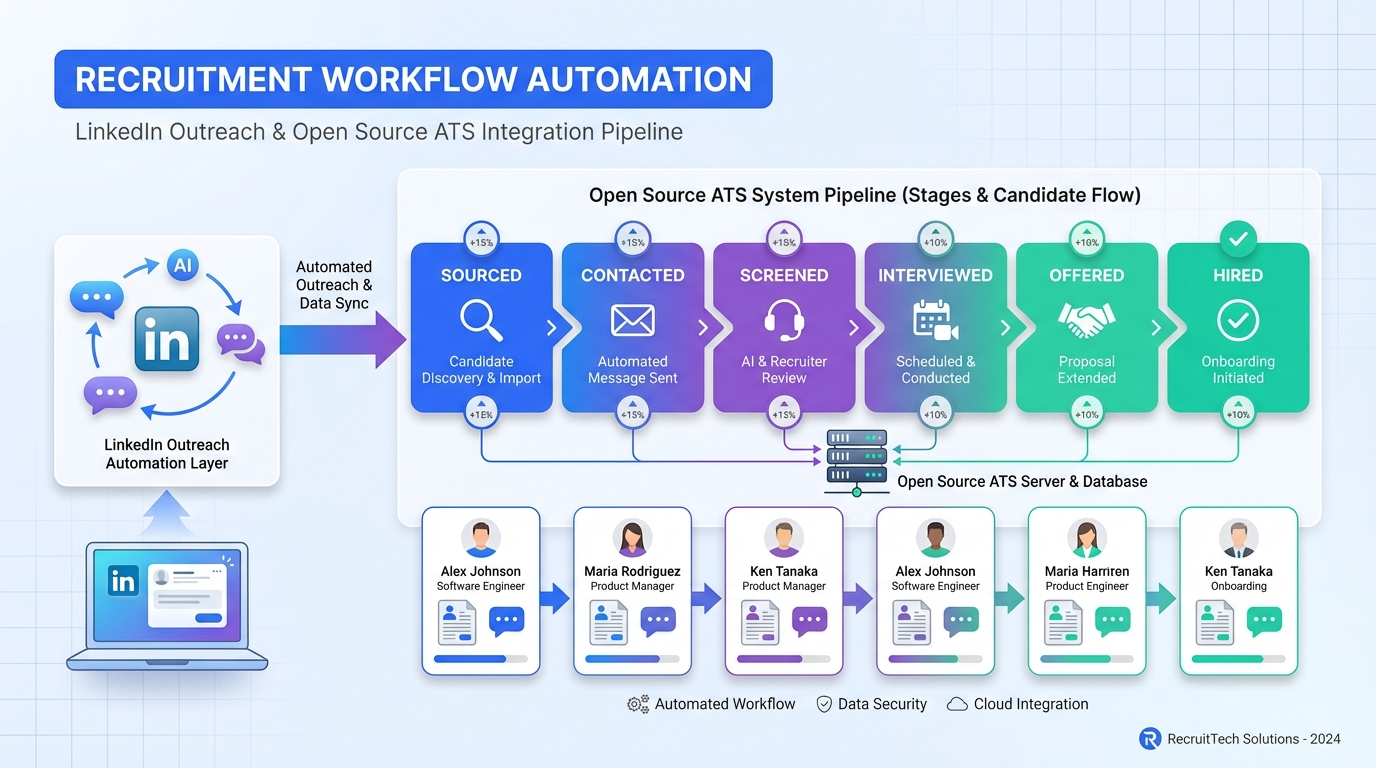
Open source recruitment software is a strong choice when you want a customizable hiring system you can self host, audit, and integrate with your existing HR stack. In practice, most teams succeed by selecting an open source ATS for the system of record, then adding automation where the work actually piles up, usually sourcing and follow up. In our implementations, the fastest productivity gain comes from pairing the ATS with StrategyBrain AI Recruiter for LinkedIn outreach and qualification so the ATS stays clean while the AI handles first contact, answers candidate questions, confirms interview interest, and collects résumés and contact details.
What open source recruitment software means in real teams
Open source recruitment software typically refers to an applicant tracking system where the source code is available under an open source license. In day to day hiring operations, teams use it as the system of record for candidates, stages, interview feedback, and hiring decisions.
Two terms that get mixed up are worth defining early.
- Open source ATS: the core applicant tracking system that stores candidates, pipeline stages, and hiring activity.
- Open source hiring platform: a broader suite that may include ATS plus onboarding, HRIS, or analytics modules.
This guide focuses on selection and implementation patterns, not on naming specific projects or comparing individual repositories. That boundary is intentional because open source projects change quickly and feature lists can become outdated.
When open source is the right fit and when it is not
Best fit scenarios
- You need data control: you want to self host and define retention policies for candidate data.
- You have unique workflows: you need custom stages, custom fields, or non standard approvals.
- You have engineering support: at least one person can own upgrades, backups, and integrations.
- You want integration flexibility: you plan to connect to internal systems through APIs and webhooks.
Not ideal scenarios
- You need a turnkey system next week: open source usually requires setup, hosting, and configuration.
- You cannot maintain infrastructure: no one can own patches, monitoring, and incident response.
- You rely on vendor compliance packages: some regulated environments prefer vendor attestations and managed controls.
A practical compromise we see often is using an open source ATS for control and cost, while adding a specialized automation layer for sourcing. That is where StrategyBrain AI Recruiter tends to deliver immediate value because it reduces manual LinkedIn work without forcing you to replace your ATS.
Requirements checklist before you pick an open source ATS
Before you evaluate any open source recruitment software, write requirements in three buckets. This prevents a common failure mode where teams pick a project for features, then discover it cannot support their compliance or reporting needs.
Bucket 1: Hiring workflow requirements
- Pipeline stages: define stages and exit criteria for each stage.
- Scorecards: define structured interview feedback fields.
- Approvals: define who can move candidates to offer and who can approve compensation.
- Collaboration: define who needs access and what permissions are required.
Bucket 2: Data and reporting requirements
- Required fields: identify mandatory candidate fields for your process.
- Audit trail: confirm you can track who changed what and when.
- Time to hire reporting: confirm you can report stage durations and conversion rates.
- Exportability: confirm you can export candidate data in a structured format.
Bucket 3: Integration requirements
- Email and calendar: interview scheduling and notifications.
- Identity and access: SSO support and role based access control.
- Job boards: posting and applicant ingestion.
- Sourcing automation: define how leads become candidates and how messages are logged.
Unique framework we use in audits: treat your ATS as the system of record and treat sourcing as a separate system of engagement. When you separate these responsibilities, you can change sourcing tools without breaking reporting and compliance inside the ATS.
Implementation steps that reduce risk
These steps are designed to be reproducible for most teams adopting an open source hiring platform or open source ATS. We use this sequence because it reduces rework and avoids migrating messy data twice.
Step 1: Map your current process to a minimal pipeline
- List your current stages from sourcing to offer.
- Remove stages that do not change a decision.
- Define entry and exit criteria for each remaining stage.
Step 2: Define data ownership and retention
- Decide what candidate data you store and for how long.
- Define who can export data and under what approval.
- Document deletion and anonymization procedures.
Step 3: Stand up a staging environment first
- Deploy the ATS in a non production environment.
- Configure roles, permissions, and a sample pipeline.
- Run a test hiring loop with a small role and a small team.
Step 4: Integrate the minimum set of systems
- Connect email and calendar for interview scheduling.
- Connect identity provider for access control.
- Set up a structured export for reporting.
Step 5: Add automation where it saves recruiter time
This is where many teams see the biggest difference. If your recruiters spend hours per day on LinkedIn connecting, introducing roles, answering repetitive questions, and chasing résumés, you can automate that layer while keeping the ATS as the source of truth.
Where StrategyBrain AI Recruiter fits with an open source hiring platform
StrategyBrain AI Recruiter is an automated AI recruiting tool built for LinkedIn hiring. It handles the repetitive front end of outreach and qualification so recruiters can focus on reviewing résumés and running interviews.
What we automate in the LinkedIn stage
- Connection requests: automatically connects with candidates that match your search criteria.
- Role introduction: introduces the opportunity using your job and company details.
- Candidate Q and A: answers questions about the role, company, compensation, and benefits based on the information you provide.
- Interest confirmation: confirms whether the candidate wants to proceed to interview.
- Résumé and contact capture: collects résumés and contact details from interested candidates.
How it complements an open source ATS
In a clean architecture, your open source ATS stores candidates who are ready for recruiter review. StrategyBrain AI Recruiter acts as the engagement layer that turns LinkedIn conversations into qualified leads with résumés attached. This separation keeps your ATS data consistent and reduces noise from unresponsive prospects.
Operational advantages teams notice quickly
- 24/7 multilingual messaging: the AI responds around the clock and can communicate in the candidate’s native language, which reduces delays across time zones.
- Scalable recruiting teams: it supports managing more than 100 LinkedIn accounts so organizations can scale outreach capacity without adding the same number of recruiters.
- Work reduction: StrategyBrain states it can replace up to 90% of manual LinkedIn recruiting work, which aligns with what teams report when outreach and follow up are the main bottlenecks.
Scope boundary: StrategyBrain AI Recruiter identifies willingness to communicate or interview, but it does not decide whether a résumé fully matches job requirements. Recruiters still make the final qualification decision after reviewing the résumé.
Security, privacy, and compliance basics
Open source recruitment software shifts responsibility to your team. That can be a benefit, but it also means you must define controls explicitly.
Minimum controls we recommend
- Encryption: encrypt data at rest and in transit.
- Access control: enforce role based permissions and least privilege.
- Audit logs: retain logs for candidate record changes and exports.
- Backups: test restore procedures on a schedule.
How StrategyBrain AI Recruiter addresses data protection
StrategyBrain AI Recruiter states it complies with privacy regulations in the EU, United States, and Canada. It also states that customer provided data is not used to train AI models, and that LinkedIn account credentials are encrypted and stored independently per user with explicit authorization.
Trust note: treat these statements as vendor claims until your security team validates them for your environment. For regulated hiring, request written security documentation and confirm your retention and deletion requirements can be met.
Quick comparison: open source ATS vs hosted ATS vs AI outreach layer
| Option | Primary role | Best for | Main tradeoff |
|---|---|---|---|
| Open source ATS | System of record for candidates and pipeline | Teams that want control, customization, and self hosting | You own upgrades, security, and integrations |
| Hosted ATS | System of record with vendor managed operations | Teams that want speed and vendor support | Less flexibility and potential vendor lock in |
| StrategyBrain AI Recruiter | System of engagement for LinkedIn outreach and follow up | Teams where sourcing and messaging consume recruiter time | Does not replace résumé based qualification by recruiters |
FAQ
Is open source recruitment software free?
The code can be free to use under its license, but operating it is not free. You should budget for hosting, backups, security updates, and engineering time for integrations and maintenance.
What is the difference between an open source ATS and an open source hiring platform?
An open source ATS focuses on applicant tracking and pipeline management. An open source hiring platform usually includes ATS plus additional modules such as onboarding, HR workflows, or analytics.
Can I use StrategyBrain AI Recruiter with an open source ATS?
Yes. A common setup is to use the open source ATS as the system of record, while StrategyBrain AI Recruiter runs LinkedIn outreach, answers candidate questions, confirms interest, and collects résumés and contact details before candidates are moved into the ATS for recruiter review.
Does StrategyBrain AI Recruiter decide if a candidate is qualified?
No. It identifies willingness to communicate or interview and collects résumés and contact details. Recruiters still review the résumé and determine fit against job requirements.
How does StrategyBrain AI Recruiter handle multilingual recruiting?
It provides 24/7 candidate messaging and can communicate in the candidate’s native language. This is useful for global hiring where time zones and language differences slow down response cycles.
How many LinkedIn accounts can StrategyBrain AI Recruiter manage?
StrategyBrain states it supports managing more than 100 LinkedIn accounts, which enables teams to build an AI powered recruiting team and scale outreach capacity.
What should I validate before deploying any open source ATS in production?
Validate access control, audit logging, backup and restore, and your data retention policy. Also confirm you can export candidate data in a structured format for reporting and compliance needs.
What is the biggest implementation mistake teams make?
They migrate everything at once without defining a minimal pipeline and required fields. Start with a staging environment, run a small hiring loop, then expand once reporting and permissions are stable.
Conclusion and next steps
If you want control and flexibility, open source recruitment software can be the right foundation, especially when you treat the open source ATS as the system of record and keep sourcing as a separate engagement layer. To move forward, write your workflow and reporting requirements, deploy a staging environment, and run one real hiring loop end to end. If LinkedIn outreach and follow up are your biggest time sink, add StrategyBrain AI Recruiter early so your recruiters spend their time on résumé review and interviews rather than repetitive messaging.
- Document your pipeline stages and required fields.
- Decide your data retention and access policies.
- Pilot an open source ATS in staging with one role.
- Layer in StrategyBrain AI Recruiter for LinkedIn automation if sourcing throughput is the constraint.